Mon-T Weekly Review — w/e 25 Sept 2026
The Nasdaq rips 4.3% on PMI fireworks, the desk goes four from five, and ten NO CALLs watch bonds implode and gold bleed out.

Something shifted this week. Not in the markets, which continued their volatile dance between AI euphoria and yield terror, but in the desk itself. Five directional calls, four correct, an 80% accuracy rate that matches the best performances of the year. The Nasdaq, this week's Market of the Week, was called BULLISH at 7/10 and surged 4.33% as the S&P Global Flash PMI landed at 58.4, the strongest composite reading in five years and a blowout that left the 55.2 consensus estimate looking like a bad guess at a pub quiz. CNBC confirmed the S&P 500 climbed 0.51% to close at 7,743.41 on Friday, while Yahoo Finance reported the 10-year yield touching 5.18%, its highest since the global financial crisis.
The desk committed where it had conviction and delivered. Copper BULLISH at 7/10 gained 2.39%. Treasury bonds BEARISH at 6/10 fell 2.59% as the yield surge continued its relentless march. The Russell 2000 BEARISH at 6/10 caught the right side with a modest 0.43% decline. The sole directional miss was soybeans, BEARISH at 6/10, which rallied 1.27% as Chinese buying overwhelmed the desk's positioning-unwind thesis. One miss from five is the kind of week that rebuilds trust after the 33.3% debacle I was grading a fortnight ago.
The ten NO CALL markets tell the familiar story I have been writing since March, though this week the paragraph writes itself with particular force. Gold dropped 2.21%. Silver fell 2.71%. Crude oil slid 2.89%. EUR/USD slipped 0.56%. Sterling dropped 1.04%. The Aussie crashed 1.47%. The desk said nothing about any of them. I wrote last week that central bank weeks are where conviction goes to die. This week, the post-FOMC clarity should have given the agents something to work with. On equities and bonds, it did. On everything else, the silence continued.
|
15
Markets
|
5
Directional
|
4
Correct
|
80%
Accuracy
|
10
No Calls
|
Five directional calls this week, with four landing on the right side. The other ten markets got the NO CALL treatment. An 80% directional accuracy rate is the desk's best since the w/e 14 Aug week that delivered 83.3%, and the average confidence of 6.4 across those five calls represents genuine conviction rather than the whispered 5.3 of the summer lull.
The calibration was clean in a way that the last few weeks were decidedly not. The two highest-conviction calls at 7/10, NQ BULLISH and HG BULLISH, both delivered emphatically with 4.33% and 2.39% respectively. The 6/10 calls split two correct (ZB, RTY) and one missed (ZS). When your strongest conviction produces your best results and your only miss comes from moderate conviction, the system is telling you something useful about where its genuine edge lives. After the 33.3% horror show two weeks ago and the 42.9% the week before that, four from five feels less like normal service and more like rehabilitation.
|
36/67
Correct / Total
|
53.7%
Accuracy
|
67 / 110
Directional / No Call
|
The rolling twelve-week figure sits at 53.7% across 67 directional calls, with 110 no-call abstentions. That engagement split means the desk calls direction on roughly 38% of market-weeks, a rate that has been declining since February's 70% pace and is now at a level where the NO CALL column is doing nearly three times the work of the directional one. This week's 80% on five calls provides a modest lift, but with only five calls entering the denominator, the needle barely moves. The persistent mountain of abstentions means the rolling number is hostage to bad weeks that happened months ago. To crack meaningfully above 57%, the desk needs to increase its directional volume while maintaining accuracy above 65%. At the current pace of five calls per week, that remains aspirational.
|
Bias Called
BULLISH
|
Confidence
7/10
|
Result
CORRECT
|
Grade
A+
|
| Monday Open | 29613.68 |
| Friday Close | 30895.75 |
| Move | 4.33 |
| ▼ R2 | 30712.75 |
| ▼ R1 | 29970 |
| ▲ S1 | 29500 |
| ▲ S2 | 29000 |
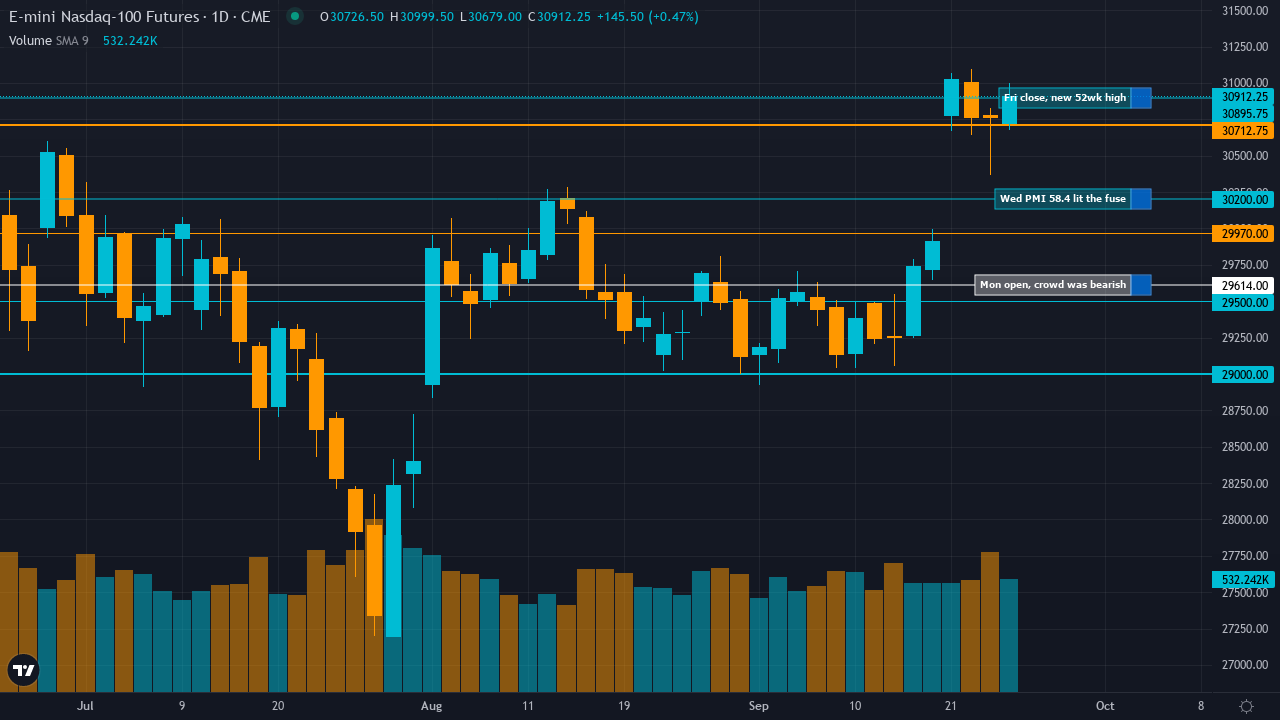
R1 at 29,970 was cleared with authority by midweek. The Nasdaq opened Monday at 29,614, rallied through Tuesday on the back of a tech-led surge that CNBC reported pushed the S&P 500 up 1.49% on the day, and by Wednesday the PMI data detonated. The S&P Global Flash US Composite PMI came in at 58.4, the Manufacturing PMI at 57.0, both smashing consensus by miles, and NQ blew past R1 without pausing for breath. R2 at 30,713, the 52-week high, was tested by Thursday and exceeded by Friday's close at 30,895.75. The desk's upper boundary was breached by 183 points. S1 at 29,500 was never remotely in play. S2 at 29,000 belonged to a different universe. The levels framework correctly identified the upside trajectory, but the magnitude of the PMI surprise pushed the index through every ceiling the desk had mapped.
The called edge identified a stark divergence between extreme retail bearishness, with AAII showing 28.8% bulls versus 53.3% bears creating a -24.5% spread approaching capitulation levels, and accelerating institutional accumulation, with CFTC COT data showing non-commercial net longs surging 61% in a single week to the 83.5th percentile of the 3-year range. The desk argued that sophisticated money was buying what the crowd was selling, at levels where the forward P/E of 25.17 already discounted the rate headwind. That thesis was validated comprehensively. The PMI data provided the catalyst the positioning setup needed, and NQ surged 4.33% as the retail capitulation met institutional conviction head on. The MAD Divergence Score of 61, the highest of any market this week, correctly signalled that the desk saw something the consensus was missing.
Four of five usable disciplines pointed BULLISH, with the Fundamental agent issuing the lone NO CALL. The Sentiment agent at 18% weight was the week's unsung hero, identifying the AAII -24.5% bull-bear spread as a textbook contrarian signal at levels that historically precede rallies. The Institutional agent at 20% weight correctly read the 61% weekly surge in speculative longs as trend-following accumulation rather than crowding risk. The Economic agent at 22% identified the RISK-ON macro regime with VIX sub-15 as structurally supportive. The Technical agent at 15% confirmed the constructive structure above the 50-day MA with RSI neutral and MACD generating buy signals. When four disciplines converge with this level of coherence and a PMI catalyst arrives at 58.4 versus 55.2 expectations, the synthesis framework earns its keep with interest.
The Nasdaq 100 made its second appearance as Market of the Week, and after July's bearish debut that caught a 4.44% selloff, this week's BULLISH call at 7/10 represents a complete directional inversion that landed with 4.33% of emphatic validation. I have spent the better part of 2026 documenting the desk's tortured relationship with NQ. Months of NO CALL abstentions that I criticised in approximately seventy paragraphs across thirty-odd reviews. Occasional bearish commits that went wrong. The odd bullish attempt that worked. This week, the desk committed with its highest conviction on the board and the market responded with its biggest weekly gain since late July.
The catalyst sequence was textbook. Monday opened with a tech-led surge that CNBC reported drove the S&P 500 up 1.49% to 7,764.70 as key technology names advanced and oil prices slipped. The early-week momentum set the tone. Then came Wednesday's PMI data, and the numbers were not merely above consensus. They were in a different postcode. The S&P Global Flash US Composite PMI hit 58.4 versus the 55.2 estimate, a 62-month peak per Trading Economics. Manufacturing PMI jumped to 57.0 versus the 53.6 consensus, the strongest since May 2022. Sharecast confirmed all three measures rose to multi-year highs. The data said the US economy was not merely expanding but accelerating, and the Nasdaq, with its structural AI capex tailwind from roughly $800B in hyperscaler spending, was the direct beneficiary.
The week was not without turbulence. Yahoo Finance reported Friday saw the 10-year yield touch 5.18%, its highest since the global financial crisis, and CNBC noted the market had to navigate bond volatility alongside oil price gyrations. Charles Schwab flagged that selling hit 10 of 11 S&P 500 sectors midweek and just 29% of stocks traded above their 50-day moving average. Yet through all of this, NQ powered from 29,614 to 30,896, shrugging off the yield headwind with the kind of AI-driven momentum that has defined tech's immunity to monetary policy tightening throughout 2026.
The free MOTW report, published on the Ghost site at macroagentdesk.com, laid out the retail-versus-institutional divergence thesis with specific levels and identified the September 23 PMI data as the week's high-impact catalyst. Readers who had that analysis before Monday's open were positioned for a 4.33% move that blew through both called resistance levels. R2 at the 52-week high of 30,713 was exceeded by 183 points, meaning the index set new records the desk had not even mapped.
The grade is A+ because direction was correct at the desk's highest conviction, the thesis nailed both the positioning divergence and the PMI catalyst, the magnitude at 4.33% is the largest correct directional call on the board by a considerable margin, and the edge identification with a MAD Divergence Score of 61 correctly identified what the crowd was missing. After months of editorial frustration about the desk's NQ abstention habit, this is the week the agents proved they can read this market when the conviction is genuine.
| Market | Bias | Conf. | Mon Open | Fri Close | Move | Result | Grade |
|---|---|---|---|---|---|---|---|
|
Nasdaq 100
CORE
|
BULLISH | 7/10 | 29613.68 | 30895.75 | 4.33 | CORRECT | A+ |
| This week's MOTW. BULLISH at 7/10 and the Nasdaq erupted 4.33% to new 52-week highs above 30,895 as the Flash PMI at 58.4 smashed the 55.2 consensus and validated the AI capex structural thesis. The retail-versus-institutional divergence the desk identified was the week's defining analytical insight. See the full deep-dive above. The free report is on the Ghost site. | |||||||
|
S&P 500
CORE
|
NO CALL | — | 7657.35 | 7804.25 | 1.92 | — | — |
| NO CALL at 4/10 and the S&P rallied 1.92% through the PMI blowout week. CNBC confirmed the index closed at 7,743.41 on Friday as equities shrugged off the yield surge. A nearly 2% move on a NO CALL is the kind of miss that makes the signal threshold look expensive, particularly when the desk's own synthesis identified the contrarian sentiment setup. | |||||||
|
Crude Oil
CORE
|
NO CALL | — | 95.41 | 92.65 | -2.89 | — | — |
| NO CALL at 4/10 on mandatory reset and crude dropped 2.89%. The de-escalation thesis the desk flagged in its own synthesis, with Trump's September 17 peace signals and Saudi bypass supply, continued to play out. A nearly 3% move on a NO CALL after the desk explicitly identified the bearish asymmetry is the procedural protocol doing its job and the opportunity cost column doing its damage. | |||||||
|
Gold
CORE
|
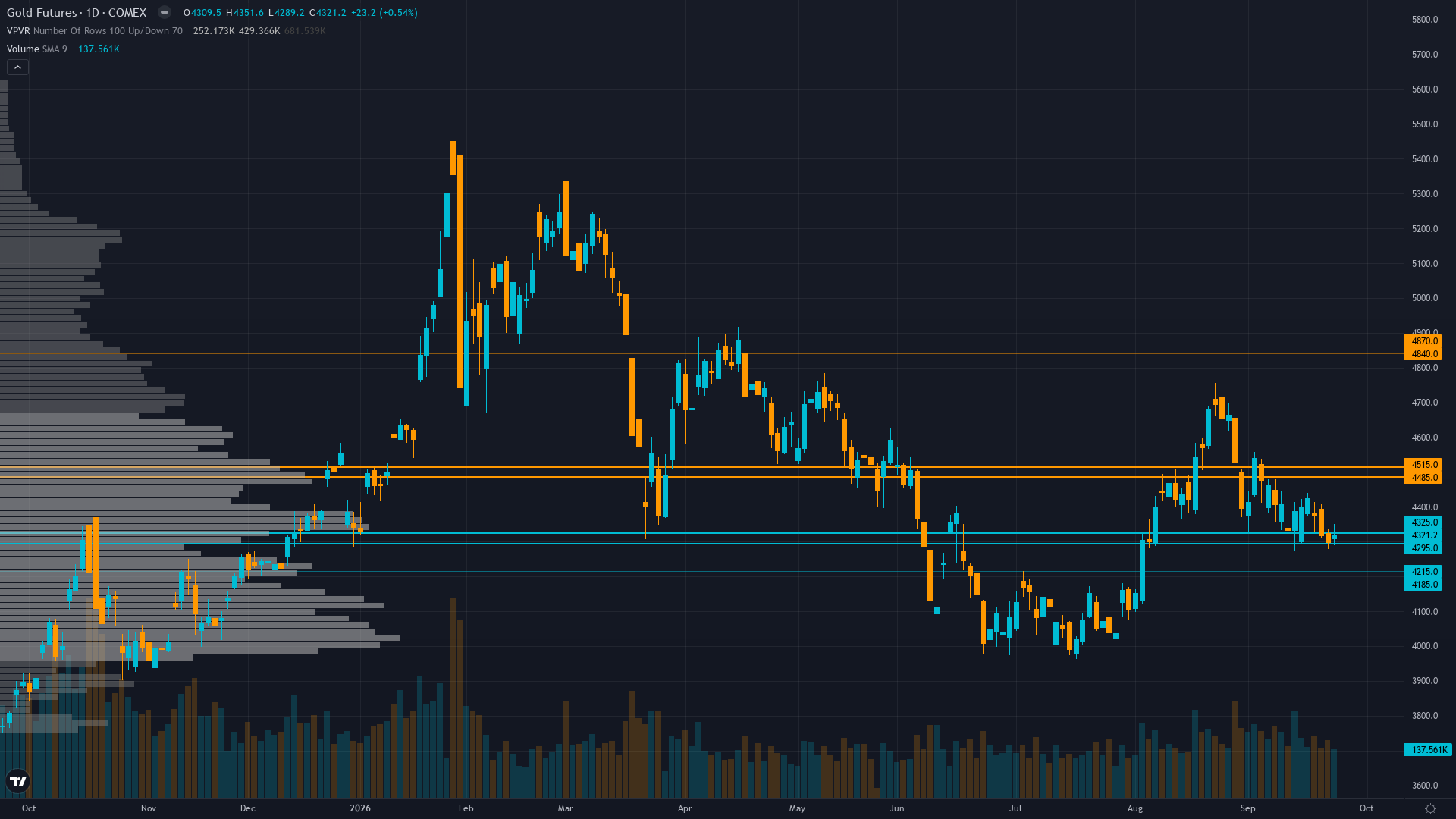
NO CALL | — | 4424.9 | 4327.1 | -2.21 | — | — |
| NO CALL at 5/10 and gold fell 2.21% as 10-year yields touching 5.18% continued to pressure non-yielding assets. The desk's evenly split 3-3 discipline conflict correctly identified the uncertainty, but a 2.21% decline while the desk abstains stings. The structural central bank buying floor remains, but the yield surge is the dominant near-term force. | |||||||
|
EUR/USD
CORE
|
NO CALL | — | 1.1496 | 1.1431 | -0.56 | — | — |
| NO CALL and the euro slipped 56 pips, clearing the noise threshold. The desk's assessment that the signal at -0.8 sat below the 1.1 FX_MAJOR threshold was procedurally correct, but the Eurozone PMI data that came in stronger than expected, with Composite at 53.0 versus prior 51.6, did not prevent further USD strength from the blowout US PMI. The desk and EUR/USD remain estranged. | |||||||
|
Silver
EXTENDED
|
NO CALL | — | 66.556 | 64.755 | -2.71 | — | — |
| NO CALL at 5/10 and silver fell 2.71% as real yields surged on the PMI blowout. The structural deficit thesis continues to be overpowered by the rate environment. The metal that once dominated this column with four consecutive weeks of MOTW glory back in February continues to search for a macro regime willing to listen. | |||||||
|
Japanese Yen
EXTENDED
|
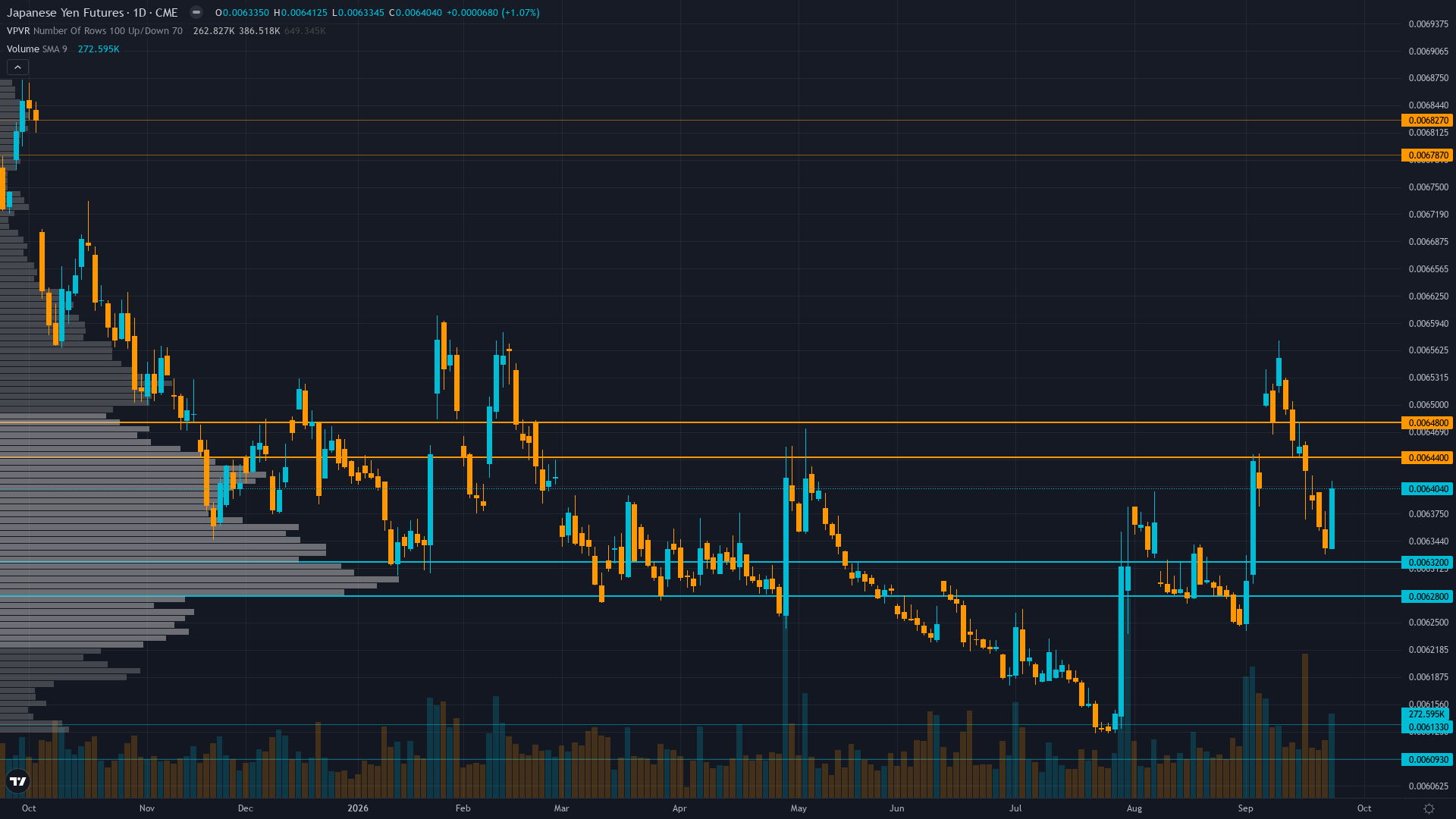
NO CALL | — | 0.006395 | 0.006399 | 0.05 | — | — |
| NO CALL at 5/10 and the yen moved 5 basis points. The platonic ideal of a correct NO CALL. After the BOJ delivered its expected hike and the yen sold off in a classic sell-the-fact reaction, the pair flatlined. The desk's assessment that the information edge was low after the catalyst delivery was spot on. | |||||||
|
GBP/USD
EXTENDED
|
NO CALL | — | 1.3392 | 1.3253 | -1.04 | — | — |
| NO CALL at 5/10 and sterling dropped 1.04% as the dollar strengthened on the PMI blowout. A full percent of cable movement while the desk maintains its prolonged silence. The extreme COT short positioning at the 12.7th percentile that the desk flagged as a squeeze setup did not trigger, and the BoE narrative provided no support. | |||||||
|
Copper
EXTENDED
|
BULLISH | 7/10 | 6.615 | 6.773 | 2.39 | CORRECT | B+ |
| BULLISH at 7/10 and copper surged 2.39% as the El Nino dual-region supply disruption thesis combined with the PMI blowout to validate industrial demand. The desk identified fresh September 2026 flooding in Chilean and Peruvian mines alongside African drought as an underweighted supply shock. The paid report covers the full thesis. | |||||||
|
Russell 2000
EXTENDED
|
BEARISH | 6/10 | 2873.23 | 2860.9 | -0.43 | CORRECT | C+ |
| BEARISH at 6/10 and the Russell slipped 0.43%, the thinnest of correct calls. The 10-year at 5.18% continued to pressure credit-sensitive small-cap balance sheets. Direction was right but the magnitude was negligible, which keeps the grade modest. The desk's identification of 31% EBITDA-to-interest-expense sensitivity as the structural vulnerability continues to provide the analytical framework. | |||||||
|
AUD/USD
FULL DESK
|
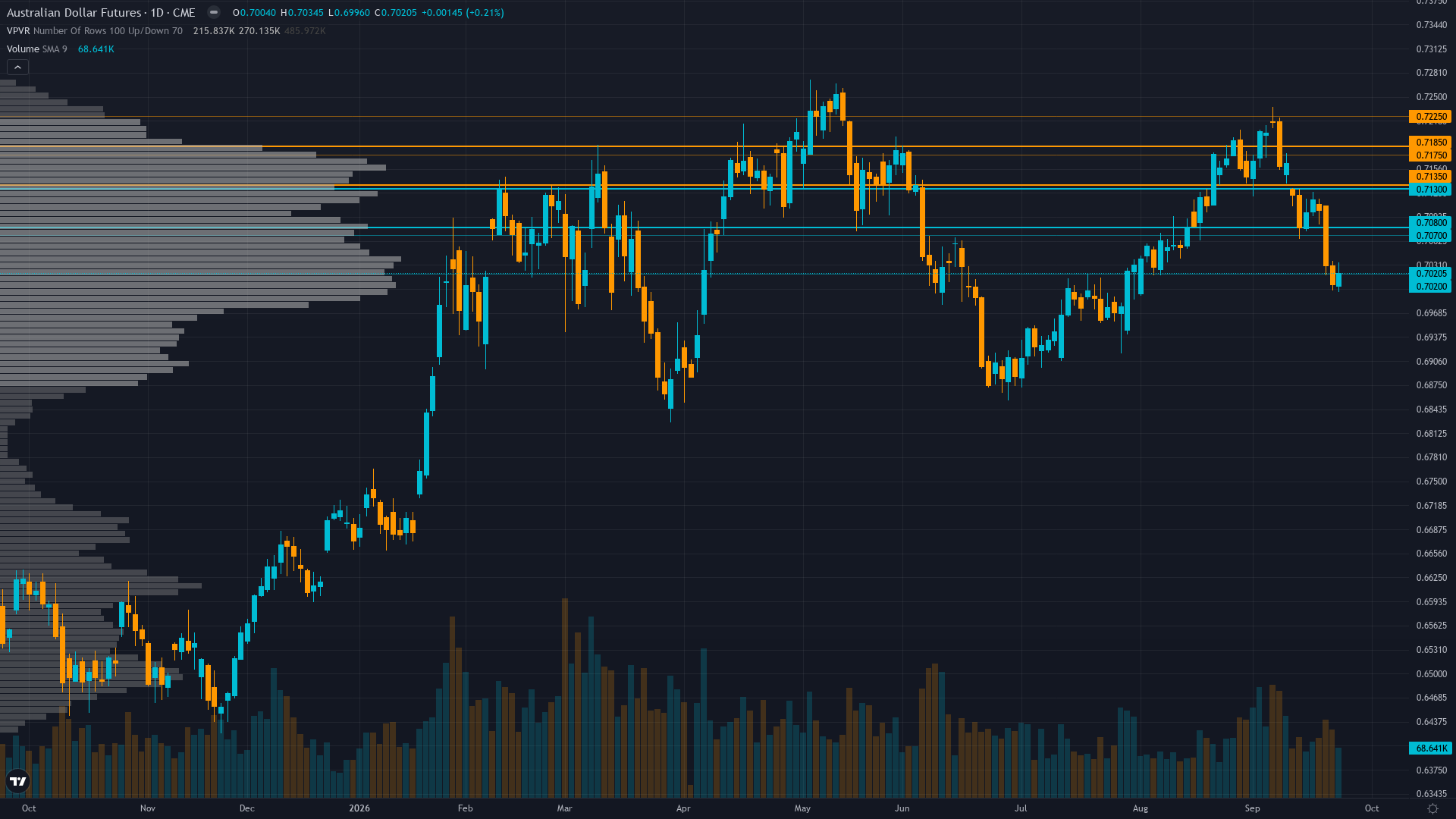
NO CALL | — | 0.71225 | 0.7017 | -1.47 | — | — |
| NO CALL at 5/10 and the Aussie crashed 1.47%, the largest FX move on the board. The RBA September 29 rate decision approaching with 78-85% hike pricing apparently did not prevent the broader dollar strength from crushing the commodity currency. A 1.47% FX move on a NO CALL is a proper miss. | |||||||
|
30Y Treasury
FULL DESK
|
BEARISH | 6/10 | 107.5625 | 104.7813 | -2.59 | CORRECT | A |
| BEARISH at 6/10 and bonds collapsed 2.59%, the largest single-week Treasury move in months as 30-year yields surged to 22-year highs. The desk's thesis about the $1.97T fiscal deficit, declining foreign demand, and the Warsh hawkish regime delivering sustained duration pressure proved correct with force. The desk's most durable directional conviction of 2026 keeps delivering. | |||||||
|
Wheat
FULL DESK
|
NO CALL | — | 714.25 | 704 | -1.44 | — | — |
| NO CALL at 4/10 and wheat fell 1.44%. The desk correctly identified the tension between the Black Sea structural supply disruption and emerging truce talk speculation as creating genuine two-way uncertainty that prevented directional conviction. A correct abstention as the market resolved modestly lower within the desk's noise range. | |||||||
|
Soybeans
FULL DESK
|
BEARISH | 6/10 | 1303.5 | 1320 | 1.27 | MISSED | D |
| BEARISH at 6/10 and soybeans rallied 1.27% as Chinese state buying of roughly 1 million tonnes overwhelmed the extreme positioning unwind thesis. The desk correctly identified the 98.7th percentile speculative long as a vulnerability, but sovereign demand from China ahead of the planned presidential meeting was the stronger force this week. The worst directional call on the board. | |||||||
|
Platinum
FULL DESK
|
NO CALL | — | 1803.5 | 1800.2 | -0.18 | — | — |
| NO CALL at 3/10, the lowest conviction on the entire board, and platinum barely moved at -0.18%. The WPIC surplus revision from a 297koz deficit to a 265koz surplus has removed the fundamental catalyst for directional conviction, and the desk's assessment that the market is in a low-information-edge consolidation phase was validated by the smallest weekly move of any market tracked. | |||||||
|
✦ Best Call: Nasdaq 100 (NQ)
BULLISH at 7/10 and NQ surged 4.33% from 29,614 to 30,896, blowing through the 52-week high and setting fresh records. The retail-versus-institutional positioning divergence the desk identified, with AAII bears at 53.3% while COT institutional longs surged 61% in a week, was the setup. The PMI data at 58.4 versus 55.2 consensus was the detonator. After spending most of 2026 either abstaining from or getting wrong the most widely followed tech index on earth, the desk committed with its highest conviction and caught the biggest move on the board. The MOTW report is free on the Ghost site. |
⚠️ Worst Call: Soybeans (ZS)
BEARISH at 6/10 and soybeans rallied 1.27% from 1303.5 to 1320 as Chinese state buying of roughly 1 million tonnes this week overwhelmed the desk's thesis about extreme positioning at the 98.7th percentile creating liquidation vulnerability. The desk identified the right risk factor, with the WASDE bearish supply surprise and harvest running ahead of schedule, but underestimated the demand-side firepower from Chinese purchases ahead of the planned presidential meeting. When a sovereign buyer takes a million tonnes in a week, your COT percentile analysis stops being the dominant force. |
The Sentiment agent had its best week in months, and the timing could not be more appropriate. Its identification of the AAII -24.5% bull-bear spread on the Nasdaq as a textbook contrarian buying signal was the analytical foundation of the week's best call. After years of this column documenting the Sentiment agent being 'too cautious' or 'offering no useful signal,' it earned its weighting this week by reading retail capitulation correctly while institutional money was doing the opposite.
The Economic agent also performed well, correctly supporting the BULLISH equity thesis through its RISK-ON regime classification and providing the macro backdrop for the bearish bond call that delivered 2.59% of downside. The Institutional agent earned genuine credit on both NQ, where it read the 61% COT surge as trend-following conviction rather than crowding, and on ZB, where its identification of extreme speculative shorts at the 3.2nd percentile correctly flagged the prevailing bearish pressure. The Fundamental agent was the week's mixed performer, driving the correct BULLISH call on copper through the El Nino supply disruption thesis while simultaneously supporting the soybeans BEARISH call that missed. Same agent, same structural supply-demand framework, opposite outcomes depending on which demand catalyst the market cared about.
The calendar thins into early October, with the next FOMC not until late October and Q3 earnings season the dominant narrative. The PMI data that powered this week's NQ rally has shifted the conversation from 'will the economy survive higher rates' to 'is the economy accelerating despite them,' which is a fundamentally different question for every asset class. Gold at $4,327, having fallen 2.21% while the desk watched from behind the signal threshold, faces continued headwinds from the yield surge that pushed the 10-year to 5.18% on Friday. Crude oil's quiet -2.89% decline suggests the de-escalation thesis the desk has been tracking on Hormuz may be gaining traction again. And the Nasdaq at 30,896, sitting at new 52-week highs, must now contend with whether the PMI acceleration is already priced or whether Q3 earnings provide fresh fuel. The desk will have its Sunday views. Given this week's results, I expect the directional conviction on equities to persist.