Soybeans Forecast This Week — Outlook, Drivers & Key Levels
This week's Soybeans outlook: key drivers, volatility context, risk-opportunity assessment and the week ahead.

Where Things Stand
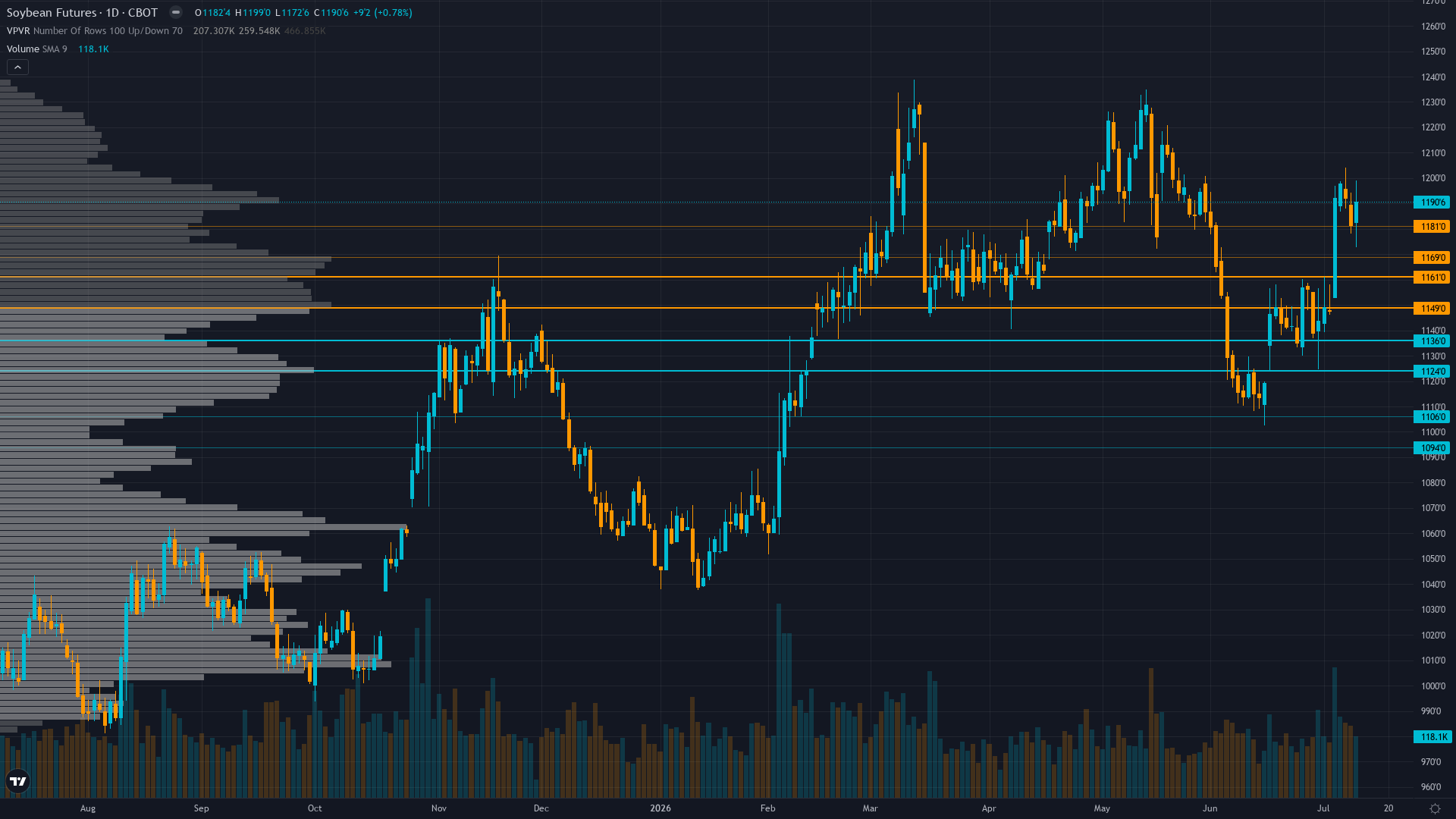
At 1181.75, soybeans has eased 0.77% in a controlled retreat. soybean futures is in a consolidating after weather-driven rally market state, requiring careful assessment of current conditions.
Mixed with fundamental bulls citing July 10 WASDE tightening stocks-to-use and weather risks during critical pollination offset by positioning analysts noting extreme speculative short buildup and export analysts highlighting Brazilian pricing advantages creating range-bound consolidation expectations between 1172-1200 ahead of August 12 WASDE
What's Driving Price
Primary driver: July 10 WASDE revealed tightening stocks-to-use ratio declining from 29% to 25% (lowest since 2022/23) plus USDA weather warnings issued July 7 for extreme heat and drought during critical reproductive stage, driving +4.36% weekly rally to 1189.50 before consolidation, yet managed money positioning shifted to net short -66,996 contracts creating severe discipline conflict
Secondary factor: China resumed soybean purchases with USDA confirming 472,000 MT bought (336,000 MT for 2026/27) on July 8 breaking above $12/bushel to five-week high, demonstrating demand follow-through on trade normalization after weeks of export weakness, though positioning data shows specs shifted from long liquidation to fresh short selling
Additional influence: Crop conditions deteriorated 1 point to 64% good-to-excellent as of July 5 with above-normal temperatures forecast through mid-July during critical pollination window, while renewable diesel structural demand at 2.75B bushels (up from 2.56B) provides floor absorbing 62% of 4.475B bushel crop independent of export performance
Economic backdrop: TRANSITIONAL macro regime with VIX at 15.03 below 20 risk-on threshold indicating calm conditions, DXY at 100.97 up 0.85% monthly creating persistent export competitiveness headwind versus Brazilian competition, Fed policy on hold with neither direction showing structural advantage for agricultural commodities
Fundamental assessment: Mildly undervalued at $11.82/bushel versus USDA $11.40 forecast, tightening global stocks-to-use from 29% to 25% plus US ending stocks at 310M bushels (7% ratio) creating genuine support, record renewable diesel demand at 2.75B bushels provides structural floor offsetting Brazilian $0.80-1.00/bu discount maintaining 8-10% export competitiveness headwind
Chart Assessment
Consolidating at 1181.75 cents mid-range between 1172.88 session low and 1200 resistance, above 50-day MA at 1140 and 200-day MA at 1080, Strong Buy technical ratings intact but momentum paused after +4.36% weather-driven rally to 1189.50
With trend strength at 5/10, the directional signal is present but far from decisive.
Risk & Opportunity
Primary risk: Weather improvement with timely rainfall across Midwest in mid-to-late July stabilizing or improving crop conditions from current 64% good-to-excellent negating production risk premium, combined with China demand failing to follow through on July 8 purchase forcing USDA downward revision to export projections in August WASDE, triggering accelerated short covering from extreme -66,996 net positioning toward 1150-1172 support representing 2-3% downside (Probability: medium)
Primary opportunity: Continued Midwest weather deterioration during critical July pollination window creating yield risk premium or China demonstrating sustained weekly purchases above 300K MT validating demand normalization, combined with August 12 WASDE confirming tighter balance sheets incorporating full July weather impact triggering short-covering rally from extreme speculative positioning toward 1200-1226 resistance representing 2-4% upside as renewable diesel floor at 2.75B bushels reasserts (Timeframe: Next 2-4 weeks through July 14 Crop Progress report, ongoing weather developments during critical reproductive phase, weekly export sales confirmation of China demand sustainability, and August 12 WASDE updating production estimates with full July weather impact)
This week's edge: Signal magnitude +0.65 falls below 1.0 minimum threshold for AGRICULTURAL directional bias per Rule 2, creating borderline NO CALL environment despite seven consecutive NO CALL weeks and fresh catalysts from July 7-10 period, as severe discipline conflicts (Fundamental/Technical bullish versus Institutional/Economic bearish creating 3v2 split where all disciplines measure 49-56% accuracy in COMMODITY class) plus TRANSITIONAL macro regime create insufficient conviction for directional lean where market faces genuine two-way risk between weather deterioration triggering short-covering rally versus weather improvement negating production risk premium forcing breakdown, requiring patience for next catalyst clarity rather than forced directional speculation in low-conviction-edge environment
Volatility Backdrop
soybean price volatility at the 64th percentile reflects a balanced environment where standard risk parameters apply. Volatility remains anchored at current levels, with no clear signal of an imminent regime shift in either direction.
Current normal volatility at 64th percentile suggests 20-25 cent daily ranges versus typical 15-20 cent agricultural baseline, consolidation patterns creating support/resistance tests at 1172/1200 requiring patience for directional conviction, standard stop placement widened to 25-30 cents for positioning versus normal 20-25 cents given recent weather-driven volatility and approaching August 12 WASDE binary risk
The Week Ahead
USDA weekly Crop Progress report updating soybean crop condition ratings and development stages during critical July reproductive phase when weather becomes primary yield determinant, plus weekly export sales data confirming whether China demand surge at 472,000 MT represents sustainable follow-through or one-time event on Tuesday 14 July is a high-impact catalyst with the potential to redefine the near-term outlook entirely.
How soybeans navigates the confluence of consolidating after weather-driven rally conditions and incoming data will determine whether the current directional thesis holds or breaks.
This analysis covers one dimension. Our full weekly report combines six specialist agents into a single actionable briefing with directional bias, key levels, and risk-opportunity matrix.
Start Free — Get the Market of the WeekFree weekly report · No credit card · Upgrade anytime