Mon-T Weekly Review — w/e 11 Sept 2026
The yen finally gets its day, crude oil stages another geopolitical ambush, and 42.9% accuracy reminds the desk that conviction is a responsibility, not a decoration.

The week began with BOJ Governor Ueda's hawkish guidance still ringing in the market's ears and ended with crude oil back above $100, the yen surging to a six-month high, and the desk's directional scorecard looking like something you'd hide from your supervisor. Three correct from seven directional calls, a 42.9% hit rate that lands firmly below the coin-flip threshold. The desk's best moment was calling the yen rally that CNBC, Reuters, and half of r/JapanFinance were tracking in real time. Its worst was calling BULLISH on four other markets and watching three of them go the other way.
Crude oil, sitting in the NO CALL column at the start of the week, surged 9.6% as Iran reportedly launched a second undisclosed attack on US Navy ships and Brent briefly topped $100 for the first time since May. The desk flagged the tanker attack risk in its own synthesis, acknowledged it as a mandatory miss reset, and then watched from behind the protocol barrier as WTI raced from $91 to $100. I have been documenting this exact pattern since March. The Hormuz premium refuses to stay buried, and the desk refuses to stop pretending it can.
The saving grace, and it is a genuine one, is the Market of the Week. The Japanese yen was selected for only its second MOTW appearance of 2026, and the desk called BULLISH at 6/10 conviction on a thesis about BOJ policy tightening and speculative short unwinding. The yen gained 2.43%, with USD/JPY crashing from 156 toward 152 as BOJ hike probability climbed to 84% per Capital Street FX. After twenty-plus consecutive weeks of NO CALL silence on this pair, the desk finally spoke, and the market listened.
|
15
Markets
|
7
Directional
|
3
Correct
|
42.9%
Accuracy
|
8
No Calls
|
Seven directional calls this week, with three landing on the right side. The other eight markets got the NO CALL treatment. A 42.9% directional accuracy rate is the worst since the w/e 28 Aug review, where I was writing elegies for the desk's conviction-9 silver miss. The average confidence of 5.4 across those seven calls tells you the desk was barely committing, which makes the four misses feel less like bold swings and more like expensive whispers.
The calibration story offers one small consolation. The week's best result came from 6J at 6/10, where the desk had its clearest catalyst thesis. The worst results came from RTY BULLISH at 6/10 (down 2.33%), GC BULLISH at 6/10 (down 0.84%), PL BULLISH at 6/10 (down 1.04%), and HG BULLISH at 6/10 (down 0.75%). Four bullish commodity and equity calls, all wrong. When you go 0-for-4 on bullish positioning across gold, copper, platinum, and small caps in a week where the Hormuz crisis re-escalated and 30-year yields pushed lower, the desk has misread the macro regime. The bearish bond call at conviction 4 was quietly the week's second-best result, delivering a clean 1.73% decline. Treasury bonds do not receive enough credit in this column, and ZB's BEARISH thesis continues to be the desk's most durable directional conviction of 2026.
|
35/65
Correct / Total
|
53.8%
Accuracy
|
65 / 108
Directional / No Call
|
The rolling twelve-week figure sits at 53.8% across 65 directional calls, with 108 no-call abstentions. That engagement split means the desk calls direction on roughly 38% of market-weeks, a number that has been declining since February's 70% pace and now sits at a level where the NO CALL column does more work than the directional one. This week's 42.9% drags the rolling number further toward the mid-fifties floor that has felt permanent since the Iran conflict rewrote the playbook in March. The desk needs to either increase its directional volume while maintaining accuracy above 60%, or accept that its framework is structurally designed for a level of caution that produces unimpressive aggregate numbers alongside occasional flashes of genuine insight.
|
Bias Called
BULLISH
|
Confidence
6/10
|
Result
CORRECT
|
Grade
A
|
| Monday Open | 0.0064 |
| Friday Close | 0.006555 |
| Move | 2.43 |
| ▼ R2 | 0.0065 |
| ▼ R1 | 0.00645 |
| ▲ S1 | 0.00635 |
| ▲ S2 | 0.00625 |
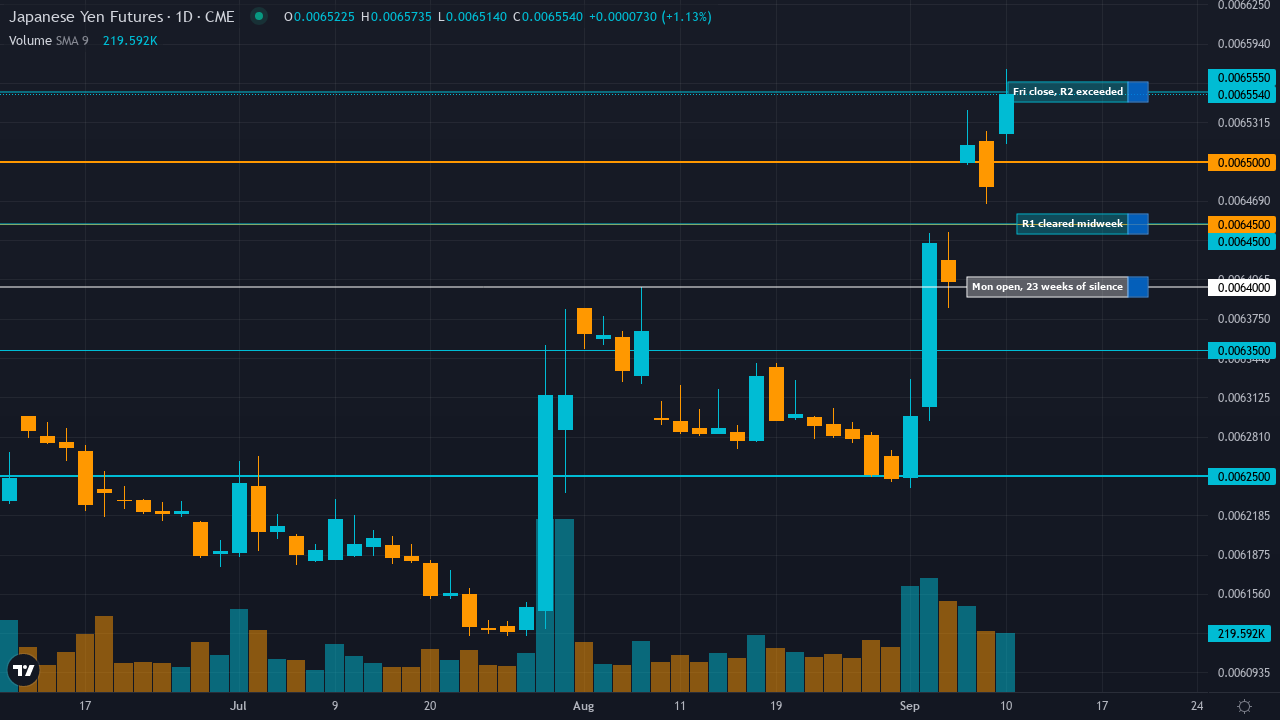
R1 at 0.00645 was breached cleanly by midweek as the yen rally gathered momentum on rising BOJ hike probability. R2 at 0.0065 was tested by Friday, with the close at 0.006555 pushing above it, meaning the desk's upper boundary was exceeded as the yen rally exceeded expectations. S1 at 0.00635 was never remotely threatened once the bullish tone was established on Monday. S2 at 0.00625, the major support, belonged to a different week entirely. The levels framework correctly mapped the upside trajectory, with R1 serving as a waypoint that was left behind by Wednesday and R2 providing a target the market pushed through by the close. USD/JPY traded from around 156 down toward the 152-153 zone per Capital Street FX reporting on September 8.
The called edge identified BOJ Governor Ueda's September 2 hawkish guidance as a regime-changing catalyst, with Bloomberg confirming on September 3 that officials favoured a 25bp hike from 1.0% to 1.25% at the September 17-18 meeting. The desk argued the market was pricing only 63% probability of delivery, leaving a textbook asymmetric squeeze setup as speculative short positioning at -92,227 contracts remained well above neutral despite a -28,929 contract weekly reduction. That thesis was validated comprehensively. Capital Street FX reported by September 8 that BOJ hike probability had surged to 84%. StoneX noted USD/JPY was under sustained pressure as Japanese front-end yields hit multi-decade highs. US Treasury Secretary Bessent reportedly held meetings with Japanese officials implying the BOJ may speed up rate hikes. The desk's specific observation that the 37% no-hike tail was mispriced given explicit Ueda and Bloomberg confirmation proved correct, as the market rapidly repriced toward near-certainty of delivery.
Four of five weighted disciplines pointed BULLISH. The Fundamental agent at 28% weight drove the thesis through PPP undervaluation at 15-20% and Japan's current account surplus of 17.43 trillion yen. The Institutional agent at 22% identified the massive weekly short covering as institutional capitulation fuel. The Economic agent at 30%, the week's heaviest allocation, correctly read the BOJ policy divergence momentum as the dominant price driver, citing the narrowing US-Japan rate differential as the structural tailwind. The Technical agent issued a NO CALL, which was the lone cautious voice, though it did correctly identify the breakout above the 50-day MA as a significant structural shift. The Sentiment agent called BULLISH at just 5% weight. When the desk's three most heavily weighted disciplines, carrying 80% of the combined allocation, agree on direction, and the catalyst is as explicit as a central bank governor telling the market what he plans to do, the synthesis framework earns its keep.
The Japanese yen made its second appearance as Market of the Week, and the contrast with its February debut could not be more stark. Back in February, the desk called BULLISH yen ahead of a Japanese election and got it wrong. This time, the catalyst was not a binary event with uncertain outcomes but a central bank governor essentially telling the market he was about to raise rates, while speculative positioning remained stubbornly short. The desk identified the gap between rhetoric and pricing, and the market closed it with force.
6J rallied from Monday's open at 0.0064 to Friday's close at 0.006555, a gain of 2.43% that translates to USD/JPY moving from approximately 156 to the 152-153 range. Reddit's r/JapanFinance community was discussing the move on September 7, noting USD/JPY had reached the 154 range, 'driven by bets that the BOJ would be hiking rates later this month.' By September 8, Capital Street FX confirmed the yen had surged to a six-month high with BOJ hike probability reaching 84%. StoneX reported front-end Japanese yields hitting multi-decade highs. The momentum was relentless throughout the week.
What makes this call particularly satisfying is its backstory. The desk had maintained NO CALL on the yen for over twenty consecutive weeks, a streak I documented with increasing editorial frustration in review after review. The signal never cleared the threshold. The agents kept disagreeing. And every time the yen moved, I wrote another paragraph about how the desk's yen discipline was either its smartest FX habit or its most persistent failure of nerve. This week, the signal surged to +2.8, the largest positive shift across the entire fifteen-market universe, and the desk finally committed. The transition from 23 consecutive weeks of NO CALL to a directional BULLISH call represents genuine regime change detection, not a punt.
The free MOTW report, published on the Ghost site at macroagentdesk.com, laid out the full thesis with the BOJ September 17-18 meeting as the approaching binary catalyst, Ueda's explicit hawkish guidance as the confirmation signal, and speculative short positioning at -92,227 contracts as the squeeze fuel. Readers who had the analysis before Monday's open were positioned for the largest yen move in weeks. The levels framework mapped the trajectory accurately, with R2 at 0.0065 tested and exceeded by Friday.
The grade is A rather than A+ because the conviction at 6/10 was measured rather than emphatic, and given the strength of the catalyst evidence, the desk could have committed with higher confidence. When a central bank governor tells you he is going to hike and Bloomberg sources confirm officials favour the move, 6/10 conviction feels a touch cautious. But after twenty-plus weeks of silence on this pair, getting the direction right on the first attempt with clean thesis execution is the kind of result that builds credibility through demonstrated competence.
| Market | Bias | Conf. | Mon Open | Fri Close | Move | Result | Grade |
|---|---|---|---|---|---|---|---|
|
S&P 500
CORE
|
NO CALL | — | 7722 | 7661.5 | -0.78 | — | — |
| NO CALL at 4/10 and the S&P fell 0.78% as September seasonal headwinds and the PPI/CPI binary risk kept the desk on the sidelines. A sub-1% move validates the abstention, though the desk's persistent equity agnosticism through the summer continues to cost it the chance to participate when the market does move. | |||||||
|
Nasdaq 100
CORE
|
NO CALL | — | 29565.25 | 29391.25 | -0.59 | — | — |
| NO CALL at 5/10 with signal at 0.94, just below the 1.0 threshold, and the Nasdaq dipped 0.59%. For once, the desk's persistent NQ abstention habit, which I have documented approximately sixty times this year, was validated by a move too small to matter. September seasonal drag of -2.1% average for the Nasdaq remains a headwind. | |||||||
|
Crude Oil
CORE
|
NO CALL | — | 91.48 | 100.26 | 9.6 | — | — |
| NO CALL at 5/10 on a 9.6% surge as Iran reportedly launched a second attack on US Navy ships per CNBC and Brent topped $100 for the first time since May. The desk's own synthesis flagged the tanker attack risk, acknowledged the mandatory miss reset, and then watched from behind the protocol barrier as WTI raced from $91 to $100. A 9.6% move on a NO CALL is the kind of result that makes the abstention policy look like a policy of permanent non-participation on the world's most volatile commodity. | |||||||
|
Gold
CORE
|
BULLISH | 6/10 | 4429.8 | 4392.6 | -0.84 | MISSED | C |
| BULLISH at 6/10 and gold slipped 0.84%. The desk's thesis about September seasonal tailwind and improved COT positioning at the 60.8th percentile was sound, but the PPI/CPI data cluster that landed midweek apparently did not deliver the dovish confirmation the thesis required. A small miss at moderate conviction. The gold recovery from July's $4,018 low takes a breather. | |||||||
|
EUR/USD
CORE
|
NO CALL | — | 1.1614 | 1.1638 | 0.21 | — | — |
| NO CALL and the euro drifted 21 pips. The 22-week consolidation range between 1.1450 and 1.1700 continues to hold, and the desk's assessment that no pre-data directional edge existed ahead of the Eurozone data cluster was validated by the absence of any meaningful breakout. The desk and EUR/USD remain on speaking terms but have nothing to say to each other. | |||||||
|
Silver
EXTENDED
|
NO CALL | — | 66.047 | 64.955 | -1.65 | — | — |
| NO CALL at 5/10 and silver slipped 1.65%. The desk correctly identified the PPI/CPI binary catalysts as reasons to stand aside, and the metal drifted lower through the week as Fed Chair Warsh's hawkish posture continued to weigh on non-yielding assets. A 1.65% move scores as a miss by the framework, but the caution was defensible ahead of the inflation data. | |||||||
|
USD/JPY
EXTENDED
|
BULLISH | 6/10 | 0.0064 | 0.006555 | 2.43 | CORRECT | A |
| This week's MOTW. BULLISH at 6/10 on the BOJ policy tightening thesis, and the yen surged 2.43% as hike probability climbed to 84% and USD/JPY crashed toward 152. After twenty-plus consecutive weeks of NO CALL, the desk finally spoke on this pair and nailed it. See the full deep-dive above. The free report is on the Ghost site. | |||||||
|
GBP/USD
EXTENDED
|
NO CALL | — | 1.3514 | 1.3532 | 0.13 | — | — |
| NO CALL at 5/10 and sterling drifted 13 pips. Firmly within noise for cable, and the desk's continued silence ahead of the Sep 8 Bailey speech and Sep 11 UK GDP was vindicated by a market that refused to commit to either direction. The desk and cable continue their polite non-relationship. | |||||||
|
Copper
EXTENDED
|
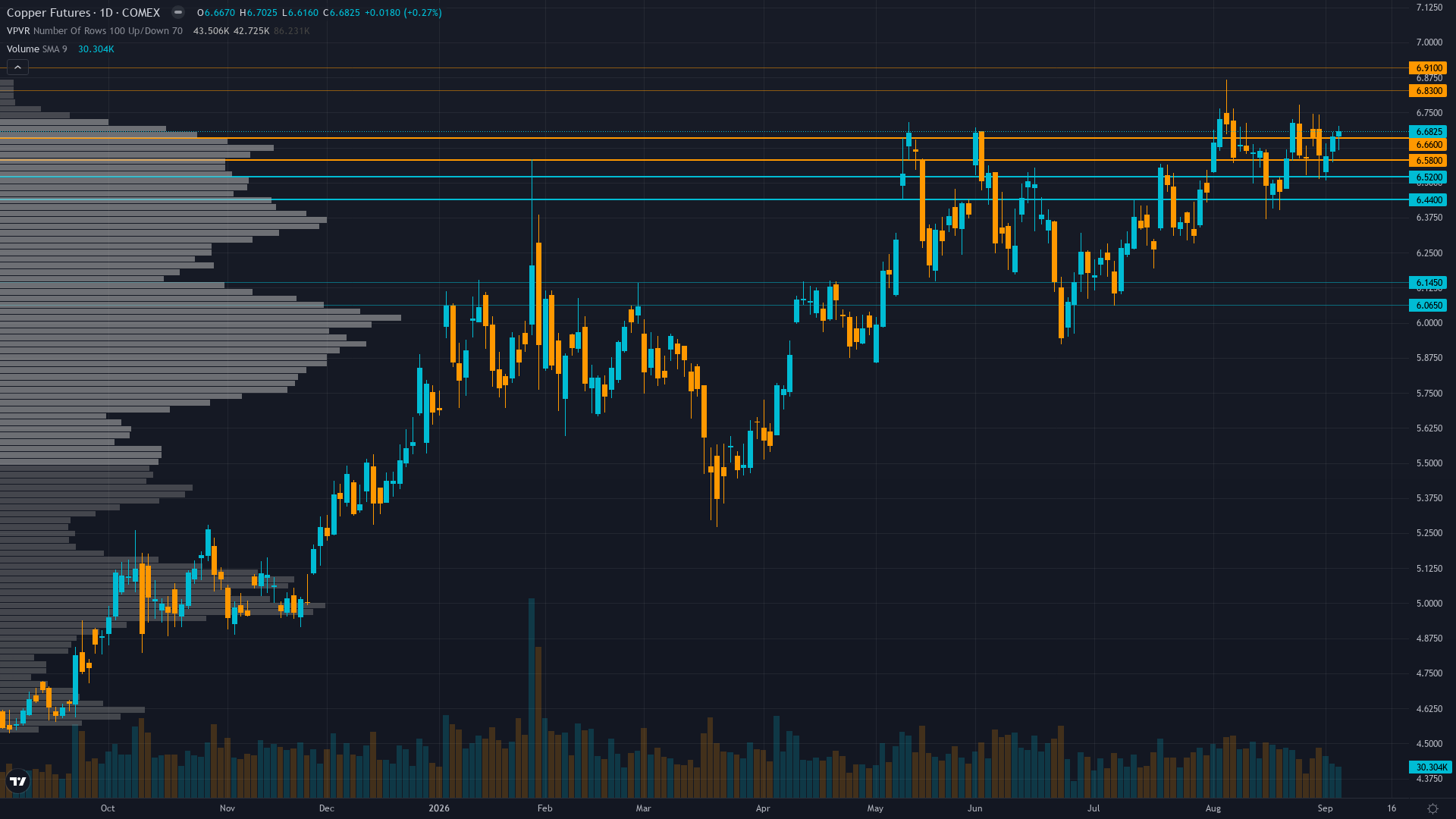
BULLISH | 6/10 | 6.597 | 6.5475 | -0.75 | MISSED | C |
| BULLISH at 6/10 and copper slipped 0.75%. The fresh Bloomberg mine setback catalyst and September seasonal tailwind the desk identified were overwhelmed by hawkish Fed repricing and the broader risk-off tone. A small miss at moderate conviction. The Grasberg supply deficit thesis remains structurally intact but keeps losing the near-term argument to macro headwinds. | |||||||
|
Russell 2000
EXTENDED
|
BULLISH | 6/10 | 2976.6 | 2907.2 | -2.33 | MISSED | D |
| BULLISH at 6/10 and the Russell dropped 2.33%, the largest directional miss on the board. The extreme speculative short positioning at the 7th percentile that the desk identified as squeeze fuel turned out to be informed money correctly positioned for a pullback. Two consecutive BULLISH misses on RTY now, and the September seasonal headwinds the desk acknowledged but bet against have asserted themselves. The worst call on the board. | |||||||
|
AUD/USD
FULL DESK
|
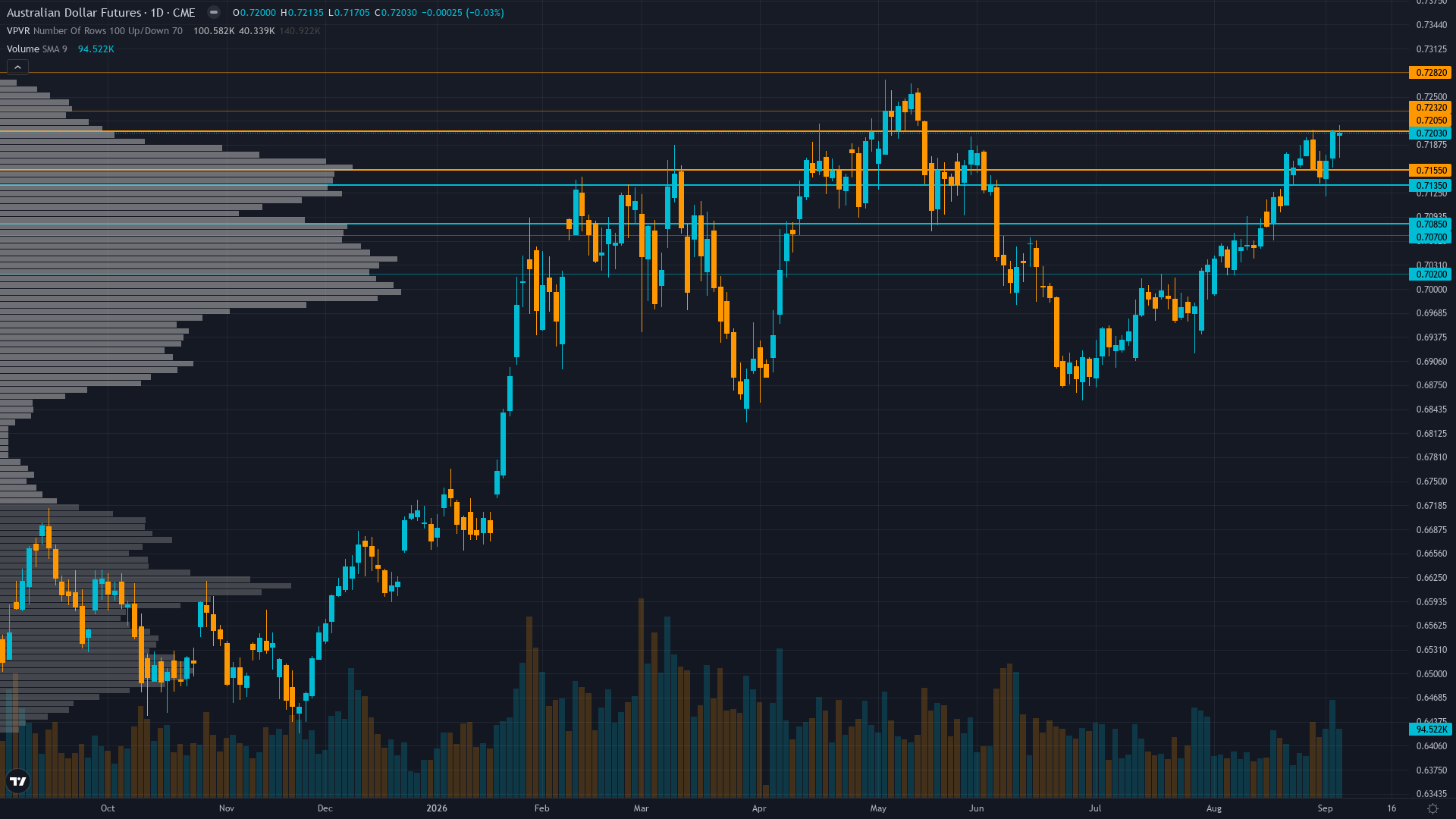
NO CALL | — | 0.7203 | 0.7162 | -0.57 | — | — |
| NO CALL at 5/10 and the Aussie slipped 0.57%, just above the noise threshold. The desk correctly identified the dense catalyst cluster, including China trade data and China inflation, as reasons to stand aside. A borderline miss by the scoring framework, but the caution was justified. | |||||||
|
30Y Treasury
FULL DESK
|
BEARISH | 4/10 | 108.625 | 106.75 | -1.73 | CORRECT | B+ |
| BEARISH at 4/10 and bonds fell 1.73%, a significant move for Treasuries. The desk's thesis about extreme speculative short crowding at the 3.8th percentile creating squeeze risk was outweighed by the structural fiscal deficit headwinds and PPI/CPI resolution that sent yields higher. The bearish bond thesis, which has been the desk's most consistent performer across 2026, quietly delivered another clean win at whispered conviction. | |||||||
|
Wheat
FULL DESK
|
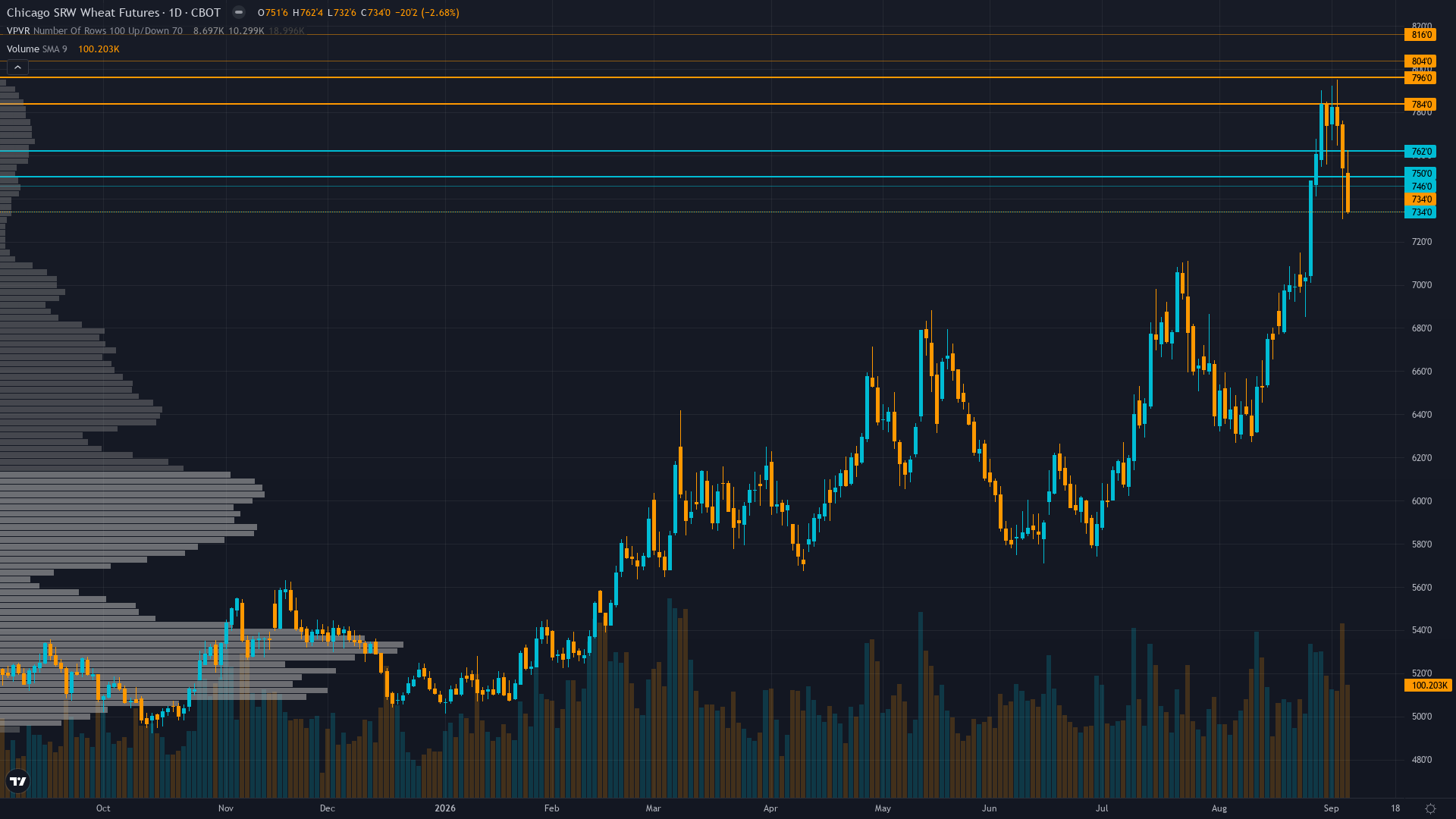
BULLISH | 4/10 | 716 | 726.25 | 1.43 | CORRECT | B |
| BULLISH at 4/10 and wheat gained 1.43% as the Black Sea export disruption and smallest US crop since 1970/71 continued to support prices ahead of the September 11 WASDE. The conviction was suppressed by mandatory penalties for the approaching binary event, which was procedurally appropriate. Direction correct, modest move, whispered conviction. | |||||||
|
Soybeans
FULL DESK
|
NO CALL | — | 1293.75 | 1299 | 0.41 | — | — |
| NO CALL at 5/10 and soybeans drifted 0.41% higher. The extreme speculative positioning at the 98.7th percentile that the desk flagged as contrarian risk was the correct reason to stand aside ahead of the September 11 WASDE. A tiny move validates the abstention. | |||||||
|
Platinum
FULL DESK
|
BULLISH | 6/10 | 1821 | 1802 | -1.04 | MISSED | C |
| BULLISH at 6/10 and platinum slipped 1.04%. The WPIC structural deficit thesis and September seasonal window met the same precious metals headwinds that dimmed gold this week. The intraweek +3.93% rally on September 3 from $1,761 to $1,845 that the desk flagged as evidence of dip-buying conviction was ultimately not sustained through the Friday close. Two consecutive weekly pullbacks at moderate conviction. | |||||||
|
✦ Best Call: USD/JPY (6J)
BULLISH at 6/10 and the yen surged 2.43% as BOJ hike probability climbed from 63% to 84% during the week. After twenty-plus consecutive weeks of NO CALL silence on this pair, the desk broke its longest FX abstention streak with a clean, catalyst-driven call that nailed the direction, the thesis, and the timing. The MOTW report identified Ueda's hawkish guidance, the 37% no-hike tail as mispriced, and speculative short covering as squeeze fuel. All three elements played out. The free report is on the Ghost site. |
⚠️ Worst Call: Russell 2000 (RTY)
BULLISH at 6/10 and the Russell fell 2.33% from 2976.6 to 2907.2. I wrote just two weeks ago that the desk's RTY BULLISH call missed when 30-year Treasury yields overwhelmed the positioning setup. This week, the same thesis about extreme speculative shorts at the 7th percentile and oversold RSI at 33.7 creating squeeze potential was tested against a market more interested in the PPI/CPI binary risk and September seasonal headwinds. The squeeze never materialised. The ADP miss on Sep 2 provided a template for how small caps might rally on rate relief, but the week itself delivered no such relief. Two consecutive BULLISH misses on RTY now, and the desk needs to accept that sub-3000 Russell in September is not a squeeze setup. It is a market that wants to go lower. |
The Economic agent had a split week that perfectly illustrates the desk's ongoing coordination challenge. On the yen, its identification of BOJ policy divergence momentum as the dominant price driver produced the week's best call. On the Russell, its reading of the transitional macro regime and rate sensitivity headwinds should have produced more caution, but the Institutional agent's extreme COT data overwhelmed the warning signals. The Fundamental agent continues its year-long pattern of being correct about medium-term supply dynamics and wrong about near-term timing. Its bullish gold thesis at 6/10 missed by 0.84%, its bullish copper thesis missed by 0.75%, and its bullish platinum thesis missed by 1.04%, all modest moves but all in the wrong direction.
The Institutional agent deserves particular scrutiny this week. Its contrarian reading of extreme COT data drove the RTY BULLISH call (7th percentile shorts) and supported the HG BULLISH call (98.7th percentile longs as trend-following). Both missed. When your positioning-based signals point BULLISH on one market because shorts are extreme and BULLISH on another because longs are extreme, the framework is not reading positioning so much as finding a bullish excuse in any dataset it encounters. The desk's yen call worked precisely because the Institutional thesis aligned with a clear, dated catalyst. Without that catalyst anchor, positioning data alone is not an edge.
The calendar ahead is dominated by two events that will ripple through every market on the board. The September 17-18 BOJ meeting, where the desk's MOTW thesis faces its resolution, will determine whether the yen's rally extends or exhausts. Central Bank Watch shows the market now pricing 84% probability of a 25bp hike, which means disappointment risk has shifted to the no-hike tail. The September FOMC follows immediately after, with Polymarket pricing 51% probability of a 25bps hike, the tightest binary risk the desk has faced on US rates since the Warsh era began. Crude oil back above $100 with Iran escalation fresh in the headlines means the Hormuz premium the desk keeps trying to bury has risen from its grave once more. Gold and silver face the question of whether the PPI/CPI data that landed this week (PPI Sep 10, CPI Sep 11) confirms or challenges the dovish narrative that has supported precious metals since July's NFP shock. The desk will have its Sunday views. I suspect the yen and bonds will carry the conviction, and the rest of the board will receive the familiar NO CALL treatment.