Crude Oil Forecast This Week — Outlook, Drivers & Key Levels
This week's Crude Oil outlook: key drivers, volatility context, risk-opportunity assessment and the week ahead.

Current Market Picture
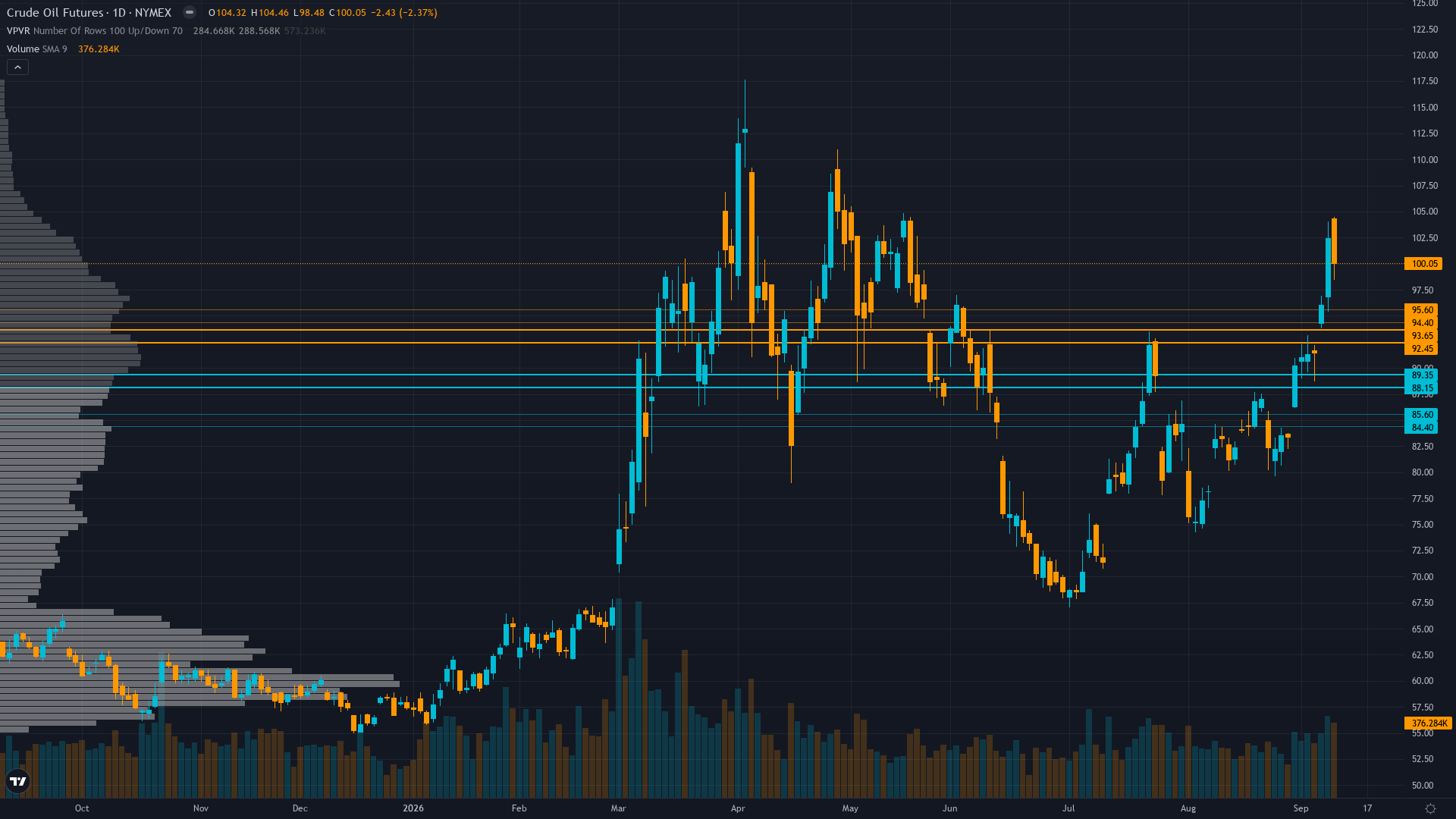
crude oil is trading at 100.05, down 2.43% as selling pressure weighs on price. crude oil futures is in a breaking out market state, requiring careful assessment of current conditions.
Market pricing sustained Hormuz escalation premium through $100 with institutional conviction building via speculative length accumulation; consensus is cautiously bullish near-term but wary of diplomatic catalyst risk and fundamental overvaluation at current levels
Key Drivers This Week
Primary driver: Strait of Hormuz tanker war escalation — two Saudi tankers attacked September 1 (NYT), US strikes on three Iranian tankers September 6, and Iran firing ballistic missiles at US warships (Al Jazeera Sep 7) have triggered a violent +20% monthly surge from $83.40 to $100.05, the most acute phase of the 7-month crisis since the March 2026 $120 peak
Secondary factor: Speculative positioning rebuilding from lean levels — CFTC COT Sep 8 shows non-commercial net long at 136,579 contracts (25.3rd percentile, +6,668 w/w), confirming institutional conviction in the geopolitical rally but with ample room before reaching crowded-long extreme territory
Additional influence: Fundamental divergence deepens — WTI at $100 trades ~15% above EIA September STEO Brent forecast of ~$90/bbl for 2H26 and J.P. Morgan's Q3 $86/Q4 $80 Brent estimates, while US production reaches record 13.96M bpd (EIA Sep STEO) and China demand contracts 8.9% annually (Sinopec Sep 9), creating a valuation gap sustained only by Hormuz disruption premium
Economic backdrop: DIVERGENT — VIX at 15.84 signals neutral equity risk appetite while the energy complex trades on its own geopolitical binary (Hormuz tanker war); Fed on hold at 3.63%, 10Y yields rising 18bp to 4.96%; China Aug PMI improved to 51.5 supporting demand narrative, but US retail sales and FOMC projections due Sep 16 are key near-term catalysts
Fundamental assessment: WTI at $100 appears 15-20% overvalued vs marginal production costs of $80-85/bbl and ~15% above EIA/JPM 2H26 Brent forecasts, with the premium entirely sustained by the Strait of Hormuz disruption removing ~17-21 mb/d of global transit capacity; structural oversupply thesis remains valid absent the geopolitical premium
Price Structure
Explosive breakout through $100 psychological resistance with WTI at $100.05, price well above all key moving averages after +9.58% weekly surge, RSI ~59-60 with room before overbought, and price at 77.6% of 52-week range with trend strongly bullish
With trend strength at 8/10, the prevailing move carries significant force behind it.
Upside & Downside
Primary risk: Diplomatic breakthrough or Hormuz ceasefire removes the repriced geopolitical disruption premium, triggering violent liquidation of speculative length and collapse back toward $85-91 range as EIA structural oversupply thesis reasserts dominance (Probability: low)
Primary opportunity: Continued Hormuz escalation with further tanker attacks and US-Iran military engagement drives WTI through $105 resistance toward $112.95 (52-week high) within 1-3 weeks as the market reprices toward full crisis premium near the March 2026 $120 peak (Timeframe: 1-3 weeks pending Hormuz headline flow and FOMC outcome)
This week's edge: Resetting after 5 consecutive misses — thesis under review. The market has correctly priced the Hormuz tanker war escalation through $100, and the desk sees the same bullish factors (active military engagement in the strait, speculative length rebuilding from low percentiles, $100 psychological breakout) that the market is already discounting. No contrarian edge exists this cycle — the market is efficiently pricing the geopolitical binary, and the desk's mandatory NEUTRAL stance reflects integrity protocol, not a differentiated view. The fundamental overvaluation vs EIA/JPM forecasts ($100 vs ~$86-90 fair value) and early signs of demand destruction (China -8.9% y/y, Sinopec Sep 9) represent the bearish counter-argument that the market is temporarily ignoring, but these are dormant risks requiring a Hormuz resolution to materialize.
Volatility Context
At the 82th percentile of its 90-day range, oil price volatility is running hot, creating both opportunity and risk for directional traders. Realised vol is trending higher across the curve, which tends to accompany transitional periods where the market is repricing risk.
Expanding volatility regime requires wide stops (1.5-2x ATR, approximately $5-7); expect 2.5-4% daily swings driven by Hormuz headline risk; trend-following is reliable in the current breakout but the $100 level creates two-way risk; position sizing must account for overnight gap risk of 2-4% on geopolitical headlines
Week Ahead Outlook
The next major catalyst is EIA Crude Oil Stocks Change (Sep 11) and FOMC Economic Projections (Sep 16 18:00) — dual catalyst day with inventory data providing supply validation and FOMC dot plot setting macro demand expectations on Wednesday 16 September — a high-impact event that could materially shift the directional picture.
For CL futures, the balance between existing momentum and scheduled risk events sets the stage for the week ahead.
This analysis covers one dimension. Our full weekly report combines six specialist agents into a single actionable briefing with directional bias, key levels, and risk-opportunity matrix.
Start Free — Get the Market of the WeekFree weekly report · No credit card · Upgrade anytime