Crude Oil Forecast This Week — Outlook, Drivers & Key Levels
This week's Crude Oil outlook: key drivers, volatility context, risk-opportunity assessment and the week ahead.

This Week's Starting Point
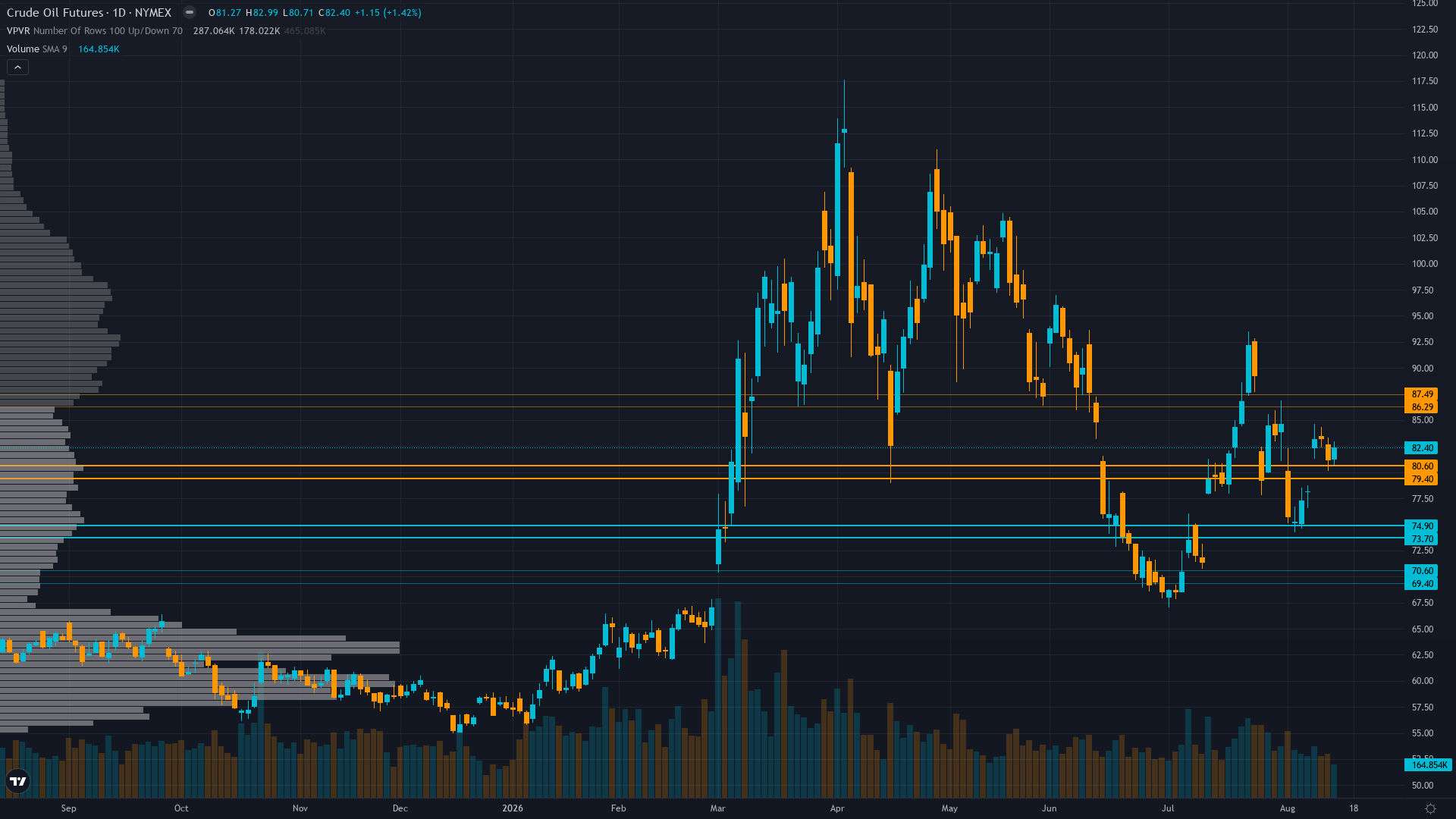
Trading at 82.4 after a 1.42% move higher, crude oil continues to attract buying interest. Price action in crude oil futures has compressed into a consolidation pattern, typically a precursor to a directional breakout.
Market divided and uncertain — traders are pricing a 50/50 binary on Hormuz reopening, with $82 representing a 'no man's land' where neither the full geopolitical premium ($85-90) nor the pure fundamental floor ($70-74) is fully reflected, as non-commercial positioning at the 13.9th percentile confirms speculative community has no conviction
Forces in Play
Primary driver: Strait of Hormuz reopening uncertainty dominates — U.S.-Iran talks stalled as Iran demands major concessions before reopening the strait, with oil surging 5% on Aug 10 on deal doubt, but no resolution in sight creating a two-way geopolitical binary risk that prevents directional conviction
Secondary factor: Non-commercial positioning at extreme bearish 13.9th percentile of 3-year range (99,196 contracts net long, CFTC Aug 11) represents contrarian setup with potential for violent short squeeze if Hormuz negotiations collapse, yet positioning also shows speculative length still being reduced week-over-week (-13,247 contracts)
Additional influence: Fundamental tug-of-war between structural supply deficit from ongoing Hormuz blockade (17-21 mb/d removed since Feb 2026) and demand destruction catalysts (China PMI contraction to 49.2, EIA/IEA demand downgrades) creating equilibrium near $82 where neither bullish nor bearish case dominates decisively
Economic backdrop: TRANSITIONAL macro regime with mixed signals: VIX at 14.25-15.15 (low complacency), HY OAS at 271bps (credit stable), USD weakening -1.42% MoM, US inflation at 2.27% (stable), Fed on hold at 3.63% — the energy complex is trading on its own catalyst (Hormuz) rather than macro direction, decoupled from broader risk appetite
Fundamental assessment: Market remains in structural deficit with Strait of Hormuz blockade continuing for 5+ months removing 17-21 mb/d transit capacity, EIA STEO forecasts Brent averaging $85/bbl suggesting current WTI at $82.40 is near fair value, but OPEC+ August production increase of 188k bpd and China demand weakness (PMI 49.2) create headwinds
Technical Landscape
WTI at $82.40 in uptrend over the past week (+5.4%) with price above key moving averages, but RSI at 75.1 is overbought suggesting near-term pullback risk; TradingView technical rating shows 'Strong Buy' while daily range Aug 14 was $80.77-82.99 establishing immediate support and resistance levels
Trend strength sits at 4/10, reflecting moderate directional pressure without clear dominance.
Volatility Backdrop
oil price is in a high-volatility environment (88th percentile over 90 days), where position sizing discipline becomes critical. Volatility expansion is underway, suggesting the market is moving into a phase of heightened activity and wider ranges.
High and expanding volatility regime requires wide stops (4-6% range); expect 3-5% daily swings driven by Hormuz headline risk; current $82.40 with daily range of $80.77-82.99 indicates intraday liquidity is adequate but position sizing must account for overnight gap risk of 2-4% on any geopolitical headline
Risk & Opportunity
Primary risk: Sudden diplomatic breakthrough reopens Strait of Hormuz without warning, removing the 17-21 mb/d supply disruption risk premium that supports current $82 pricing and triggering a violent collapse toward $70-74 as the structural oversupply thesis reasserts dominance (Probability: medium)
Primary opportunity: Strait of Hormuz negotiations collapse entirely with Iran hardening its position on compensation demands, forcing rapid repricing of full geopolitical risk premium back toward $85-90 as the market discovers the supply disruption is structural not tactical and will persist through Q4 2026 (Timeframe: 1-3 weeks as U.S.-Iran diplomatic track either resolves or collapses — current uncertainty prevents directional conviction)
This week's edge: Resetting after 3 consecutive misses — thesis under review. The market has been whipsawed by Hormuz headlines: the bearish thesis was invalidated by the Aug 10 deal collapse news, but the bullish thesis lacks catalyst conviction while speculative positioning is already lean. The desk's edge this week is recognizing that three consecutive directional failures necessitate a pause, not a doubling down.
Looking Forward
On the calendar, NY Empire State Manufacturing Index (Aug) and NAHB Housing Market Index (Aug) — data points providing US growth signals that could shift demand expectations for oil on Monday 17 August carries moderate market-moving potential and warrants attention in trade planning.
The week ahead for crude oil futures hinges on whether the prevailing consolidating regime can absorb the scheduled catalysts without a regime shift.
This analysis covers one dimension. Our full weekly report combines six specialist agents into a single actionable briefing with directional bias, key levels, and risk-opportunity matrix.
Start Free — Get the Market of the WeekFree weekly report · No credit card · Upgrade anytime