Crude Oil Forecast This Week — Outlook, Drivers & Key Levels
This week's Crude Oil outlook: key drivers, volatility context, risk-opportunity assessment and the week ahead.

Current Market Picture
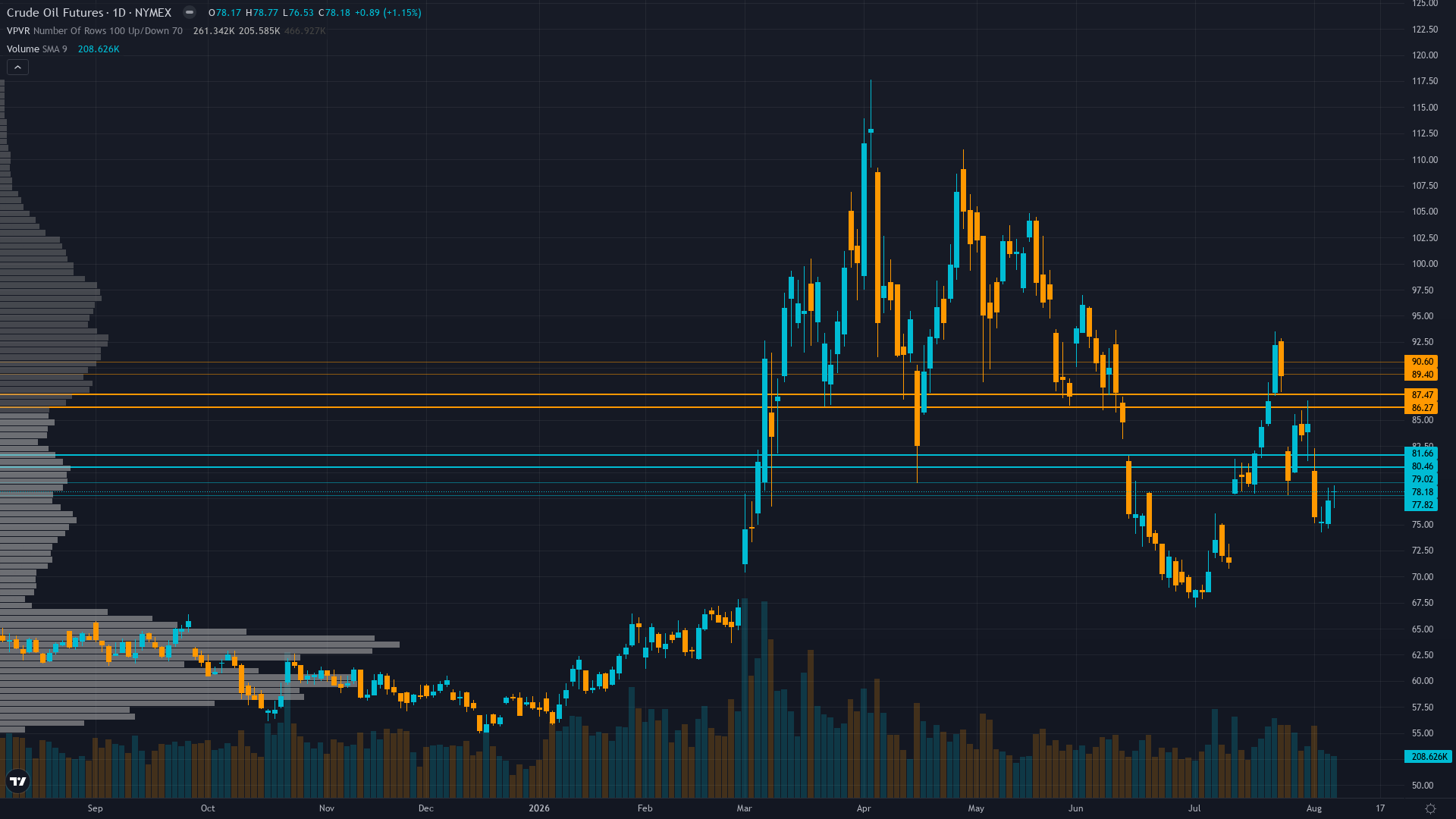
crude oil sits at 77.08 after slipping 0.27% — a shallow pullback rather than a decisive move. crude oil futures is in a breaking down market state, requiring careful assessment of current conditions.
Market heavily bearish with Polymarket pricing 100% probability of WTI below $85 in August and crowd positioning already short, reflecting consensus that Hormuz normalization completes the geopolitical premium unwind toward fundamental equilibrium near $70-75
Key Drivers This Week
Primary driver: Strait of Hormuz reopening deal finalized between Iran and Oman (Aug 5-6, 2026) awaiting Supreme Leader approval, removing last major geopolitical supply risk premium and triggering aggressive repricing of WTI toward fundamental equilibrium as EIA structural oversupply projections reassert dominance
Secondary factor: China manufacturing PMI contracted to 49.2 in July 2026 (first contraction since February) validating demand destruction narrative as world's largest crude importer reduces purchases amid economic slowdown and high input costs
Additional influence: Bearish technical breakdown continuation with WTI breaking below $80 psychological support and 200-day MA, now trading at 39.7% of 52-week range with RSI 44 showing bearish momentum without oversold conditions allowing further downside toward $74-70 support zone
Economic backdrop: TRANSITIONAL trending RISK-OFF in energy complex with VIX at 15.15 (below 20) indicating broader market calm but CL decoupled in its own risk-off regime driven by China contraction (PMI 49.2) and demand destruction; Fed on hold at 3.63% with CPI data (Jul) due Aug 12; 10Y yield down 10bp to 4.65% reflecting safe-haven flows amid growth concerns
Fundamental assessment: Crude remains moderately overvalued 25-30% vs marginal production costs of $58-61/bbl, with OPEC+ August production increase (+188k bpd), US production at 13.80M bpd, and China demand at decade lows creating emerging surplus; EIA structural oversupply projections and IEA demand contraction of -1.2M b/d for 2026 provide fundamental ceiling well below current pricing
Price Structure
Bearish breakdown below $80 psychological support with price at $77.08 decisively below both 50-day and 200-day moving averages, RSI 44 showing bearish momentum without extreme oversold (below 30 would be capitulation), 52-week range position at 39.7% percentile suggesting room to decline toward $70-74 zone before approaching major support levels
Trend strength registers just 3/10, which typically corresponds to choppy, directionless price action.
Upside & Downside
Primary risk: Strait of Hormuz deal stalls at final approval stage with Iran's Supreme Leader rejecting Oman-brokered terms, forcing rapid repricing of geopolitical risk premium back into WTI toward $82-85 range as market discovers residual supply disruption risk was not fully removed (Probability: low)
Primary opportunity: Full Hormuz deal approval within days removes last geopolitical support for WTI, combined with China demand destruction and OPEC+ supply increases, driving sustained decline toward $74 immediate support then $70 major support as structural oversupply (EIA/IEA projections) reasserts full dominance over pricing (Timeframe: 1-3 weeks through late August as Hormuz deal finalization removes residual risk premium and Q3 oversupply materializes in inventory builds)
This week's edge: The market may be underweighting the magnitude of residual downside if Hormuz deal completes fully — current pricing at $77 still embeds $3-5/bbl of residual risk premium versus EIA structural fair value estimates of $70-74, and non-commercial positioning at 17th percentile suggests further speculative liquidation potential if deal finalization triggers a final capitulation wave toward $70 support
Volatility Context
At the 88th percentile of its 90-day range, oil price volatility is running hot, creating both opportunity and risk for directional traders. Realised vol is trending higher across the curve, which tends to accompany transitional periods where the market is repricing risk.
High and expanding volatility requires wide stops (4-6% range); expect 3-5% daily swings as Hormuz deal headlines drive binary price reactions; breakdown reliability is moderate given elevated headline risk but established trend favors continued downside with periodic squeeze risk on deal delay headlines
Week Ahead Outlook
The next major catalyst is OPEC Monthly Report (Aug 12) and US CPI data (Jul, Aug 12) - dual catalyst day with OPEC demand forecast revision providing demand-side validation and CPI providing macro direction; API Crude Oil Stock Change (Aug 11) also key on Wednesday 12 August — a high-impact event that could materially shift the directional picture.
For CL futures, the balance between existing momentum and scheduled risk events sets the stage for the week ahead.
This analysis covers one dimension. Our full weekly report combines six specialist agents into a single actionable briefing with directional bias, key levels, and risk-opportunity matrix.
Start Free — Get the Market of the WeekFree weekly report · No credit card · Upgrade anytime