Mon-T Weekly Review — w/e 24 Jul 2026
Three from six, the Nasdaq finally gets its MOTW moment, and wheat discovers that drought theses work better when you time them correctly.

The semiconductor collapse that dominated last week's headlines continued its march through the grading window, but this time the desk was positioned for it. NQ, selected as Market of the Week for the first time in the desk's history, was called BEARISH at 6/10 conviction and fell 1.75% as Alphabet's blowout earnings ($9.11 versus $2.88 consensus, per the Globe and Mail) paradoxically triggered a 7% selloff in GOOGL on July 23 because investors decided $700 billion in AI capex was not, in fact, a compliment. Tesla dropped 14% the same day. The Nasdaq shed over 2% on Thursday alone, per CNBC, its worst session in more than a month.
Three of six directional calls correct, a 50% accuracy rate that sits right on the statistical boundary between "this desk adds value" and "this desk is a coin with opinions." The wins were clean: NQ BEARISH landed as described, RTY BEARISH caught a 1.49% decline on the credit sensitivity thesis, and platinum's BEARISH grind continued with a modest 0.42% dip. The misses, though, cut in familiar places. Wheat was called BULLISH at 7/10, the desk's strongest conviction of the week, and promptly fell 3.21% because the worst US production since 1957 apparently means less to the market than seasonal harvest pressure. Silver, called BEARISH at 5/10, rebounded 3.62% in the kind of mean reversion snap that the desk's own analysis flagged as a risk and then bet against. And Treasury bonds, called BULLISH at 6/10 in a dramatic thesis reversal driven by the June CPI dovish surprise, fell 0.79% because Kevin Warsh does not appear to share the desk's enthusiasm for rate cut narratives.
The eight NO CALL markets had an eventful week of their own, most notably soybeans surging 5.99% while the desk stared at its shoes behind the signal threshold barrier. I have written this paragraph in various forms approximately fifty times since February. The pattern holds. The desk's discipline protects its accuracy at the cost of missing agricultural fireworks.
|
14
Markets
|
6
Directional
|
3
Correct
|
50%
Accuracy
|
8
No Calls
|
Six directional calls this week, with three landing on the right side. The other eight markets got the NO CALL treatment. A 50% directional accuracy rate matches the late-March coin-flip week and last week's result, creating an uncomfortable pattern of consecutive weeks at the statistical floor. The average confidence of 5.8 tells you the desk was whispering most of its views, with only wheat at 7/10 showing genuine conviction. That highest-conviction call was the week's most painful miss, falling 3.21% in the wrong direction. When your strongest belief produces your worst outcome for the second consecutive week, the calibration system deserves scrutiny.
The wins at least came from the right places. NQ BEARISH at 6/10 was the week's most consequential correct call, catching the continuation of the semiconductor selloff that TheStreet confirmed dragged Alphabet and Tesla lower despite massive earnings beats. RTY BEARISH at 5/10 caught a 1.49% decline that validates the June NFP credit sensitivity thesis. Platinum at 6/10 continues its quiet bearish streak. The problem is not the correct calls. The problem is that the desk keeps issuing its strongest conviction on agricultural markets and keeps getting humbled by them.
|
43/78
Correct / Total
|
55.1%
Accuracy
|
78 / 97
Directional / No Call
|
The rolling twelve-week figure sits at 55.1% across 78 directional calls, with 97 no-call abstentions. That engagement split means the desk calls direction on fewer than half of all market-weeks, a rate that has been declining since February's 70% pace when the precious metals thesis was minting money. This week's 50% does nothing to improve matters, and two consecutive coin-flip weeks are pulling the rolling number back toward the low fifties. The desk needs to either increase its directional volume while maintaining accuracy above 60%, or accept that the current framework operates at a level of caution so extreme it struggles to justify the subscription.
|
Bias Called
BEARISH
|
Confidence
6/10
|
Result
CORRECT
|
Grade
B+
|
| Monday Open | 28773 |
| Friday Close | 28269.75 |
| Move | -1.75 |
| ▼ R2 | 30000 |
| ▼ R1 | 29400 |
| ▲ S1 | 28400 |
| ▲ S2 | 26282 |
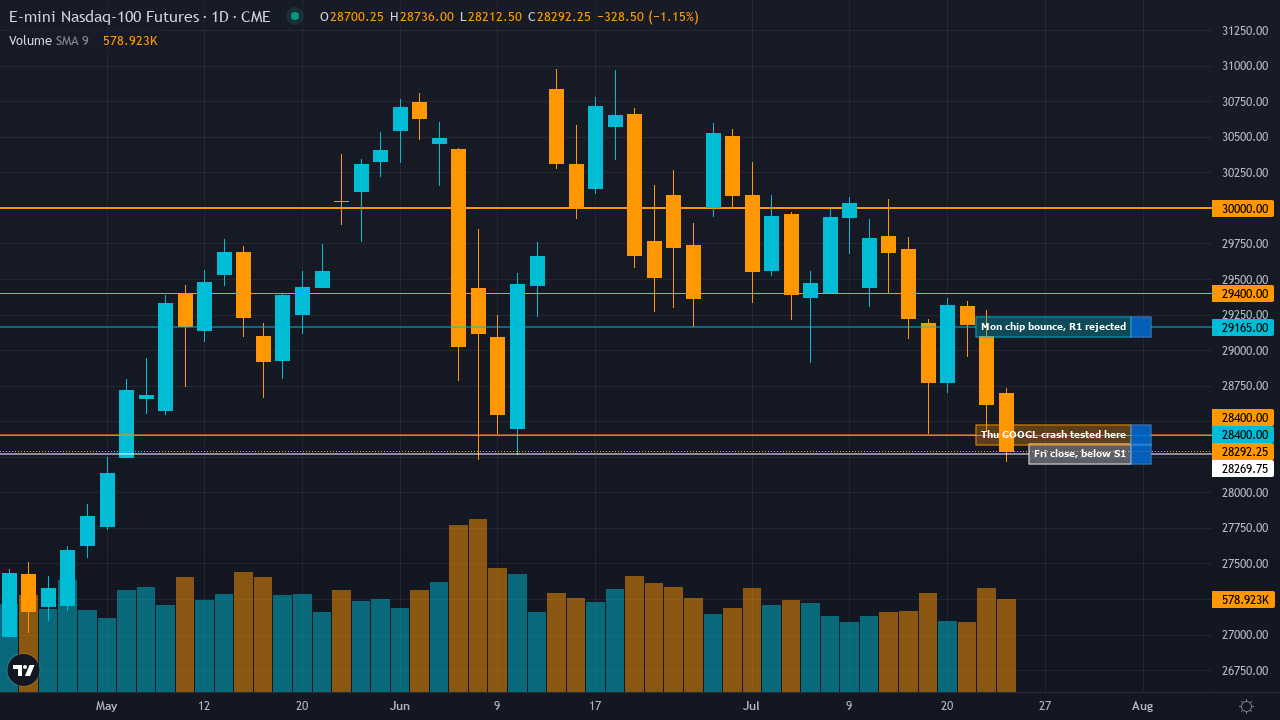
R1 at 29,400 (the 50-day MA) acted as a ceiling for the entire week. NQ opened Monday at 28,773, already well below that level, and any early-week chip revival was capped precisely where the desk said it would be. Capital Street FX confirmed Nasdaq futures jumped 1.3% on Monday to around 29,165 on chip stock recovery hopes, but the bounce stalled just below R1 and reversed hard by Wednesday as Alphabet and Tesla earnings hit. S1 at 28,400 was tested during the Thursday selloff, with the synthesis noting an intraday low of 28,408 earlier in the week. Friday's close at 28,269.75 settled below S1, suggesting the desk's immediate support gave way under the weight of the tech earnings reaction. S2 at 26,282, the 200-day MA, was never in play. The levels framework earned its keep, with R1 correctly capping the recovery attempt and S1 identifying the week's battleground.
The called edge centred on the PHLX semiconductor index collapsing 18.2% in July while equity put/call remained dangerously complacent at 0.73, a divergence the desk argued markets had not fully priced. The thesis held that the $700B AI capex sustainability question would create further downside as Q2 earnings began, with Alphabet's July 22 report serving as the binary test. That edge was partially vindicated in an ironic fashion. Alphabet beat earnings spectacularly, reporting $9.11 per share against $2.88 consensus per the Globe and Mail, and revenue of $103.62 billion topped expectations. But the stock fell 7% anyway, because apparently beating estimates by 216% is insufficient when the market has decided AI infrastructure spending is a liability rather than an asset. Tesla dropped 14% on the same day. CNBC confirmed the Nasdaq fell over 2% on Thursday. The desk's identification of complacent put/call ratios as the crowd's blind spot proved correct, as the earnings catalyst triggered precisely the kind of repricing the synthesis anticipated.
Four of six disciplines pointed BEARISH, with only Fundamental and Institutional showing mild bullish leans. The Technical agent, carrying 20% weight, drove the breakdown thesis through its identification of the decisive move below the 50-day MA at 29,400 on massive volume with 619K contracts. Last week I wrote that the Technical agent had been the desk's weakest performer on NQ through most of 2026. This week, with a confirmed breakdown structure and declining RSI, it earned its keep. The Sentiment agent at 25% weight correctly flagged the dangerous divergence between VIX spiking to 18.77 and equity put/call remaining at 0.73, a pattern that historically precedes further selling. The Economic agent at 25% weight identified the TRANSITIONAL regime approaching RISK-OFF, which proved directionally useful. The Fundamental agent's mild bullish lean, based on Q2 earnings growth at 23.3%, was technically correct about the earnings quality but wrong about what the market would do with that information. When Alphabet beats by 216% and falls 7%, fundamental analysis has left the building.
The Nasdaq 100 made its debut as Market of the Week, and the timing was genuinely compelling. After approximately fifty paragraphs across this year's reviews in which I documented, criticised, lamented, and eventually accepted the desk's persistent NQ agnosticism, the agents finally committed to a directional view on the world's most watched tech index. BEARISH at 6/10 conviction, driven by a semiconductor sector that had shed 18.2% in July and earnings reports that threatened to either validate or destroy the AI infrastructure thesis.
The week played out in two distinct acts. Act one saw chip stocks attempt a recovery on Monday, with Capital Street FX reporting Nasdaq futures up 1.3% to around 29,165 as South Korea's KOSPI jumped 2% in sympathy. That bounce stalled precisely at the desk's R1 of 29,400, the 50-day moving average, and reversed. Act two arrived on Wednesday and Thursday when Alphabet and Tesla reported after the bell. Alphabet's $9.11 EPS crushed the $2.88 consensus, revenue topped $103 billion, and the stock promptly fell 7%. Tesla dropped 14%. CNBC confirmed the Nasdaq lost over 2% on Thursday, its worst session in more than a month. Schwab's morning update on Friday noted stocks stabilising as oil prices retreated, but the damage was done.
The free MOTW report, published on the Ghost site Sunday evening, identified the semiconductor collapse as a structural challenge to the AI infrastructure thesis and flagged Alphabet's July 22 earnings as the binary test. The report specifically warned about complacent equity put/call at 0.73 creating vulnerability to further downside. Readers who had that analysis before Monday's open had both the directional thesis and the specific catalyst mapped in advance. The irony, of course, is that Alphabet delivered perhaps the most impressive earnings beat of the entire season, and the market sold it anyway. The desk was right about the direction for the wrong reasons, or perhaps the right reasons expressed through unexpected mechanisms.
The grade is B+ rather than A because while direction was correct, the 1.75% decline was modest relative to the intraweek volatility. Thursday's 2%+ single-session crash was partially recovered by Friday's bounce, meaning the weekly candle understates the drama. The conviction at 6/10 was appropriate for a first directional commitment on a market the desk has historically struggled with, and the levels framework correctly identified both the R1 ceiling and the S1 battleground. For a debut MOTW, the Nasdaq delivered a credible performance that justifies featuring it when genuine catalysts exist, rather than defaulting to NO CALL for the fiftieth consecutive week.
| Market | Bias | Conf. | Mon Open | Fri Close | Move | Result | Grade |
|---|---|---|---|---|---|---|---|
|
S&P 500
CORE
|
NO CALL | — | 7495.75 | 7442.75 | -0.71 | — | — |
| NO CALL at 5/10 and the S&P slipped 0.71%. The signal sat at -0.5, below the 1.0 minimum threshold, and the desk's restraint was rewarded by a move within noise. The Alphabet and Tesla earnings debacle on Thursday dragged the index to new weekly lows before Friday's partial recovery. A clean abstention. | |||||||
|
Nasdaq 100
CORE
|
BEARISH | 6/10 | 28773 | 28269.75 | -1.75 | CORRECT | B+ |
| This week's MOTW. BEARISH at 6/10 on the semiconductor collapse and AI capex sustainability thesis. Alphabet beat earnings by 216% and fell 7%. Tesla dropped 14%. The desk called the direction, the catalyst window, and the complacent put/call blind spot. See the full deep-dive above. The free report is on the Ghost site. | |||||||
|
Gold
CORE
|
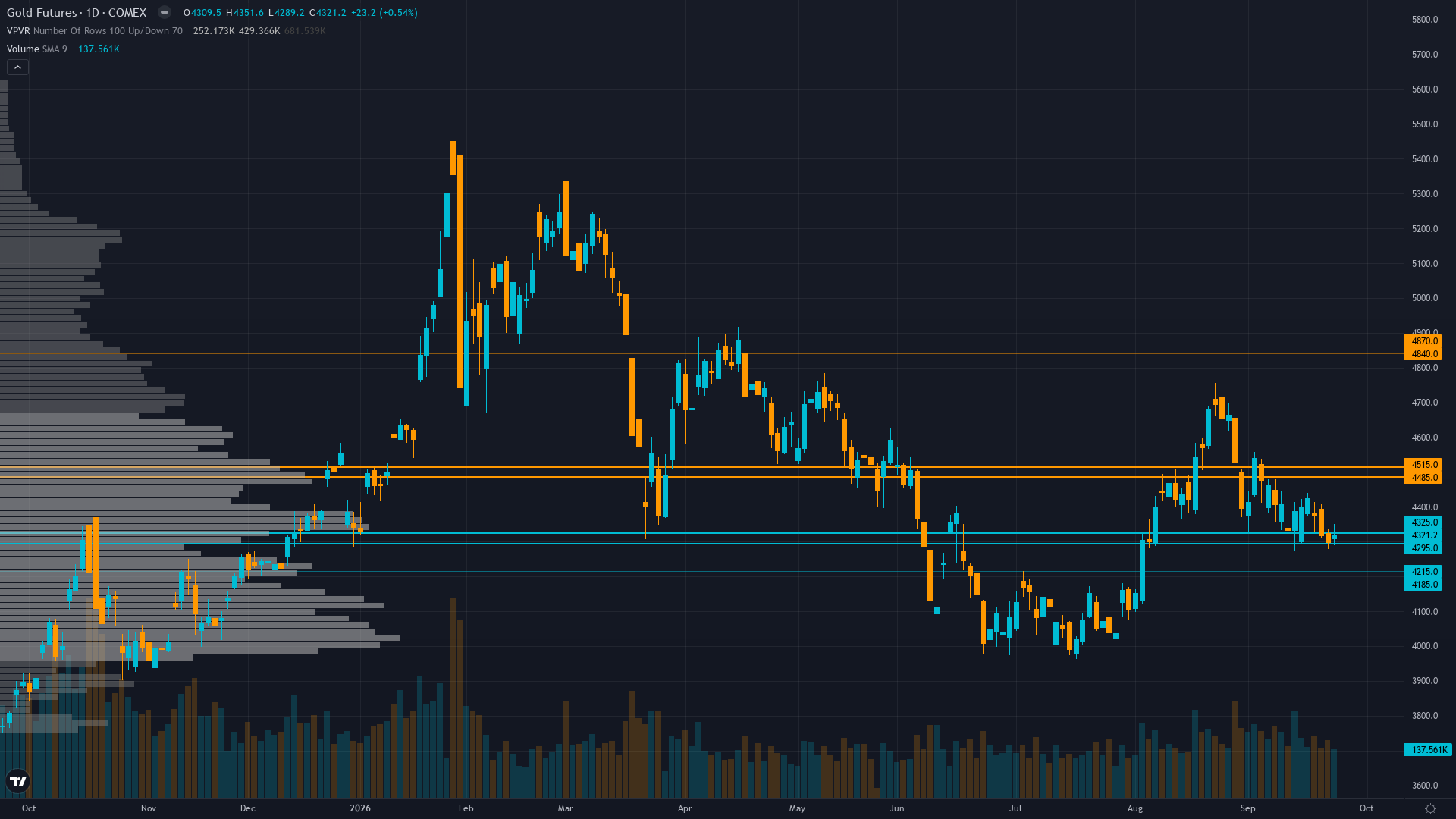
NO CALL | — | 4015.75 | 4055.2 | 0.98 | — | — |
| NO CALL per mandatory miss reset after eleven consecutive missed directional calls, and gold bounced 0.98% back above $4,000. The desk was procedurally locked out during a modest recovery week. At eleven misses, the reset protocol is doing exactly what it was designed to do, even if watching gold stabilise from behind the fire line remains its own kind of frustration. | |||||||
|
EUR/USD
CORE
|
NO CALL | — | 1.1435 | 1.1395 | -0.35 | — | — |
| NO CALL for the twentieth consecutive week. The euro drifted 35 pips. The ECB met on July 23 within the grading window, markets had priced 88% probability of a hold at 2.25%, and the pair barely noticed. Twenty weeks. At this point, the desk and EUR/USD should exchange anniversary cards. | |||||||
|
Silver
EXTENDED
|
BEARISH | 5/10 | 56.38 | 58.42 | 3.62 | MISSED | D |
| BEARISH at 5/10 and silver rebounded 3.62%. The desk's ninth consecutive bearish week met a market that decided mean reversion from deeply oversold territory was more interesting than the real yield headwind thesis. After being right on silver's direction for eight of the last nine calls, this miss breaks a productive streak. The 3.62% bounce from the $56 zone suggests the desk held the bearish view one week too many. | |||||||
|
USD/JPY
EXTENDED
|
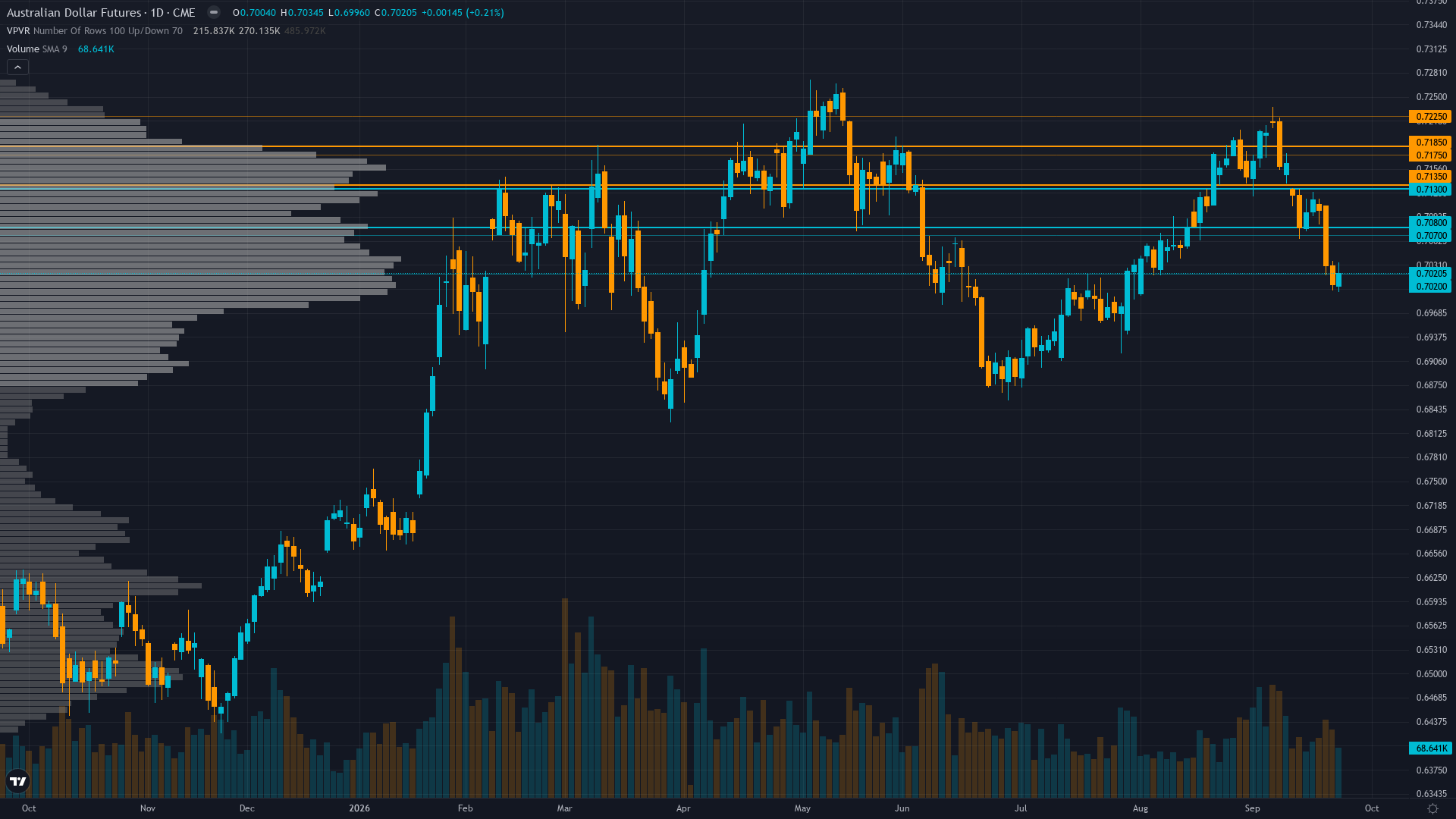
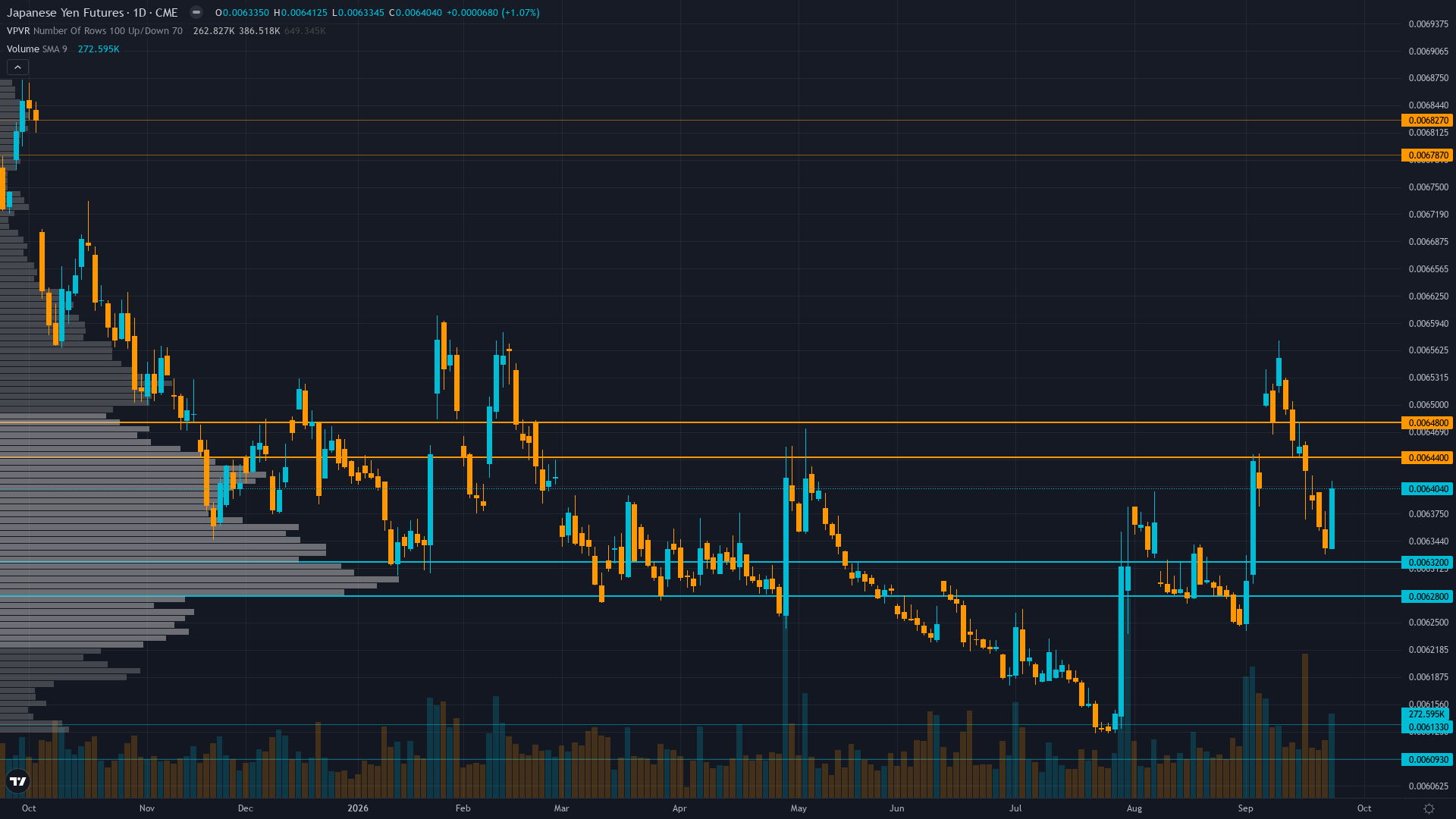
NO CALL | — | 0.006184 | 0.006128 | -0.91 | — | — |
| NO CALL for the nineteenth consecutive week, and the yen strengthened 0.91% past the noise threshold. A meaningful FX move the desk missed entirely. The BoJ meets July 30-31 with Mainichi reporting a stand-pat expectation, but the yen moved anyway. Nineteen weeks of silence on a pair that occasionally speaks rather loudly. | |||||||
|
GBP/USD
EXTENDED
|
NO CALL | — | 1.3176 | 1.3321 | 1.1 | — | — |
| NO CALL for the nineteenth consecutive week, and sterling surged 1.10%. The BoE meets July 30, and the pound decided not to wait for the invitation. A full percent of GBP strength while the desk abstained is the kind of miss that makes the nineteen-week streak look less like discipline and more like a commitment to irrelevance on cable. | |||||||
|
Copper
EXTENDED
|
NO CALL | — | 6.27 | 6.3325 | 1 | — | — |
| NO CALL with signal at 0.8, below the 1.0 minimum threshold, and copper gained 1.0%. The 18-consecutive-session LME inventory decline the desk flagged as fresh physical evidence appears to have provided support. A sub-threshold signal kept the desk on the sidelines during a week where the paid reports' supply deficit thesis continued proving correct without the desk being positioned for it. | |||||||
|
Russell 2000
EXTENDED
|
BEARISH | 5/10 | 2986 | 2941.4 | -1.49 | CORRECT | B |
| BEARISH at 5/10 and the Russell fell 1.49%. The catastrophic June NFP credit sensitivity thesis continues to deliver, with small caps carrying 40% floating-rate debt into a hawkish Fed environment. Eight consecutive correct calls on RTY now, a streak the desk should be quietly proud of even at minimum conviction. Direction correct, thesis sound, and the credit-versus-rate framework is earning its keep. | |||||||
|
AUD/USD
FULL DESK
|
NO CALL | — | 0.6982 | 0.69725 | -0.14 | — | — |
| NO CALL per mandatory miss reset after three consecutive missed directional calls, and the Aussie drifted 14 pips. The mandatory reset was emphatically the right call this week, as the market did nothing worth committing to. The RBA meets August 11 as the next catalyst. | |||||||
|
30Y Treasury
FULL DESK
|
BULLISH | 6/10 | 110.625 | 109.75 | -0.79 | MISSED | C |
| BULLISH at 6/10, the desk's dramatic thesis reversal driven by the June CPI dovish surprise, and bonds fell 0.79%. The desk flipped from its long-running bearish bond conviction to bullish for the first time, arguing the CPI moderation to 3.5% created tension with the June hawkish dot plot. The market disagreed, with yields continuing to rise through the FOMC approach. When your first bullish bond call of the year misses, the lesson is that Kevin Warsh's hawkish narrative is more durable than one CPI print can overcome. | |||||||
|
Wheat
FULL DESK
|
BULLISH | 7/10 | 701.5 | 679 | -3.21 | MISSED | D |
| BULLISH at 7/10, the desk's highest conviction, and wheat fell 3.21%. Last week's A+ turned into this week's D as the record managed money short positioning the desk identified as squeeze fuel proved to be trend-following wisdom rather than contrarian opportunity. The worst US production since 1957 and escalating Black Sea strikes could not overcome seasonal harvest pressure for the second time in three weeks. The desk's wheat conviction remains inversely correlated with its wheat accuracy. | |||||||
|
Soybeans
FULL DESK
|
NO CALL | — | 1181.75 | 1252.5 | 5.99 | — | — |
| NO CALL with signal at 0.85, below the 1.0 minimum threshold, and soybeans erupted 5.99%. China resumed US soybean purchases at 330,000 tons on July 6, and the market evidently noticed. A 6% rally while the desk sits behind the signal threshold barrier is the largest NO CALL miss on the board this week. The renewable diesel structural demand thesis the paid reports cover in detail is very much alive. | |||||||
|
Platinum
FULL DESK
|
BEARISH | 6/10 | 1605.7 | 1599 | -0.42 | CORRECT | C+ |
| BEARISH at 6/10 and platinum drifted lower by 0.42%. Direction correct, though the move barely qualifies as a statement. Four consecutive correct calls on platinum now after emerging from its mandatory miss reset purgatory. The WPIC deficit thesis continues to lose the near-term argument against elevated real yields and investment demand collapse, and the desk is riding that decline with appropriate caution. | |||||||
|
✦ Best Call: Nasdaq 100 (NQ)
BEARISH at 6/10 and the Nasdaq fell 1.75% as the semiconductor selloff consumed even Alphabet's 216% earnings beat. After a year of documenting the desk's painful NQ abstention habit in this column, watching the agents finally commit on tech and get it right feels like a minor vindication for everyone involved. The desk identified complacent put/call ratios as the crowd's blind spot and flagged Alphabet earnings as the binary catalyst. Both observations proved correct. The MOTW is on the Ghost site. Read it and ask yourself how a market can beat earnings by $6.23 per share and still fall 7%. The answer tells you everything about the current regime. |
⚠️ Worst Call: Wheat (ZW)
BULLISH at 7/10, the desk's highest conviction of the week, and wheat fell 3.21% from 701.50 to 679. I gave wheat an A+ last week for its magnificent 8.35% eruption on the WASDE production catastrophe. One week later, at the same conviction level, the market gave it all back. The worst US production since 1957, record managed money shorts, escalating Black Sea strikes: none of it mattered when seasonal harvest pressure reasserted itself. When I wrote two weeks ago that the desk's wheat record since March had been 'stubbornly erratic,' I was being diplomatic. This is now the second time in three weeks the desk has called wheat BULLISH at 7/10 and been wrong. The drought thesis works brilliantly one week in three and gets shredded by harvest mechanics the other two. |
The Technical agent had its best week in months on the NQ call, correctly identifying the breakdown below the 50-day MA as continuation rather than exhaustion and mapping the R1 ceiling that capped Monday's chip revival attempt. Its contribution to the RTY bearish call, flagging the failed ATH breakout and breadth collapse to 41.3% advancing, also landed cleanly. After spending most of 2026 as the desk's least reliable discipline on equity calls, the Technical agent appears to have found its footing when the market provides genuine structural damage rather than ambiguous consolidation patterns.
The Fundamental agent continues its year-long identity crisis. On wheat, its WASDE production catastrophe thesis drove the desk's highest conviction call and produced the week's worst miss. On platinum, its WPIC deficit thesis was correctly overridden by the bearish synthesis for another week. On soybeans, its renewable diesel demand floor thesis sat behind a locked NO CALL door while the market surged 5.99%. The Fundamental agent reads supply and demand correctly on a structural level but cannot time when those structural forces will assert themselves over seasonal and macro dynamics. After eighteen months of reviews, this observation has graduated from insight to cliche.
The coming week is a wall of catalysts dense enough to make the summer lull feel like a distant memory. The FOMC meets July 28-29, with Chair Warsh facing the question of whether June CPI moderation to 3.5% justifies any softening of the hawkish stance he established at his inaugural meeting. The BoE follows on July 30, and the BoJ meets July 30-31. Q2 earnings season intensifies with peak mega-cap tech reporting. Crude oil, which the desk did not cover this week but which remains the most volatile geopolitical proxy on the board, sits in a zone where any Hormuz headline could move it 10% in either direction. Gold continues testing $4,000 psychological support. The desk will have its Sunday views. Given the catalyst density, I suspect the NO CALL count may actually decrease for once.