Mon-T Weekly Review — w/e 21 Aug 2026
Precious metals roar, equities crumble, and the Russell's ATH breakout lasts about as long as a British summer.

Two stories, one week, and the desk managed to be brilliantly right about one of them and comprehensively wrong about the other. Gold surged 6.7%. Silver ripped 6.69%. Platinum posted a staggering 8.22% gain. The precious metals complex delivered the kind of synchronised rally that makes the Fundamental agent want to frame its COT report and hang it on the wall. Three BULLISH calls on metals, three correct, three moves north of six percent. If you had only read the metals section of the Sunday reports, you would think this desk walks on water.
Then there is the equity side. The S&P 500, called BULLISH at 6/10 after weeks of cautious recovery, fell 1.46% as 30-year Treasury yields hit their highest point in nearly two decades per TheStreet, and the Nasdaq shed 2.52% on a NO CALL. CNBC confirmed the S&P tumbled 1.4% on the week, snapping a three-week winning streak, while the Russell 2000, this week's Market of the Week and the desk's showcase free report, was called BULLISH at 6/10 and promptly surrendered 1.71% of its fresh all-time high. The ATH breakout that was supposed to trigger a short squeeze from -42,304 speculative shorts instead triggered profit-taking from everyone else.
Six directional calls this week, three correct. Fifty percent. The statistical equivalent of flipping a coin, except the coin had opinions about institutional positioning and COT percentiles. Nine NO CALL markets produced seven misses and two correct abstentions, with crude oil surging 5.17%, soybeans rallying 4.11%, wheat climbing 3.74%, and EUR/USD breaking 1.06% higher while the desk maintained its legendary silence on currencies. The precious metals half of the portfolio is doing extraordinary work. The rest of it is having what I can only describe as a character-building experience.
|
15
Markets
|
6
Directional
|
3
Correct
|
50%
Accuracy
|
9
No Calls
|
Six directional calls this week, with three landing on the right side. The other nine markets got the NO CALL treatment. A 50% directional accuracy rate matches the late-March coin-flip week and sits at the threshold where following the desk offers precisely zero statistical advantage over guessing. The average confidence of 6.3 is the highest in weeks, which makes the result more painful, not less. When you commit with genuine conviction and still only hit half, the confidence column stops being a selling point.
The calibration story is fascinating in its split personality. The two highest-conviction calls at 7/10, gold and silver, both delivered emphatically with gains of 6.7% and 6.69% respectively. The four calls at 6/10 split one correct (platinum) and three missed (ES, HG, RTY). When your strongest conviction produces your best results and your moderate conviction produces your worst, the system is telling you something about where it has genuine edge and where it is guessing with a nice suit on. The precious metals complex is the desk's profit engine right now. Everything else is noise dressed up as analysis.
|
37/66
Correct / Total
|
56.1%
Accuracy
|
66 / 107
Directional / No Call
|
The rolling twelve-week figure sits at 56.1% across 66 directional calls, with 107 no-call abstentions. That engagement split means the desk calls direction on roughly 38% of market-weeks, a rate that has continued its long decline from February's 70% pace. This week's 50% does nothing to improve the rolling number, and the persistent mountain of NO CALLs means the denominator barely moves from week to week. The desk needs to either increase its directional volume while maintaining accuracy above 65%, or accept that the mid-fifties is the structural ceiling for a framework operating at this level of selectivity.
|
Bias Called
BULLISH
|
Confidence
6/10
|
Result
MISSED
|
Grade
D
|
| Monday Open | 3074.9 |
| Friday Close | 3022.2 |
| Move | -1.71 |
| ▼ R2 | 3150 |
| ▼ R1 | 3100 |
| ▲ S1 | 3040 |
| ▲ S2 | 3000 |
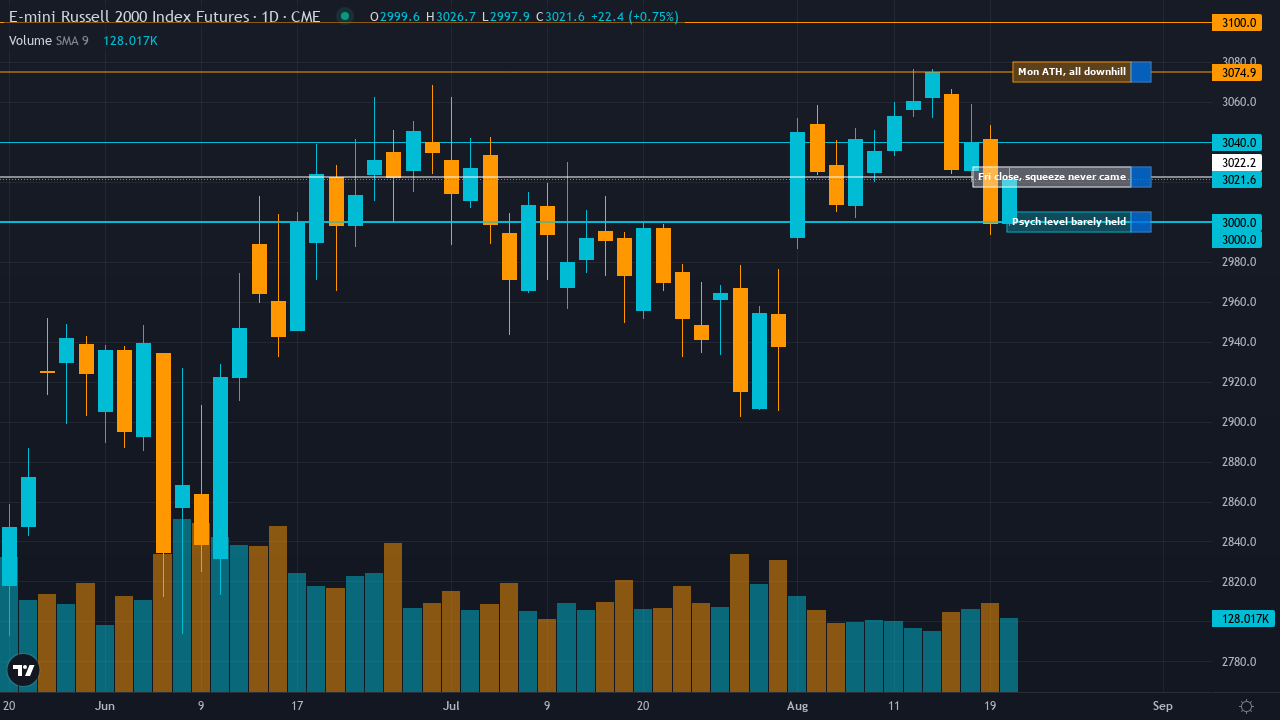
S1 at 3040 was breached cleanly. The Russell opened Monday at 3074.9, sitting at its fresh all-time high from the prior week's breakout, and immediately began leaking lower as Treasury yields hit nearly two-decade highs on Monday per TheStreet. By midweek, the index had sliced through S1 at 3040 without ceremony. S2 at 3000, the psychological level the index had only first breached in June, came under pressure on Thursday's equity rout before a Friday bounce lifted the close to 3022.2. R1 at 3100 was never remotely in play. R2 at 3150 belonged to a different week entirely. The levels framework correctly identified 3040 as the first downside test and 3000 as the major support, but the BULLISH directional call meant the desk expected price to push toward resistance, not crash through support.
The called edge centred on extreme speculative short positioning at -42,304 contracts (28.5th percentile of the 3-year range), with -7,577 contracts added the week of the breakout, creating a textbook squeeze setup against a fresh ATH at 3074.9. The desk argued this positioning mismatch, combined with a 34.5% forward P/E discount to large caps, would drive forced covering and sustained institutional rotation. The market disagreed. TheStreet confirmed the Russell gave up 0.35% on Monday alone as 30-year Treasury yields hit their highest point in nearly two decades, and the index continued bleeding through the week. CNBC reported the S&P tumbled 1.4% on the week as Thursday's pullback dominated sentiment. The squeeze thesis was logical but mistimed. The speculative shorts appear to have been informed money correctly positioned for a pullback from overbought conditions, not uninformed bears about to get caught. When the crowd is short a market at all-time highs and the market falls, the crowd was right and the desk was wrong.
All six disciplines pointed BULLISH, the rarest possible configuration in the desk's framework. The Technical agent at 20% weight identified the ATH breakout as confirmation of trend continuation, and the market promptly reversed it. The Sentiment agent at 30%, the week's heaviest weighting, read greed-level positioning as supportive within a RISK-ON regime rather than as a contrarian warning. That was wrong. The Institutional agent at 15% flagged the -42,304 contract speculative short as squeeze fuel, and it turned out to be prescient positioning rather than a trap. The Economic agent at 25% correctly identified the benign CPI and Fed-hold backdrop but missed that 30-year yields at 25-year highs would become the dominant driver of small-cap sentiment this week. When all six disciplines agree unanimously and the market drops 1.71%, the problem is not any individual agent. It is collective blindness to the bond market's ability to overwhelm everything else.
The Russell 2000 made its third appearance as Market of the Week, and after June's glorious reconstitution-fuelled 2.57% win at 7/10 conviction and July's scraped-through 0.34% bearish correct at C+, this week's result completes the trilogy with a thud. BULLISH at 6/10 conviction, the index fell 1.71% from its fresh all-time high of 3074.9 to a Friday close of 3022.2, wiping out the prior week's breakout and pushing back toward the 3000 psychological level that has been the gravitational centre of small-cap price action since June.
The backstory makes this miss particularly instructive. The desk had built a genuinely compelling setup. Speculative shorts at -42,304 contracts represented the most aggressive short-selling into strength in the data history, with -7,577 contracts added during the very week the index broke to new highs. The forward P/E discount of 34.5% to large caps provided fundamental justification for rotation. The CPI disinflation narrative validated by the prior week's data supported rate-sensitive balance sheets. On paper, this was a textbook squeeze. In practice, the bond market had other plans.
TheStreet reported on Monday August 18 that the Nasdaq and S&P slipped as the 30-year Treasury yield hit its highest point in nearly two decades, with the Russell giving up 0.35% on the opening session alone. The week was dominated by Treasury market volatility, with the 30-year auction clearing at 5.216%, the highest since 2001, and yields surging to 5.267% by Thursday per the synthesis data. CNBC confirmed Thursday's pullback led the S&P to tumble 1.4% on the week, snapping three-week winning streaks for both the S&P and Nasdaq. Small caps, with their 31% EBITDA-to-interest-expense sensitivity the desk itself flagged in the report, were particularly vulnerable.
The free MOTW report, published on the Ghost site Sunday evening, laid out the squeeze thesis with specific levels and the positioning data. The report correctly identified S1 at 3040 as the first downside test, and that level was breached by midweek. For readers who used the levels framework for risk management rather than directional conviction, S1 provided a clean stop-loss reference that would have limited damage. That is the levels framework doing its job even when the directional call fails.
The grade is D because the direction was wrong at meaningful conviction of 6/10 on the desk's showcase free report, the move of 1.71% is material for an equity index, and the thesis about speculative short squeezes was conclusively rejected by a market more interested in bond yields than positioning extremes. The one saving grace is that the levels framework mapped the downside accurately, with price settling between S1 and S2 exactly in the range the desk would have identified as the bear scenario.
| Market | Bias | Conf. | Mon Open | Fri Close | Move | Result | Grade |
|---|---|---|---|---|---|---|---|
|
Gold
CORE
|
BULLISH | 7/10 | 4380.4 | 4674.1 | 6.7 | CORRECT | A+ |
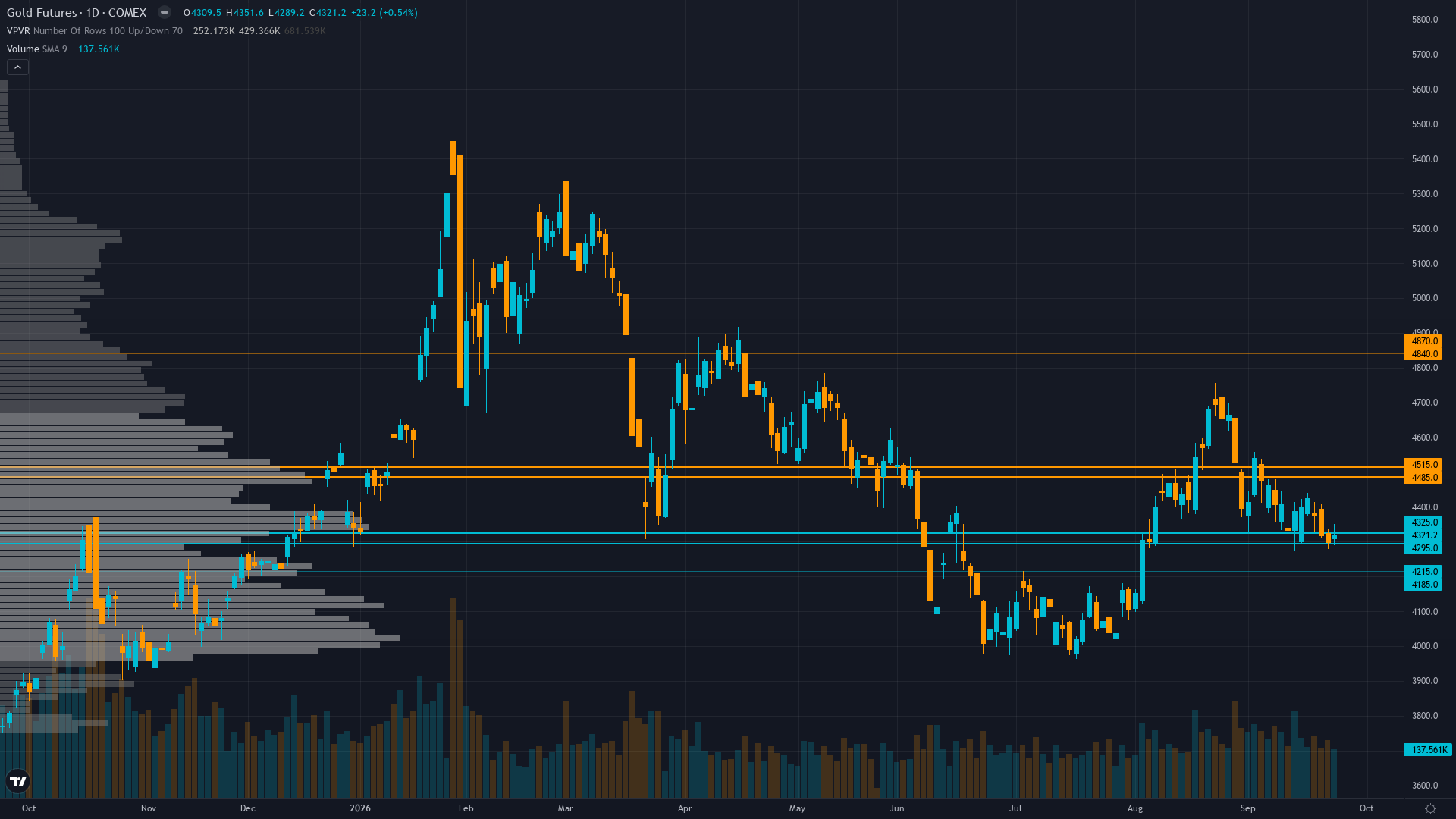
| BULLISH at 7/10 and gold erupted 6.7% from $4,380 to $4,674, its strongest weekly performance since the August 7 NFP shock. Trading Economics confirmed gold rose to $4,587 on August 21 with an 11% monthly gain. The central bank buying thesis and NFP regime change continue to power the recovery from July's $4,018 low. Three consecutive correct BULLISH calls. The desk's gold redemption arc, which I have been tracking since the nine-miss purgatory, is now a proper comeback story. | |||||||
|
EUR/USD
CORE
|
NO CALL | — | 1.1566 | 1.1689 | 1.06 | — | — |
| NO CALL for the twenty-third consecutive week, and the euro surged 1.06%, its largest weekly move in months. The pair's 22-week consolidation that the desk kept referencing as justification for silence appears to have finally resolved to the upside. At 23 weeks, this NO CALL streak is old enough to vote in some countries. A 1% move while the desk watches is, at this point, a tradition. | |||||||
|
Crude Oil
CORE
|
NO CALL | — | 82.4 | 86.66 | 5.17 | — | — |
| NO CALL at 5/10 and crude surged 5.17% as Hormuz uncertainty persisted and the desk wisely stayed on the sidelines after its mandatory miss reset. A 5% oil move on a NO CALL is the kind of miss that hurts, but given the desk's whipsaw history on crude since the Iran conflict began, the restraint was probably the correct procedural response. | |||||||
|
Nasdaq 100
CORE
|
NO CALL | — | 30141.75 | 29381.75 | -2.52 | — | — |
| NO CALL at 5/10 on a 2.52% decline. CNBC confirmed the Nasdaq lost 2% on the week, snapping a three-week winning streak. I have written approximately fifty paragraphs about the desk's NQ abstention habit since February. This week, sitting out a 2.5% decline was less painful than being BULLISH would have been. Small mercies. | |||||||
|
S&P 500
CORE
|
BULLISH | 6/10 | 7805 | 7691 | -1.46 | MISSED | D |
| BULLISH at 6/10 and the S&P fell 1.46% as 30-year Treasury yields at 25-year highs rattled the equity complex. CNBC confirmed the index tumbled 1.4% on the week, snapping three-week winning streaks. The desk's thesis about AI capex and VIX compression ran headlong into a bond market that demanded attention. A meaningful miss at moderate conviction. | |||||||
|
Silver
EXTENDED
|
BULLISH | 7/10 | 64.988 | 69.335 | 6.69 | CORRECT | A |
| BULLISH at 7/10, the desk's joint-highest conviction, and silver surged 6.69% continuing the NFP regime change thesis. The desk's identification of speculative positioning at the 18.4th percentile as providing massive upside fuel proved correct again. Two consecutive correct BULLISH calls on the regime change narrative. The metal that spent June and early July collapsing 48% from its January peak is mounting a genuine recovery. | |||||||
|
USD/JPY
EXTENDED
|
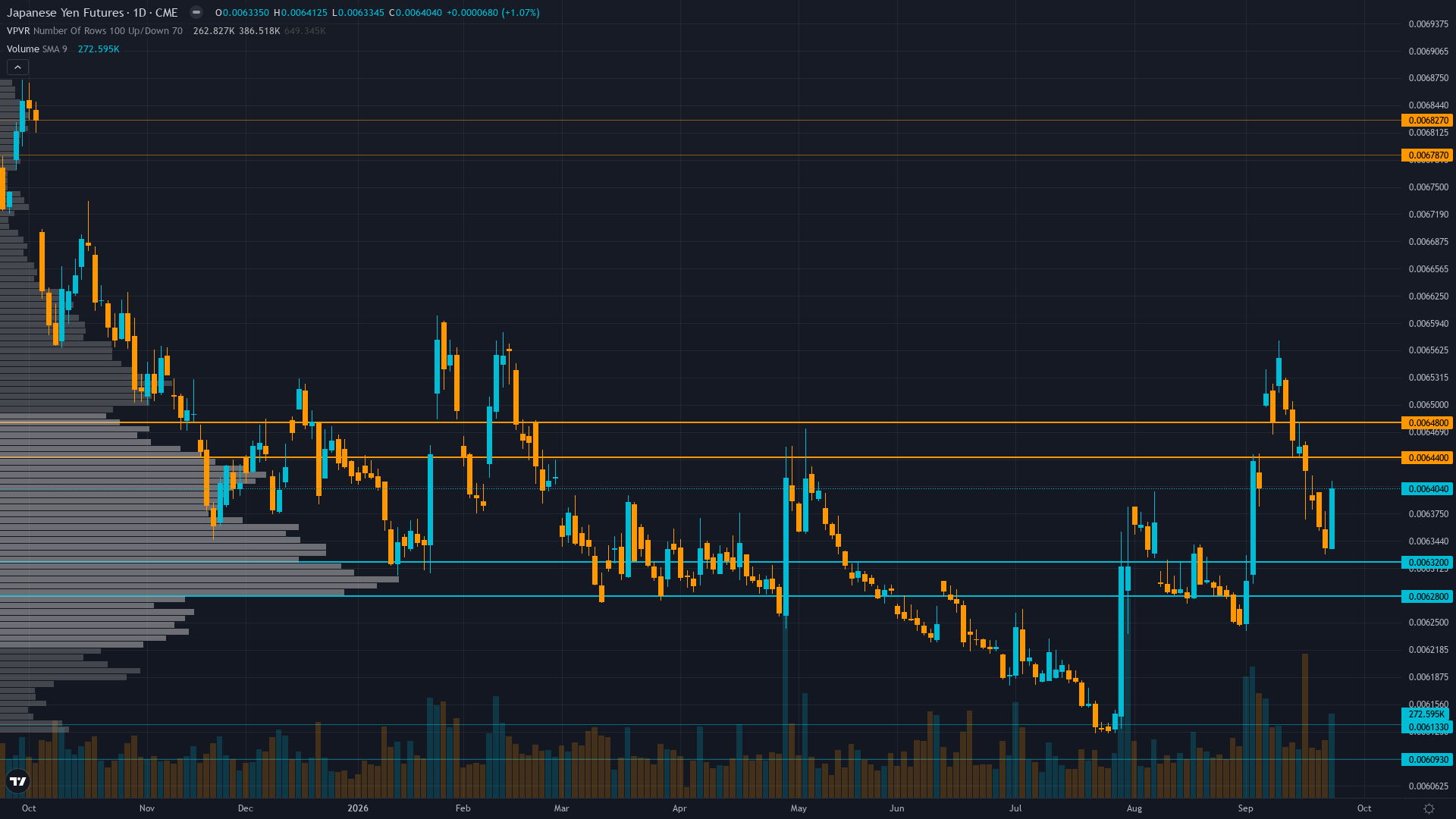
NO CALL | — | 0.0063 | 0.0063 | 0.01 | — | — |
| NO CALL for the twenty-third consecutive week, and the yen moved one basis point. The platonic ideal of a correct NO CALL. The desk and the yen have achieved a state of mutual indifference that transcends market analysis and enters the realm of philosophy. | |||||||
|
GBP/USD
EXTENDED
|
NO CALL | — | 1.3534 | 1.3648 | 0.84 | — | — |
| NO CALL for the twenty-third consecutive week, and sterling gained 84 pips. Above the noise threshold for cable, making this a miss by the scoring framework. The 23-week abstention streak has now lasted longer than most reality television romances and produced roughly the same amount of drama. | |||||||
|
Copper
EXTENDED
|
BULLISH | 6/10 | 6.5995 | 6.581 | -0.28 | MISSED | C |
| BULLISH at 6/10 and copper slipped 0.28%. The smallest possible direction miss, the market equivalent of disagreeing by clearing its throat. The extreme COT at 99.4th percentile that the desk flagged as contrarian risk proved not to be the dominant force, but neither did the supply deficit thesis produce upside. A tiny miss at moderate conviction. | |||||||
|
Russell 2000
EXTENDED
|
BULLISH | 6/10 | 3074.9 | 3022.2 | -1.71 | MISSED | D |
| This week's MOTW. BULLISH at 6/10 on the ATH breakout and speculative short squeeze thesis, and the Russell fell 1.71% as 30-year Treasury yields at 25-year highs overwhelmed the positioning setup. See the full deep-dive above. The free report is on the Ghost site. | |||||||
|
AUD/USD
FULL DESK
|
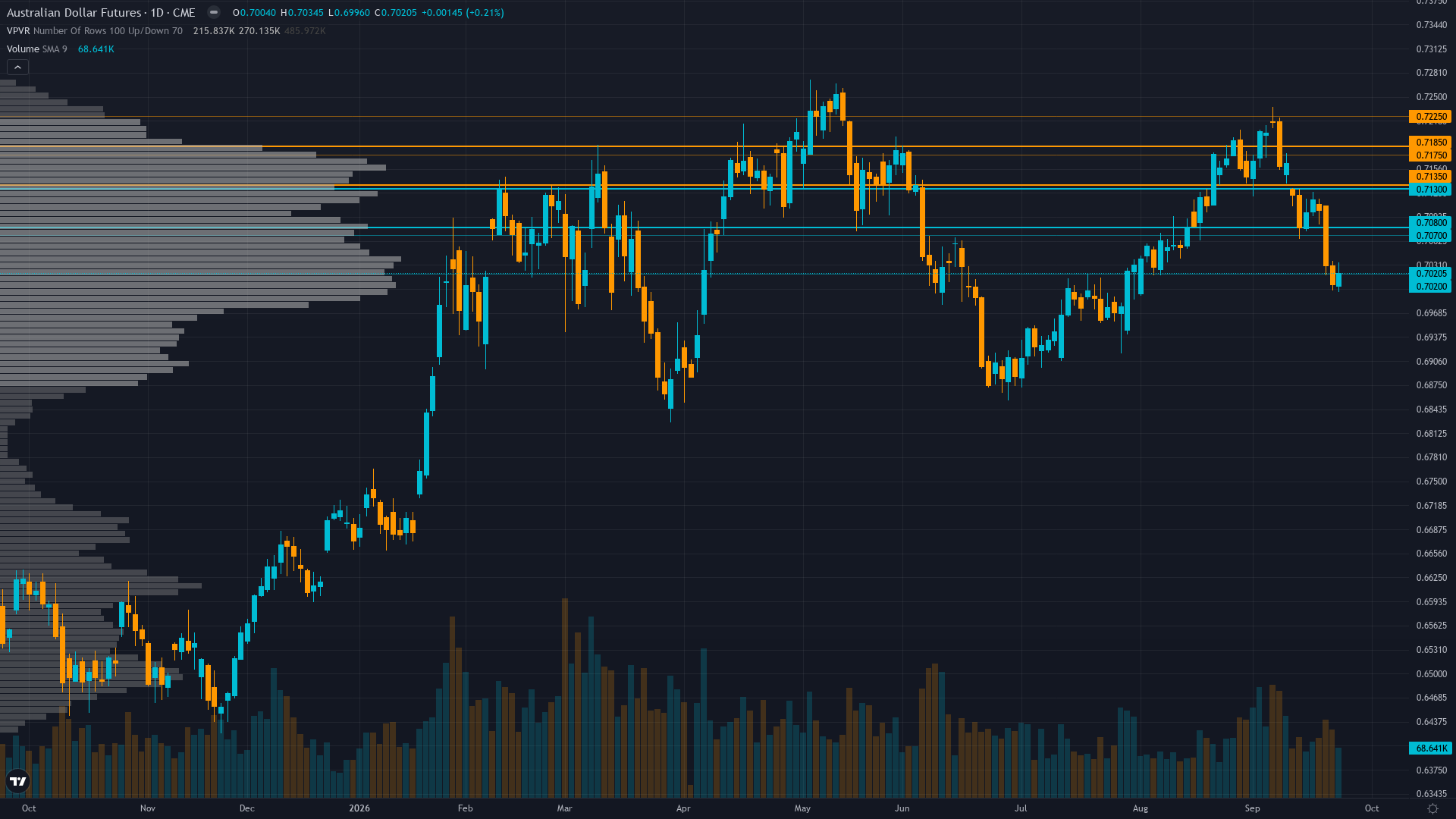
NO CALL | — | 0.7082 | 0.717 | 1.24 | — | — |
| NO CALL at 5/10 and the Aussie gained 1.24%, a meaningful FX move the desk missed. The RBA-Fed policy divergence that was once the desk's most reliable FX call continues to generate moves while the desk observes from behind the signal threshold barrier. | |||||||
|
30Y Treasury
FULL DESK
|
NO CALL | — | 108.84 | 108.94 | 0.09 | — | — |
| NO CALL at 4/10 on a 9 basis point gain. Bonds barely moved on a weekly basis despite 30-year yields hitting 25-year highs midweek, suggesting the week's intraday violence was more dramatic than the Monday-to-Friday candle reveals. A correct abstention, validated by the smallest move on the entire board. | |||||||
|
Wheat
FULL DESK
|
NO CALL | — | 674.75 | 700 | 3.74 | — | — |
| NO CALL per mandatory miss reset after four consecutive misses, and wheat rallied 3.74% toward the 700 cent level. The August WASDE production shock thesis that the desk has been tracking all year continues to drive prices higher while the desk sits behind its mandatory reset protocol. Another week of agricultural fireworks behind the NO CALL curtain. | |||||||
|
Soybeans
FULL DESK
|
NO CALL | — | 1191.25 | 1240.25 | 4.11 | — | — |
| NO CALL per mandatory miss reset after six consecutive misses, and soybeans surged 4.11%. The August WASDE yield cut and China's 80%+ export share continue to drive the fundamental bullish case while the desk remains procedurally locked out. A 4% agricultural move on a NO CALL is the kind of result that makes the reset protocol feel like a cage. | |||||||
|
Platinum
FULL DESK
|
BULLISH | 6/10 | 1750 | 1893.8 | 8.22 | CORRECT | A+ |
| BULLISH at 6/10 and platinum exploded 8.22% from $1,750 to $1,894, its best weekly performance of the year. The WPIC structural deficit thesis, which I described as 'the Fundamental agent's favourite bedtime story' during months of painful rejection, has found a macro environment willing to listen. After a 44% decline from January's peak, this is the week platinum finally fought back. Best call on the board. | |||||||
|
✦ Best Call: Platinum (PL)
BULLISH at 6/10 and platinum surged 8.22% from $1,750 to $1,893.80. After months of painful misses, mandatory resets, and a 44% decline from the January $2,925 peak that I documented with increasing editorial frustration, platinum has staged its most emphatic weekly rally of the year. The WPIC structural deficit thesis, which the Fundamental agent championed through every crushing week of rejection, finally found a macro environment willing to listen. The NFP regime change, cooling CPI, and weakening dollar removed the headwinds that had been suffocating the metal since March. When a 6/10 conviction call delivers 8.22%, the conviction should have been higher. But after what platinum has put the desk through this year, nobody is complaining about the calibration. |
⚠️ Worst Call: Russell 2000 (RTY)
BULLISH at 6/10 and the Russell fell 1.71% from its fresh all-time high. The textbook squeeze setup, with -42,304 speculative shorts at the 28.5th percentile building into strength, was overwhelmed by 30-year Treasury yields hitting 25-year highs. The MOTW deep-dive is above. When all six disciplines agree unanimously and the market drops nearly 2%, the framework has a regime-identification problem. Bond market stress trumped positioning dynamics, and the desk's equity side continues to struggle while its metals side prints money. |
The Fundamental agent had its best week of the summer across the precious metals complex. Its structural deficit thesis on gold (record central bank buying), silver (sixth consecutive year of shortfall at 67M oz), and platinum (fourth consecutive annual deficit per WPIC) all delivered gains exceeding 6%. After months of being correctly overridden during the bearish precious metals regime from March through July, then being vindicated on gold's 7.15% eruption three weeks ago, the Fundamental agent is now on a genuine run. Three consecutive correct precious metals calls is the kind of streak that suggests the NFP-driven macro regime change has durably shifted the environment in favour of supply-demand analysis.
The weakest collective performance came from the equity disciplines, where the Technical agent's ATH breakout thesis on RTY and the Economic agent's RISK-ON regime classification both failed to account for the 30-year Treasury yield hitting 25-year highs. I wrote last week that the Economic agent's framework was the 'most useful analytical lens in the post-Warsh regime.' This week, Treasury volatility proved that rate dynamics can override even the most supportive macro backdrop when yields move this aggressively. The Sentiment agent's greed reading on equities, which it treated as supportive rather than contrarian, also missed the mark.
The calendar intensifies into late August. Jackson Hole on August 27-29 is the week's defining event, with markets watching closely for any signal on the September FOMC trajectory following the NFP contraction that rewrote the rate outlook. Gold at $4,674 is pushing toward the $4,700 level with momentum, and whether precious metals can sustain this rally through Jackson Hole or exhaust themselves ahead of the event is the metals question of the month. The Russell's failed ATH breakout creates a genuine technical question about whether 3000 holds as support or gives way to a deeper correction toward 2900. NVIDIA earnings on August 26 provide the binary catalyst for the AI capex thesis that underpins the entire tech complex. The desk will have its Sunday views. Given what happened to equities this week, I expect either reduced equity conviction or some serious recalibration of the bond yield transmission mechanism.