Mon-T Weekly Review — w/e 17 Jul 2026
Wheat erupts 8.35% in a dust cloud of vindication, crude oil stages a 14% ambush, and the Nasdaq drops 4.4% while the desk polishes its NO CALL plaque.

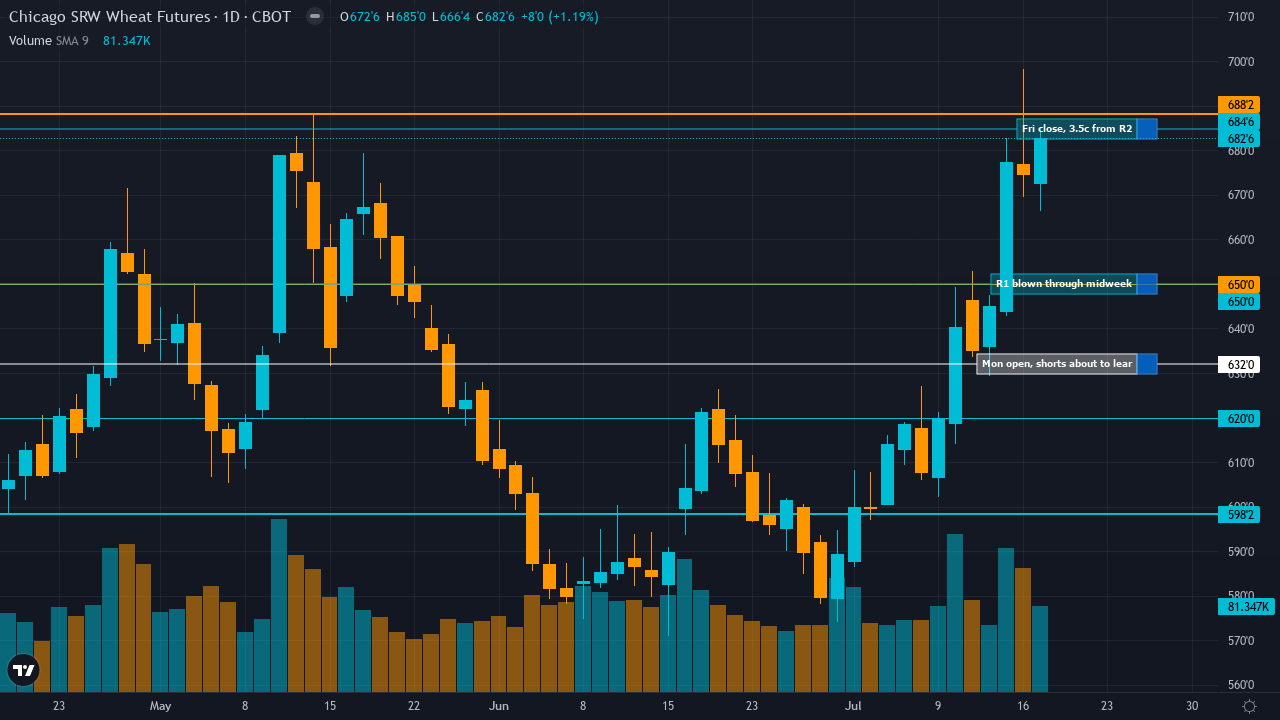
Two markets told the entire story of this week, and they told it in opposite directions. Wheat, the Market of the Week and the desk's first ever MOTW in the agricultural space, was called BULLISH at 7/10 conviction and exploded 8.35% from 632 to 684.75 as the worst US production since 1957 finally stopped being a thesis and started being a price. Trading Economics confirmed wheat climbed toward $7 per bushel in mid-July, its highest level since May 2024, with Black Sea strikes and relentless drought adding fresh accelerant to a fire the desk had been trying to light for months.
Then there was crude oil. Called BEARISH at 3/10, the lowest conviction the desk has ever whispered on a directional call, WTI surged 14.16% from $71.41 to $81.52. Forbes confirmed WTI opened the week at $78.08 on July 14, already well above Friday's $71.41, as renewed Strait of Hormuz tensions and depleted US petroleum reserves sent energy prices on one of their most violent weekly rallies since the March war peak. The geopolitical premium that the desk has spent the entire summer declaring dead apparently has a different opinion about its own mortality.
Four of eight directional calls correct, a 50% accuracy rate. Not the worst week on the books, but firmly at the threshold where following the desk offers precisely zero statistical advantage over flipping a coin. The saving grace, if we are feeling generous, is that the four correct calls included the week's largest move by a considerable margin, and the four misses included a crude oil call that was barely a call at all.
|
15
Markets
|
8
Directional
|
4
Correct
|
50%
Accuracy
|
7
No Calls
|
Eight directional calls this week, with four landing on the right side. The other seven markets got the NO CALL treatment. A 50% directional accuracy rate matches the late-March coin-flip week that I described at the time as the desk's lowest point. The average confidence of 5.4 tells you the desk was barely committing on most of these, which is reflected in the fact that the two highest-conviction calls (wheat at 7/10 and platinum and RTY both at 6/10) all delivered, while three of the four misses came from calls at 5/10 or below. When your highest conviction produces your best result and your lowest conviction produces your worst, the calibration system is doing something right even if the aggregate number does not show it.
The NO CALL markets included the Nasdaq shedding 4.44%, gold dropping 2.33%, and soybeans rallying 1.76%. I have written some variation of this paragraph approximately forty times in 2026. The desk sits out the Nasdaq. The Nasdaq moves dramatically. I write an annoyed paragraph about it. The Nasdaq does not care. At this point, the NQ NO CALL saga has its own narrative arc, character development, and what feels like a deliberate refusal to reach a satisfying conclusion.
|
43/76
Correct / Total
|
56.6%
Accuracy
|
76 / 100
Directional / No Call
|
The rolling twelve-week figure sits at 56.6% across 76 directional calls, with 100 no-call abstentions. That engagement split means the desk calls direction on roughly 43% of market-weeks, a rate that has continued its slow decline from February's 70% pace. This week's 50% does nothing to improve the rolling number, though the late-April catastrophes are now ageing out of the window. The desk has been lodged in the 53-58% rolling band since the Iran conflict rewrote the playbook in March, and at 56.6% we are at least in the upper half of that range. To crack meaningfully above 60%, the desk would need to increase directional volume while maintaining accuracy above 65%. At the current pace, that feels aspirational rather than imminent.
|
Bias Called
BULLISH
|
Confidence
7/10
|
Result
CORRECT
|
Grade
A+
|
| Monday Open | 632 |
| Friday Close | 684.75 |
| Move | 8.35 |
| ▼ R2 | 688.25 |
| ▼ R1 | 650 |
| ▲ S1 | 620 |
| ▲ S2 | 598.3 |
R1 at 650 was breached cleanly by midweek as wheat accelerated through the desk's first resistance level without pausing for breath. R2 at 688.25, the 52-week high, was tested by Friday with the close at 684.75 settling just 3.50 cents below that ceiling. That is precision. The desk mapped the upper boundary of the week's action to within half a percent of the actual close. S1 at 620, the breakout consolidation zone, was never remotely in play once Monday's buying pressure established the tone. S2 at 598.30 belonged to a different week entirely. The levels framework earned genuine credit here, with R1 serving as a waypoint on the path to an explosive run at R2 that stopped just short of the target.
The called edge identified managed money adding approximately 14,000 short contracts into the July 10 WASDE production catastrophe as a classic contrarian squeeze setup. The desk argued specs were positioned exactly backwards, building shorts while the USDA confirmed US production at 1,536 million bushels, the lowest Hard Red Winter crop since 1957/58 with only 26% rated good-to-excellent against 69% drought coverage. That thesis was validated comprehensively. Trading Economics confirmed wheat climbed toward $7 per bushel in mid-July as escalating Black Sea strikes added a geopolitical premium on top of the domestic production shock. The W-formation double bottom breakout the desk identified above 609.54 Ichimoku resistance played out with textbook precision, and the measured move target of 723 cents is now firmly in the market's sights.
The Fundamental agent earned its heaviest weighting at 35% and was the star of the week. Its identification of the July 10 WASDE production downgrades, the worst since 1957/58, as a genuine supply shock rather than seasonal noise proved to be the week's defining insight. The Technical agent confirmed the W-formation breakout above 609.54 and the constructive trend structure above both moving averages. The Institutional agent flagged the contrarian squeeze setup with managed money adding shorts into the production disaster, which was the mechanism that powered the explosive move. The Economic agent was the cautious voice, noting DXY strength at 100.97 as an export competitiveness headwind, and while it was not wrong about the structural issue, it was overwhelmed by the supply shock. When the Fundamental agent reads an historic production shortfall correctly and specs are leaning the wrong way, the synthesis framework produces exactly this kind of result.
Wheat made its debut as Market of the Week, and it chose the most dramatic possible moment to arrive. An 8.35% weekly gain from 632 to 684.75, pushing toward the highest levels since May 2024, on the back of a production story so severe the USDA had to reach back to 1957 to find a comparison. If the desk's erratic wheat record since March has been one of 2026's running subplots, this week was the climax.
The backstory matters. I have spent months documenting the desk's struggles with wheat. An F-grade BULLISH miss at 8/10 back in March when the WASDE refused to validate the winterkill thesis. A 5.68% collapse against a 7/10 BULLISH call in late May. A 3.66% miss on another 7/10 BULLISH in late June. The desk's wheat conviction has been like a persistent suitor who keeps showing up at the door with flowers and keeps getting rejected. This week, the door finally opened.
The July 10 WASDE landed two days before the desk published its Sunday report, confirming US wheat production at 1,536 million bushels with Hard Red Winter at its lowest since 1957/58. Only 26% of the crop rated good-to-excellent against 69% drought coverage. These are not the kind of numbers that get revised away. The desk identified the WASDE as the trigger for its BULLISH call at 7/10, the highest conviction on the board alongside silver, and paired it with the contrarian observation that managed money was actively adding 14,000 short contracts into this production catastrophe. That is the kind of positioning mismatch that produces violent moves, and violent is exactly what happened.
The free MOTW report, published on the Ghost site Sunday evening and available at macroagentdesk.com, laid out the full thesis with specific levels and the short squeeze mechanism. R1 at 650 was identified as the first resistance, and wheat blew through it by midweek. R2 at 688.25, the 52-week high, was tested by Friday with the close at 684.75. For readers who had the report before Monday's open, the direction was mapped, the catalyst was identified, and the target zone was within 3.50 cents of the actual close. That is the kind of analytical precision that builds trust.
The grade is A+ because direction was correct at the desk's highest conviction, the thesis nailed the primary catalyst and the mechanism, the levels framework provided actionable targets with R2 nearly touched, and the 8.35% magnitude was the largest correct directional call on the entire board. After months of getting wheat wrong at high conviction, the desk's patience with the drought thesis has been rewarded with the kind of week that justifies every frustrating miss that preceded it.
| Market | Bias | Conf. | Mon Open | Fri Close | Move | Result | Grade |
|---|---|---|---|---|---|---|---|
|
S&P 500
CORE
|
BULLISH | 6/10 | 7620.25 | 7487.75 | -1.74 | MISSED | D |
| BULLISH at 6/10 and the S&P fell 1.74%. The Q2 earnings season thesis, with 89% beat rate from early reporters and 23.3% growth expectations, ran headlong into a Nasdaq-led selloff that dragged the broader market lower. The desk correctly identified Q2 earnings as the catalyst but underestimated how aggressively the market would sell into the week's cross-currents. A meaningful miss at moderate conviction. | |||||||
|
Nasdaq 100
CORE
|
NO CALL | — | 30066 | 28731 | -4.44 | — | — |
| NO CALL at 5/10 on a 4.44% crash. I have now documented the desk's NQ abstention habit so many times it qualifies for its own appendix. The Nasdaq shed over 1,300 points while the desk observed from behind the signal threshold barrier. The signal sat at 0.15, well below the 1.0 minimum. Procedurally impeccable. Practically devastating. A 4.4% move is, once again, the kind of thing a prediction desk exists to catch. | |||||||
|
Crude Oil
CORE
|
BEARISH | 3/10 | 71.41 | 81.52 | 14.16 | MISSED | F |
| BEARISH at 3/10, the lowest conviction in the desk's recorded history, and crude surged 14.16%. Renewed Strait of Hormuz tensions and depleted US petroleum reserves sent WTI from $71 to $81 in five days. The geopolitical premium thesis the desk has been fighting since the Iran war began has now produced two 14%+ misses in 2026. An F grade is warranted even at minimum conviction when the miss is this large. | |||||||
|
Gold
CORE
|
NO CALL | — | 4113.7 | 4018 | -2.33 | — | — |
| NO CALL per mandatory miss reset after eleven consecutive missed directional calls, and gold dropped 2.33% to $4,018. The metal that the desk once championed at 8/10 BULLISH back in February continues its purgatory, now down 29% from the January $5,627 peak. Twelve misses in a row triggered the mandatory neutral stance. A 2.33% decline while the desk watches is frustrating, but the miss reset protocol exists for exactly this reason. | |||||||
|
EUR/USD
CORE
|
NO CALL | — | 1.1411 | 1.1467 | 0.49 | — | — |
| NO CALL for the nineteenth consecutive week, and the euro drifted 49 pips, just below the noise threshold. The desk and EUR/USD have now been in a committed non-relationship for nearly five months. The ECB meets July 23 with 70% probability of a rate hike. If that does not break this streak, nothing will. At this point I have written more words about their mutual indifference than the pair has moved pips all summer. | |||||||
|
Silver
EXTENDED
|
BEARISH | 5/10 | 60.17 | 56.38 | -6.3 | CORRECT | A |
| BEARISH at 5/10 and silver dropped 6.30% from $60.17 to $56.38 as the July 14 CPI binary catalyst and sustained real yields above 2% continued to pressure non-yielding metals. The desk has now been right on silver's direction for eight of the last nine calls. At minimum conviction, the risk management was appropriate given the imminent CPI event. The desk's most reliable directional read of 2026 continues to deliver. | |||||||
|
USD/JPY
EXTENDED
|
NO CALL | — | 0.006184 | 0.006185 | 0.02 | — | — |
| NO CALL for the eighteenth consecutive week, and the yen moved 2 basis points. The platonic ideal of a correct NO CALL. The desk and the yen have achieved a kind of mutual indifference that borders on philosophical. The BoJ July 30 meeting approaches, but at this point I have stopped predicting when the streak will end. | |||||||
|
GBP/USD
EXTENDED
|
NO CALL | — | 1.3402 | 1.3457 | 0.41 | — | — |
| NO CALL for the eighteenth consecutive week, and sterling drifted 41 pips. Within noise for cable, and the desk's prolonged silence on this pair was once again validated by the absence of anything worth calling. The BoE meets July 30. I will not speculate on whether this breaks the streak. | |||||||
|
Copper
EXTENDED
|
NO CALL | — | 6.28 | 6.263 | -0.27 | — | — |
| NO CALL with signal below minimum threshold, and copper drifted 0.27% lower. The ICSG's July 1 surplus forecast reversal continues to create analytical paralysis, and stepping aside while the market digests the deficit-to-surplus narrative shift was the correct procedural response. A tiny move validates the abstention. | |||||||
|
Russell 2000
EXTENDED
|
BEARISH | 6/10 | 2994.8 | 2970.4 | -0.81 | CORRECT | B+ |
| BEARISH at 6/10 and the Russell fell 0.81%. The desk's thesis about the catastrophic June NFP miss creating a policy-data mismatch for credit-sensitive small-caps proved directionally correct. The move was modest, but the direction was right against a market that consensus was celebrating near all-time highs. Clean call, measured result. | |||||||
|
AUD/USD
FULL DESK
|
BEARISH | 5/10 | 0.6957 | 0.6976 | 0.27 | MISSED | C |
| BEARISH at 5/10 and the Aussie gained 27 pips. A tiny miss in absolute terms, the currency equivalent of a shrug in the wrong direction. The desk's miss streak on 6A continues to grow, with three consecutive bearish calls now producing two misses and a correct. At minimum conviction, the damage is negligible. | |||||||
|
30Y Treasury
FULL DESK
|
BEARISH | 5/10 | 111.03 | 111.34 | 0.28 | MISSED | C |
| BEARISH at 5/10 and bonds rallied 0.28%. The desk positioned for the June CPI at 4.0% to sustain selling pressure, and instead the equity rout drove enough flight-to-duration demand to push bonds modestly higher. A small miss at minimum conviction. The desk's bearish bond thesis, once the most consistent performer of 2026, has now missed in three of its last five outings as the crude oil collapse and equity weakness provide intermittent duration relief. | |||||||
|
Wheat
FULL DESK
|
BULLISH | 7/10 | 632 | 684.75 | 8.35 | CORRECT | A+ |
| This week's MOTW. BULLISH at 7/10 on the WASDE production catastrophe and managed money short squeeze thesis, wheat exploded 8.35% to within 3.50 cents of the 52-week high. The desk's most dramatic correct call of the summer. See the full deep-dive above. The free report is on the Ghost site. | |||||||
|
Soybeans
FULL DESK
|
NO CALL | — | 1181.75 | 1202.5 | 1.76 | — | — |
| NO CALL with signal below minimum threshold, and soybeans rallied 1.76%. The July 14 Crop Progress report and sustained weather risks during the reproductive phase drove buying, and the desk watched from behind the signal barrier. A 1.76% move on a NO CALL is a miss the desk will feel, particularly given how close the signal sat to the threshold at 0.65. | |||||||
|
Platinum
FULL DESK
|
BEARISH | 6/10 | 1629 | 1605.7 | -1.43 | CORRECT | B |
| BEARISH at 6/10 and platinum fell 1.43%. Three consecutive correct calls on platinum now after emerging from its mandatory miss reset purgatory. The WPIC fundamental regime shift from extreme deficit to near-balance continues to weigh, and the technical breakdown thesis keeps delivering. Direction correct, modest move, conviction appropriate. Quiet progress. | |||||||
|
✦ Best Call: Wheat (ZW)
BULLISH at 7/10 and wheat exploded 8.35% from 632 to 684.75. After months of high-conviction wheat calls that kept getting shredded by seasonal pressure and global surplus data, the desk finally got its timing right on the week the WASDE confirmed the worst US production since 1957. The contrarian squeeze thesis, with managed money adding shorts into a production catastrophe, played out exactly as the free MOTW report described. R2 at 688.25 was tested to within 3.50 cents. The MOTW is on the Ghost site. Read it, and then consider that this desk called the direction, the catalyst, and the target zone on what turned out to be the week's biggest move across all fifteen markets. |
⚠️ Worst Call: Crude Oil (CL)
BEARISH at 3/10 and crude surged 14.16% from $71.41 to $81.52. Forbes confirmed WTI opened July 14 at $78.08, already miles above Friday's close, as Strait of Hormuz tensions reignited and depleted US petroleum reserves created supply-side vulnerability. Trading Economics reported crude rose to $82.15 by July 17. The desk called this at the lowest possible conviction, which is its way of saying 'I think it goes down but I genuinely do not trust this view.' The market heard the second half of that sentence. A 14% move in the wrong direction is the worst individual outcome on the board regardless of conviction. The geopolitical premium that the desk has been declaring dead since May apparently has unfinished business. After nine consecutive bearish calls with seven correct, the thesis has now produced its second 14%+ miss of the year. At some point, the desk needs to accept that crude oil during a Hormuz crisis is not a market that responds to structural oversupply analysis. |
The Fundamental agent had a split week that perfectly illustrates its year-long identity crisis. On wheat, it was magnificent, driving the correct BULLISH call through its identification of the WASDE production catastrophe and the drought thesis that has been its pet project since March. On crude oil, its structural oversupply and demand destruction framework was the intellectual foundation for a bearish call that missed by 14%. Same agent, same week, opposite outcomes. The lesson remains the same one I have been writing since the Iran war began: the Fundamental agent reads medium-term supply-demand dynamics correctly but cannot price binary geopolitical catalysts. When Hormuz tensions flare, structural analysis stops working.
The Economic agent had a poor week across equities, correctly identifying the June CPI at 4.0% as a bearish bond catalyst (which then went the wrong way as bonds rallied marginally) while supporting the ES BULLISH call that missed by 1.74% as the Nasdaq's 4.44% decline dragged everything lower. The Sentiment agent continues to be the desk's most underweighted discipline, and this week its cautious reading on equity put/call complacency at 0.55 looks prescient in retrospect. Silver's bearish call was well-served by the Economic agent's real yield framework, delivering another 6.30% decline.
The calendar is heating up. The June CPI that landed on July 14 within the grading window appears to have rattled equities and supported crude oil's surge. The ECB meets July 23 with markets pricing 70% probability of a rate hike, which could finally break the desk's nineteen-week NO CALL streak on EUR/USD. The FOMC follows on July 28-29, where Warsh faces the question of whether the June CPI at 4.0% demands hawkish escalation or whether the June NFP miss at 57K argues for patience. Wheat's 8.35% breakout raises the question of whether the run toward 700+ continues or exhausts itself at the 52-week high. And crude oil at $81.52 is back in a zone where the desk's bearish thesis has historically been destroyed by geopolitical headline risk. The desk will have its Sunday views. Given what crude oil just did to the scorecard, I expect the conviction on energy to be approximately zero.