Russell 2000 Key Levels This Week — Support, Resistance & Confluence Zones
Russell 2000 key levels breakdown: support zones, resistance zones, confluence and price structure.

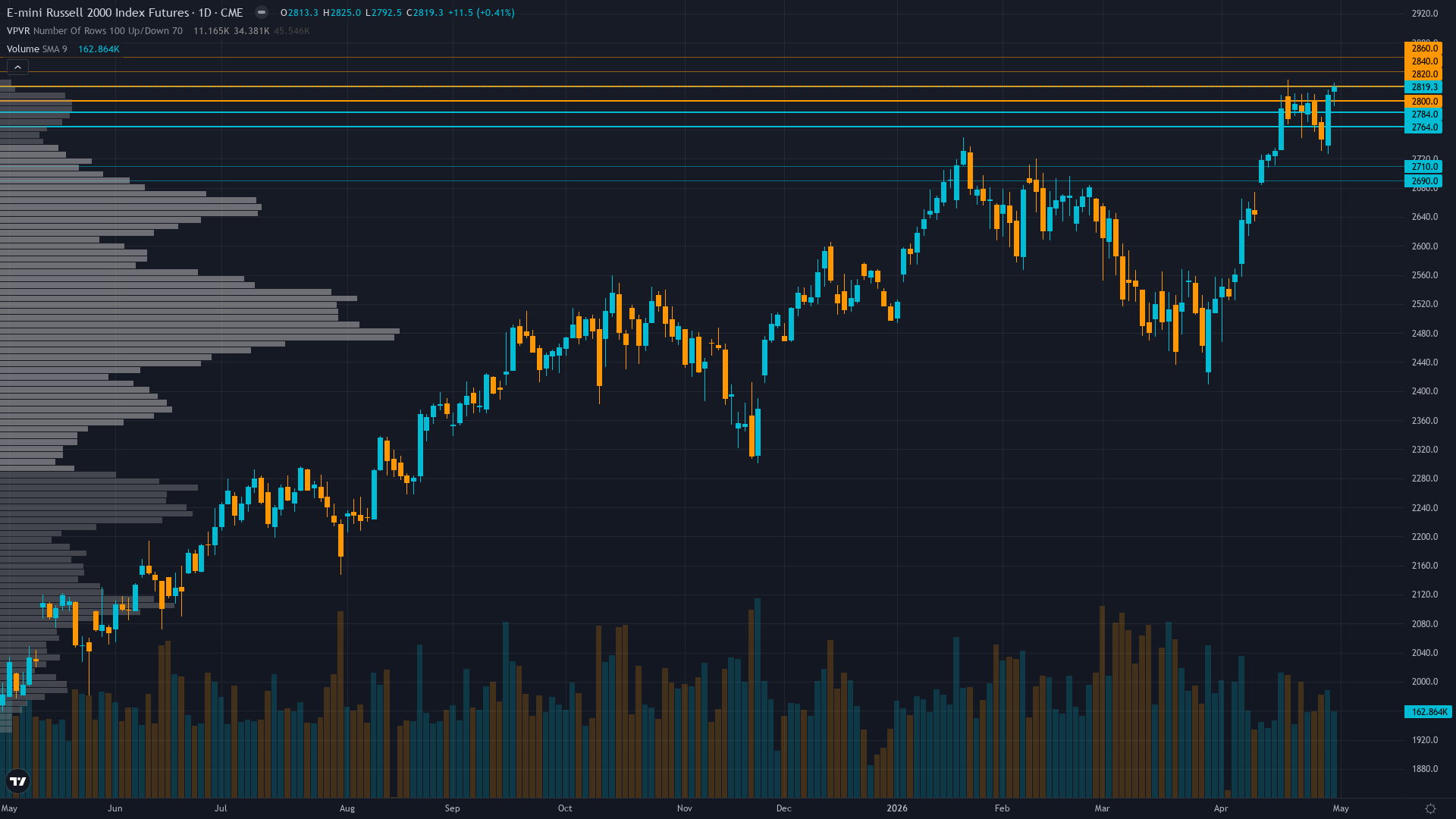
Current Price Structure
Russell 2000 holds at 2743.3, up a marginal 0.41% as the market grinds forward. Russell 2000 futures is range-bound and tightening, with decreasing volatility signalling a directional resolution ahead.
Price at 2743 trading 1.6% below April 17 ATH of 2797 but Technical agent showing BEARISH signal with downtrend below MAs—severe data inconsistency suggesting futures vs cash divergence
With trend strength at 6/10, there's a clear directional tilt but room for the move to develop further.
Support Zone Context
Below the current level, small-cap futures has structural support where demand has historically stepped in. The reliability of these zones depends on the volume profile and the number of prior interactions.
In the current consolidating environment, support zones carry standard probability of reaction.
Ceilings & Supply Zones
Above current price, Russell 2000 futures faces resistance zones where selling pressure has historically intensified. These levels represent previous supply zones, profit-taking areas, or structural barriers that price needs to overcome for continuation.
How firmly these zones hold depends on the confluence of volume, prior reactions, and the current market regime.
Where Disciplines Converge
For small-cap futures, the levels that matter most are those confirmed by independent analytical approaches. When six different disciplines identify the same zone, the signal-to-noise ratio improves dramatically.
Normal volatility regime at 52nd percentile supports standard risk management with 2-3% stops below 2650 support, expect 40-60 point daily ranges versus 60-100 during March correction, stable pattern suggests range-bound environment until FOMC catalyst
How Macro Agent Desk Identifies Key Levels
Macro Agent Desk identifies key levels through a six-agent process. Each analytical discipline contributes independently — technical for structure, institutional for smart money interest, options for hedging activity, fundamentals for fair value context, sentiment for crowd positioning, and economics for catalyst timing.
What this means in practice: every key level in the full weekly report has been stress-tested across multiple independent analytical frameworks before it reaches the page.
Our paid reports include specific support and resistance levels identified by six specialist agents — technical structure, institutional positioning, options flow, fundamentals, sentiment, and economic analysis. Not just lines on a chart, but zones validated by multi-discipline confluence.
Start Free — Get the Market of the WeekFree weekly report · No credit card · Upgrade anytime