Russell 2000 Forecast This Week — Outlook, Drivers & Key Levels
This week's Russell 2000 outlook: key drivers, volatility context, risk-opportunity assessment and the week ahead.

This Week's Starting Point
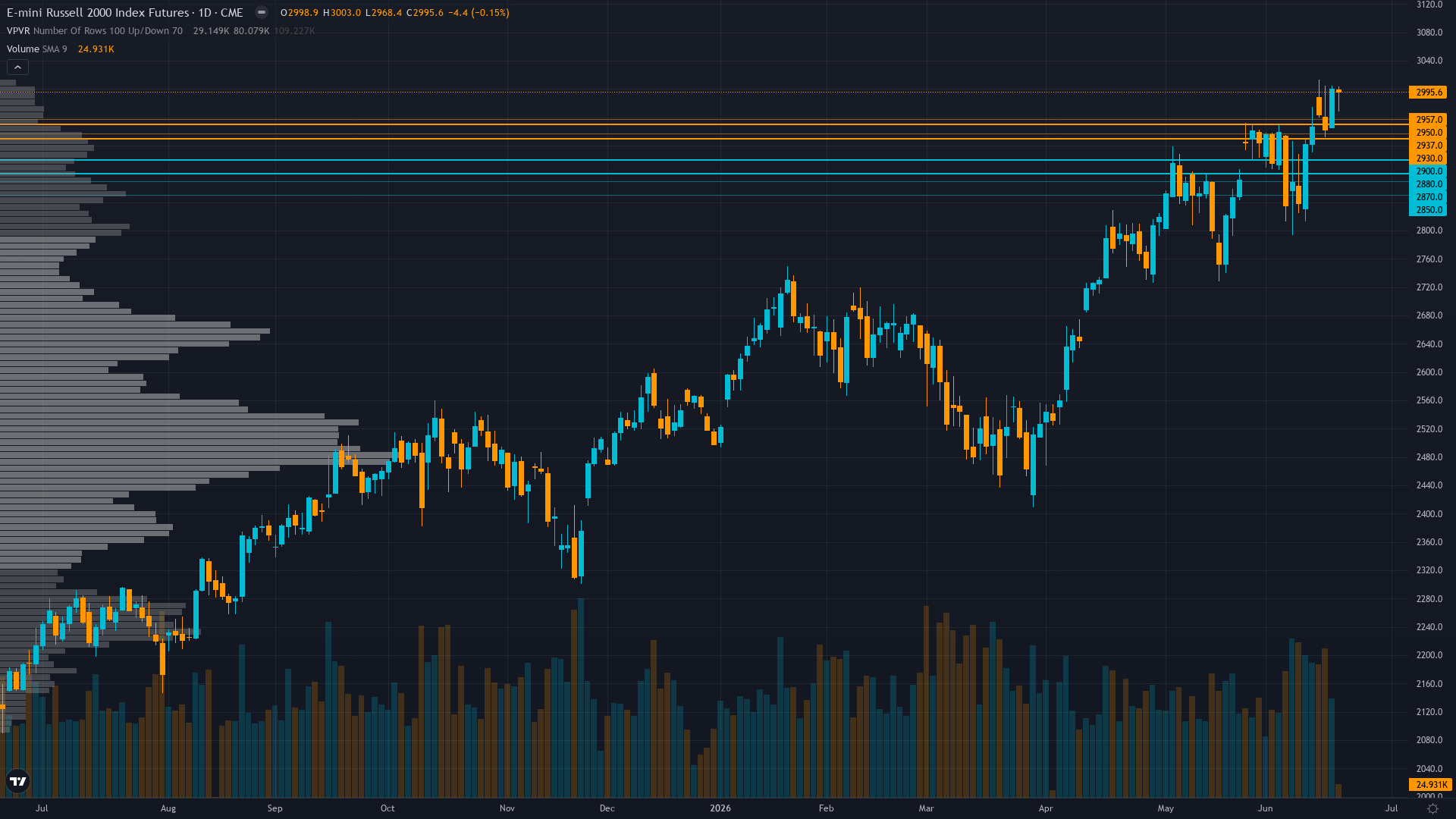
At 2995.6, Russell 2000 has eased 0.15% in a controlled retreat. Price action in Russell 2000 futures has compressed into a consolidation pattern, typically a precursor to a directional breakout.
Small-caps consolidating near June 15 all-time high at 3002 with market positioned for June 26 Russell reconstitution to provide technical support through forced passive rebalancing flows, though June 17 Fed hawkish pivot removing easing narrative creates fresh uncertainty
Forces in Play
Primary driver: Post-input development identified: Fed Chair Kevin Warsh's June 17 FOMC meeting delivered hawkish pivot removing forward guidance language, with dot plot shift showing 9 of 18 officials now pointing toward potential 2026 rate hike versus only 1 seeing cut, materially changing policy trajectory for rate-sensitive small-caps
Secondary factor: Russell reconstitution June 26 (5 days away) entering final critical window with $11 trillion benchmarked to Russell indices creating massive forced asset flows, though hawkish Fed surprise on June 17 has dampened reconstitution tailwind with RTY +2.12% on June 18 rally now fading
Additional influence: Severe discipline conflict emerging with Technical (-2, conf 6) showing BEARISH downtrend contradicting current price near 3000 all-time high zone, while Economic (1.5, conf 6) turns BULLISH on strong NFP but Fundamental (0.5, conf 4) warns elevated 25.39x P/E vulnerable to 40%+ earnings bar delivery risk
Economic backdrop: RISK-ON macro regime with VIX 16.78 below 20 threshold, but Fed Chair Warsh's June 17 hawkish pivot removing dovish forward guidance and shifting dot plot to show 9 of 18 officials expecting 2026 rate hike creates fresh headwind for credit-sensitive small-caps carrying higher floating-rate debt exposure than large-caps
Fundamental assessment: Q1 2026 earnings delivered 44.9% YoY growth providing validation, but forward P/E at 25.39x versus 13.62-17.34x historical range creates acute vulnerability if Q2 results disappoint elevated bar, with no fresh fundamental catalyst this week beyond reconstitution flows in 5 days
Technical Landscape
Price at 2995 consolidating 0.2% below June 15 all-time high of 3002 but Technical agent shows contradictory BEARISH signal citing downtrend below 50/200-day MAs at 2492/2564—severe data inconsistency likely reflecting futures vs cash index pricing lag, actual structure constructive near record levels
Trend strength registers at 6/10, suggesting meaningful but not extreme directional bias.
Risk-Reward Assessment
Primary risk: Fed Chair Warsh's June 17 hawkish pivot with dot plot showing 9 of 18 officials expecting 2026 rate hike removes small-cap easing narrative just as reconstitution approaches, creating risk that forced flows on June 26 prove insufficient to offset tightening financial conditions for credit-sensitive Russell 2000 constituents carrying 1.5x debt-to-equity versus 0.8x large-caps (Probability: medium)
Primary opportunity: Reconstitution-driven technical rally as $11 trillion in passive benchmarked capital executes forced rebalancing into June 26 effective date, targeting breakout above 3002-3010 resistance toward 3050-3100 measured extension if mechanical flows override June 17 hawkish Fed concerns and current consolidation validates support (Timeframe: 5 days through June 26 reconstitution effective date)
This week's edge: Market consensus celebrating June 15 ATH and focusing on reconstitution flows may be underpricing the significance of June 17 Fed hawkish pivot (9 of 18 officials expecting 2026 hike versus 1 expecting cut) for credit-sensitive small-caps, while desk sees tactical tension between mechanical reconstitution support and fundamental repricing of tightening financial conditions requiring reduced conviction at 5
Risk Environment
With vol at the 45th percentile over 90 days, RTY futures is in a measured regime that doesn't require unusual adjustments. Volatility is stable, with realised vol holding steady across timeframes. This equilibrium can persist but eventually resolves into expansion or contraction.
Normal volatility regime at 45th percentile supports standard risk management with 2-3% stops below 2860 support, expect 30-50 point daily ranges versus 60-100 during elevated volatility periods, stable pattern suggests consolidation environment until June 26 reconstitution catalyst provides directional clarity with recent narrow ranges confirming compression
Seasonal Context
Historically, June 2026 has been a headwind for small-cap futures, with seasonal data showing a 42% win rate. Summer doldrums typically hit small-caps harder.
Week Ahead Outlook
The next major catalyst is Russell 2000 annual reconstitution takes effect after market close June 26 with final preliminary list update June 18 already passed, creating estimated $11 trillion in forced passive fund rebalancing flows as index tracking funds execute mandatory portfolio adjustments on Friday 26 June — a high-impact event that could materially shift the directional picture.
For Russell 2000, the balance between existing momentum and scheduled risk events sets the stage for the week ahead.
This analysis covers one dimension. Our full weekly report combines six specialist agents into a single actionable briefing with directional bias, key levels, and risk-opportunity matrix.
Start Free — Get the Market of the WeekFree weekly report · No credit card · Upgrade anytime