Russell 2000 COT & Institutional Positioning — Smart Money Analysis
Russell 2000 institutional positioning: COT data, sentiment analysis and smart money flow assessment.

The Institutional Landscape
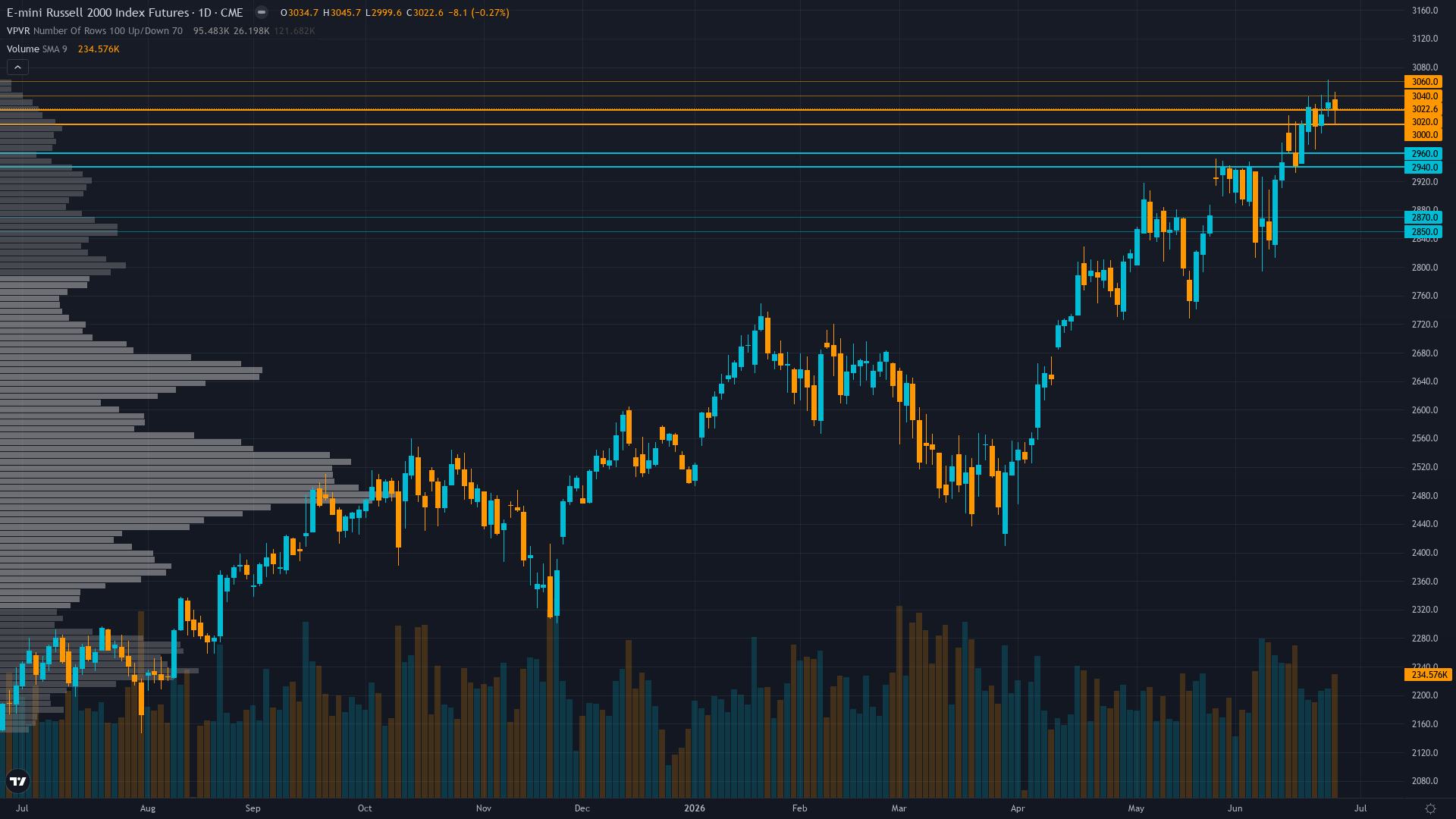
At 2999.9, Russell 2000 has eased 0.03% in a controlled retreat.
Reconstitution flows completed June 26 after market close with estimated $11 trillion in forced passive rebalancing now exhausted, while persistent IWM outflows of -4.15B over trailing year show institutional caution despite price resilience near record highs, stale COT data limits real-time smart money visibility
Market Consensus vs Our Analysis
Market consensus: Small-caps consolidating near June 25 all-time high at 3,040 after Russell reconstitution completion June 26, market positioned for July 1 ISM Manufacturing data and mid-July Q2 earnings season to provide validation catalyst with Wall Street banks backing small-cap rotation narrative per recent Traders Union reporting
Primary driver: Russell reconstitution executed June 26 (2 days ago) completing the single largest annual institutional flow event with mechanical buying pressure now exhausted, while price consolidates 1.3% below June 25 all-time high of 3,040.1 creating post-catalyst directional uncertainty
Contrarian Assessment
Desk mildly bullish at conviction 5 on six-discipline agreement while acknowledging reconstitution exhaustion and Fed pivot uncertainty broadly aligns with market's mixed positioning (Fear & Greed 25 Fear, put/call 0.67 complacent, Wall Street banks backing small-cap rotation per Traders Union), creating low divergence as both desk and consensus recognize post-catalyst consolidation environment requiring patience for fresh catalyst before conviction increases
Sentiment & Positioning
Sentiment around Russell 2000 futures is neutral, with no extreme positioning on either side. This balanced state often resolves when a catalyst breaks the equilibrium.
Options Market Signal
VIX at 18.41 near 52-week low of 13.38 signals complacency, equity put/call at 0.67 showing only 0.67 puts per call traded indicates minimal defensive hedging despite consolidation near all-time highs creating latent reversal risk but also confirming bullish positioning without panic protection
Putting It Together
In summary, the positioning picture for Russell 2000 reflects fear conviction levels set against a consolidating market backdrop. Trend strength sits at 7/10, reflecting a market that has directional bias but hasn't reached extreme conviction. The interplay between smart money activity, retail sentiment, and options market signals will shape how this positioning resolves.
This analysis covers one dimension. Our full weekly report combines six specialist agents into a single actionable briefing with directional bias, key levels, and risk-opportunity matrix.
Start Free — Get the Market of the WeekFree weekly report · No credit card · Upgrade anytime