Crude Oil Forecast This Week — Outlook, Drivers & Key Levels
This week's Crude Oil outlook: key drivers, volatility context, risk-opportunity assessment and the week ahead.

Where Things Stand
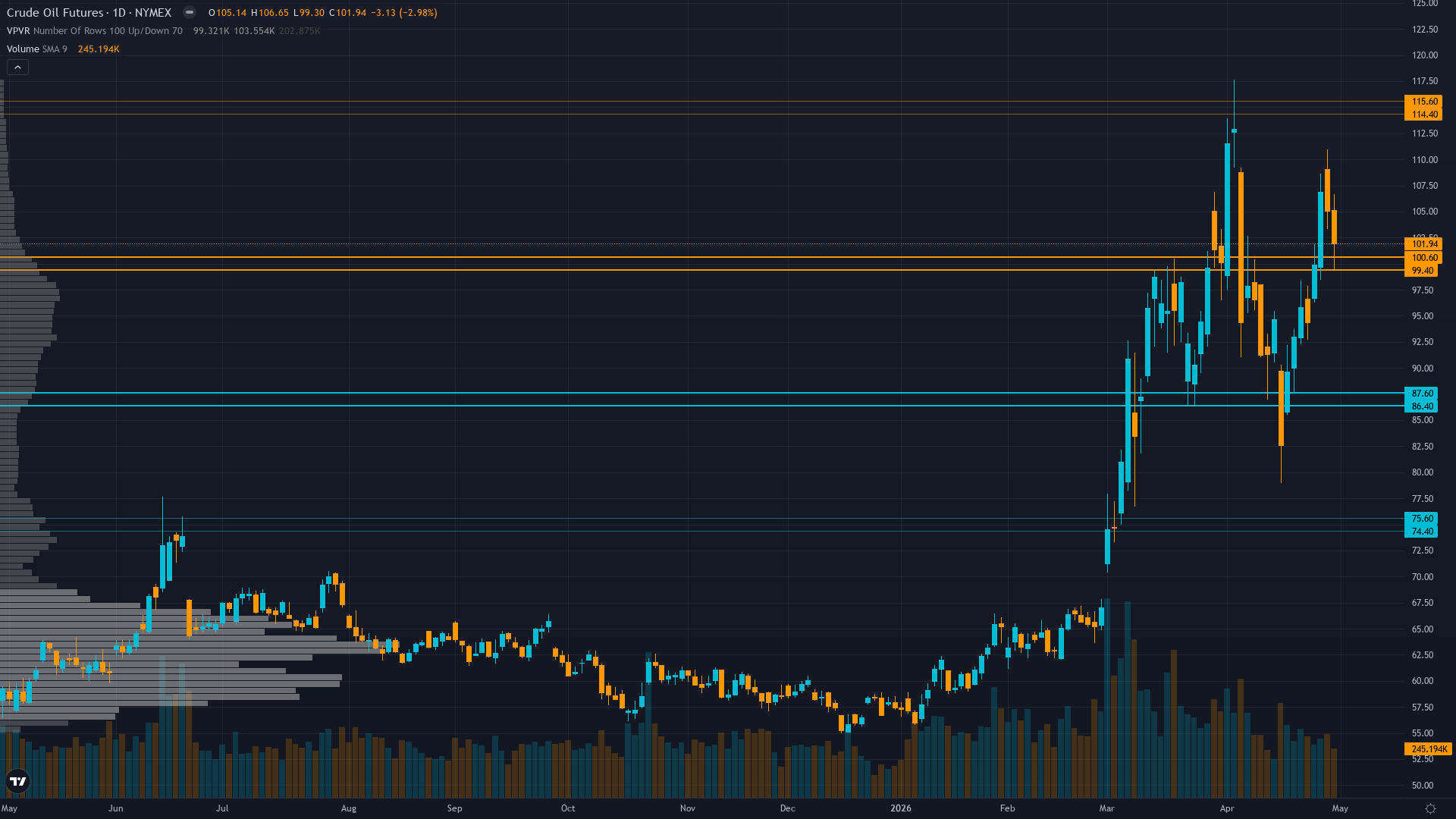
Trading at 102.29 with a 0.65% uptick, crude oil is drifting higher without strong conviction. crude oil futures is in a consolidating near resistance market state, requiring careful assessment of current conditions.
Tactically uncertain with market split between ceasefire optimists expecting mean reversion toward $85-90 and geopolitical hawks expecting sustained premium above $100; structural oversupply consensus (EIA $88 Q4, IEA 2.5 mb/d surplus 2H26) implies modest downside from current $102 but ceasefire binary risk prevents conviction
What's Driving Price
Primary driver: Geopolitical premium compression as ceasefire negotiations advance with WTI pulling back from $106 highs to $102 range, yet structural oversupply fundamentals (IEA 2.5 mb/d surplus 2H26, EIA Q4 forecast $88 Brent) create bearish ceiling above current levels despite ongoing Strait of Hormuz disruptions
Secondary factor: Fundamental divergence intensifying as UAE OPEC exit (May 1, 2026) signals production discipline fractures while IEA demand destruction data shows global oil demand revised down 720 kb/d in one month creating net bearish picture once geopolitical noise fades
Additional influence: Positioning vulnerability with managed money likely elevated from 60% war-premium rally while producer hedging at $100+ levels validates commercial bearish forward view, creating asymmetric liquidation risk if ceasefire extends and 6.7 mb/d Persian Gulf shut-ins normalize per EIA May projections
Economic backdrop: MACRO REGIME: TRANSITIONAL - VIX 16.89 (below 20 calm threshold) indicating geopolitical risk contained to energy sector rather than systemic; Fed on hold, China PMI strong but recession risks building; EIA assumes Hormuz conflict not persisting past April creating policy backdrop favoring mean reversion
Fundamental assessment: Crude overvalued 12-18% versus structural fair value $85-88 range; IEA projects 2.5 mb/d surplus 2H26 as Persian Gulf production returns while EIA forecasts Brent declining to $88/b Q4 2026 indicating current $102 WTI prices temporary scarcity not structural tightness
Chart Assessment
WTI consolidating $100-106 range after rejecting $107 swing high, death cross confirmed (100 SMA below 200 SMA), trading 52nd percentile of $55-$120 war-driven range with distribution characteristics as open interest declines despite elevated prices
With trend strength at 5/10, the directional signal is present but far from decisive.
Risk & Opportunity
Primary risk: Ceasefire negotiations collapse before mid-May with renewed military escalation forcing complete Strait of Hormuz reclosure, triggering violent reversal back toward $115-120 range as 20% supply disruption risk premium reprices and invalidates mean reversion thesis based on diplomatic normalization (Probability: low)
Primary opportunity: Ceasefire extends with full Strait of Hormuz normalization by mid-May as EIA projections anticipate, triggering complete geopolitical premium unwind toward Goldman Sachs/EIA forecast $85-88 range as structural oversupply (IEA 2.5 mb/d surplus 2H26) and demand destruction (720 kb/d downgrade) overwhelm tactical support within 2-4 weeks (Timeframe: 2-4 weeks through late May into early June as ceasefire clarity emerges and Persian Gulf production returns per EIA 6.7 mb/d May normalization timeline)
This week's edge: Market may be overweighting ceasefire negotiation optimism while underweighting IEA April 14 demand destruction magnitude (720 kb/d downgrade largest in years) and UAE OPEC exit signaling production discipline fractures; however two consecutive misses demonstrate desk's bearish timing has been premature and binary catalyst uncertainty means edge is LOW with conviction 5 representing maximum appropriate given unknowable ceasefire outcome probability
Volatility Backdrop
oil price is in a high-volatility environment (88th percentile over 90 days), where position sizing discipline becomes critical. Volatility remains anchored at current levels, with no clear signal of an imminent regime shift in either direction.
High but contracting vol requires moderately wide stops; expect 4-6% daily ranges currently versus 2-3% normal as ceasefire negotiations create episodic whipsaw but overall volatility declining from peak conflict levels; intraday volatility elevated but declining suggests market adapting to conflict as baseline with directional resolution likely around mid-May normalization timeline
The Week Ahead
EIA Weekly Petroleum Status Report following week of geopolitical premium compression and inventory assessment of Persian Gulf production normalization trajectory versus IEA deficit/surplus projections on Wednesday 6 May is a high-impact catalyst with the potential to redefine the near-term outlook entirely.
How crude oil navigates the confluence of consolidating near resistance conditions and incoming data will determine whether the current directional thesis holds or breaks.
This analysis covers one dimension. Our full weekly report combines six specialist agents into a single actionable briefing with directional bias, key levels, and risk-opportunity matrix.
Start Free — Get the Market of the WeekFree weekly report · No credit card · Upgrade anytime