Crude Oil Forecast This Week — Outlook, Drivers & Key Levels
This week's Crude Oil outlook: key drivers, volatility context, risk-opportunity assessment and the week ahead.

Market Overview
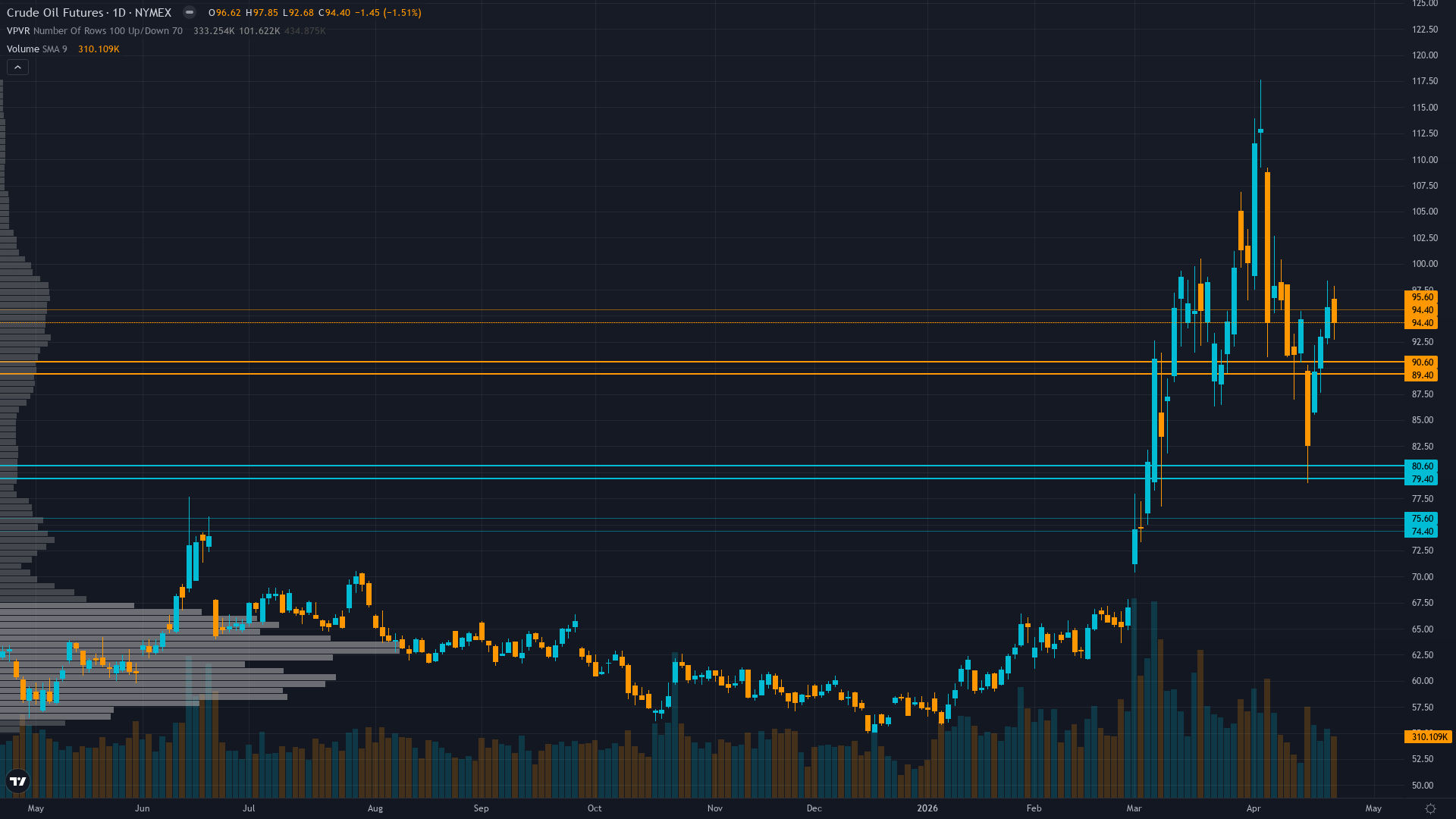
Trading at 95.33 with a 0.47% uptick, crude oil is drifting higher without strong conviction. crude oil futures is in a consolidating near resistance market state, requiring careful assessment of current conditions.
Tactically confused with market split between ceasefire optimists expecting mean reversion to $85-90 and geopolitical hawks expecting collapse back to $110-115; structural oversupply consensus (EIA $88 Q4, IEA 1.9 mb/d surplus) implies modest downside from $95 current but ceasefire binary risk prevents conviction
This Week's Catalysts & Drivers
Primary driver: Ceasefire extension whipsaw creating extreme binary path dependency as Trump's April 22 unilateral extension keeps WTI oscillating $85-97 range while IEA April 14 demand destruction data (global oil demand revised DOWN 720 kb/d from +640 to -80 kb/d in one month) creates fundamental ceiling at current levels
Secondary factor: Strait of Hormuz remains effectively restricted despite April 17 Iranian 'completely open' announcement with only 3 ships transiting in last 24 hours per Guardian April 25, sustaining residual geopolitical premium but insufficient to justify current $95 pricing versus EIA Q4 forecast $88 Brent-equivalent
Additional influence: Technical death cross confirmed (100 SMA below 200 SMA) with price rejected at psychological $100 resistance creating bearish structure, yet managed money positioning likely elevated from ceasefire rally creating asymmetric liquidation risk on fresh negative catalyst
Economic backdrop: MACRO REGIME: TRANSITIONAL - VIX at 18.71 (below 20 threshold indicating geopolitical risk ring-fenced to energy sector); Fed on hold at 3.50-3.75%, recession probability 26% (elevated but not imminent), USD strength moderate headwind; ceasefire binary risk dominates near-term over structural fundamentals
Fundamental assessment: Crude overvalued 8-12% versus structural fair value; IEA April 14 demand revision DOWN 720 kb/d (from +640 to -80 growth) represents most significant monthly downgrade in years, indicating demand destruction overwhelming supply disruptions as EIA forecasts Brent $88/b Q4 2026 implying 7% downside from current WTI-equivalent
Technical Picture
WTI at $95.33 consolidating mid-range after whipsaw from $84 low to $95 on ceasefire news, rejected at $100 resistance with death cross bearish structure (100 SMA below 200 SMA) but unable to break support creating range-bound chop
At 5/10, trend strength is middling — enough to suggest a lean, but not enough to trade with high confidence.
Bull & Bear Case
Primary risk: Ceasefire extension becomes permanent agreement with full Strait of Hormuz normalization by month-end, triggering complete geopolitical premium collapse toward EIA Q4 forecast $88 Brent-equivalent ($84-86 WTI) as structural oversupply (IEA 1.9 mb/d surplus) and demand destruction (720 kb/d downgrade) overwhelm tactical support within 1-2 weeks, forcing managed money long liquidation (Probability: medium)
Primary opportunity: Ceasefire collapses before month-end with renewed strikes or complete Strait reclosure, forcing violent reversal back toward $110-115 range as 20% supply disruption risk premium reprices and invalidates mean reversion thesis, though probability assessed as LOW given diplomatic momentum and Trump administration's ceasefire commitment (Timeframe: 1-2 weeks through month-end as ceasefire expiration timeline provides directional clarity)
This week's edge: Market may be overweighting ceasefire durability (only 3 ships transiting versus 'completely open' claim) while underweighting IEA April 14 demand destruction magnitude (720 kb/d downgrade in one month largest in years) and EIA Q4 forecast $88 Brent implying current $95 WTI already pricing extended disruption assumptions; however, binary catalyst uncertainty means edge is LOW and directional call at conviction 5 represents maximum appropriate given unknowable outcome probability distribution
Volatility Regime
Volatility for oil price sits at the 94th percentile over 90 days — an elevated regime that demands wider risk parameters and faster decision-making. The vol trend is flat, with no meaningful shift across timeframes. Stable vol environments often lull traders before a regime change arrives.
Extreme and contracting vol requires very wide stops; expect 5-8% daily ranges currently versus 2-3% normal as ceasefire whipsaw headlines dominate, intraday volatility elevated but declining from March peaks suggesting market adapting to ceasefire regime as new baseline; consolidation at $95 mid-range with binary catalyst approaching creates coiled energy for breakout favoring downside on normalization or upside on collapse
What to Watch
The EIA Weekly Petroleum Status Report following week of extreme ceasefire-driven volatility and inventory trend assessment, plus ceasefire durability signals as April 22 extension timeline approaches expiration window on Thursday 30 April stands as the week's primary risk event — high-impact and capable of overriding the existing technical and sentiment setup.
The interplay between consolidating near resistance market conditions and upcoming catalysts will define this week's trading landscape for WTI crude.
This analysis covers one dimension. Our full weekly report combines six specialist agents into a single actionable briefing with directional bias, key levels, and risk-opportunity matrix.
Start Free — Get the Market of the WeekFree weekly report · No credit card · Upgrade anytime