Wheat (ZW) — Mandatory neutral reset after 3 consecutive missed directional calls (April 24,…
Mixed to cautiously bullish with fundamental analysts acknowledging April 9 WASDE oversupply confirmation yet noting intensifying Southern Plains drought creating production tail-risk while technical analysts highlighting uptrend establishment above moving averages creating conflicting narratives wi

Mixed to cautiously bullish with fundamental analysts acknowledging April 9 WASDE oversupply confirmation yet noting intensifying Southern Plains drought creating production tail-risk while technical analysts highlighting uptrend establishment above moving averages creating conflicting narratives without clear consensus direction ahead of May 8 WASDE
Mandatory neutral reset after 3 consecutive missed directional calls (April 24, 17, 10) per Rule 5 requiring thesis recalibration before resuming directional analysis
Post-input development identified: Fortune reports April 25 that Plains drought persists with region unusually dry despite periodic spring rains as La Niña winter stripped moisture creating intensifying crop stress as wheat prices surged above $6.10/bushel hitting highest level since March 31
Fundamental conflict remains unresolved with April 9 WASDE confirming global wheat production 283.12 MMT (global stocks 951.5 million tonnes) yet U.S. winter wheat conditions deteriorating to 34% good-to-excellent as of April 12 down from 35% prior week amid Southern Plains drought covering 65% of winter wheat areas
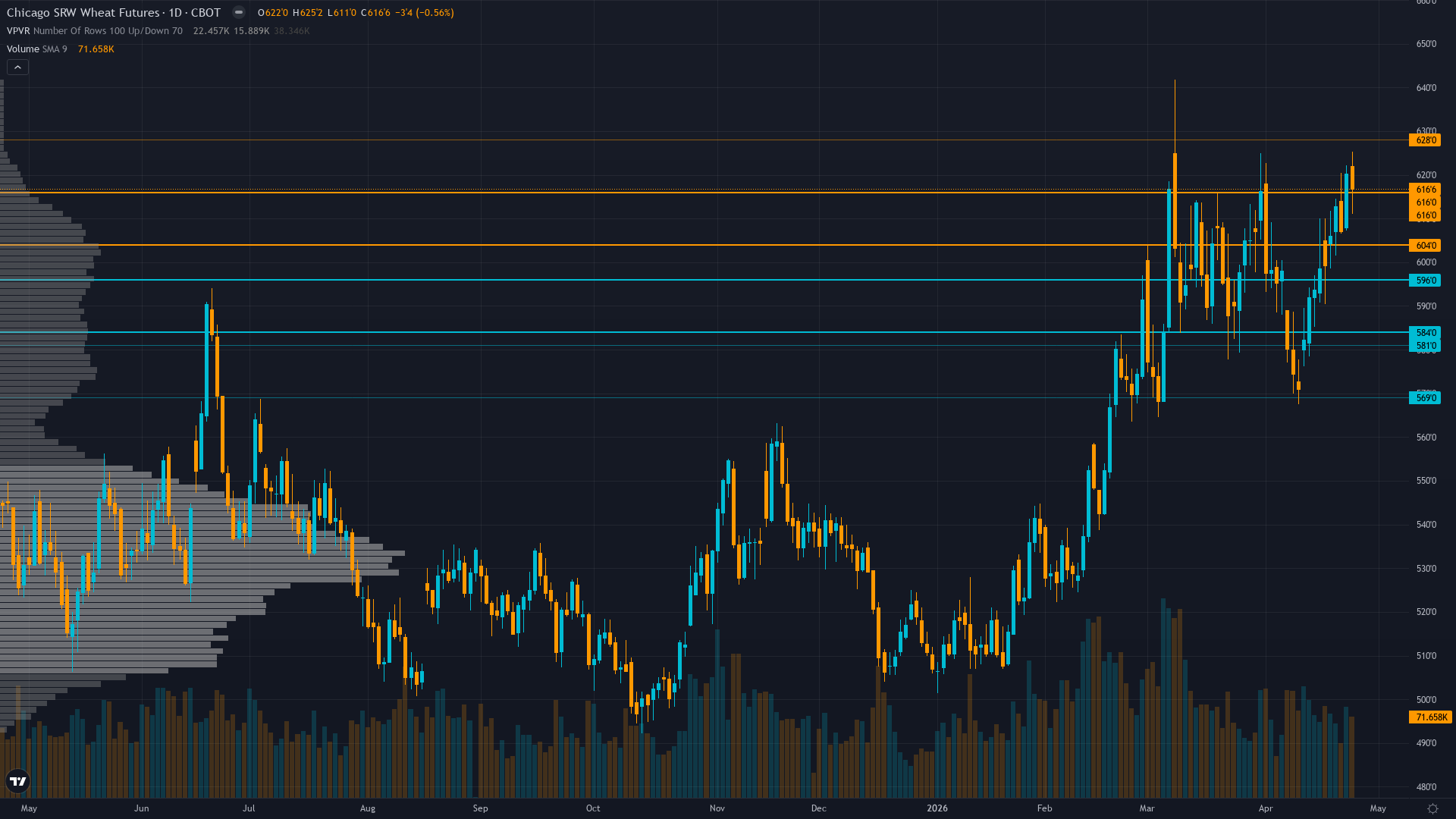
| ▼ Resistance Zone 2 | 630.00 – 640.00 |
| ▼ Resistance Zone 1 | 620.00 – 630.00 |
| ─ Pivot Area | ~616.75 |
| ▲ Support Zone 1 | 595.00 – 605.00 |
| ▲ Support Zone 2 | 570.00 – 580.00 |
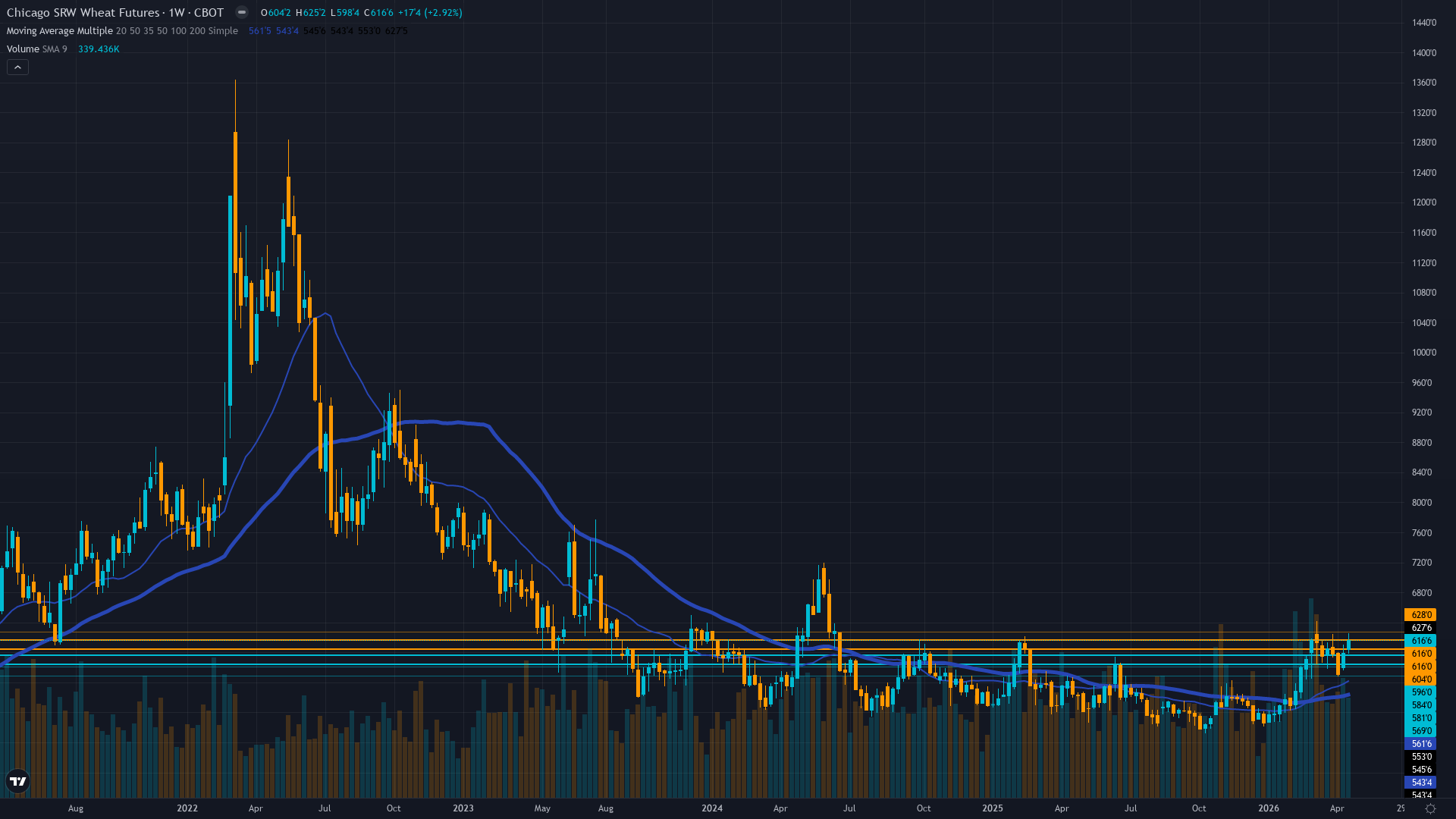
Price at 616.75 holding above 50-day MA (~595) and 200-day MA (~585) in established uptrend from October 492 lows yet consolidating in 600-625 range after testing 52-week high zone near 635 with RSI estimated 55-60 indicating bullish momentum without overbought conditions
Overwhelmingly conflicted with April 9 WASDE confirming structural global oversupply at 283.12 MMT production and 951.5 million tonne stocks (32% stocks-to-use ratio) yet U.S. regional supply tightening from drought covering 65% of Southern Plains winter wheat areas with only 34% good-to-excellent ratings creating fundamental uncertainty requiring May 8 WASDE resolution
Managed money net long positioning expanded to approximately 11,571 additional contracts in week ending April 22 with positioning shifted from prior net shorts creating trend-following bullish structure yet removes asymmetric squeeze fuel that drove February-March rally
Implied volatility at 33.96% for May 2026 options reflects moderate two-way risk in normal range for agricultural commodities yet thin wheat options markets provide minimal directional signal with no notable skew or unusual flow identified
TRANSITIONAL macro regime with VIX 19.50 neutral, USD weakness to 98.5 DXY (down 1.08% monthly) supporting U.S. export competitiveness offset by crude oil spike to $95/bbl raising input costs creating mixed agricultural margin backdrop
Slightly inverted - short-term volatility 28.5% elevated versus medium-term 26.5% following April 9 WASDE event and subsequent price volatility with term structure suggesting elevated two-way risk persists in consolidation phase
WASDE-driven volatility typically produces 30-50% expansion over 1-2 weeks followed by gradual normalization - current elevated volatility at 68th percentile consistent with post-event repositioning phase suggesting peak volatility achieved unless fresh weather catalyst emerges before May 8 WASDE
Volatility elevated in high regime following April 9 WASDE event with potential for 10-15% compression if market enters sustained directional trend without fresh catalyst or modest expansion if drought concerns re-emerge from Southern Plains deterioration into May
Daily ranges expanded from prior 15-20 cents to current 18-28 cent action following WASDE breakdown and subsequent rally requiring wider stops - sustained move below 600 or breakout above 625 would trigger accelerated directional moves given elevated volatility environment and conflicting fundamental-technical forces
Elevated volatility in high regime creates balanced two-way risk where continued consolidation in 600-625 range appears most probable absent fresh catalyst with downside to 575-590 support possible if fundamental oversupply narrative reasserts dominance while upside toward 635-650 resistance remains viable if drought concerns intensify - stable high volatility favors range-trading strategies over directional momentum until May 8 WASDE provides next major catalyst
|
⚠️ Primary Risk
May 8 WASDE confirms Southern Plains drought damage overestimated with adequate global supplies sending market back toward 575-590 support as structural oversupply narrative reasserts dominance over regional U.S. weather concerns Probability: MEDIUM
|
✦ Primary Opportunity
Intensifying Plains drought through late April-May combined with late-season freeze risk from early dormancy break triggers additional production downgrades in May 8 WASDE driving explosive rally toward 650-675 range as weather premium expands and managed money longs add from current positioning base Timeframe: Next 2-4 weeks through May 8 WASDE and critical April-May weather window for 2026 crop
|
ZW wheat futures trade at 616.75 cents per bushel on April 26, 2026, requiring a MANDATORY NEUTRAL call following three consecutive MISSED directional forecasts (April 24 NO CALL missed +2.62%, April 17 BEARISH missed +4.73%, April 10 NO CALL missed -5.99%) per Rule 5 miss streak reset protocol. This is not a discretionary analytical choice but a required system integrity measure. Current macro regime classification: TRANSITIONAL with VIX at 19.50 (neutral zone below 20 threshold) indicating neither fear nor complacency, USD weakness to 98.5 DXY (down 1.08% monthly from 100+ levels) providing modest tailwind for U.S. export competitiveness, yet crude oil elevated near $95/bbl raising input costs creating cross-currents where improving risk appetite clashes with commodity-specific fundamental tensions.
Post-input development identified: Fortune reported April 25 (yesterday, 1 day ago) that U.S. wheat crops are withering and herds thinning as spring drought deepens across the Plains, noting that though periodic rains have rolled through parts of the region this spring, the area as a whole remains unusually dry after a La Niña winter marked by low snow and record-breaking warm temperatures that stripped moisture from the soil. AgWeb reported April 7 that winter wheat conditions plunged as drought grips the Southern Plains with only 35% good-to-excellent ratings in the first national USDA Crop Progress report of 2026, 13 points below 48% at the same time last year.
DTN Progressive Farmer confirmed April 17 that as temperatures rise and rain doesn't fall, HRW wheat conditions continue deteriorating to only 34% good-to-excellent for the week ended April 12, 13% less than the same week in 2025. RFD-TV reported April 24 that drought threatens winter wheat harvests across the Plains where needed rains are coming too late, noting the drought persists in the West and Southeast. These weather developments represent intensifying production risks that have driven wheat futures above $6.10/bushel to the highest level since March 31 according to Trading Economics April 24 data.
The critical fundamental tension creating analytical uncertainty: The April 9 WASDE (released 17 days ago) raised global wheat production to 283.12 MMT (up 6.16 MMT from March estimate) and confirmed U.S. ending stocks at 938 million bushels (highest since 2019/20) creating global stocks at 951.5 million tonnes with 32% stocks-to-use ratio representing structural oversupply, yet U.S. regional supply is tightening dramatically with 65% of Southern Plains winter wheat areas in drought and crop conditions deteriorating from 35% good-to-excellent (April 6) to 34% (April 12) to current levels amid forecast precipitation failures reported April 16 by industry sources. Current price at 616.75 sits in the middle percentile of the 52-week range 492-635, up 25% from October capitulation lows yet 3% below March highs near 635, reflecting market pricing partial weather premium without full commitment to production catastrophe scenario.
The discipline signals reveal profound conflict creating genuine two-way uncertainty: Fundamental shows mildly bullish +1.5 on U.S. production risks despite global surplus, Technical shows mildly bullish +1.5 with price above moving averages, Institutional shows strong bullish +2.5 on managed money adding 11,571 long contracts, yet Economic shows bearish -0.5 on structural conditions, Sentiment shows mildly bullish +0.5 without crowd extreme, and Options provides no signal 0.0 due to thin markets. Weighted signal calculation using Agricultural category weights (Fundamental 0.35, Institutional 0.20, Economic 0.15, Technical 0.15, Sentiment 0.10, Options 0.05): (0.35 × 1.5) + (0.20 × 2.5) + (0.15 × -0.5) + (0.15 × 1.5) + (0.10 × 0.5) + (0.05 × 0.0) = 0.525 + 0.50 - 0.075 + 0.225 + 0.05 + 0.0 = +1.225.
However, RULE 5 OVERRIDES: After 3 consecutive MISSED calls, the system MUST issue NEUTRAL for at least 1 week regardless of signal calculation or discipline consensus. This reset exists because historical analysis shows that doubling down during losing streaks is the single most damaging pattern in the system. The miss pattern reveals the desk calling contradictory stances (NO CALL, BEARISH, NO CALL) into volatile post-WASDE price action without adequate respect for two-way uncertainty following binary event when fundamental oversupply reality clashed with technical rally momentum and drought tail-risk.
Current positioning shows managed money shifted from net short positioning (prior months) to net long with 11,571 contracts added in week ending April 22, removing the asymmetric squeeze fuel that drove February-March rallies from extreme oversold conditions. The May 8 WASDE (12 days away) emerges as the critical catalyst that will determine whether Southern Plains drought concerns are material enough to alter U.S. winter wheat production forecasts sufficiently to offset global oversupply, or whether structural surplus narrative extends.
The combination of mandatory miss reset requirement, conflicting discipline signals creating 3-vs-2 standoff (Technical/Institutional/Fundamental bullish vs Economic/Sentiment mild), no immediate catalyst before May 8 (12 days away), probable weekly move approaching or potentially below 0.75% noise threshold for agricultural assets, and analytical humility requirement after 3 consecutive failures creates setup where NEUTRAL is the only permissible output. Devil's advocate argues the 65% drought coverage and deteriorating 34% good-to-excellent ratings combined with La Niña moisture stripping create explosive upside scenario if late-season weather deterioration materializes production losses triggering fresh positioning shift toward 650-675 range, yet the counter-argument is April 9 WASDE explicitly accounted for drought conditions visible at that time and still raised global production by 6.16 MMT while current price at 616.75 already reflects substantial weather premium above October 492 lows, and the market's consolidation in 600-625 range represents decisive vote requiring fresh catalyst for breakout.
| Week | Bias | Confidence | Result |
|---|---|---|---|
| April 24, 2026 | NO CALL | 5/10 | ➖ |
| April 17, 2026 | BEARISH | 5/10 | ❌ |
| April 10, 2026 | NO CALL | 5/10 | ➖ |
| April 3, 2026 | NO CALL | 5/10 | ➖ |
| March 27, 2026 | BEARISH | 5/10 | ❌ |
| March 20, 2026 | NO CALL | 5/10 | ➖ |
| March 14, 2026 | BULLISH | 8/10 | ❌ |
| March 6, 2026 | BULLISH | 8/10 | ✅ |
| February 27, 2026 | BULLISH | 8/10 | ✅ |
| February 21, 2026 | NO CALL | 7/10 | ➖ |
| February 13, 2026 | NO CALL | 7/10 | ➖ |
| February 8, 2026 | NO CALL | 7/10 | ➖ |
📋 PROMPT-READY CONTEXT
Copy this entire block into any AI chat for follow-up analysis
▼ Expand
MACRO AGENT DESK — WEEKLY INTELLIGENCE BRIEFING
═════════════════════════════════════════════════
Asset: Wheat (ZW)
Report Date: April 26, 2026

── DIRECTIONAL BIAS ─────────────────────────────
Call: NO CALL
Confidence: 5/10
Signal: VIEW MAINTAINED FROM LAST WEEK
MAD Index: 18 (MOSTLY ALIGNED)

── MARKET CONTEXT ───────────────────────────────
State: CONSOLIDATING
Regime: TRANSITIONAL WITH VIX AT 19.50 (NEUTRAL ZONE BELOW 20 THRESHOLD) YET GEOPOLITICAL TENSIONS AND ELEVATED CRUDE OIL NEAR $95/BBL CREATING CROSS-CURRENTS WHERE IMPROVING RISK APPETITE CLASHES WITH COMMODITY-SPECIFIC SUPPLY-DEMAND TENSIONS
Sentiment: NEUTRAL

── WHAT THE MARKET SEES ─────────────────────────
Mixed to cautiously bullish with fundamental analysts acknowledging April 9 WASDE oversupply confirmation yet noting intensifying Southern Plains drought creating production tail-risk while technical analysts highlighting uptrend establishment above moving averages creating conflicting narratives without clear consensus direction ahead of May 8 WASDE

── WHAT THE MARKET IS MISSING ───────────────────
Resetting after 3 consecutive misses — thesis under review. Analytical discipline requires acknowledging insufficient edge to overcome 0.75% noise threshold when April 9 WASDE structural oversupply reality clashes with intensifying Southern Plains drought tail-risk and managed money positioning shift creating genuine two-way uncertainty without fresh catalyst before May 8 WASDE 12 days away.

── KEY DRIVERS ──────────────────────────────────
1. Mandatory neutral reset after 3 consecutive missed directional calls (April 24, 17, 10) per Rule 5 requiring thesis recalibration before resuming directional analysis
2. Post-input development identified: Fortune reports April 25 that Plains drought persists with region unusually dry despite periodic spring rains as La Niña winter stripped moisture creating intensifying crop stress as wheat prices surged above $6.10/bushel hitting highest level since March 31
3. Fundamental conflict remains unresolved with April 9 WASDE confirming global wheat production 283.12 MMT (global stocks 951.5 million tonnes) yet U.S. winter wheat conditions deteriorating to 34% good-to-excellent as of April 12 down from 35% prior week amid Southern Plains drought covering 65% of winter wheat areas

── KEY ZONES ──────────────��─────────────────────
Resistance 2: 630.00 – 640.00
Resistance 1: 620.00 – 630.00
Pivot: ~616.75
Support 1: 595.00 – 605.00
Support 2: 570.00 – 580.00

── DISCIPLINE BIASES ────────────────────────────
Technical: BULLISH
Fundamental: BULLISH
Institutional: BULLISH
Options: NO CALL
Economic: BEARISH
Sentiment: BULLISH

── TECHNICAL STRUCTURE ──────────────────────────
Price at 616.75 holding above 50-day MA (~595) and 200-day MA (~585) in established uptrend from October 492 lows yet consolidating in 600-625 range after testing 52-week high zone near 635 with RSI estimated 55-60 indicating bullish momentum without overbought conditions

── FUNDAMENTAL ASSESSMENT ───────────────────────
Overwhelmingly conflicted with April 9 WASDE confirming structural global oversupply at 283.12 MMT production and 951.5 million tonne stocks (32% stocks-to-use ratio) yet U.S. regional supply tightening from drought covering 65% of Southern Plains winter wheat areas with only 34% good-to-excellent ratings creating fundamental uncertainty requiring May 8 WASDE resolution

── INSTITUTIONAL POSITIONING ────────────────────
Managed money net long positioning expanded to approximately 11,571 additional contracts in week ending April 22 with positioning shifted from prior net shorts creating trend-following bullish structure yet removes asymmetric squeeze fuel that drove February-March rally

── OPTIONS FLOW ─────────────────────────────────
Implied volatility at 33.96% for May 2026 options reflects moderate two-way risk in normal range for agricultural commodities yet thin wheat options markets provide minimal directional signal with no notable skew or unusual flow identified

── ECONOMIC BACKDROP ────────────────────────────
TRANSITIONAL macro regime with VIX 19.50 neutral, USD weakness to 98.5 DXY (down 1.08% monthly) supporting U.S. export competitiveness offset by crude oil spike to $95/bbl raising input costs creating mixed agricultural margin backdrop

── VOLATILITY REGIME ────────────────────────────
Regime: HIGH
Percentile: 68th
Trend: Stable —
Days in Regime: 14
Term Structure: slightly inverted - short-term volatility 28.5% elevated versus medium-term 26.5% following April 9 WASDE event and subsequent price volatility with term structure suggesting elevated two-way risk persists in consolidation phase
Historical Pattern: WASDE-driven volatility typically produces 30-50% expansion over 1-2 weeks followed by gradual normalization - current elevated volatility at 68th percentile consistent with post-event repositioning phase suggesting peak volatility achieved unless fresh weather catalyst emerges before May 8 WASDE
Outlook: Volatility elevated in high regime following April 9 WASDE event with potential for 10-15% compression if market enters sustained directional trend without fresh catalyst or modest expansion if drought concerns re-emerge from Southern Plains deterioration into May
Trading Context: Daily ranges expanded from prior 15-20 cents to current 18-28 cent action following WASDE breakdown and subsequent rally requiring wider stops - sustained move below 600 or breakout above 625 would trigger accelerated directional moves given elevated volatility environment and conflicting fundamental-technical forces
Vol Risk/Opportunity: Elevated volatility in high regime creates balanced two-way risk where continued consolidation in 600-625 range appears most probable absent fresh catalyst with downside to 575-590 support possible if fundamental oversupply narrative reasserts dominance while upside toward 635-650 resistance remains viable if drought concerns intensify - stable high volatility favors range-trading strategies over directional momentum until May 8 WASDE provides next major catalyst

── PRIMARY RISK ─────────────────────────────────
May 8 WASDE confirms Southern Plains drought damage overestimated with adequate global supplies sending market back toward 575-590 support as structural oversupply narrative reasserts dominance over regional U.S. weather concerns
Probability: MEDIUM

── PRIMARY OPPORTUNITY ──────────────────────────
Intensifying Plains drought through late April-May combined with late-season freeze risk from early dormancy break triggers additional production downgrades in May 8 WASDE driving explosive rally toward 650-675 range as weather premium expands and managed money longs add from current positioning base
Timeframe: Next 2-4 weeks through May 8 WASDE and critical April-May weather window for 2026 crop

── NEXT CATALYST ────────────────────────────────
Date: May 8, 2026
Event: USDA May 2026 WASDE Report with updated winter wheat production estimates incorporating spring weather conditions and final damage assessments from Southern Plains drought plus initial 2026/27 crop year projections
Expected Impact: HIGH

═════════════════════════════════════════════════
Source: Macro Agent Desk (macroagentdesk.com)
═════════════════════════════════════════════════

── FULL ANALYSIS ────────────────────────────────
ZW wheat futures trade at 616.75 cents per bushel on April 26, 2026, requiring a MANDATORY NEUTRAL call following three consecutive MISSED directional forecasts (April 24 NO CALL missed +2.62%, April 17 BEARISH missed +4.73%, April 10 NO CALL missed -5.99%) per Rule 5 miss streak reset protocol. This is not a discretionary analytical choice but a required system integrity measure. Current macro regime classification: TRANSITIONAL with VIX at 19.50 (neutral zone below 20 threshold) indicating neither fear nor complacency, USD weakness to 98.5 DXY (down 1.08% monthly from 100+ levels) providing modest tailwind for U.S. export competitiveness, yet crude oil elevated near $95/bbl raising input costs creating cross-currents where improving risk appetite clashes with commodity-specific fundamental tensions. Post-input development identified: Fortune reported April 25 (yesterday, 1 day ago) that U.S. wheat crops are withering and herds thinning as spring drought deepens across the Plains, noting that though periodic rains have rolled through parts of the region this spring, the area as a whole remains unusually dry after a La Niña winter marked by low snow and record-breaking warm temperatures that stripped moisture from the soil. AgWeb reported April 7 that winter wheat conditions plunged as drought grips the Southern Plains with only 35% good-to-excellent ratings in the first national USDA Crop Progress report of 2026, 13 points below 48% at the same time last year. DTN Progressive Farmer confirmed April 17 that as temperatures rise and rain doesn't fall, HRW wheat conditions continue deteriorating to only 34% good-to-excellent for the week ended April 12, 13% less than the same week in 2025. RFD-TV reported April 24 that drought threatens winter wheat harvests across the Plains where needed rains are coming too late, noting the drought persists in the West and Southeast. These weather developments represent intensifying production risks that have driven wheat futures above $6.10/bushel to the highest level since March 31 according to Trading Economics April 24 data. The critical fundamental tension creating analytical uncertainty: The April 9 WASDE (released 17 days ago) raised global wheat production to 283.12 MMT (up 6.16 MMT from March estimate) and confirmed U.S. ending stocks at 938 million bushels (highest since 2019/20) creating global stocks at 951.5 million tonnes with 32% stocks-to-use ratio representing structural oversupply, yet U.S. regional supply is tightening dramatically with 65% of Southern Plains winter wheat areas in drought and crop conditions deteriorating from 35% good-to-excellent (April 6) to 34% (April 12) to current levels amid forecast precipitation failures reported April 16 by industry sources. Current price at 616.75 sits in the middle percentile of the 52-week range 492-635, up 25% from October capitulation lows yet 3% below March highs near 635, reflecting market pricing partial weather premium without full commitment to production catastrophe scenario. The discipline signals reveal profound conflict creating genuine two-way uncertainty: Fundamental shows mildly bullish +1.5 on U.S. production risks despite global surplus, Technical shows mildly bullish +1.5 with price above moving averages, Institutional shows strong bullish +2.5 on managed money adding 11,571 long contracts, yet Economic shows bearish -0.5 on structural conditions, Sentiment shows mildly bullish +0.5 without crowd extreme, and Options provides no signal 0.0 due to thin markets. Weighted signal calculation using Agricultural category weights (Fundamental 0.35, Institutional 0.20, Economic 0.15, Technical 0.15, Sentiment 0.10, Options 0.05): (0.35 × 1.5) + (0.20 × 2.5) + (0.15 × -0.5) + (0.15 × 1.5) + (0.10 × 0.5) + (0.05 × 0.0) = 0.525 + 0.50 - 0.075 + 0.225 + 0.05 + 0.0 = +1.225. However, RULE 5 OVERRIDES: After 3 consecutive MISSED calls, the system MUST issue NEUTRAL for at least 1 week regardless of signal calculation or discipline consensus. This reset exists because historical analysis shows that doubling down during losing streaks is the single most damaging pattern in the system. The miss pattern reveals the desk calling contradictory stances (NO CALL, BEARISH, NO CALL) into volatile post-WASDE price action without adequate respect for two-way uncertainty following binary event when fundamental oversupply reality clashed with technical rally momentum and drought tail-risk. Current positioning shows managed money shifted from net short positioning (prior months) to net long with 11,571 contracts added in week ending April 22, removing the asymmetric squeeze fuel that drove February-March rallies from extreme oversold conditions. The May 8 WASDE (12 days away) emerges as the critical catalyst that will determine whether Southern Plains drought concerns are material enough to alter U.S. winter wheat production forecasts sufficiently to offset global oversupply, or whether structural surplus narrative extends. The combination of mandatory miss reset requirement, conflicting discipline signals creating 3-vs-2 standoff (Technical/Institutional/Fundamental bullish vs Economic/Sentiment mild), no immediate catalyst before May 8 (12 days away), probable weekly move approaching or potentially below 0.75% noise threshold for agricultural assets, and analytical humility requirement after 3 consecutive failures creates setup where NEUTRAL is the only permissible output. Devil's advocate argues the 65% drought coverage and deteriorating 34% good-to-excellent ratings combined with La Niña moisture stripping create explosive upside scenario if late-season weather deterioration materializes production losses triggering fresh positioning shift toward 650-675 range, yet the counter-argument is April 9 WASDE explicitly accounted for drought conditions visible at that time and still raised global production by 6.16 MMT while current price at 616.75 already reflects substantial weather premium above October 492 lows, and the market's consolidation in 600-625 range represents decisive vote requiring fresh catalyst for breakout.