Wheat (ZW) — consolidating in high regime
Cautiously neutral to bearish following March WASDE confirmation of ample supplies with rally viewed as short-covering event within structural bear market - consensus expects mean reversion toward 575-590 once weather premium fully dissipates

Cautiously neutral to bearish following March WASDE confirmation of ample supplies with rally viewed as short-covering event within structural bear market - consensus expects mean reversion toward 575-590 once weather premium fully dissipates
Post-WASDE consolidation at 613.75 after March 10 report showed no material changes to U.S. wheat balance sheets - market digesting 25% rally from October 492 lows while facing USD strength headwinds and declining open interest signaling weakening trend participation
Short-covering exhaustion following massive spec short reduction from 109,483 contracts to 17,758 as of March 3 - 84% of bearish positioning unwound removes primary fuel for further rally without fresh catalyst
Structural oversupply fundamentals reasserting with global stocks at 277.5 million metric tons (five-year high) and 33.7% stocks-to-use ratio overwhelming any weather premium from February Arctic blast and early dormancy break concerns
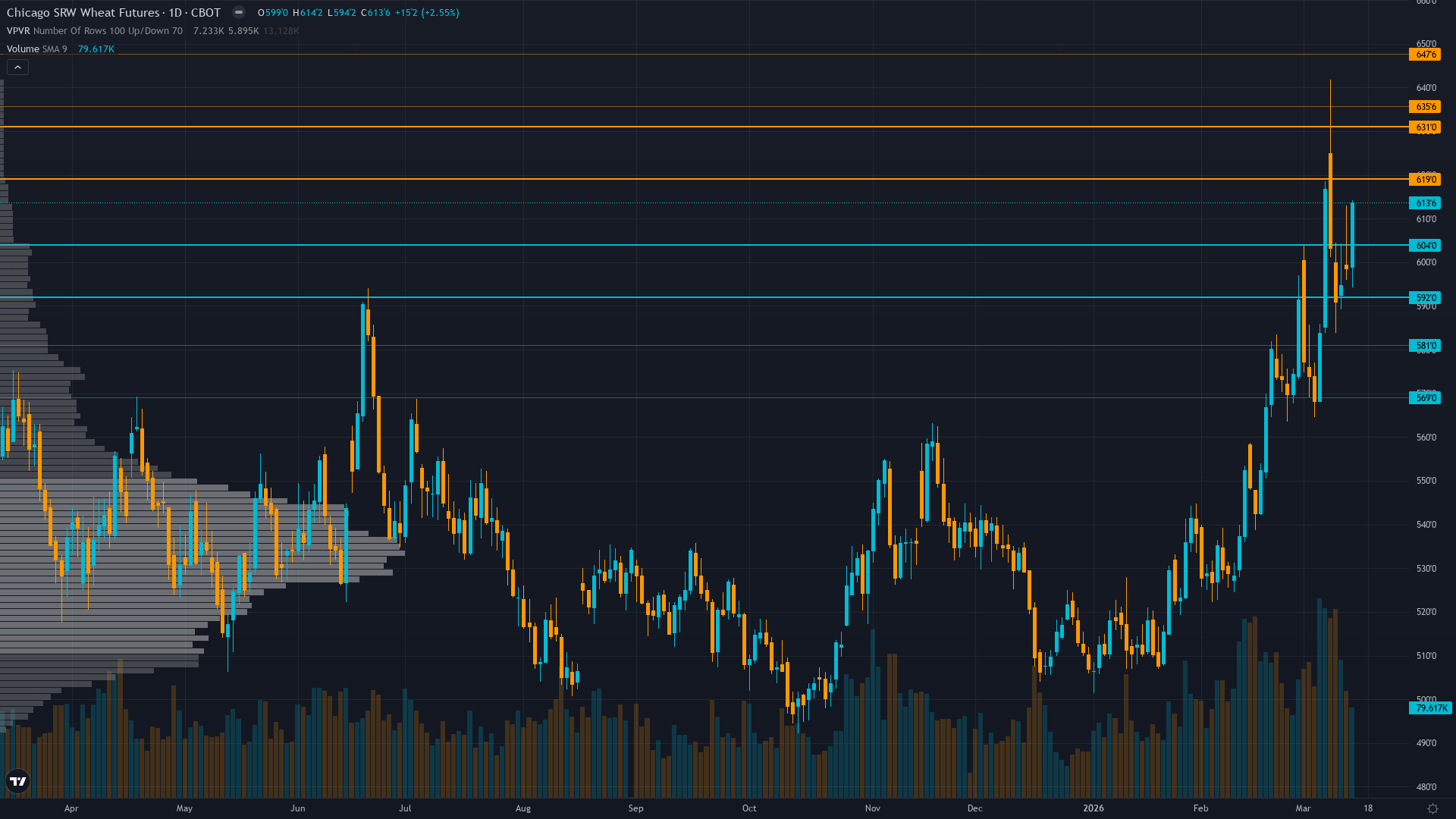
| ▼ Resistance Zone 2 | 636.75 – 646.75 |
| ▼ Resistance Zone 1 | 620.00 – 630.00 |
| ─ Pivot Area | ~613.75 |
| ▲ Support Zone 1 | 593.00 – 603.00 |
| ▲ Support Zone 2 | 570.00 – 580.00 |
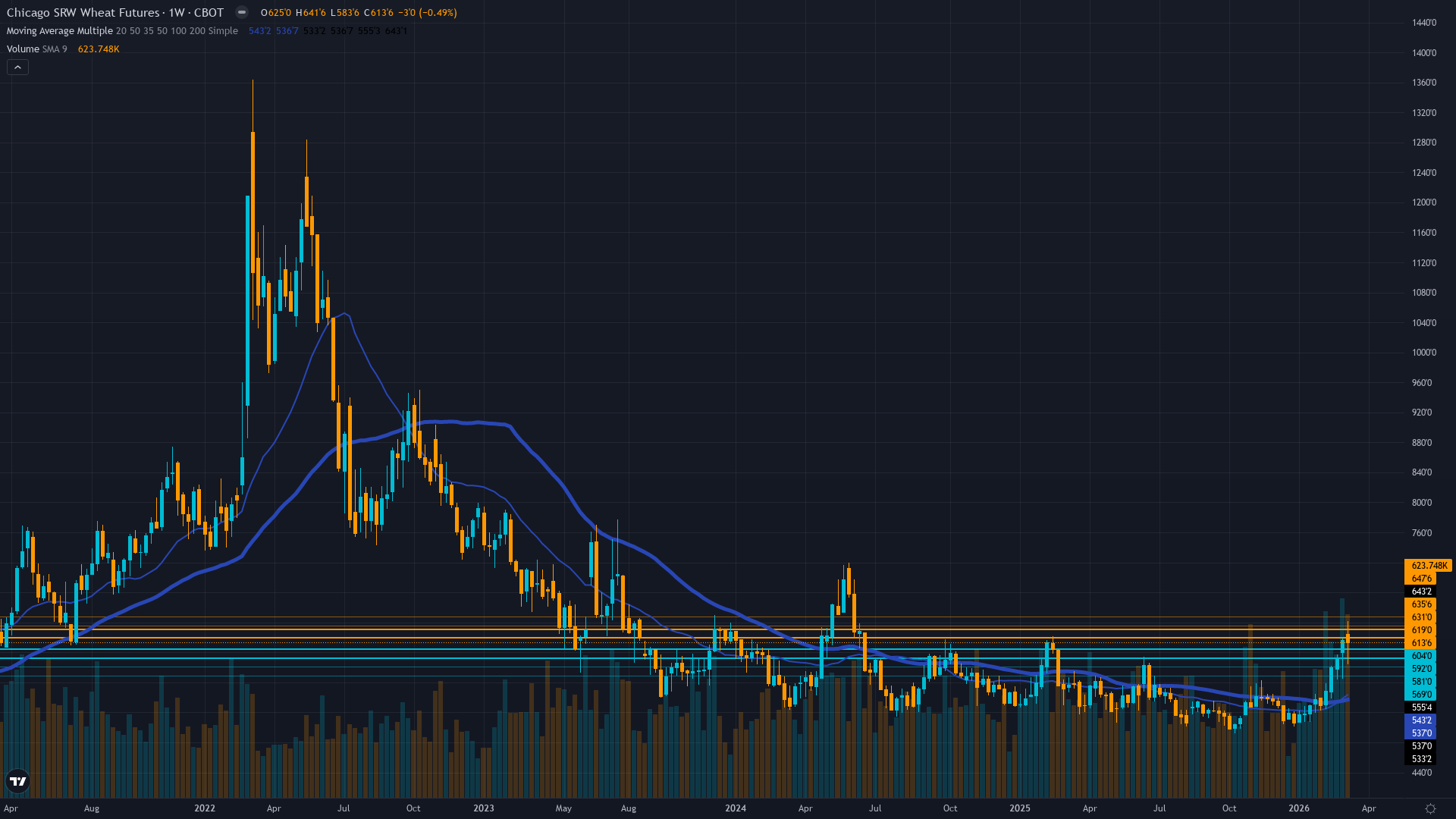
Trading at 613.75 near 52-week high of 641.75 after 25% rally from October 492 lows but showing signs of exhaustion with declining open interest and failed breakout above 620-625 resistance zone
Overwhelmingly bearish with record global supplies at 277.5 MMT yet strong U.S. export pace at 900 million bushels provides floor around 590-600 as market has fully discounted worst-case oversupply scenarios
Spec shorts reduced to 17,758 contracts from 109,483 peak representing 84% unwind of bearish positioning - contrarian bullish signal largely played out with diminishing squeeze potential remaining at neutral territory
Implied volatility elevated at 37.79% in May 2026 options up 58% from December 2025 levels of 23.96% reflecting binary event premium following WASDE and continued two-way risk
USD strength accelerating to 100.5 DXY as of March 13 following Goldman Sachs rate cut delay to September creates direct export competitiveness headwind offsetting strong 900 million bushel U.S. export forecast
Slightly inverted - short-term volatility elevated at 28.5% versus medium-term 26.5% following February-March rally and WASDE event risk with term structure suggesting elevated two-way action persists but expansion phase may be maturing
Weather-driven rallies from extreme short positioning historically produce 50-80% volatility expansion over 4-6 weeks - current expansion from 24% to 32% consistent with mature stages suggesting peak volatility likely achieved unless fresh catalyst emerges
Volatility expanded from January-February consolidation following Arctic blast and WASDE events now stabilizing in high regime - potential for 15-20% compression if market enters sustained consolidation without fresh weather catalyst or modest additional expansion if directional breakout occurs
Daily ranges expanded from compressed 10-16 cents during late 2025 consolidation to current 20-30 cent action requiring wider stops - breakout above 625 or breakdown below 600 would trigger accelerated moves given resistance testing and elevated volatility environment
Elevated volatility in high regime creates balanced two-way risk where fresh bullish catalyst (freeze event, geopolitical disruption) could drive 5-8% rally toward 650-675 while downside to 575-590 appears increasingly probable absent catalyst given positioning exhaustion and USD headwinds - stable high volatility suggests ranging behavior most likely near-term
|
⚠️ Primary Risk
April WASDE confirms limited damage from February Arctic blast and early dormancy break with weather premium dissipating sending market back toward 575-590 support as structural oversupply narrative reasserts dominance and remaining spec longs exit positions Probability: HIGH
|
✦ Primary Opportunity
March-April freeze event damages winter wheat that broke dormancy early in late February combined with geopolitical disruption to Black Sea exports triggering renewed short-covering and weather premium expansion toward 650-675 range Timeframe: Next 3-8 weeks through April WASDE and critical March-April freeze vulnerability window
|
ZW wheat futures stand at a critical crossroads on March 15, 2026, trading at 613.75 cents per bushel after completing a spectacular 25% rally from the catastrophic October 2025 breakdown to 52-week lows at 492.25. The market is now consolidating following the March 10 WASDE report that delivered minimal changes to U.S. corn, soybean, and wheat ending stocks, holding U.S. wheat estimates steady at approximately 931 million bushels with a 32% stocks-to-use ratio. Post-input development identified: Last week's BULLISH call at conviction 8 MISSED as price fell from Monday open 635 to Friday close 613.75 (-3.35%), representing a significant reversal that signals potential rally exhaustion.
The desk's consecutive BULLISH streak reached three weeks before this week's downgrade. Current macro regime classification: TRANSITIONAL with mixed signals - VIX data from March 12 showing elevated levels, USD strengthening sharply to 100.5 on March 13 (hawkish Fed repricing), and crude oil spiked to $92/bbl on geopolitical tensions, yet equity markets showing resilience. For agricultural commodities, the dominant headwind is USD strength which directly impairs U.S. export competitiveness versus Argentina, Russia, and Black Sea suppliers.
The positioning dynamics reveal the rally's primary driver has been exhausted: spec shorts collapsed from 109,483 contracts on January 7 to 25,800 as of March 3 (77% reduction), then to 17,758 in the latest data - an 84% total unwind that removes asymmetric squeeze fuel. Technical structure shows price testing the 52-week high zone near 620-625 with declining open interest at 232,470K suggesting weakening trend conviction. The March 9 short-squeeze rally to 618+ has failed to follow through, and the subsequent pullback to 613.75 confirms resistance at these levels.
Fundamental assessment remains overwhelmingly bearish with global ending stocks at 277.5 million metric tons representing a five-year high and 33.7% stocks-to-use ratio, yet the market holding above 600 suggests worst-case oversupply scenarios are now fully discounted after six months of bear market price discovery. The critical wildcard that provided February-March rally fuel - early dormancy break creating March-April freeze vulnerability - remains active but is being increasingly discounted by the market.
Late February warm weather prompted winter wheat to break dormancy unusually early, creating scenario where late-season freeze could cause severe damage, yet no freeze event has materialized and the window is narrowing. Trading context suggests the probable weekly move is approaching the 0.75% noise threshold for agricultural assets. Without a fresh catalyst (weather event, geopolitical disruption, or April WASDE surprise), the market lacks conviction for sustained directional moves above background volatility.
The combination of exhausted short-covering dynamics, USD strength headwinds, structural oversupply reasserting dominance, and absence of fresh bullish catalysts creates a setup where downside risk toward 575-590 appears greater than upside potential toward 640-650 absent a material new development. Current conviction is constrained to 5 reflecting: (1) last week's MISSED call requiring -1 penalty, (2) three consecutive BULLISH weeks triggering Thesis Health Score review with price action contradicting bias, (3) signal below minimum threshold of 1.0 for directional call, and (4) no major catalyst present.
The desk downgrades from BULLISH to NEUTRAL acknowledging the rally from extreme October oversold conditions has largely run its course at current resistance levels.
| Week | Bias | Confidence | Result |
|---|---|---|---|
| March 14, 2026 | BULLISH | 8/10 | ❌ |
| March 6, 2026 | BULLISH | 8/10 | ✅ |
| February 27, 2026 | BULLISH | 8/10 | ✅ |
| February 21, 2026 | NO CALL | 7/10 | ➖ |
| February 13, 2026 | NO CALL | 7/10 | ➖ |
| February 8, 2026 | NO CALL | 7/10 | ➖ |
| February 1, 2026 | NO CALL | 7/10 | ➖ |
| January 25, 2026 | NO CALL | 7/10 | ➖ |
| January 11, 2026 | NO CALL | 7/10 | ➖ |
| January 4, 2026 | BEARISH | 7/10 | ❌ |
| December 28, 2025 | BEARISH | 7/10 | ✅ |
| December 21, 2025 | BEARISH | 8/10 | ❌ |
📋 PROMPT-READY CONTEXT
Copy this entire block into any AI chat for follow-up analysis
▼ Expand
MACRO AGENT DESK — WEEKLY INTELLIGENCE BRIEFING
═════════════════════════════════════════════════
Asset: Wheat (ZW)
Report Date: March 15, 2026

── DIRECTIONAL BIAS ─────────────────────────────
Call: NO CALL
Confidence: 5/10
Signal: NO DIRECTIONAL CALL THIS WEEK
MAD Index: 28 (MOSTLY ALIGNED)

── MARKET CONTEXT ───────────────────────────────
State: CONSOLIDATING
Regime: CONSOLIDATING AFTER RALLY EXHAUSTION
Sentiment: NEUTRAL

── WHAT THE MARKET SEES ─────────────────────────
Cautiously neutral to bearish following March WASDE confirmation of ample supplies with rally viewed as short-covering event within structural bear market - consensus expects mean reversion toward 575-590 once weather premium fully dissipates

── WHAT THE MARKET IS MISSING ───────────────────
Market may be underestimating March-April freeze risk from unusually early dormancy break in late February 2026 creating tail-risk scenario for severe crop damage if arctic air returns, yet positioning exhaustion and USD headwinds suggest limited edge for directional call at current levels - NEUTRAL stance appropriate given noise threshold proximity and catalyst void

── KEY DRIVERS ──────────────────────────────────
1. Post-WASDE consolidation at 613.75 after March 10 report showed no material changes to U.S. wheat balance sheets - market digesting 25% rally from October 492 lows while facing USD strength headwinds and declining open interest signaling weakening trend participation
2. Short-covering exhaustion following massive spec short reduction from 109,483 contracts to 17,758 as of March 3 - 84% of bearish positioning unwound removes primary fuel for further rally without fresh catalyst
3. Structural oversupply fundamentals reasserting with global stocks at 277.5 million metric tons (five-year high) and 33.7% stocks-to-use ratio overwhelming any weather premium from February Arctic blast and early dormancy break concerns

── KEY ZONES ────────────────────────────────────
Resistance 2: 636.75 – 646.75
Resistance 1: 620.00 – 630.00
Pivot: ~613.75
Support 1: 593.00 – 603.00
Support 2: 570.00 – 580.00

── DISCIPLINE BIASES ────────────────────────────
Technical: BULLISH
Fundamental: BEARISH
Institutional: BULLISH
Options: BEARISH
Economic: BEARISH
Sentiment: NO CALL

── TECHNICAL STRUCTURE ──────────────────────────
Trading at 613.75 near 52-week high of 641.75 after 25% rally from October 492 lows but showing signs of exhaustion with declining open interest and failed breakout above 620-625 resistance zone

── FUNDAMENTAL ASSESSMENT ───────────────────────
Overwhelmingly bearish with record global supplies at 277.5 MMT yet strong U.S. export pace at 900 million bushels provides floor around 590-600 as market has fully discounted worst-case oversupply scenarios

── INSTITUTIONAL POSITIONING ────────────────────
Spec shorts reduced to 17,758 contracts from 109,483 peak representing 84% unwind of bearish positioning - contrarian bullish signal largely played out with diminishing squeeze potential remaining at neutral territory

── OPTIONS FLOW ─────────────────────────────────
Implied volatility elevated at 37.79% in May 2026 options up 58% from December 2025 levels of 23.96% reflecting binary event premium following WASDE and continued two-way risk

── ECONOMIC BACKDROP ────────────────────────────
USD strength accelerating to 100.5 DXY as of March 13 following Goldman Sachs rate cut delay to September creates direct export competitiveness headwind offsetting strong 900 million bushel U.S. export forecast

── VOLATILITY REGIME ────────────────────────────
Regime: HIGH
Percentile: 68th
Trend: Stable —
Days in Regime: 14
Term Structure: slightly inverted - short-term volatility elevated at 28.5% versus medium-term 26.5% following February-March rally and WASDE event risk with term structure suggesting elevated two-way action persists but expansion phase may be maturing
Historical Pattern: Weather-driven rallies from extreme short positioning historically produce 50-80% volatility expansion over 4-6 weeks - current expansion from 24% to 32% consistent with mature stages suggesting peak volatility likely achieved unless fresh catalyst emerges
Outlook: Volatility expanded from January-February consolidation following Arctic blast and WASDE events now stabilizing in high regime - potential for 15-20% compression if market enters sustained consolidation without fresh weather catalyst or modest additional expansion if directional breakout occurs
Trading Context: Daily ranges expanded from compressed 10-16 cents during late 2025 consolidation to current 20-30 cent action requiring wider stops - breakout above 625 or breakdown below 600 would trigger accelerated moves given resistance testing and elevated volatility environment
Vol Risk/Opportunity: Elevated volatility in high regime creates balanced two-way risk where fresh bullish catalyst (freeze event, geopolitical disruption) could drive 5-8% rally toward 650-675 while downside to 575-590 appears increasingly probable absent catalyst given positioning exhaustion and USD headwinds - stable high volatility suggests ranging behavior most likely near-term

── PRIMARY RISK ─────────────────────────────────
April WASDE confirms limited damage from February Arctic blast and early dormancy break with weather premium dissipating sending market back toward 575-590 support as structural oversupply narrative reasserts dominance and remaining spec longs exit positions
Probability: HIGH

── PRIMARY OPPORTUNITY ──────────────────────────
March-April freeze event damages winter wheat that broke dormancy early in late February combined with geopolitical disruption to Black Sea exports triggering renewed short-covering and weather premium expansion toward 650-675 range
Timeframe: Next 3-8 weeks through April WASDE and critical March-April freeze vulnerability window

── NEXT CATALYST ────────────────────────────────
Date: April 9, 2026
Event: USDA April 2026 WASDE Report with updated winter wheat acreage and spring planting estimates incorporating weather-adjusted production forecasts
Expected Impact: MEDIUM

═════════════════════════════════════════════════
Source: Macro Agent Desk (macroagentdesk.com)
═════════════���═══════════════════════════════════

── FULL ANALYSIS ────────────────────────────────
ZW wheat futures stand at a critical crossroads on March 15, 2026, trading at 613.75 cents per bushel after completing a spectacular 25% rally from the catastrophic October 2025 breakdown to 52-week lows at 492.25. The market is now consolidating following the March 10 WASDE report that delivered minimal changes to U.S. corn, soybean, and wheat ending stocks, holding U.S. wheat estimates steady at approximately 931 million bushels with a 32% stocks-to-use ratio. Post-input development identified: Last week's BULLISH call at conviction 8 MISSED as price fell from Monday open 635 to Friday close 613.75 (-3.35%), representing a significant reversal that signals potential rally exhaustion. The desk's consecutive BULLISH streak reached three weeks before this week's downgrade. Current macro regime classification: TRANSITIONAL with mixed signals - VIX data from March 12 showing elevated levels, USD strengthening sharply to 100.5 on March 13 (hawkish Fed repricing), and crude oil spiked to $92/bbl on geopolitical tensions, yet equity markets showing resilience. For agricultural commodities, the dominant headwind is USD strength which directly impairs U.S. export competitiveness versus Argentina, Russia, and Black Sea suppliers. The positioning dynamics reveal the rally's primary driver has been exhausted: spec shorts collapsed from 109,483 contracts on January 7 to 25,800 as of March 3 (77% reduction), then to 17,758 in the latest data - an 84% total unwind that removes asymmetric squeeze fuel. Technical structure shows price testing the 52-week high zone near 620-625 with declining open interest at 232,470K suggesting weakening trend conviction. The March 9 short-squeeze rally to 618+ has failed to follow through, and the subsequent pullback to 613.75 confirms resistance at these levels. Fundamental assessment remains overwhelmingly bearish with global ending stocks at 277.5 million metric tons representing a five-year high and 33.7% stocks-to-use ratio, yet the market holding above 600 suggests worst-case oversupply scenarios are now fully discounted after six months of bear market price discovery. The critical wildcard that provided February-March rally fuel - early dormancy break creating March-April freeze vulnerability - remains active but is being increasingly discounted by the market. Late February warm weather prompted winter wheat to break dormancy unusually early, creating scenario where late-season freeze could cause severe damage, yet no freeze event has materialized and the window is narrowing. Trading context suggests the probable weekly move is approaching the 0.75% noise threshold for agricultural assets. Without a fresh catalyst (weather event, geopolitical disruption, or April WASDE surprise), the market lacks conviction for sustained directional moves above background volatility. The combination of exhausted short-covering dynamics, USD strength headwinds, structural oversupply reasserting dominance, and absence of fresh bullish catalysts creates a setup where downside risk toward 575-590 appears greater than upside potential toward 640-650 absent a material new development. Current conviction is constrained to 5 reflecting: (1) last week's MISSED call requiring -1 penalty, (2) three consecutive BULLISH weeks triggering Thesis Health Score review with price action contradicting bias, (3) signal below minimum threshold of 1.0 for directional call, and (4) no major catalyst present. The desk downgrades from BULLISH to NEUTRAL acknowledging the rally from extreme October oversold conditions has largely run its course at current resistance levels.