Wheat (ZW) — Market consolidating near 518 after recovering from October 492 capitulation…
Bearish consensus has complete dominance expecting continued weakness with January WASDE confirming oversupply trajectory yet acknowledging potential for tactical bounces from extreme positioning

Bearish consensus has complete dominance expecting continued weakness with January WASDE confirming oversupply trajectory yet acknowledging potential for tactical bounces from extreme positioning
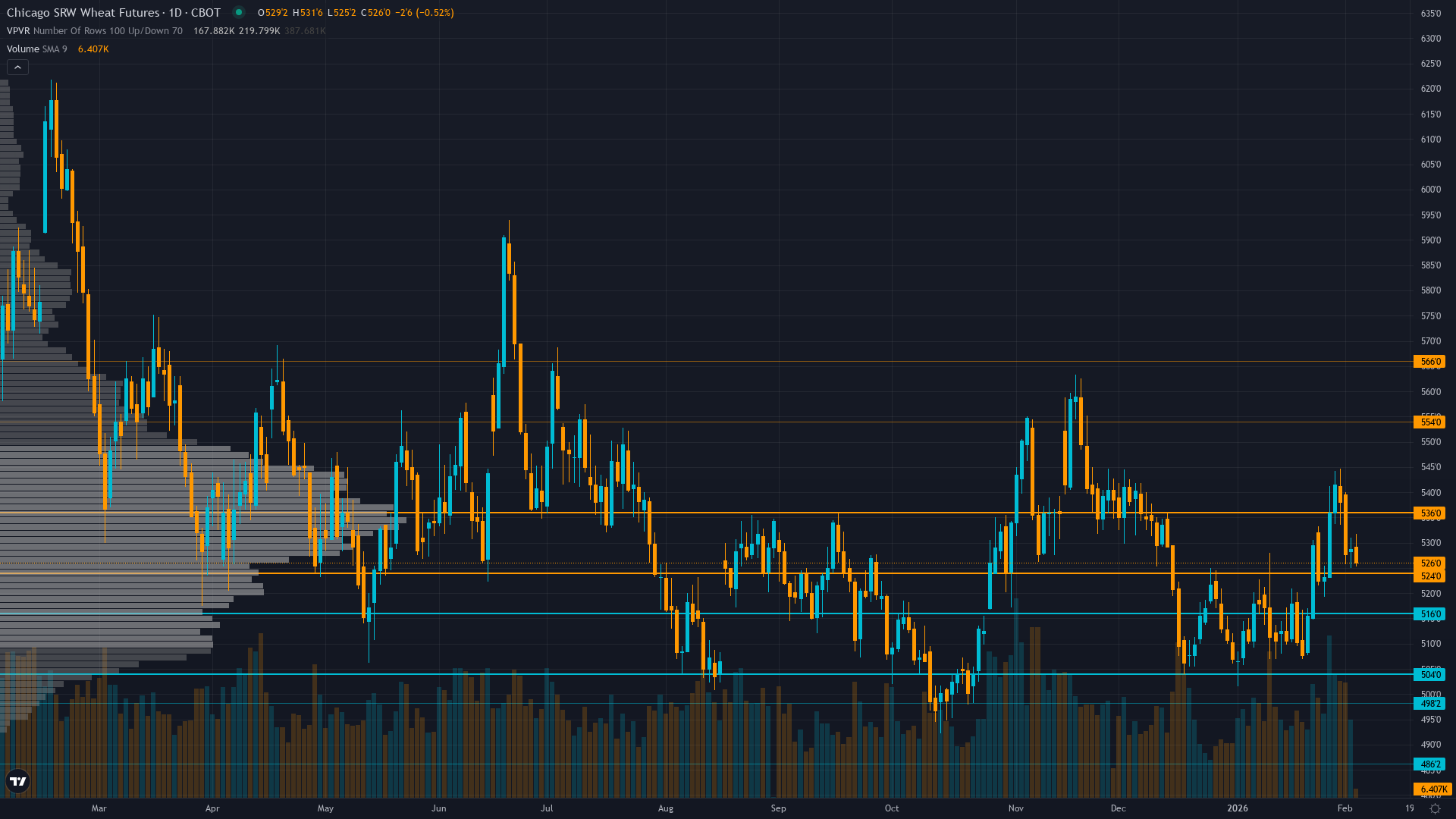
Market consolidating near 518 after recovering from October 492 capitulation lows testing whether February seasonal patterns can maintain momentum against record 1097.8 million ton global oversupply
Extreme positioning dynamics with net shorts at 109,483 contracts as of January 7 creating asymmetric short-covering vulnerability at multi-year lows just 5% above October floor
Black Sea winter weather concerns emerging in late January 2026 with frozen ports and severe cold threatening Russian-Ukrainian winter wheat dormancy reintroducing supply-side risk premiums
| ▲ Resistance Zone 2 | 555.00 – 565.00 |
| ▲ Resistance Zone 1 | 525.00 – 535.00 |
| ─ Pivot Area | ~518.00 |
| ▼ Support Zone 1 | 505.00 – 515.00 |
| ▼ Support Zone 2 | 487.25 – 497.25 |
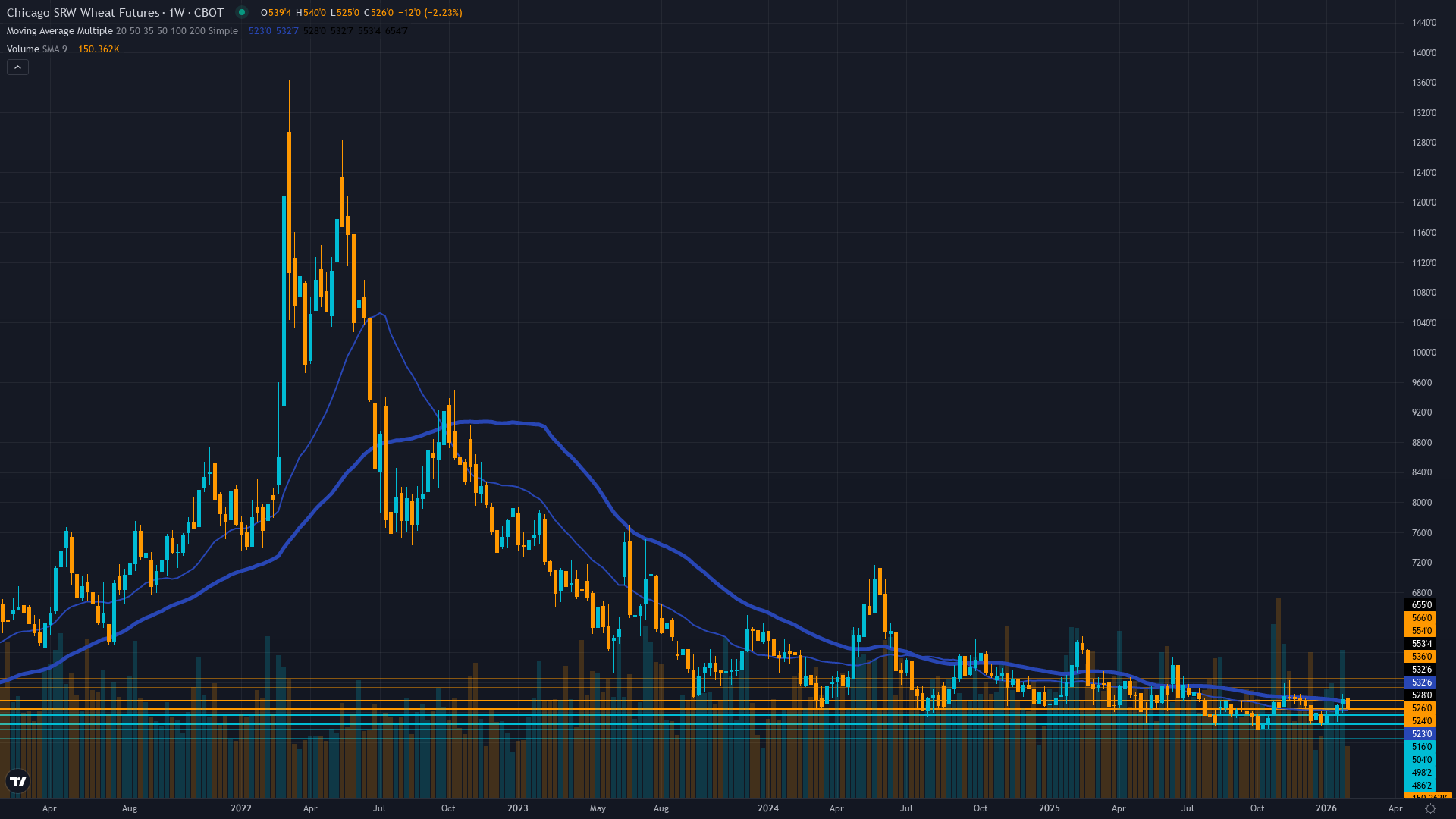
Trading at 518 just 5.2% above October 492 capitulation lows in lower 20th percentile of 52-week range 492-622 attempting stabilization after spectacular November-December seasonal pattern failure
Overwhelmingly bearish with January 12 WASDE confirming global stocks at 276.2 million tons yet strong US export pace at 900 million bushels highest since 2020-21 provides tangible floor around 500-515
Net short 109,483 contracts as of January 7 2026 largest bearish position since October reflecting oversupply consensus but vulnerable to squeeze at extremes
Implied volatility normalizing around 23-24% annualized after October breakdown expansion reflecting market acceptance of oversupply narrative yet readings remain elevated versus prior 18% compression suggesting continued two-way risk
Stable agricultural demand environment unable to absorb record global wheat supply with USD strength creating export headwinds offset by US competitive positioning maintaining 11% global market share
Normalizing - short-term volatility stable around medium-term following October breakdown and January WASDE confirmation with term structure flattening as market finds equilibrium
Post-breakdown volatility typically remains elevated 10-12 weeks before normalizing - current 14-week period since October capitulation suggests volatility normalization underway unless fresh Black Sea weather catalyst triggers new expansion
Volatility expanded from October breakdown through December consolidation now stabilizing around normal range suggesting market acceptance of new lower price equilibrium around 500-520 level with potential for spike if Black Sea weather concerns accelerate or breakdown extends below 500
Daily ranges stable around 10-16 cents suggesting reduced directional conviction near multi-year lows - breakout above 530 or breakdown below 510 would trigger expansion with Black Sea weather developments representing high-impact catalyst for potential volatility spike in either direction
Stable volatility near 52-week lows creates asymmetric setup where unexpected bullish catalyst from Black Sea port disruptions severe Russian winter weather or February WASDE surprises could trigger explosive 10-15% short-covering rally toward 560-575 while downside appears increasingly limited to 492-510 zone by export floor and extreme oversold conditions from October
|
⚠️ Primary Risk
February WASDE confirms continued global oversupply trajectory sending market below 500 psychological support toward breaking October 492 lows as structural bear market extends into 2026 Probability: MEDIUM
|
✦ Primary Opportunity
Black Sea winter weather disruptions combine with February seasonal tailwinds and extreme short positioning at 109,483 contracts to trigger explosive 10-15% short-covering rally toward 560-575 range as capitulation exhaustion sets in Timeframe: Next 2-6 weeks through February WASDE and peak January-February seasonal strength period
|
ZW wheat futures stand at one of the most critical junctures in modern commodity market history on February 1, 2026, trading at 518 cents per bushel after experiencing the most spectacular failure of seasonal patterns on record during November-December 2025 where record 1097.8 million ton global oversupply completely overwhelmed multi-decade calendar effects. The market enters February having staged a November bounce to 541 from the catastrophic October 10-12 breakdown below the psychologically critical 500 level that marked complete capitulation to 52-week lows at 492.25, yet surrendered those gains in December as the January 12 WASDE raised global stocks to 276.2 million tons confirming structural oversupply.
Current positioning shows spec shorts aggressively expanded to 109,483 contracts on January 7—the largest bearish position since October 14—reflecting entrenched oversupply consensus yet creating maximum vulnerability to squeeze dynamics at multi-year lows. The defining narrative: November-December traditionally represent wheat's strongest seasonal period with decades of consistent recoveries from harvest lows, yet 2025 marked the first time in modern history where two consecutive months of peak seasonal strength were completely overwhelmed by fundamental forces as normalized Black Sea exports created regime shift from scarcity to abundance.
However, February 2026 brings emerging developments: Black Sea winter weather with severe cold and frozen ports reintroducing supply-side risks absent for months, winter wheat crop conditions showing stress with 42% of areas in drought per January USDA data, and the market now trading in extreme valuation territory just 5% above multi-year lows. Historical precedent shows wheat in February typically continues January-February recovery patterns, and current positioning at 109,483 net shorts combined with extreme oversold technical conditions creates asymmetric risk profile where unexpected bullish catalysts from Black Sea disruptions, stronger export demand, or February 10 WASDE surprises could trigger explosive 10-15% short-covering rallies toward 560-575 given the crowded short side and stable volatility regime, while downside appears increasingly limited by psychological 500 support and strong 900 million bushel export floor providing tangible fundamental support around 500-515 zone.
The February 10 WASDE emerges as critical catalyst determining whether extreme positioning and seasonal patterns finally establish mean reversion from unprecedented oversupply cycle, or whether structural bear market extends below October lows into new territory.
| Week | Bias | Confidence |
|---|---|---|
| February 1, 2026 | NEUTRAL | 7/10 |
| January 25, 2026 | NEUTRAL | 7/10 |
| January 18, 2026 | NEUTRAL | 7/10 |
| January 11, 2026 | NEUTRAL | 7/10 |
| January 4, 2026 | BEARISH | 7/10 |
| December 28, 2025 | BEARISH | 7/10 |
| December 21, 2025 | BEARISH | 8/10 |
| December 14, 2025 | NEUTRAL | 7/10 |
| December 7, 2025 | NEUTRAL | 7/10 |
| November 30, 2025 | NEUTRAL | 7/10 |
| November 23, 2025 | NEUTRAL | 7/10 |
| November 16, 2025 | BULLISH | 8/10 |