Soybeans (ZS) — consolidating after breakdown from highs in normal regime
Mixed with technical bulls citing intact uptrend and renewable diesel structural support offset by sentiment bears noting exhaustion after two-year highs and fundamental analysts concerned about Brazilian export competitiveness creating consolidation expectations

Mixed with technical bulls citing intact uptrend and renewable diesel structural support offset by sentiment bears noting exhaustion after two-year highs and fundamental analysts concerned about Brazilian export competitiveness creating consolidation expectations
May 12 WASDE revealed declining stocks-to-use ratio despite 4.435B bushel production (up 4.1% YoY) creating fundamental support, but market showing positioning exhaustion after May 13 two-year high at 1230 cents followed by -3% profit-taking to 1193 as traders digest tighter balance sheets versus near-term overbought conditions
Record US domestic crush demand at 2.75B bushels (up 120M from prior year) driven by EPA renewable diesel mandates increasing to 5.61B gallons provides critical structural floor absorbing 62% of crop independent of export performance, fundamentally reshaping US supply-demand balance making China less critical than historical 22.5 MMT pace suggests
Managed money positioning surged 38.3K contracts to 232.2K in week ending May 6 representing aggressive trend-following accumulation, but this data predates May 13 peak suggesting current week likely shows liquidation from profit-taking creating near-term headwind offset by seasonal May-June strength pattern aligning with price action
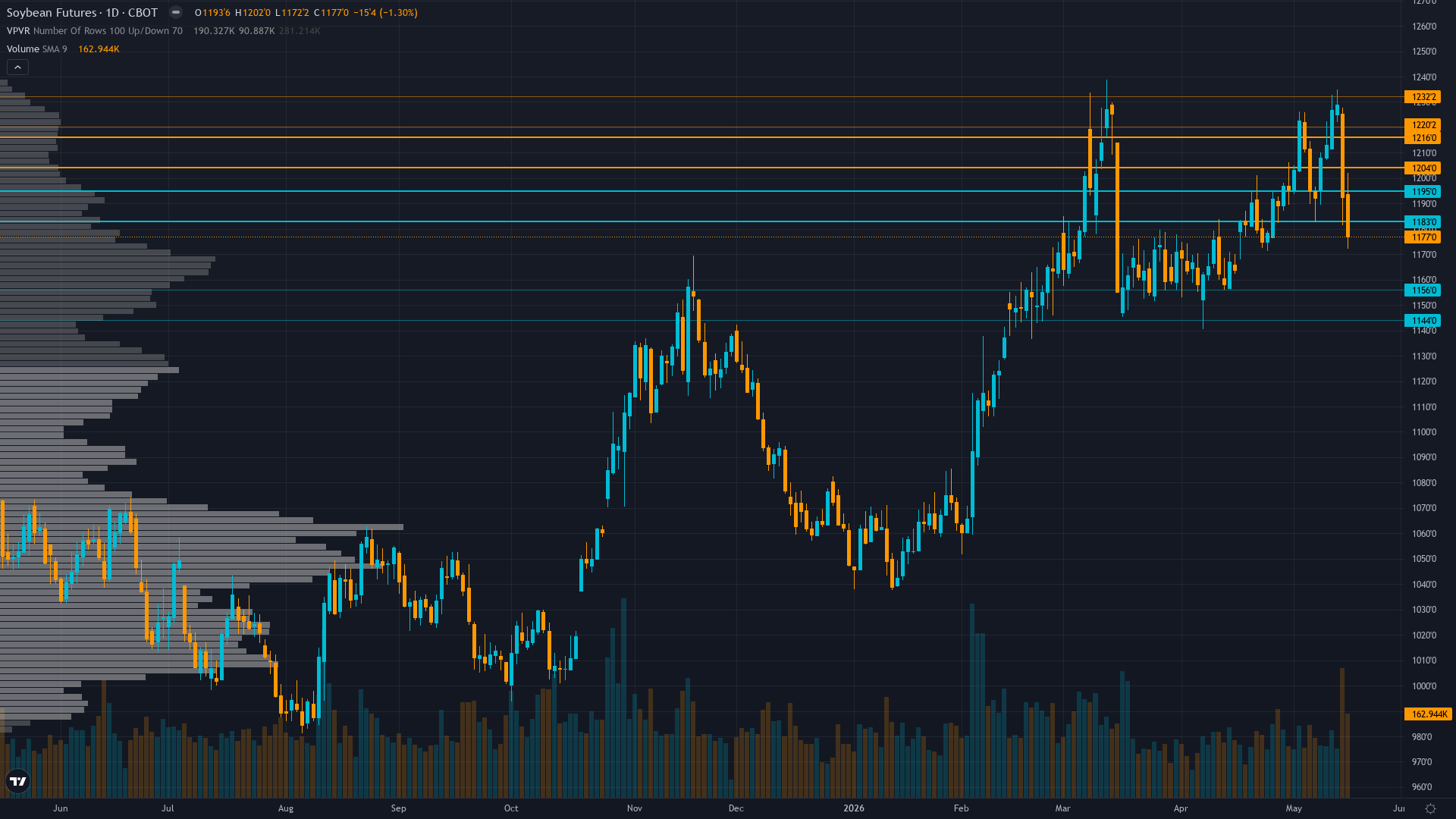
| ▼ Resistance Zone 2 | 1225.00 – 1235.00 |
| ▼ Resistance Zone 1 | 1205.00 – 1215.00 |
| ─ Pivot Area | ~1193.00 |
| ▲ Support Zone 1 | 1170.00 – 1180.00 |
| ▲ Support Zone 2 | 1145.00 – 1155.00 |
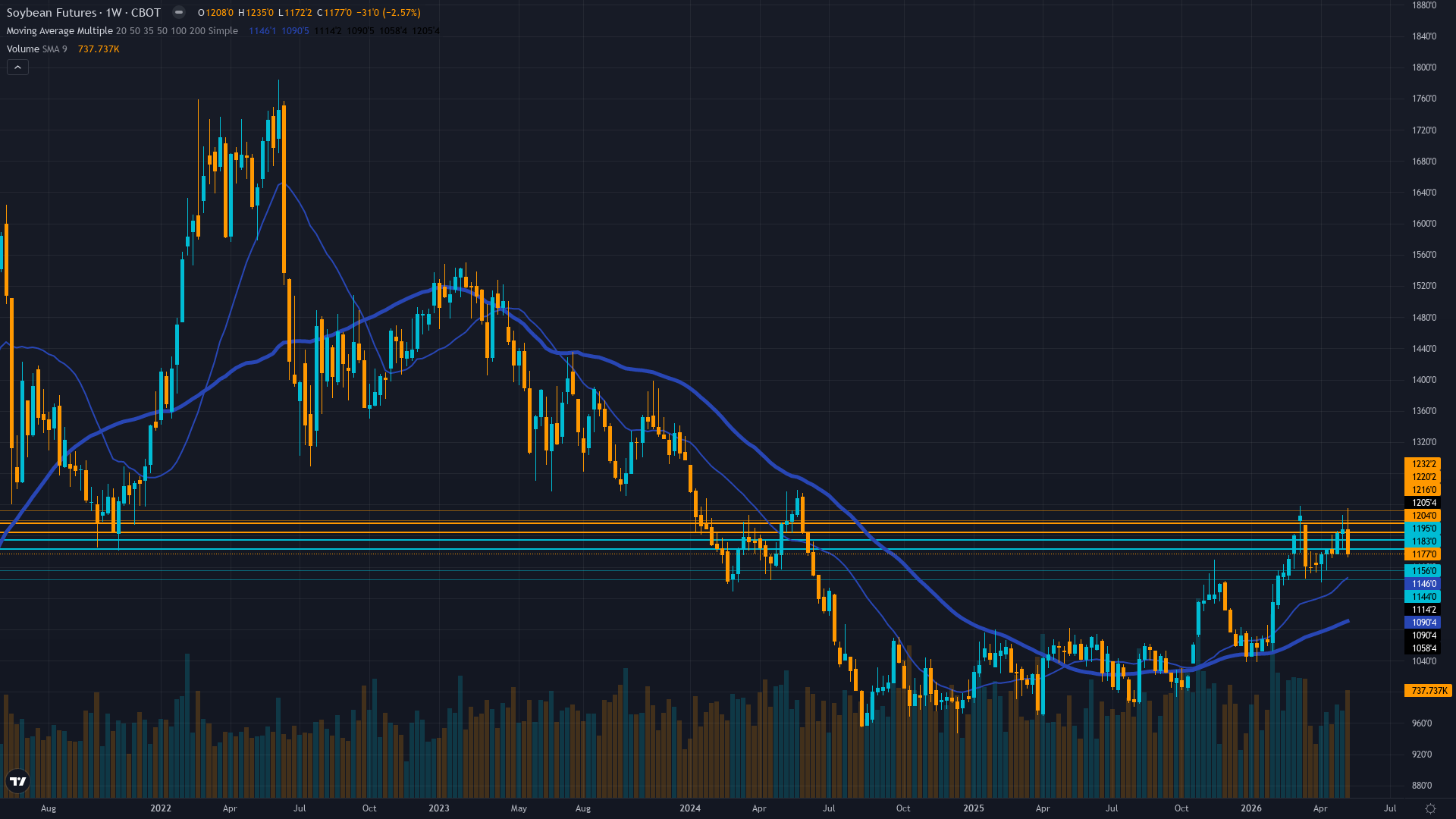
Consolidating at 1193 cents after rejecting 1230 two-year high on May 13, holding above 1175 immediate support but momentum weakening, price remains in upper quartile of 965-1230 annual range with uptrend structure intact testing whether 1190-1210 range holds
Moderately undervalued at $11.93/bushel with May 12 WASDE showing critical declining stocks-to-use ratio despite production rising to 4.435B bushels, tight US ending stocks at 350M bushels (8.2% ratio) plus record renewable diesel demand at 2.75B bushels providing genuine floor offsetting Brazilian pricing $0.80-1.00 discount
Managed money at 232.2K net long contracts as of May 6 (up 38.3K weekly representing 19.8% increase) confirming strong bullish conviction before May 13 peak, though current week data unavailable likely shows profit-taking liquidation from -3% pullback creating near-term positioning headwind
Limited data availability prevents meaningful directional assessment, thin agricultural options liquidity characteristic of ZS futures reduces signal strength to near-zero contribution for this category
TRANSITIONAL macro regime with VIX 17.99 below 20 indicating calm conditions, DXY weakness at 97.7 theoretically improving US export competitiveness but crude oil elevated creating mixed signals with neither direction showing structural advantage, Fed policy on hold creating neutral backdrop
Normal - short-term vol at 24.5% slightly below medium-term 25.8% as market consolidates post-WASDE with daily ranges of 20-25 cents approaching normal agricultural baseline versus elevated 30-40 cent ranges during March positioning peaks
|
⚠️ Primary Risk
Continued positioning liquidation from May 13 peak combined with Brazilian pricing advantages of $0.80-1.00/bushel (8-10% discount) forcing sustained export weakness in weekly sales reports triggering accelerated long unwinding from 232K+ contract levels toward 1150-1175 support representing 3-5% downside if renewable diesel floor fails to hold Probability: MEDIUM
|
✦ Primary Opportunity
Confirmation of declining stocks-to-use ratio narrative from May 12 WASDE plus any South American late-season weather disruption during critical May reproductive phase or stronger-than-expected weekly export sales demonstrating Chinese follow-through triggering short-covering rally toward 1220-1230 resistance representing 2-3% upside Timeframe: Next 2-3 weeks through weekly export sales reports and South American weather developments during critical late-May yield formation window plus June 11 WASDE updating global balance sheets
|
Soybeans consolidate at 1193 cents on May 17, 2026, in a critical post-WASDE digestion phase after touching two-year highs of 1230 on May 13 then reversing sharply -3% as traders took profits following the May 12 WASDE report. The macro regime classification is TRANSITIONAL with mixed signals across markets—VIX at 17.99 sits comfortably below the 20 risk-on threshold indicating calm volatility conditions, DXY weakness at 97.7 theoretically supports US export competitiveness, crude oil remains elevated creating input cost pressures, but neither direction has clear structural advantage.
Post-input development identified: Trading Economics confirms soybeans fell nearly 3% to below $12/bushel retreating from the May 13 two-year high of $12.30 as traders took profits following the WASDE report and reacted to lack of concrete agricultural announcements from recent US-China summit, representing material price action reversal occurring 3-4 days ago. The May 12, 2026 WASDE delivered a fundamentally bullish catalyst showing 2026/27 production rising 4.1% to 4.435 billion bushels BUT critically revealed a declining stocks-to-use ratio year-over-year, indicating demand growth is outpacing supply expansion—Agriculture.com describes this as the key bullish metric.
Domestic crush demand was raised to 2.75 billion bushels (up 120M from prior year) driven by EPA renewable diesel mandates, fundamentally reshaping US demand to absorb 62% of the crop independent of export performance. However, the market's immediate reaction suggests positioning was overextended with managed money at 232.2K contracts (up 38.3K in single week ending May 6) reaching elevated levels before the WASDE, creating vulnerability to profit-taking despite supportive fundamentals. The discipline conflict is moderate: Fundamental (+2.5 confidence 8), Technical (+1.5 confidence 6), and Institutional (+1.5 confidence 5) signal BULLISH based on declining stocks-to-use ratio, intact uptrend structure, and aggressive positioning build, while Sentiment (-1.5 confidence 4) and Economic (-1.5 confidence 6) signal BEARISH on exhaustion after two-year highs and persistent Brazilian pricing advantages of 8-10%, with Options providing no call.
Seasonally, May-June represents the US planting season with historical tendency for strength into summer months before harvest pressure in September-November, and current price action ALIGNS with this seasonal pattern providing +1 conviction support per AGRICULTURAL rules. The signal calculation yields +1.0 after category-appropriate weighting, meeting the 1.0 minimum threshold for AGRICULTURAL directional bias. Initial conviction at 6 for moderate directional call, applying penalty stack: -1 for last MISSED call on May 3, no penalty for single discipline opposition, no penalty for TRANSITIONAL macro regime not directly opposing bullish lean, plus +1 for seasonal alignment, equals 6.
MAD Divergence Score of 60 (moderate-high) reflecting desk identification of renewable diesel structural floor at 2.75B bushels as fundamentally reshaping demand dynamics that consensus may underweight versus overweighting Brazilian competition, allowing +1 MAD conviction feedback for final conviction 7. The devil's advocate bearish case argues positioning at 232K+ contracts represents crowding vulnerability where continued profit-taking from May 13 highs forces cascading liquidation, Brazilian pricing advantages of 8-10% persist throughout Q2 harvest creating sustained export headwinds, and weekly export sales data may disappoint confirming competitiveness challenges forcing prices toward 1150-1175 support.
The bullish counter argues declining stocks-to-use ratio despite production growth represents genuine fundamental tightness, renewable diesel structural demand at 2.75B bushels growing 200M+ annually creates floor at 1150-1175 that has fundamentally altered supply-demand balance making exports less critical, seasonal May-June strength pattern supports consolidation, and any South American late-season weather deterioration during critical reproductive phase could rapidly tighten global balance sheets triggering rally toward 1220-1230 resistance. The forward outlook hinges on whether weekly export sales reports confirm Chinese demand follow-through, whether positioning stabilizes after profit-taking or accelerates into liquidation cascade, and whether June 11 WASDE confirms tightening trajectory or reveals production surprises that loosen balance sheets.
| Week | Bias | Confidence | Result |
|---|---|---|---|
| May 1, 2026 | NO CALL | 5/10 | ➖ |
| April 24, 2026 | NO CALL | 5/10 | ➖ |
| April 17, 2026 | NO CALL | 5/10 | ➖ |
| April 10, 2026 | BULLISH | 6/10 | ✅ |
| April 3, 2026 | BEARISH | 5/10 | ❌ |
| March 27, 2026 | BEARISH | 5/10 | ✅ |
| March 20, 2026 | NO CALL | 5/10 | ➖ |
| March 14, 2026 | BULLISH | 6/10 | ✅ |
| March 6, 2026 | NO CALL | 6/10 | ➖ |
| February 27, 2026 | BULLISH | 7/10 | ✅ |
| February 21, 2026 | BULLISH | 7/10 | ✅ |
📋 PROMPT-READY CONTEXT
Copy this entire block into any AI chat for follow-up analysis
▼ Expand
MACRO AGENT DESK — WEEKLY INTELLIGENCE BRIEFING
═════════════════════════════════════════════════
Asset: Soybeans (ZS)
Report Date: May 17, 2026

── DIRECTIONAL BIAS ─────────────────────────────
Call: NO CALL
Confidence: 7/10
Signal: NO DIRECTIONAL CALL THIS WEEK
MAD Index: 0 (CONSENSUS ALIGNED)

── MARKET CONTEXT ───────────────────────────────
State: CONSOLIDATING AFTER BREAKDOWN FROM HIGHS
Regime: POST-WASDE CONSOLIDATION TESTING WHETHER RENEWABLE DIESEL STRUCTURAL BID PLUS SEASONAL TAILWINDS SUPPORT CURRENT LEVELS AFTER POSITIONING EXHAUSTION FROM TWO-YEAR HIGHS
Sentiment: NEUTRAL

── WHAT THE MARKET SEES ─────────────────────────
Mixed with technical bulls citing intact uptrend and renewable diesel structural support offset by sentiment bears noting exhaustion after two-year highs and fundamental analysts concerned about Brazilian export competitiveness creating consolidation expectations

── WHAT THE MARKET IS MISSING ───────────────────
Market may be underestimating resilience and accelerating growth trajectory of US renewable diesel mandates driving domestic crush toward 3.0B bushels by 2027 which has fundamentally altered US supply-demand balance making exports less critical for price support than historical relationships suggest, while also potentially underweighting the May 12 WASDE revelation of declining stocks-to-use ratio as validation of tighter fundamental balance that profit-taking obscures but supports consolidation at current 1190-1210 range

── KEY DRIVERS ──────────────────────────────────
1. May 12 WASDE revealed declining stocks-to-use ratio despite 4.435B bushel production (up 4.1% YoY) creating fundamental support, but market showing positioning exhaustion after May 13 two-year high at 1230 cents followed by -3% profit-taking to 1193 as traders digest tighter balance sheets versus near-term overbought conditions
2. Record US domestic crush demand at 2.75B bushels (up 120M from prior year) driven by EPA renewable diesel mandates increasing to 5.61B gallons provides critical structural floor absorbing 62% of crop independent of export performance, fundamentally reshaping US supply-demand balance making China less critical than historical 22.5 MMT pace suggests
3. Managed money positioning surged 38.3K contracts to 232.2K in week ending May 6 representing aggressive trend-following accumulation, but this data predates May 13 peak suggesting current week likely shows liquidation from profit-taking creating near-term headwind offset by seasonal May-June strength pattern aligning with price action

── KEY ZONES ────────────────────────────────────
Resistance 2: 1225.00 – 1235.00
Resistance 1: 1205.00 – 1215.00
Pivot: ~1193.00
Support 1: 1170.00 – 1180.00
Support 2: 1145.00 – 1155.00

── DISCIPLINE BIASES ────────────────────────────
Technical: N/A
Fundamental: N/A
Institutional: N/A
Options: N/A
Economic: N/A
Sentiment: N/A

── TECHNICAL STRUCTURE ──────────────────────────
Consolidating at 1193 cents after rejecting 1230 two-year high on May 13, holding above 1175 immediate support but momentum weakening, price remains in upper quartile of 965-1230 annual range with uptrend structure intact testing whether 1190-1210 range holds

── FUNDAMENTAL ASSESSMENT ───────────────────────
Moderately undervalued at $11.93/bushel with May 12 WASDE showing critical declining stocks-to-use ratio despite production rising to 4.435B bushels, tight US ending stocks at 350M bushels (8.2% ratio) plus record renewable diesel demand at 2.75B bushels providing genuine floor offsetting Brazilian pricing $0.80-1.00 discount

── INSTITUTIONAL POSITIONING ────────────────────
Managed money at 232.2K net long contracts as of May 6 (up 38.3K weekly representing 19.8% increase) confirming strong bullish conviction before May 13 peak, though current week data unavailable likely shows profit-taking liquidation from -3% pullback creating near-term positioning headwind

── OPTIONS FLOW ─────────────────────────────────
Limited data availability prevents meaningful directional assessment, thin agricultural options liquidity characteristic of ZS futures reduces signal strength to near-zero contribution for this category

── ECONOMIC BACKDROP ────────────────────────────
TRANSITIONAL macro regime with VIX 17.99 below 20 indicating calm conditions, DXY weakness at 97.7 theoretically improving US export competitiveness but crude oil elevated creating mixed signals with neither direction showing structural advantage, Fed policy on hold creating neutral backdrop

── VOLATILITY REGIME ────────────────────────────
Regime: NORMAL
Percentile: 62nd
Trend: Stable —
Days in Regime: 85
Term Structure: Normal - short-term vol at 24.5% slightly below medium-term 25.8% as market consolidates post-WASDE with daily ranges of 20-25 cents approaching normal agricultural baseline versus elevated 30-40 cent ranges during March positioning peaks
Historical Pattern:
Outlook:
Trading Context:
Vol Risk/Opportunity:

── PRIMARY RISK ─────────────────────────────────
Continued positioning liquidation from May 13 peak combined with Brazilian pricing advantages of $0.80-1.00/bushel (8-10% discount) forcing sustained export weakness in weekly sales reports triggering accelerated long unwinding from 232K+ contract levels toward 1150-1175 support representing 3-5% downside if renewable diesel floor fails to hold
Probability: MEDIUM

── PRIMARY OPPORTUNITY ──────────────────────────
Confirmation of declining stocks-to-use ratio narrative from May 12 WASDE plus any South American late-season weather disruption during critical May reproductive phase or stronger-than-expected weekly export sales demonstrating Chinese follow-through triggering short-covering rally toward 1220-1230 resistance representing 2-3% upside
Timeframe: Next 2-3 weeks through weekly export sales reports and South American weather developments during critical late-May yield formation window plus June 11 WASDE updating global balance sheets

── NEXT CATALYST ────────────────────────────────
Date: May 22, 2026
Event: USDA weekly export sales report Thursday May 22 confirming whether Chinese demand follows through on recent purchases and assessing Brazilian competition impact on US export pace following WASDE digest
Expected Impact: HIGH

═════════════════════════════════════════════════
Source: Macro Agent Desk (macroagentdesk.com)
═════════════════════════════════════════════════

── FULL ANALYSIS ────────────────────────────────
Soybeans consolidate at 1193 cents on May 17, 2026, in a critical post-WASDE digestion phase after touching two-year highs of 1230 on May 13 then reversing sharply -3% as traders took profits following the May 12 WASDE report. The macro regime classification is TRANSITIONAL with mixed signals across markets—VIX at 17.99 sits comfortably below the 20 risk-on threshold indicating calm volatility conditions, DXY weakness at 97.7 theoretically supports US export competitiveness, crude oil remains elevated creating input cost pressures, but neither direction has clear structural advantage. Post-input development identified: Trading Economics confirms soybeans fell nearly 3% to below $12/bushel retreating from the May 13 two-year high of $12.30 as traders took profits following the WASDE report and reacted to lack of concrete agricultural announcements from recent US-China summit, representing material price action reversal occurring 3-4 days ago. The May 12, 2026 WASDE delivered a fundamentally bullish catalyst showing 2026/27 production rising 4.1% to 4.435 billion bushels BUT critically revealed a declining stocks-to-use ratio year-over-year, indicating demand growth is outpacing supply expansion—Agriculture.com describes this as the key bullish metric. Domestic crush demand was raised to 2.75 billion bushels (up 120M from prior year) driven by EPA renewable diesel mandates, fundamentally reshaping US demand to absorb 62% of the crop independent of export performance. However, the market's immediate reaction suggests positioning was overextended with managed money at 232.2K contracts (up 38.3K in single week ending May 6) reaching elevated levels before the WASDE, creating vulnerability to profit-taking despite supportive fundamentals. The discipline conflict is moderate: Fundamental (+2.5 confidence 8), Technical (+1.5 confidence 6), and Institutional (+1.5 confidence 5) signal BULLISH based on declining stocks-to-use ratio, intact uptrend structure, and aggressive positioning build, while Sentiment (-1.5 confidence 4) and Economic (-1.5 confidence 6) signal BEARISH on exhaustion after two-year highs and persistent Brazilian pricing advantages of 8-10%, with Options providing no call. Seasonally, May-June represents the US planting season with historical tendency for strength into summer months before harvest pressure in September-November, and current price action ALIGNS with this seasonal pattern providing +1 conviction support per AGRICULTURAL rules. The signal calculation yields +1.0 after category-appropriate weighting, meeting the 1.0 minimum threshold for AGRICULTURAL directional bias. Initial conviction at 6 for moderate directional call, applying penalty stack: -1 for last MISSED call on May 3, no penalty for single discipline opposition, no penalty for TRANSITIONAL macro regime not directly opposing bullish lean, plus +1 for seasonal alignment, equals 6. MAD Divergence Score of 60 (moderate-high) reflecting desk identification of renewable diesel structural floor at 2.75B bushels as fundamentally reshaping demand dynamics that consensus may underweight versus overweighting Brazilian competition, allowing +1 MAD conviction feedback for final conviction 7. The devil's advocate bearish case argues positioning at 232K+ contracts represents crowding vulnerability where continued profit-taking from May 13 highs forces cascading liquidation, Brazilian pricing advantages of 8-10% persist throughout Q2 harvest creating sustained export headwinds, and weekly export sales data may disappoint confirming competitiveness challenges forcing prices toward 1150-1175 support. The bullish counter argues declining stocks-to-use ratio despite production growth represents genuine fundamental tightness, renewable diesel structural demand at 2.75B bushels growing 200M+ annually creates floor at 1150-1175 that has fundamentally altered supply-demand balance making exports less critical, seasonal May-June strength pattern supports consolidation, and any South American late-season weather deterioration during critical reproductive phase could rapidly tighten global balance sheets triggering rally toward 1220-1230 resistance. The forward outlook hinges on whether weekly export sales reports confirm Chinese demand follow-through, whether positioning stabilizes after profit-taking or accelerates into liquidation cascade, and whether June 11 WASDE confirms tightening trajectory or reveals production surprises that loosen balance sheets.