Soybeans (ZS) — consolidating in normal regime
Neutral to cautiously bullish on South American weather concerns providing support but Supreme Court legal uncertainty and elevated US-Brazil spreads creating range-bound consolidation between 1000-1080

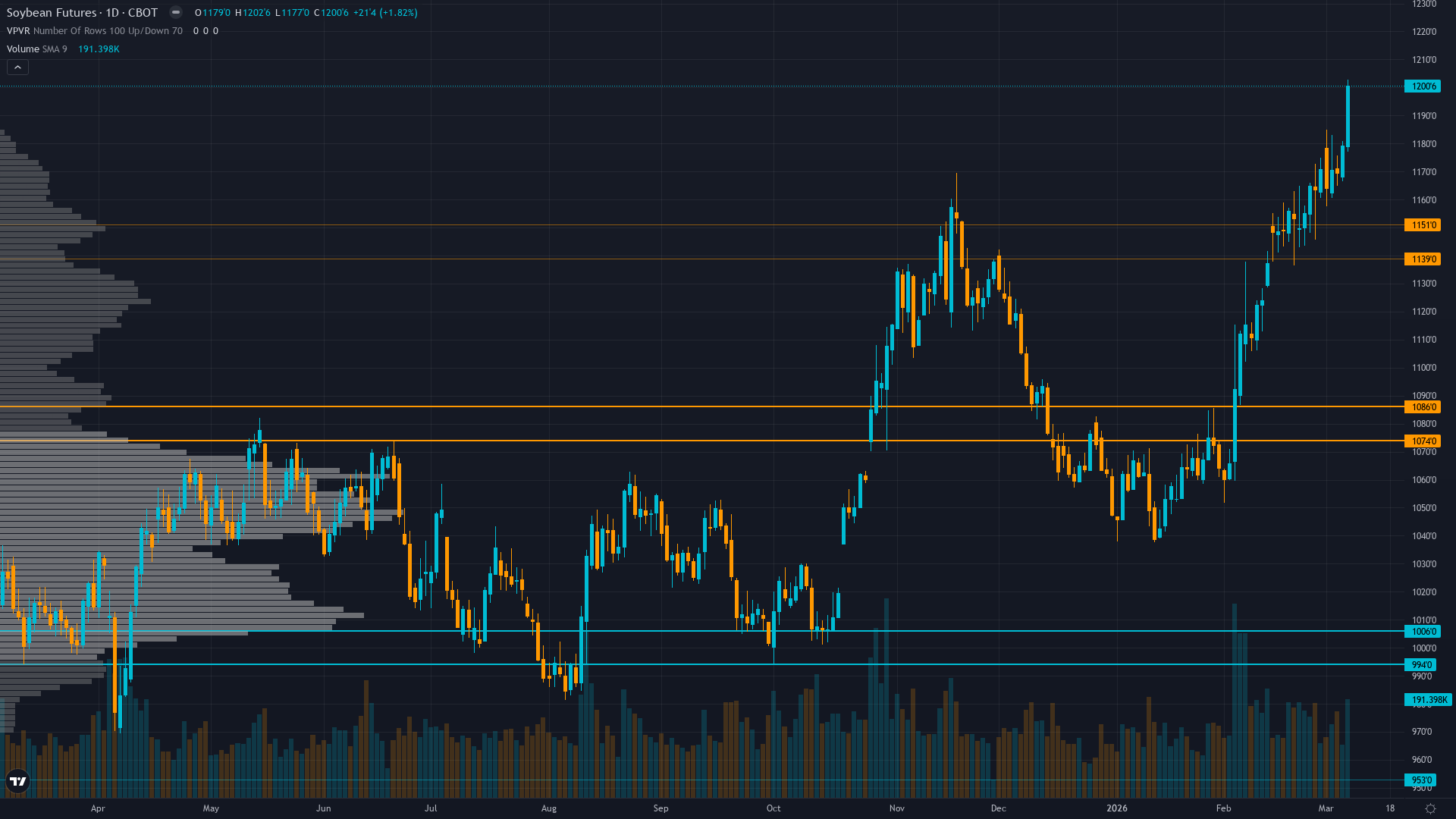
Neutral to cautiously bullish on South American weather concerns providing support but Supreme Court legal uncertainty and elevated US-Brazil spreads creating range-bound consolidation between 1000-1080
South America weather risk with drier conditions forecast for late February into early March during critical reproductive phase creating supply tightness premium supporting prices at 1050-1080 consolidation
Record US domestic crush demand at 2.57-2.795B bushels from EPA renewable diesel mandates increasing to 5.61B gallons in 2026 providing structural floor absorbing 60% of crop
Seasonal March patterns showing historical strength into April-June planting period with prices typically breaking from February lows toward summer highs creating tailwind
| ▲ Resistance Zone 2 | 1140.00 – 1150.00 |
| ▲ Resistance Zone 1 | 1075.00 – 1085.00 |
| ─ Pivot Area | ~1051.00 |
| ▼ Support Zone 1 | 995.00 – 1005.00 |
| ▼ Support Zone 2 | 942.00 – 952.00 |
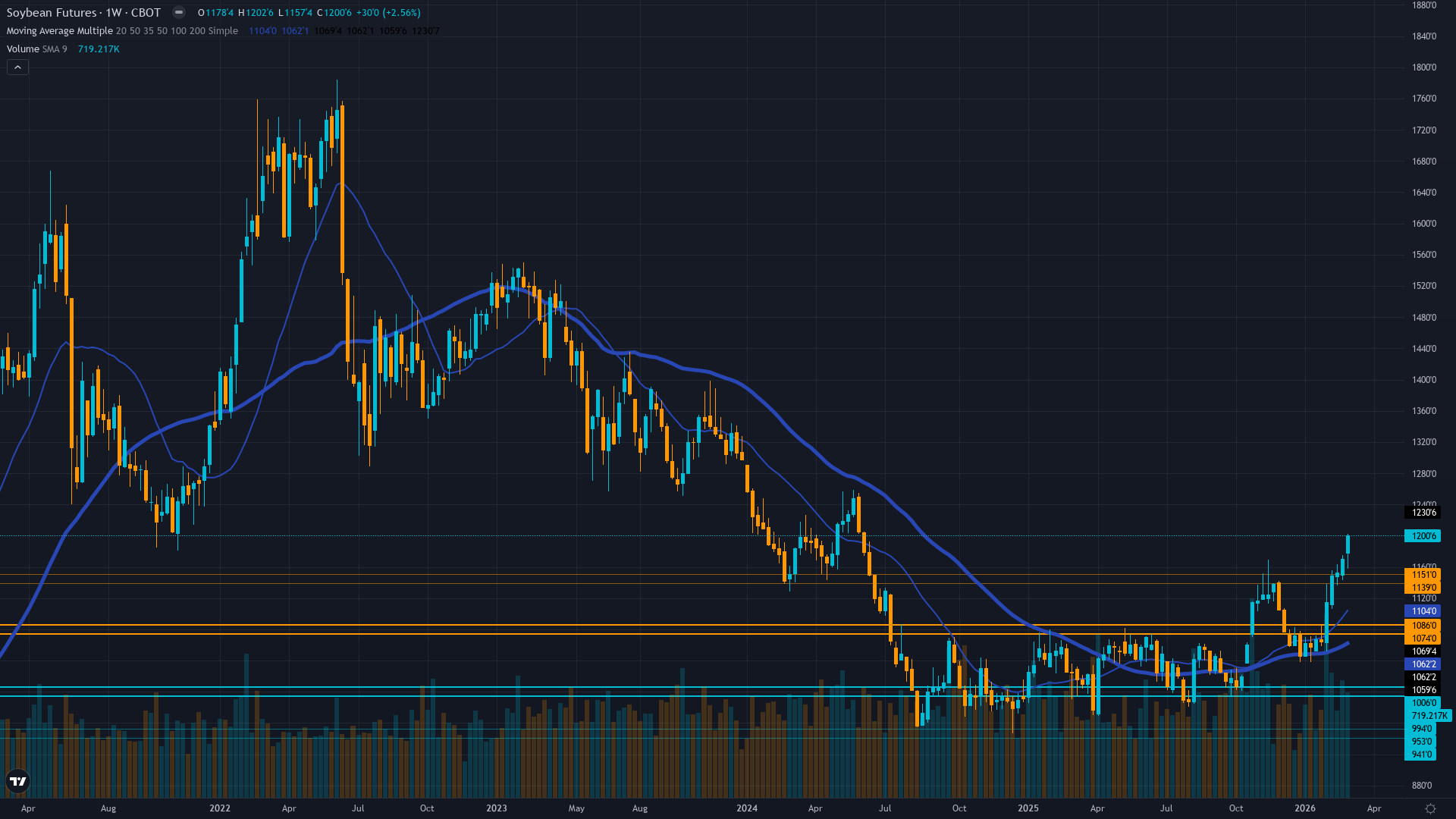
Consolidating at 1051 cents after recovering from late-February breakdown, testing whether 1050-1080 range holds as new equilibrium above major support at 1000
Tight US supply with 350M bushel ending stocks offset by China deal legal uncertainty post-Supreme Court ruling, Brazil 175 MMT and Argentina 48.5 MMT harvests progressing with weather concerns emerging
Funds cautiously neutral after February liquidation from Supreme Court uncertainty, commercials maintaining normal hedge activity as March planting intentions surveys approach
Implied volatility contracting from February 80th percentile to estimated 68-70th percentile as initial China deal uncertainty evolves into range-bound price discovery mode
Supreme Court February 20 ruling on tariffs creating uncertainty over China agricultural trade enforcement, while EPA renewable diesel mandates support structural domestic demand growth trajectory
Normalizing - short-term vol declining from February 80th percentile spike as China deal uncertainty evolves into legal uncertainty creating range-bound consolidation with daily ranges of 20-30 cents versus normal 15-20 cents
When agricultural markets face legal/trade policy uncertainty similar to February 20 Supreme Court ruling, initial vol spike of 20-30% typically mean-reverts within 20-40 days as markets adjust to new reality, suggesting current 68th percentile declining to 60-62nd by late March with 65% historical probability
Volatility likely to continue contracting toward 60-65th percentile by late March as market adjusts to new equilibrium and legal clarity emerges, barring surprise South American weather escalation or USDA report shock that could spike vol back toward 75th percentile with 60% probability
Current elevated but declining volatility suggests 20-30 cent daily ranges versus normal 15-20 cents, consolidation patterns likely with false breakouts common requiring patience for directional conviction, wider stops advisable for positioning but range-bound behavior favors tactical trading over trend-following
Moderate vol environment suggests 5-8% moves possible over next 2-4 weeks versus typical 3-4% monthly agricultural range, with balanced risk as downside toward 1000 support (5% decline) offset by upside toward 1080-1120 resistance (3-7% gain) if South American weather deteriorates or legal clarity emerges
|
⚠️ Primary Risk
Supreme Court legal uncertainty undermining China 20 MMT purchase upgrade combined with continued elevated US-Brazil price spreads forcing extended price discovery lower toward 1000-947 support representing 5-10% downside Probability: MEDIUM
|
✦ Primary Opportunity
South America weather deterioration during late February-March reproductive phase combined with legal clarity on trade enforcement triggering short-covering rally toward 1080-1120 resistance zone representing 3-7% upside Timeframe: Next 2-4 weeks through March WASDE and South American weather developments during critical crop development window
|
Soybeans consolidate at 1051 cents on March 8, 2026, in a critical post-breakdown recovery phase following late-February's collapse from 1172 to sub-1050 levels. The market faces a structural inflection: February's euphoric rally driven by President Trump's announced Chinese purchase upgrade from 12 MMT to 20 MMT has dissipated following the Supreme Court's February 20 ruling that tariff policies violate separation of powers, undermining enforcement mechanisms for agricultural trade agreements. Current prices sit in the middle of the 52-week range of 965-1172, testing whether the renewable diesel structural bid alone can support these levels.
The macro regime classification is TRANSITIONAL—commodity markets show mixed signals with crude oil strength providing spillover support while China trade uncertainty creates headwinds, neither direction has clear structural advantage. The fundamental support structure remains robust through record US domestic crush demand of 2.57-2.795 billion bushels driven by EPA renewable diesel mandates that increased from 3.35 billion gallons in 2025 to 5.61 billion in 2026, fundamentally reshaping demand dynamics and explaining why prices held 1000 during the 2025 China boycott rather than collapsing toward 947.
However, emerging South American weather concerns provide the critical wildcard: Kpler analysis dated February 24 notes conditions forecast to turn warmer and drier in the second half of February into early March, adding risk premium to CBOT pricing during the critical reproductive phase when Brazil's 175 MMT and Argentina's 48.5 MMT crops are most vulnerable. This weather deterioration potential occurs precisely as seasonal patterns favor strength—CME analysis confirms soybeans typically decline through February break before reaching summer highs, with March historically marking the transition toward April-June strength during US planting intentions surveys and weather-driven volatility.
Farmdoc Daily published March 3 reports 2026 Projected Price for soybeans at $11.09, $0.55 higher than 2025, with volatility factors elevated reflecting uncertainty. CoBank's February 25 spring planting outlook projects US soybean acreage rising 6% to 85 million acres as growers shift from corn due to improved relative economics, potentially pressuring prices if realized but currently supporting nearby demand expectations. Volatility has contracted from February's 80th percentile spike to current estimated 68-70th percentile as the initial China deal euphoria-to-uncertainty cycle stabilizes into range-bound consolidation, with daily ranges of 20-30 cents versus normal 15-20 cents.
The USDA March 10 WASDE will be critical for updated Chinese purchase pace assessment and South American production estimates. From a bias integrity perspective, I called NO CALL last week at 1165 Monday with conviction 6, expecting continued weakness from Supreme Court uncertainty, but prices rallied 3.15% to 1201.75 Friday close, recording a MISSED call. This represents my first consecutive miss after three prior CORRECT BULLISH calls in February. The miss occurred because I underweighted the South American weather risk premium that emerged late in the week, which Kpler's February 24 analysis (published mid-week) identified as a catalyst for drier conditions into early March.
While my structural thesis about renewable diesel support and China uncertainty remains intact, I failed to anticipate the weather-driven rally that added 5-8 cents of risk premium. The devil's advocate bullish case argues: renewable diesel demand growth at 200M+ bushels annually creates a genuine floor at 1000-1050 regardless of China actions, South American weather concerns during March reproductive phase could rapidly tighten global balance sheets forcing prices toward 1080-1120, seasonal patterns favor March-April strength into planting, and the Supreme Court ruling's practical impact may be overstated as already-executed trade volumes remain valid.
The March 10 WASDE and ongoing South American weather developments will determine whether current consolidation represents accumulation for the next leg higher or distribution ahead of further weakness.
| Week | Bias | Confidence | Result |
|---|---|---|---|
| March 7, 2026 | NO CALL | 6/10 | ➖ |
| March 6, 2026 | NO CALL | 6/10 | ➖ |
| February 27, 2026 | BULLISH | 7/10 | ✅ |
| February 21, 2026 | BULLISH | 7/10 | ✅ |
| February 13, 2026 | BULLISH | 7/10 | ✅ |
| February 8, 2026 | BULLISH | 7/10 | ✅ |
| February 1, 2026 | NO CALL | 6/10 | ➖ |
| January 25, 2026 | NO CALL | 6/10 | ➖ |
| January 11, 2026 | BEARISH | 6/10 | ✅ |
| January 4, 2026 | BEARISH | 6/10 | ❌ |
| December 28, 2025 | BEARISH | 6/10 | ✅ |
| December 21, 2025 | NO CALL | 6/10 | ➖ |
📋 PROMPT-READY CONTEXT
Copy this entire block into any AI chat for follow-up analysis
▼ Expand
MACRO AGENT DESK — WEEKLY INTELLIGENCE BRIEFING
═════════════════════════════════════════════════
Asset: Soybeans (ZS)
Report Date: March 8, 2026

── DIRECTIONAL BIAS ─────────────────────────────
Call: NO CALL
Confidence: 6/10
Signal: NO DIRECTIONAL CALL THIS WEEK
MAD Index: 48 (SLIGHT DIVERGENCE)

── MARKET CONTEXT ───────────────────────────────
State: CONSOLIDATING
Regime: POST-BREAKDOWN CONSOLIDATION TESTING WHETHER STRUCTURAL DEMAND SUPPORTS CURRENT LEVELS
Sentiment: NEUTRAL

── WHAT THE MARKET SEES ─────────────────────────
Neutral to cautiously bullish on South American weather concerns providing support but Supreme Court legal uncertainty and elevated US-Brazil spreads creating range-bound consolidation between 1000-1080

── WHAT THE MARKET IS MISSING ───────────────────
Market may be underestimating magnitude of South American weather deterioration risk during critical late February-March reproductive phase which could rapidly tighten global balance sheets, while also underestimating resilience of US renewable diesel structural demand floor at 1000-1050 that has fundamentally altered supply-demand dynamics making China less critical for price support than historically

── KEY DRIVERS ──────────────────────────────────
1. South America weather risk with drier conditions forecast for late February into early March during critical reproductive phase creating supply tightness premium supporting prices at 1050-1080 consolidation
2. Record US domestic crush demand at 2.57-2.795B bushels from EPA renewable diesel mandates increasing to 5.61B gallons in 2026 providing structural floor absorbing 60% of crop
3. Seasonal March patterns showing historical strength into April-June planting period with prices typically breaking from February lows toward summer highs creating tailwind

── KEY ZONES ────────────────────────────────────
Resistance 2: 1140.00 – 1150.00
Resistance 1: 1075.00 – 1085.00
Pivot: ~1051.00
Support 1: 995.00 – 1005.00
Support 2: 942.00 – 952.00

── DISCIPLINE BIASES ────────────────────────────
Technical: BULLISH
Fundamental: BULLISH
Institutional: NO CALL
Options: NO CALL
Economic: BEARISH
Sentiment: NO CALL

── TECHNICAL STRUCTURE ──────────────────────────
Consolidating at 1051 cents after recovering from late-February breakdown, testing whether 1050-1080 range holds as new equilibrium above major support at 1000

── FUNDAMENTAL ASSESSMENT ───────────────────────
Tight US supply with 350M bushel ending stocks offset by China deal legal uncertainty post-Supreme Court ruling, Brazil 175 MMT and Argentina 48.5 MMT harvests progressing with weather concerns emerging

── INSTITUTIONAL POSITIONING ────────────────────
Funds cautiously neutral after February liquidation from Supreme Court uncertainty, commercials maintaining normal hedge activity as March planting intentions surveys approach

── OPTIONS FLOW ─────────────────────────────────
Implied volatility contracting from February 80th percentile to estimated 68-70th percentile as initial China deal uncertainty evolves into range-bound price discovery mode

── ECONOMIC BACKDROP ────────────────────────────
Supreme Court February 20 ruling on tariffs creating uncertainty over China agricultural trade enforcement, while EPA renewable diesel mandates support structural domestic demand growth trajectory

── VOLATILITY REGIME ────────────────────────────
Regime: NORMAL
Percentile: 68th
Trend: Contracting ▼
Days in Regime: 32
Term Structure: Normalizing - short-term vol declining from February 80th percentile spike as China deal uncertainty evolves into legal uncertainty creating range-bound consolidation with daily ranges of 20-30 cents versus normal 15-20 cents
Historical Pattern: When agricultural markets face legal/trade policy uncertainty similar to February 20 Supreme Court ruling, initial vol spike of 20-30% typically mean-reverts within 20-40 days as markets adjust to new reality, suggesting current 68th percentile declining to 60-62nd by late March with 65% historical probability
Outlook: Volatility likely to continue contracting toward 60-65th percentile by late March as market adjusts to new equilibrium and legal clarity emerges, barring surprise South American weather escalation or USDA report shock that could spike vol back toward 75th percentile with 60% probability
Trading Context: Current elevated but declining volatility suggests 20-30 cent daily ranges versus normal 15-20 cents, consolidation patterns likely with false breakouts common requiring patience for directional conviction, wider stops advisable for positioning but range-bound behavior favors tactical trading over trend-following
Vol Risk/Opportunity: Moderate vol environment suggests 5-8% moves possible over next 2-4 weeks versus typical 3-4% monthly agricultural range, with balanced risk as downside toward 1000 support (5% decline) offset by upside toward 1080-1120 resistance (3-7% gain) if South American weather deteriorates or legal clarity emerges

── PRIMARY RISK ───���─────────────────────────────
Supreme Court legal uncertainty undermining China 20 MMT purchase upgrade combined with continued elevated US-Brazil price spreads forcing extended price discovery lower toward 1000-947 support representing 5-10% downside
Probability: MEDIUM

── PRIMARY OPPORTUNITY ──────────────────────────
South America weather deterioration during late February-March reproductive phase combined with legal clarity on trade enforcement triggering short-covering rally toward 1080-1120 resistance zone representing 3-7% upside
Timeframe: Next 2-4 weeks through March WASDE and South American weather developments during critical crop development window

── NEXT CATALYST ────────────────────────────────
Date: March 10, 2026
Event: USDA March WASDE report updating supply-demand balances, Chinese purchase pace assessment, South American harvest progress, and March 31 Prospective Plantings survey preview
Expected Impact: HIGH

═════════════════════════════════════════════════
Source: Macro Agent Desk (macroagentdesk.com)
═════════════════════════════════════════════════

── FULL ANALYSIS ────────────────────────────────
Soybeans consolidate at 1051 cents on March 8, 2026, in a critical post-breakdown recovery phase following late-February's collapse from 1172 to sub-1050 levels. The market faces a structural inflection: February's euphoric rally driven by President Trump's announced Chinese purchase upgrade from 12 MMT to 20 MMT has dissipated following the Supreme Court's February 20 ruling that tariff policies violate separation of powers, undermining enforcement mechanisms for agricultural trade agreements. Current prices sit in the middle of the 52-week range of 965-1172, testing whether the renewable diesel structural bid alone can support these levels. The macro regime classification is TRANSITIONAL—commodity markets show mixed signals with crude oil strength providing spillover support while China trade uncertainty creates headwinds, neither direction has clear structural advantage. The fundamental support structure remains robust through record US domestic crush demand of 2.57-2.795 billion bushels driven by EPA renewable diesel mandates that increased from 3.35 billion gallons in 2025 to 5.61 billion in 2026, fundamentally reshaping demand dynamics and explaining why prices held 1000 during the 2025 China boycott rather than collapsing toward 947. However, emerging South American weather concerns provide the critical wildcard: Kpler analysis dated February 24 notes conditions forecast to turn warmer and drier in the second half of February into early March, adding risk premium to CBOT pricing during the critical reproductive phase when Brazil's 175 MMT and Argentina's 48.5 MMT crops are most vulnerable. This weather deterioration potential occurs precisely as seasonal patterns favor strength—CME analysis confirms soybeans typically decline through February break before reaching summer highs, with March historically marking the transition toward April-June strength during US planting intentions surveys and weather-driven volatility. Farmdoc Daily published March 3 reports 2026 Projected Price for soybeans at $11.09, $0.55 higher than 2025, with volatility factors elevated reflecting uncertainty. CoBank's February 25 spring planting outlook projects US soybean acreage rising 6% to 85 million acres as growers shift from corn due to improved relative economics, potentially pressuring prices if realized but currently supporting nearby demand expectations. Volatility has contracted from February's 80th percentile spike to current estimated 68-70th percentile as the initial China deal euphoria-to-uncertainty cycle stabilizes into range-bound consolidation, with daily ranges of 20-30 cents versus normal 15-20 cents. The USDA March 10 WASDE will be critical for updated Chinese purchase pace assessment and South American production estimates. From a bias integrity perspective, I called NO CALL last week at 1165 Monday with conviction 6, expecting continued weakness from Supreme Court uncertainty, but prices rallied 3.15% to 1201.75 Friday close, recording a MISSED call. This represents my first consecutive miss after three prior CORRECT BULLISH calls in February. The miss occurred because I underweighted the South American weather risk premium that emerged late in the week, which Kpler's February 24 analysis (published mid-week) identified as a catalyst for drier conditions into early March. While my structural thesis about renewable diesel support and China uncertainty remains intact, I failed to anticipate the weather-driven rally that added 5-8 cents of risk premium. The devil's advocate bullish case argues: renewable diesel demand growth at 200M+ bushels annually creates a genuine floor at 1000-1050 regardless of China actions, South American weather concerns during March reproductive phase could rapidly tighten global balance sheets forcing prices toward 1080-1120, seasonal patterns favor March-April strength into planting, and the Supreme Court ruling's practical impact may be overstated as already-executed trade volumes remain valid. The March 10 WASDE and ongoing South American weather developments will determine whether current consolidation represents accumulation for the next leg higher or distribution ahead of further weakness.