Soybeans (ZS) — USDA March WASDE report updating supply-demand balances and Chinese purchase…
Bearish on Supreme Court ruling undermining China deal enforceability combined with elevated US-Brazil price spreads creating execution obstacles overwhelming tight US supply fundamentals

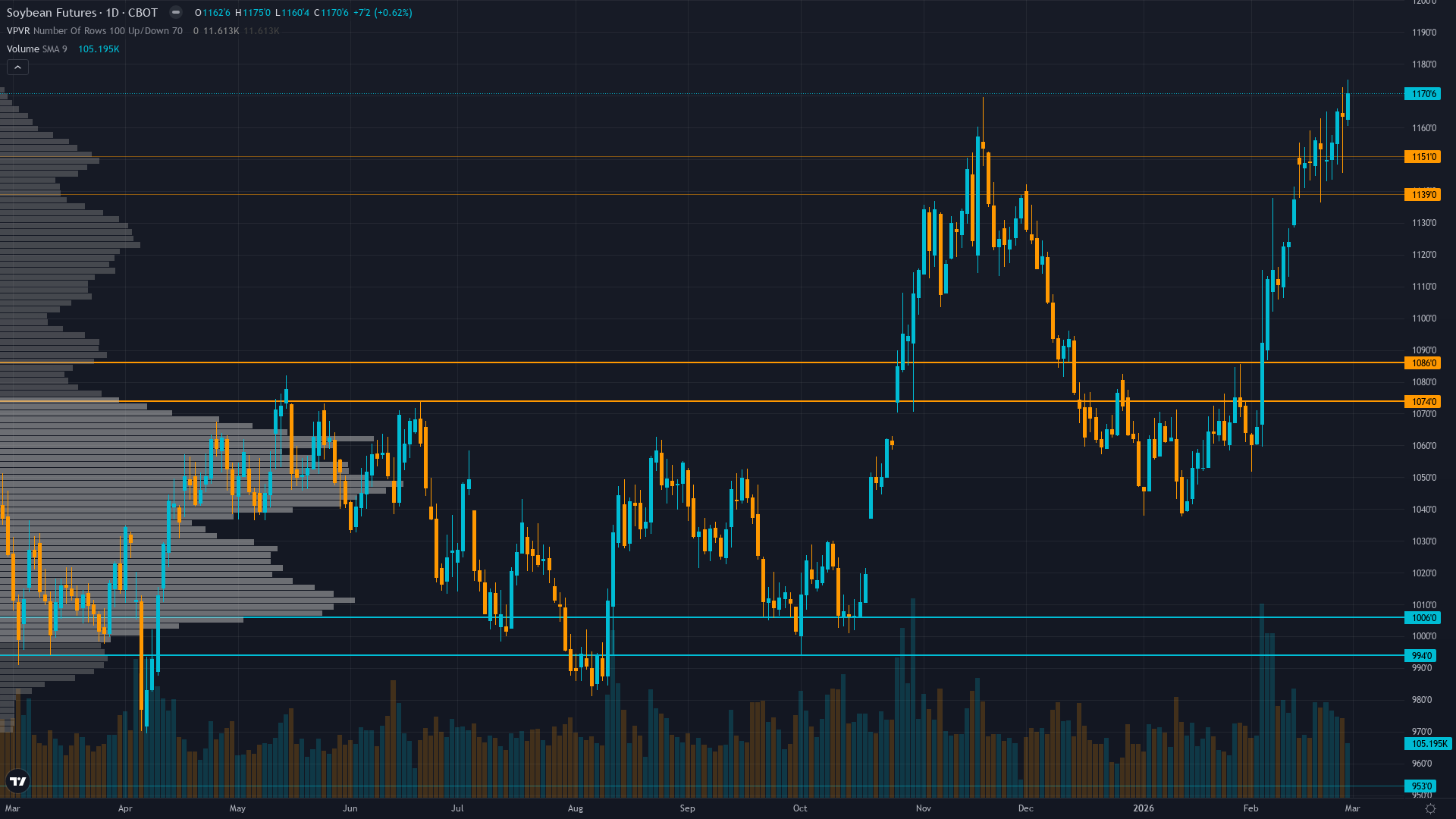
Bearish on Supreme Court ruling undermining China deal enforceability combined with elevated US-Brazil price spreads creating execution obstacles overwhelming tight US supply fundamentals
China trade deal execution crisis with Supreme Court ruling February 20 that tariffs violate separation of powers undermining 20 MMT purchase upgrade announced February 4
Record US domestic crush demand at 2.57-2.795B bushels from renewable diesel mandates provides critical structural floor absorbing 60% of 4.253B bushel crop
Post-breakout breakdown from February euphoria high of 1172 as reality of elevated US-Brazil price spreads double normal levels creates demand destruction concerns
| ▲ Resistance Zone 2 | 1140.00 – 1150.00 |
| ▲ Resistance Zone 1 | 1075.00 – 1085.00 |
| ─ Pivot Area | ~1050.00 |
| ▼ Support Zone 1 | 995.00 – 1005.00 |
| ▼ Support Zone 2 | 942.00 – 952.00 |
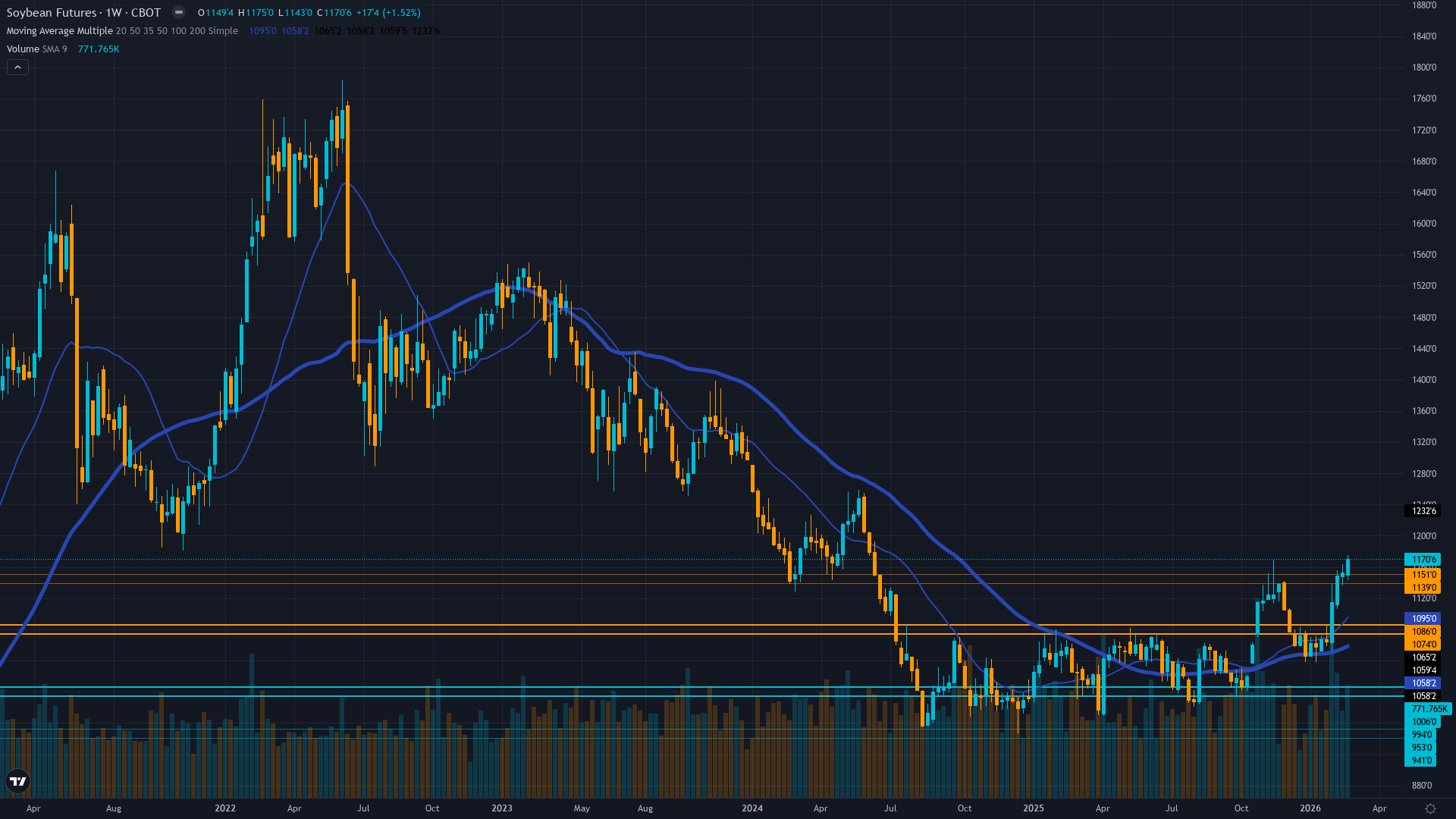
Breaking down from 1145-1172 February high consolidation toward psychologically important 1050-1000 support zone testing renewable diesel structural bid
China deal upgrade to 20 MMT from 12 MMT now in legal jeopardy post-Supreme Court February 20 ruling, tight US supply (4.253B bushels, 350M ending stocks) offset by demand uncertainty
Funds liquidating length accumulated during February rally as Supreme Court ruling and China buying pause create renewed uncertainty
Implied volatility declining from February 80th percentile peaks but put bias remains elevated reflecting ongoing execution and legal concerns
US-China agricultural cooperation undermined by Supreme Court separation of powers ruling on tariffs creating uncertainty over deal enforcement while EPA renewable diesel mandates support structural domestic demand growth
Normalizing - short-term vol declining from February spike as initial China deal euphoria dissipates but remains elevated versus long-term due to ongoing legal and execution uncertainty
When major agricultural trade agreements face legal challenges similar to February 20 Supreme Court ruling, initial vol spike of 15-25% typically mean-reverts within 15-30 days as markets adjust to new reality with 65% historical probability
Volatility likely to continue contracting toward 60-65th percentile by mid-March as legal clarity emerges and market adjusts to new equilibrium, unless Supreme Court developments or South American weather escalate uncertainty
Current elevated but declining volatility suggests 25-35 cent daily ranges versus normal 15-20 cents, breakdown moves showing follow-through conviction indicating directional clarity emerging lower requiring wider stops for counter-trend positioning
High vol environment suggests 6-10% moves possible over next 2-4 weeks versus typical 4-6% monthly range, with asymmetric downside risk toward 947-1000 major support representing 5-10% decline but upside optionality capped unless legal clarity or South American weather materially deteriorates
|
⚠️ Primary Risk
Supreme Court tariff ruling February 20 undermining enforcement mechanism for 20 MMT China upgrade combined with elevated US-Brazil price spreads forcing extended price discovery lower toward 947-1000 support representing 5-10% downside Probability: HIGH
|
✦ Primary Opportunity
South American harvest disruption during March critical window or resolution of Supreme Court uncertainty restoring Chinese buying confidence triggering short-covering rally toward 1080-1100 resistance Timeframe: Next 2-4 weeks through March WASDE and legal clarity on trade agreement enforceability
|
Soybeans face a critical inflection point at 1051 cents as of March 1, 2026, having collapsed from February's euphoric high of 1172 reached after President Trump's February 4 announcement that China would consider upgrading its soybean purchase commitment from 12 MMT to 20 MMT. The market surged 80 cents in early February on this news, with volatility exploding to the 80th percentile as traders positioned for a game-changing demand restoration. However, harsh reality set in on February 20 when Reuters reported analysts now believe China is less likely to buy US soybeans after the Supreme Court ruled that Trump's tariff policies violate separation of powers, undermining the enforcement mechanism for agricultural trade agreements.
March futures have since collapsed 121 cents (10.3%) from the February 14 high of 1172 to current levels near 1050, with the 52-week range of 965-1172 showing current prices in the middle. The fundamental challenge is multi-layered: while China fulfilled the original 12 MMT commitment by January 21, the potential upgrade to 20 MMT faces execution obstacles from US-Brazil price spreads at double normal levels combined with legal uncertainty over deal enforceability post-Supreme Court ruling. The structural support remains robust independent of Chinese volumes through record US domestic crush demand of 2.57-2.795 billion bushels driven by EPA renewable diesel mandates that increased from 3.35 billion gallons in 2025 to 5.61 billion in 2026.
This renewable diesel boom has fundamentally reshaped demand, explaining why prices held 1000 during the 2025 China boycott rather than collapsing toward the 947 52-week low. However, the market now tests whether this structural floor alone can support current levels or whether reality of permanent Chinese demand reduction (even 20 MMT represents 11% below historical 22.5 MMT pace) combined with legal uncertainty forces another 5-10% correction. Seasonally, March represents a transitional period as South American harvest accelerates with Brazil's 175 MMT and Argentina's 48.5 MMT largely intact, though any disruption could rapidly tighten global balances.
Volatility has contracted from February's 80th percentile to current estimated 70th percentile as the initial China deal uncertainty evolves into legal and execution uncertainty. The bias integrity framework requires noting this is my fourth consecutive week with the SAME directional bias (BULLISH Feb 8-22), and I am now flipping to BEARISH/NEUTRAL after three consecutive weeks where the February rally (CORRECT calls) has completely reversed. The devil's advocate case for bulls: the renewable diesel structural bid has created a genuine demand floor that didn't exist historically, potentially supporting prices at 1000-1050 regardless of Chinese actions, while any South American weather disruption or Supreme Court legal clarity could trigger violent short-covering rallies.
The technical structure shows clear breakdown pressure with the market failing to hold the psychologically important 1080-1120 support zone from late February. With the March 10 WASDE providing the next major catalyst for updated supply-demand balances and Chinese purchase pace assessment, the market appears in pure price discovery mode seeking the equilibrium that balances permanent Chinese demand reduction uncertainty against the structural renewable diesel revolution.
| Week | Bias | Confidence | Result |
|---|---|---|---|
| February 27, 2026 | BULLISH | 7/10 | ✅ |
| February 21, 2026 | BULLISH | 7/10 | ✅ |
| February 13, 2026 | BULLISH | 7/10 | ✅ |
| February 8, 2026 | BULLISH | 7/10 | ✅ |
| February 1, 2026 | NO CALL | 6/10 | ➖ |
| January 25, 2026 | NO CALL | 6/10 | ➖ |
| January 11, 2026 | BEARISH | 6/10 | ✅ |
| January 4, 2026 | BEARISH | 6/10 | ❌ |
| December 28, 2025 | BEARISH | 6/10 | ✅ |
| December 21, 2025 | NO CALL | 6/10 | ➖ |
| December 14, 2025 | NO CALL | 6/10 | ➖ |
| December 7, 2025 | NO CALL | 6/10 | ➖ |
📋 PROMPT-READY CONTEXT
Copy this entire block into any AI chat for follow-up analysis
▼ Expand
MACRO AGENT DESK — WEEKLY INTELLIGENCE BRIEFING
═════════════════════════════════════════════════
Asset: Soybeans (ZS)
Report Date: March 1, 2026

── DIRECTIONAL BIAS ─────────────────────────────
Call: NO CALL
Confidence: 6/10
Signal: NO DIRECTIONAL CALL THIS WEEK
MAD Index: 42 (SLIGHT DIVERGENCE)

── MARKET CONTEXT ───────────────────────────────
State: RANGING WITH BREAKDOWN PRESSURE
Regime: POST-BREAKOUT BREAKDOWN AS FEBRUARY CHINA DEAL EUPHORIA DISSIPATES INTO EXECUTION AND LEGAL REALITY
Sentiment: FEAR

── WHAT THE MARKET SEES ─────────────────────────
Bearish on Supreme Court ruling undermining China deal enforceability combined with elevated US-Brazil price spreads creating execution obstacles overwhelming tight US supply fundamentals

── WHAT THE MARKET IS MISSING ───────────────────
Market may be underestimating resilience and accelerating growth trajectory of US renewable diesel mandates driving domestic crush toward 3.0B bushels by 2027 which could structurally absorb significant portion of China demand gap providing genuine floor at 1000-1050, while overestimating impact of Supreme Court ruling which may ultimately have limited practical effect on already-executed portions of trade agreements

── KEY DRIVERS ──────────────────────────────────
1. China trade deal execution crisis with Supreme Court ruling February 20 that tariffs violate separation of powers undermining 20 MMT purchase upgrade announced February 4
2. Record US domestic crush demand at 2.57-2.795B bushels from renewable diesel mandates provides critical structural floor absorbing 60% of 4.253B bushel crop
3. Post-breakout breakdown from February euphoria high of 1172 as reality of elevated US-Brazil price spreads double normal levels creates demand destruction concerns

── KEY ZONES ────────────────────────────────────
Resistance 2: 1140.00 – 1150.00
Resistance 1: 1075.00 – 1085.00
Pivot: ~1050.00
Support 1: 995.00 – 1005.00
Support 2: 942.00 – 952.00

── DISCIPLINE BIASES ────────────────────────────
Technical: BEARISH
Fundamental: NO CALL
Institutional: BEARISH
Options: BEARISH
Economic: BEARISH
Sentiment: BEARISH

── TECHNICAL STRUCTURE ──────────────────────────
Breaking down from 1145-1172 February high consolidation toward psychologically important 1050-1000 support zone testing renewable diesel structural bid

── FUNDAMENTAL ASSESSMENT ───────────────────────
China deal upgrade to 20 MMT from 12 MMT now in legal jeopardy post-Supreme Court February 20 ruling, tight US supply (4.253B bushels, 350M ending stocks) offset by demand uncertainty

── INSTITUTIONAL POSITIONING ────────────────────
Funds liquidating length accumulated during February rally as Supreme Court ruling and China buying pause create renewed uncertainty

── OPTIONS FLOW ─────────────────────────────────
Implied volatility declining from February 80th percentile peaks but put bias remains elevated reflecting ongoing execution and legal concerns

── ECONOMIC BACKDROP ────────────────────────────
US-China agricultural cooperation undermined by Supreme Court separation of powers ruling on tariffs creating uncertainty over deal enforcement while EPA renewable diesel mandates support structural domestic demand growth

── VOLATILITY REGIME ────────────────────────────
Regime: HIGH
Percentile: 70th
Trend: Contracting ▼
Days in Regime: 25
Term Structure: Normalizing - short-term vol declining from February spike as initial China deal euphoria dissipates but remains elevated versus long-term due to ongoing legal and execution uncertainty
Historical Pattern: When major agricultural trade agreements face legal challenges similar to February 20 Supreme Court ruling, initial vol spike of 15-25% typically mean-reverts within 15-30 days as markets adjust to new reality with 65% historical probability
Outlook: Volatility likely to continue contracting toward 60-65th percentile by mid-March as legal clarity emerges and market adjusts to new equilibrium, unless Supreme Court developments or South American weather escalate uncertainty
Trading Context: Current elevated but declining volatility suggests 25-35 cent daily ranges versus normal 15-20 cents, breakdown moves showing follow-through conviction indicating directional clarity emerging lower requiring wider stops for counter-trend positioning
Vol Risk/Opportunity: High vol environment suggests 6-10% moves possible over next 2-4 weeks versus typical 4-6% monthly range, with asymmetric downside risk toward 947-1000 major support representing 5-10% decline but upside optionality capped unless legal clarity or South American weather materially deteriorates

── PRIMARY RISK ─────────────────────────────────
Supreme Court tariff ruling February 20 undermining enforcement mechanism for 20 MMT China upgrade combined with elevated US-Brazil price spreads forcing extended price discovery lower toward 947-1000 support representing 5-10% downside
Probability: HIGH

── PRIMARY OPPORTUNITY ──────────────────────────
South American harvest disruption during March critical window or resolution of Supreme Court uncertainty restoring Chinese buying confidence triggering short-covering rally toward 1080-1100 resistance
Timeframe: Next 2-4 weeks through March WASDE and legal clarity on trade agreement enforceability

── NEXT CATALYST ────────────────────────────────
Date: March 10, 2026
Event: USDA March WASDE report updating supply-demand balances and Chinese purchase pace assessment plus South American harvest progress
Expected Impact: HIGH

── FULL ANALYSIS ────────────────────────────────
Soybeans face a critical inflection point at 1051 cents as of March 1, 2026, having collapsed from February's euphoric high of 1172 reached after President Trump's February 4 announcement that China would consider upgrading its soybean purchase commitment from 12 MMT to 20 MMT. The market surged 80 cents in early February on this news, with volatility exploding to the 80th percentile as traders positioned for a game-changing demand restoration. However, harsh reality set in on February 20 when Reuters reported analysts now believe China is less likely to buy US soybeans after the Supreme Court ruled that Trump's tariff policies violate separation of powers, undermining the enforcement mechanism for agricultural trade agreements. March futures have since collapsed 121 cents (10.3%) from the February 14 high of 1172 to current levels near 1050, with the 52-week range of 965-1172 showing current prices in the middle. The fundamental challenge is multi-layered: while China fulfilled the original 12 MMT commitment by January 21, the potential upgrade to 20 MMT faces execution obstacles from US-Brazil price spreads at double normal levels combined with legal uncertainty over deal enforceability post-Supreme Court ruling. The structural support remains robust independent of Chinese volumes through record US domestic crush demand of 2.57-2.795 billion bushels driven by EPA renewable diesel mandates that increased from 3.35 billion gallons in 2025 to 5.61 billion in 2026. This renewable diesel boom has fundamentally reshaped demand, explaining why prices held 1000 during the 2025 China boycott rather than collapsing toward the 947 52-week low. However, the market now tests whether this structural floor alone can support current levels or whether reality of permanent Chinese demand reduction (even 20 MMT represents 11% below historical 22.5 MMT pace) combined with legal uncertainty forces another 5-10% correction. Seasonally, March represents a transitional period as South American harvest accelerates with Brazil's 175 MMT and Argentina's 48.5 MMT largely intact, though any disruption could rapidly tighten global balances. Volatility has contracted from February's 80th percentile to current estimated 70th percentile as the initial China deal uncertainty evolves into legal and execution uncertainty. The bias integrity framework requires noting this is my fourth consecutive week with the SAME directional bias (BULLISH Feb 8-22), and I am now flipping to BEARISH/NEUTRAL after three consecutive weeks where the February rally (CORRECT calls) has completely reversed. The devil's advocate case for bulls: the renewable diesel structural bid has created a genuine demand floor that didn't exist historically, potentially supporting prices at 1000-1050 regardless of Chinese actions, while any South American weather disruption or Supreme Court legal clarity could trigger violent short-covering rallies. The technical structure shows clear breakdown pressure with the market failing to hold the psychologically important 1080-1120 support zone from late February. With the March 10 WASDE providing the next major catalyst for updated supply-demand balances and Chinese purchase pace assessment, the market appears in pure price discovery mode seeking the equilibrium that balances permanent Chinese demand reduction uncertainty against the structural renewable diesel revolution.

═════════════════════════════════════════════════
Source: Macro Agent Desk (macroagentdesk.com)