Soybeans (ZS) — Market may be underestimating acceleration trajectory of US renewable diesel…
Cautiously bullish on Trump-Xi breakthrough potential upgrade to 20 MMT but concerned about pricing execution risk and whether deal represents consideration versus confirmed commitment

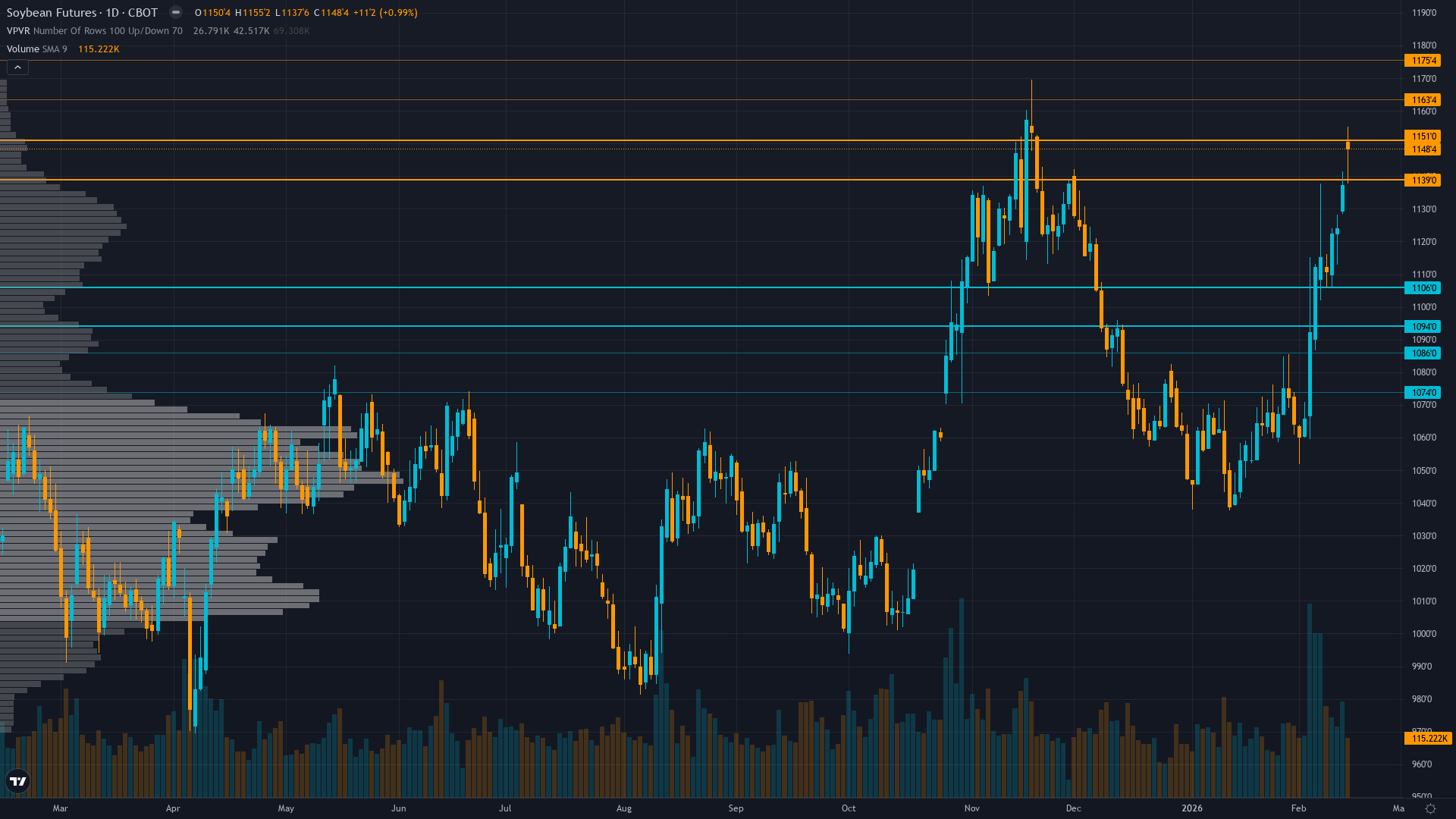
Cautiously bullish on Trump-Xi breakthrough potential upgrade to 20 MMT but concerned about pricing execution risk and whether deal represents consideration versus confirmed commitment
Trump-Xi breakthrough potential upgrade to 20 MMT soybean purchase commitment from 12 MMT representing 67% increase and 89% of historical demand levels
Record US domestic crush demand at 2.56-2.795B bushels driven by EPA renewable diesel mandate increases to 5.61B gallons in 2026 creating structural floor
February seasonal breakout pattern aligning with historical tendency for late-winter strength before April-June highs following January-March lows
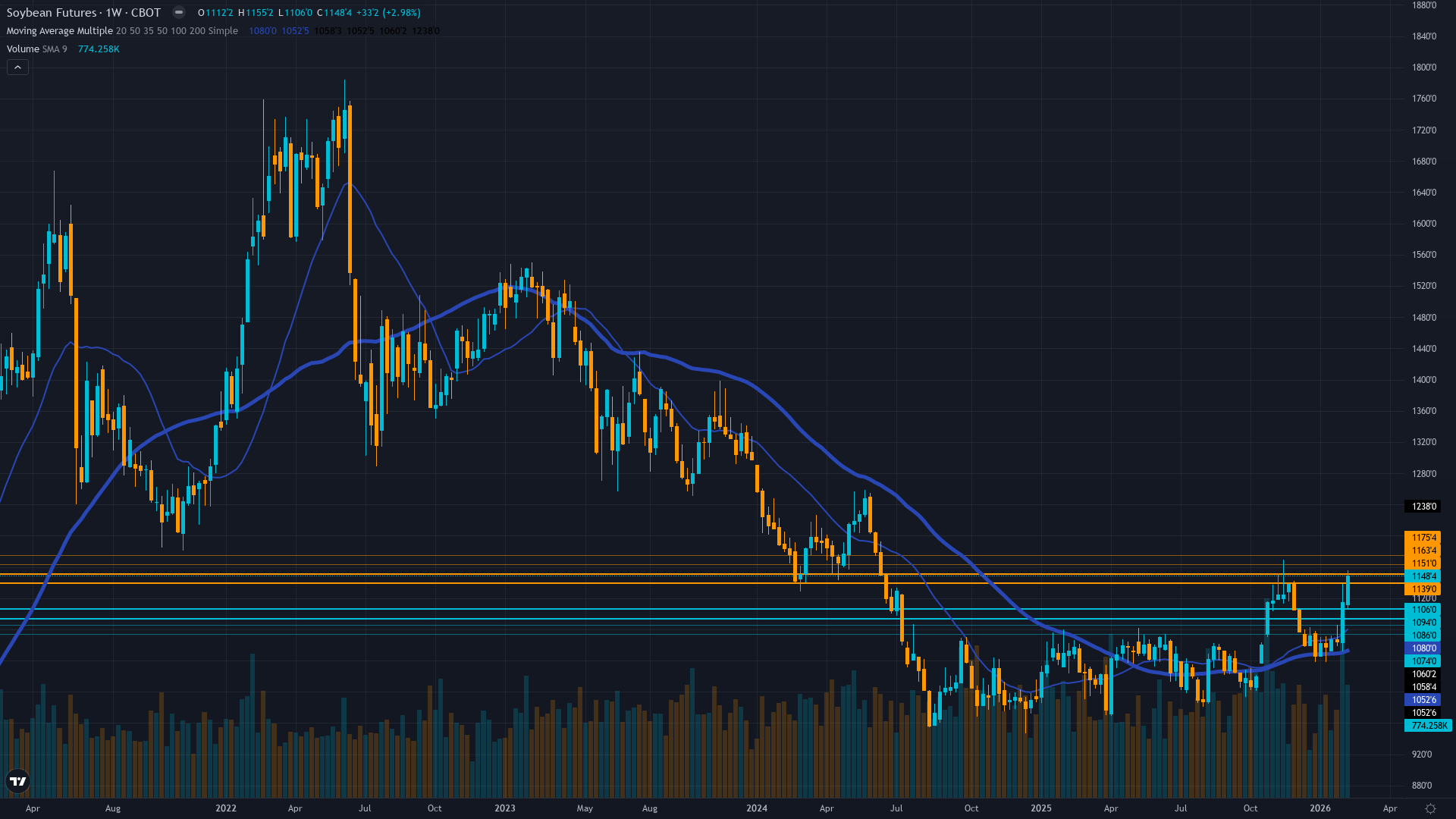
| ▲ Resistance Zone 2 | 1164.50 – 1174.50 |
| ▲ Resistance Zone 1 | 1140.00 – 1150.00 |
| ─ Pivot Area | ~1120.00 |
| ▼ Support Zone 1 | 1095.00 – 1105.00 |
| ▼ Support Zone 2 | 1075.00 – 1085.00 |
Breaking above 1120-1134 consolidation with explosive momentum testing November 52-week high of 1169.50 after surging from 1112 on Trump announcement
China deal evolution from 12 MMT to potential 20 MMT transforms near-term demand outlook though still represents 11% reduction from historical 22.5 MMT annual pace
Short-covering rally underway from February 4 announcement after funds accumulated shorts during Q4 consolidation, now repositioning long
Implied volatility spiking from 64th to estimated 78-82nd percentile on trade breakthrough creating massive two-way action with call buying surging
US-China trade détente accelerating with Trump-Xi February 4 call discussing Taiwan and agricultural trade before April Beijing visit creating positive momentum
Inverted - short-term vol spiking sharply above long-term as Trump-Xi trade breakthrough creates explosive near-term two-way action with daily ranges of 30-50 cents versus normal 15-20 cents
When major trade breakthroughs occur after extended boycotts similar to October 30 and February 4 announcements, initial vol spike of 20-35% typically mean-reverts within 15-30 days as positioning stabilizes with 65-70% historical probability once catalyst clarity emerges
Volatility likely to remain elevated 1-3 weeks until Chinese follow-through confirmation emerges via weekly export sales data or pricing execution concerns force reality check, then contract toward 60th percentile by early March
Current elevated volatility suggests 30-60 cent daily ranges versus normal 15-20 cents, breakouts highly reliable as momentum builds but whipsaws common as euphoria battles pricing reality requiring wider stops, trend-following strategies favored over mean-reversion
High vol environment suggests 8-15% moves possible over next 2-4 weeks versus typical 4-6% monthly range, with asymmetric upside if 20 MMT confirmed and executed driving sustained breakout toward 1200-1250 but significant downside risk toward 1080-1100 support if pricing concerns force Chinese demand pullback or deal upgrade fails to materialize
|
⚠️ Primary Risk
China purchase upgrade from 12 MMT to 20 MMT remains consideration not confirmation with Reuters noting Chinese importers face higher US-Brazil price spreads creating execution risk Probability: MEDIUM
|
✦ Primary Opportunity
Confirmation and execution of 20 MMT upgrade combined with any South American harvest disruption could drive sustained breakout toward 1170-1200 resistance zone Timeframe: Next 2-4 weeks through February WASDE and actual Chinese purchase confirmation via weekly export sales data
|
Soybeans stand at a critical inflection point on February 15, 2026, trading at 1134.38 cents after explosive gains following President Trump's February 4 announcement of an 'excellent' call with Chinese President Xi Jinping. Trump revealed China is considering increasing US soybean purchases to 20 million metric tons for the current season, up 67% from the 12 MMT commitment established in the October 30, 2025 breakthrough that ended China's unprecedented six-month zero-purchase boycott. This represents a game-changing development: while still 11% below the historical 22.5 MMT pace, the potential upgrade to 20 MMT would substantially close the demand gap that pressured markets from summer 2025 through January 2026.
March futures jumped 30-50 cents on the news, with prices reaching $11.16-11.37 per bushel by February 6-11. However, critical execution challenges remain. Reuters analysis on February 5 cautioned that Chinese importers face pricing headwinds with CBOT premiums to Brazilian benchmarks now nearly double normal levels, making US origin significantly more expensive and creating demand destruction risk. China already fulfilled the original 12 MMT commitment by January 21, purchasing ahead of schedule, but the question is whether economic incentives support the additional 8 MMT at current elevated price levels.
The fundamental support structure remains robust independent of Chinese volumes. Record US domestic crush demand of 2.56-2.795 billion bushels continues providing critical structural support, driven by EPA's renewable diesel mandate increase from 3.35 billion gallons in 2025 to 5.61 billion in 2026 and 5.86 billion in 2027. This renewable diesel boom has fundamentally reshaped demand, explaining market resilience during the boycott and creating a structural floor that absorbs roughly 60% of the 4.253 billion bushel crop.
The February WASDE released February 10 left US soybean supply-demand projections entirely unchanged with ending stocks at 350 million bushels, confirming tight balance sheets. Seasonally, February represents a critical inflection point—historical patterns show January-March typically marks seasonal lows before April-June strength emerges, with the current breakout aligning with this tendency. South American weather has improved through late January-early February with Brazil's harvest progressing mostly in line with expectations at 175 MMT, though some regions face rainfall that will delay harvest while improving late-developing bean moisture.
Argentina continues experiencing irregular patterns but recent rain has boosted southwestern soil moisture. Any significant disruption to South America's 223.5 MMT combined production (Brazil 175 MMT + Argentina 48.5 MMT) could rapidly tighten global balances and force China to execute above committed levels. The 52-week range of 965.25-1169.50 shows current prices in the upper third, with the November 14 post-deal high of 1169.50 now within striking distance. Volatility has exploded from the 64th percentile to estimated 78-82nd percentile as the Trump announcement created massive two-way action with daily ranges expanding to 30-50 cents versus normal 15-20 cents.
From a bias integrity perspective, this represents my second consecutive week of BULLISH bias after correctly calling the February 3-7 rally (last week BULLISH conviction 7, signal 3.5 resulted in CORRECT with prices rising from 1095 Monday open to 1118 Friday close). While the same directional bias continues, the fundamental catalyst has strengthened materially with the Trump-Xi 20 MMT potential upgrade justifying maintained conviction. However, I must note the devil's advocate case: the upgrade remains 'consideration' not 'confirmation,' Chinese importers face genuine pricing obstacles with US-Brazil spreads at 2x normal, and execution of even the 12 MMT original commitment took significant time.
Market euphoria may be front-running reality, with the additional 8 MMT (roughly 300k tons) requiring sustained Chinese buying at premium prices that may not materialize if spreads remain elevated. Technical momentum is clearly bullish above the 1120 pivot testing 1145 resistance, but execution risk on the upgraded commitment creates tactical uncertainty for sustained breakout continuation beyond the 1150-1170 zone without confirmed follow-through.
| Week | Bias | Confidence | Result |
|---|---|---|---|
| February 8, 2026 | BULLISH | 7/10 | ✅ |
| February 1, 2026 | NEUTRAL | 6/10 | ❌ |
| January 25, 2026 | NO CALL | 6/10 | ➖ |
| January 11, 2026 | BEARISH | 6/10 | ✅ |
| January 4, 2026 | BEARISH | 6/10 | ❌ |
| December 28, 2025 | BEARISH | 6/10 | ✅ |
| December 21, 2025 | NO CALL | 6/10 | ➖ |
| December 14, 2025 | NO CALL | 6/10 | ➖ |
| December 7, 2025 | NO CALL | 6/10 | ➖ |
| November 30, 2025 | BULLISH | 7/10 | ❌ |
| November 23, 2025 | BULLISH | 7/10 | ✅ |