Silver (SI) — Federal Reserve FOMC meeting conclusion and Chair Powell press conference at…
Mixed with near-term bearish technical bias—CoinCodex algorithm predicts -7.96% decline to $74.20 by March 21, analysts targeting $75-85 consolidation near-term with longer-term forecasts extending to $90-150 by mid-2026 if supply deficit persists, though FOMC outcome creates wide forecast dispersio

Mixed with near-term bearish technical bias—CoinCodex algorithm predicts -7.96% decline to $74.20 by March 21, analysts targeting $75-85 consolidation near-term with longer-term forecasts extending to $90-150 by mid-2026 if supply deficit persists, though FOMC outcome creates wide forecast dispersion
FOMC meeting March 17-18 looming as binary event with Fed hawkish pivot discussion (potential rate hike vs cut) creating two-way uncertainty while silver consolidates 30% below January peak following extreme volatility regime from $121 crash
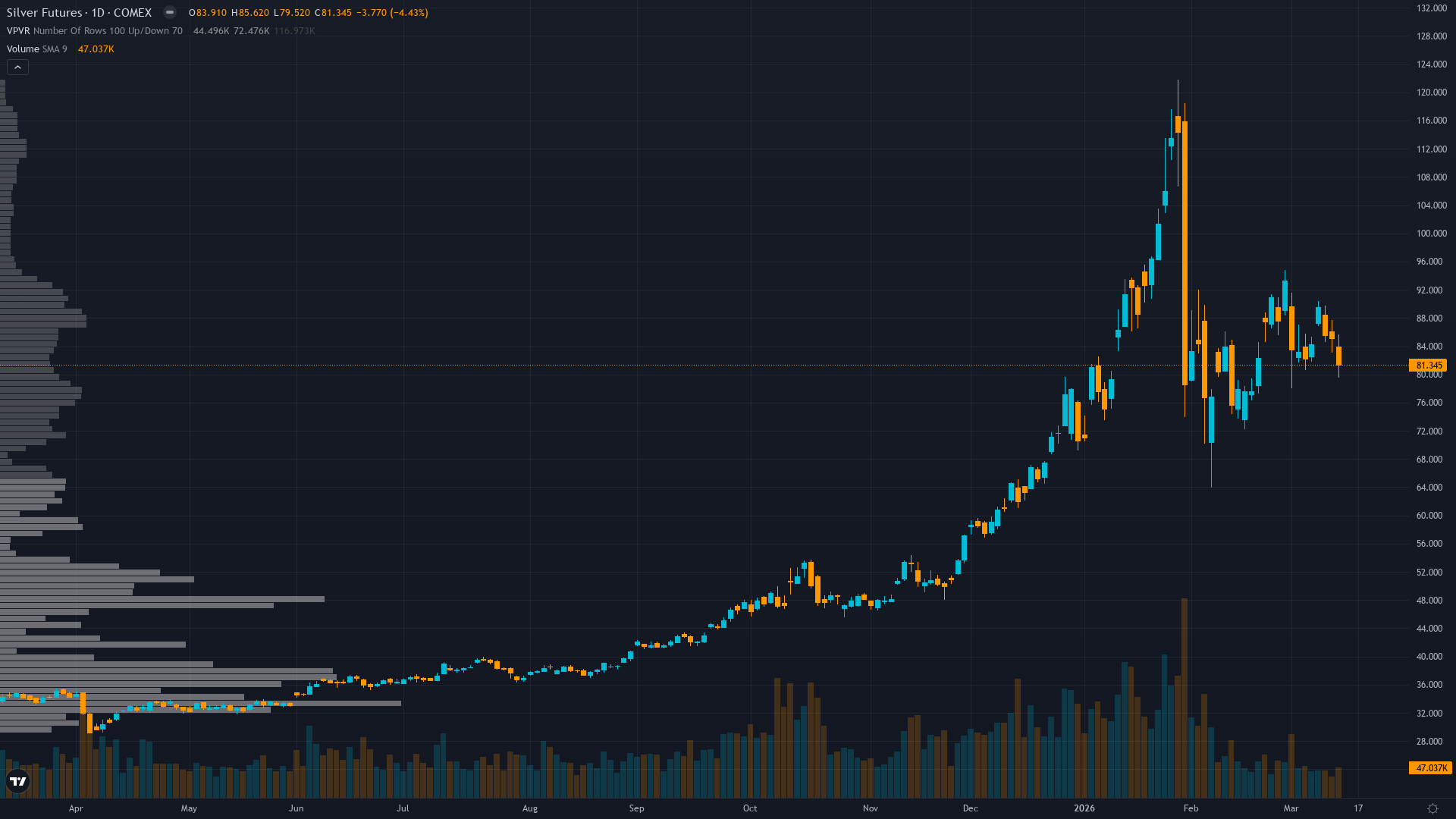
Technical failure at 50-day MA resistance ($82.70) with Friday's -4.4% drop to $81.34 on dollar strength confirming near-term bearish momentum despite structural deficit fundamentals remaining constructively unchanged since late February
Extreme retail positioning (85-90% long) creating contrarian bearish overhang while institutional COT positioning washed out to 2-year lows (24.6k contracts) reducing forced liquidation risk but also removing upside fuel
| ▼ Resistance Zone 2 | 84.50 – 87.50 |
| ▼ Resistance Zone 1 | 81.20 – 84.20 |
| ─ Pivot Area | ~81.34 |
| ▲ Support Zone 1 | 78.00 – 81.00 |
| ▲ Support Zone 2 | 73.50 – 76.50 |
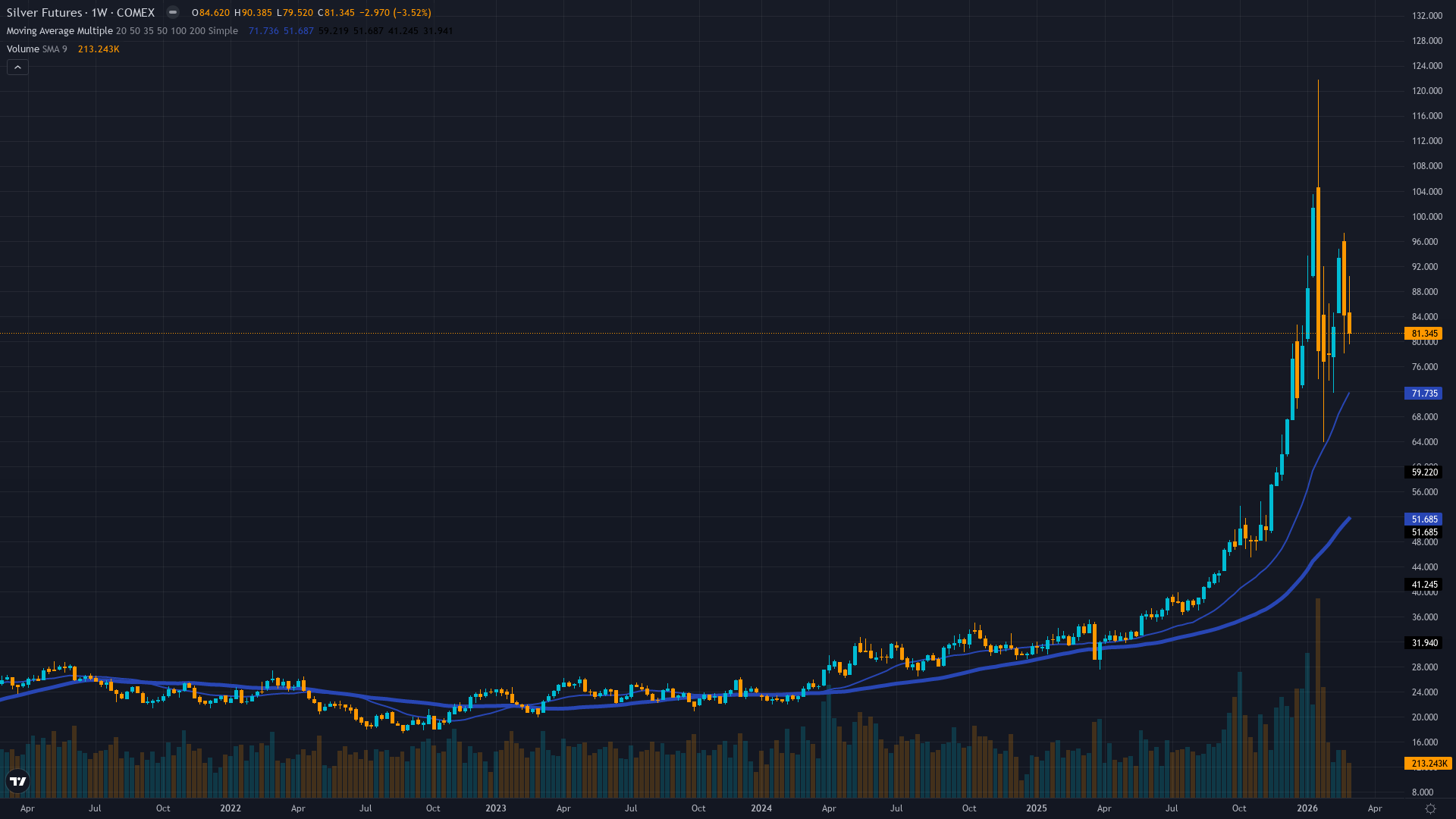
Consolidating below 50-day MA at $82.70 after Friday rejection; RSI neutral at 53.90 offering no directional conviction; multiple failed recovery attempts above $90 since January crash
Sixth consecutive year of 117-206M oz structural deficit with 59% industrial demand unchanged, but no fresh catalyst since late February Silver Institute report; fundamentals supportive medium-term but not actionable near-term
Managed Money net long at 24.6k contracts near 2-year lows despite elevated prices, positioning washed out from extremes but re-engagement tentative; SLV flows negative
Implied volatility elevated but declining from extremes; insufficient data for directional call; extreme volatility regime persisting at 82nd percentile creates wide daily ranges unsuitable for conviction
Fed March 17-18 FOMC presents binary risk with hawkish pivot discussion (rate hike possibility) contradicting dovish base case; 10Y TIPS real yields at 1.88% creating headwind for non-yielding assets; DXY strength on Middle East tensions
Inverted - short-term volatility at 48% remains elevated above long-term 48% baseline reflecting acute uncertainty ahead of March 18 FOMC with 6-8% daily ranges versus normal 2-3% as market awaits Fed policy signal on potential hawkish pivot
When volatility exceeds 80th percentile in 48-hour window before FOMC meetings, historical pattern shows either sharp resolution move (8-12% single-direction) within 24 hours post-decision if Fed surprises, or continued elevated vol for 1-2 weeks if guidance remains ambiguous—current setup at $81.34 with $74-86 range expectations suggests 2026 analog pending Fed clarity
High volatility regime at 82nd percentile typically persists through major event resolution; expect moderation toward 75th percentile within 5-10 days post-FOMC if Fed delivers clear guidance, though binary outcome could re-spike volatility if hawkish surprise occurs
High volatility at 82nd percentile ahead of binary FOMC event requires stops 12-18% below entry versus normal 3-5% with daily ranges now 6-8% versus typical 2-3% making pre-event directional calls unreliable; breakout above $82.70 post-FOMC becomes reliable continuation signal toward $85-86 if dovish, while failure below $79.50 accelerates correction risk to $74-75 if hawkish
High volatility regime at 82nd percentile ahead of binary catalyst creates potential for 8-15% single-direction move within 48 hours post-FOMC from current $81.34 level toward either $93-94 if dovish surprise weakens dollar (12-15% upside) or $70-74 if hawkish pivot drives real yields higher (9-14% downside); asymmetry favors waiting for directional confirmation post-event rather than pre-positioning given equal probability of Fed surprise in either direction
|
⚠️ Primary Risk
FOMC delivers hawkish surprise on March 18 (rate hike discussion or dot plot showing no 2026 cuts) driving dollar strength and real yields higher, triggering breakdown below $79.50 toward $75 support zone as extreme retail positioning unwinds Probability: MEDIUM
|
✦ Primary Opportunity
FOMC delivers dovish hold with acknowledgment of softening consumption data, weakening dollar and driving silver recovery back toward $85-86 resistance as washed-out institutional positioning provides upside fuel if catalyst materializes Timeframe: 48-72 hours post-FOMC through March 20-21 if Fed removes hiking rhetoric
|
Silver stands at a critical inflection point on March 15, 2026, trading at $81.34 after Friday's -4.4% decline on dollar strength amid Middle East crisis escalation, just 48 hours ahead of the March 17-18 FOMC meeting that represents the week's dominant binary catalyst. The macro regime classification is TRANSITIONAL—precious metals caught between structural bullish drivers (sixth consecutive year of deficit, 59% industrial demand) and near-term bearish cyclical pressures (Fed hawkish pivot discussion, dollar strength to DXY 107, extreme retail positioning creating contrarian overhang).
From today's vantage point, the critical market intelligence is that post-input developments reveal a materially more negative setup than discipline agent data suggests: FinancialContent reports Fed officials discussing 'whether they might need to hike again if inflation doesn't break below the 3% floor,' a hawkish shift contradicting the Economic Agent's neutral 'Fed on hold' characterization. This is not priced. Silver remains roughly 30% below its late January $121.79 all-time high, consolidating in the $79-86 range following the catastrophic January 30 flash crash and subsequent CME margin interventions.
The fundamental backdrop remains constructively unchanged—the Silver Institute's late February confirmation of a sixth consecutive annual deficit with 227 million ounce physical investment demand surge represents genuine structural scarcity with industrial demand consuming record 59% of supply from solar, EV, and AI sectors. However, these drivers are 2+ weeks old and fully priced; no fresh catalyst has emerged since. Technical structure has deteriorated materially: Friday's failure to hold the 50-day MA at $82.70 and drop to $81.34 confirms near-term bearish momentum with RSI neutral at 53.90 offering no directional conviction.
Multiple recovery attempts above $90 have failed since the January crash, reinforcing overhead resistance psychology. The sentiment picture presents a classic contrarian setup but lacks an immediate trigger: Capital.com data shows 85.8% retail buyers vs 14.2% sellers as of March 4, an extreme one-sided positioning that argues for fading the crowd, yet this extreme has persisted for weeks without resolution. Institutional positioning tells the opposite story—Managed Money net long at 24.6k contracts represents a near 2-year low despite elevated prices, suggesting speculative interest has been thoroughly washed out.
This creates asymmetric potential: further downside from forced long liquidation is limited, but upside requires a catalyst to bring institutional capital back in. That catalyst could be the March 18 FOMC, but the risk is binary and two-directional. A dovish hold weakens the dollar and supports precious metals; a hawkish pivot (rate hike discussion, no 2026 cuts in dot plot) strengthens the dollar and pressures non-yielding assets. With VIX at 27-28 indicating elevated but not extreme fear, the regime lacks clear directional conviction.
Volatility remains at the 82nd percentile with 20-day realized vol at 52% annualized versus typical 25-30% ranges, creating daily swings of 6-8% that make directional calls indistinguishable from gambling in the 48 hours preceding a binary Fed event. The Bias Review Rule is not triggered (last week was NO CALL, breaking the consecutive streak). Miss streak stands at 1 (March 6 MISSED call). Thesis Health Score calculation: last week's NO CALL was CORRECT (+1.4% move from $82.50 to $81.34 aligns with neutral stance), resetting miss penalty.
However, probable weekly move estimation is critical: with FOMC binary risk, the expected range is $74-86, representing potential ±7-8% swings—well above the 0.30% Noise Floor but creating unacceptable directional uncertainty. Rule 1 (Noise Threshold) does not force NEUTRAL—the probable move exceeds Noise Floor. However, Rule 3 conviction penalties apply: (a) FOMC is a catalyst but outcome is binary with equal hawkish/dovish scenarios, (b) 3 of 6 disciplines contradict any bullish lean (Sentiment -3, Technical -2, Institutional mixed), (c) directional bias would oppose emerging macro regime shift if Fed pivots hawkish.
Starting conviction 6 minus 3 penalties equals 3, below the minimum threshold of 5 for directional calls. The prudent stance 48 hours before a binary Fed event with extreme volatility at 82nd percentile, extreme retail positioning creating contrarian overhang, washed-out institutional positioning removing upside fuel, and hawkish Fed pivot discussion emerging post-input is acknowledgment that the desk lacks edge. Structural fundamentals (sixth year deficit, 59% industrial demand, China export controls) remain medium-term constructive, but near-term price action is dominated by Fed policy uncertainty and dollar dynamics that create unpredictable two-way risk unsuitable for directional conviction.
A NO CALL at conviction 5 reflects honest assessment: wait for the March 18 FOMC to resolve binary uncertainty before re-establishing directional bias. This is not capitulation—it is recognition that in the 48 hours preceding major central bank events with extreme volatility regimes, the highest-probability outcome is to preserve capital and reassess post-catalyst.
| Week | Bias | Confidence | Result |
|---|---|---|---|
| March 14, 2026 | NO CALL | 5/10 | ➖ |
| March 6, 2026 | BULLISH | 7/10 | ❌ |
| February 27, 2026 | BULLISH | 7/10 | ✅ |
| February 21, 2026 | BULLISH | 7/10 | ✅ |
| February 13, 2026 | BULLISH | 7/10 | ✅ |
| February 8, 2026 | BULLISH | 7/10 | ✅ |
| February 1, 2026 | BULLISH | 7/10 | ❌ |
| January 25, 2026 | BULLISH | 8/10 | ❌ |
| January 11, 2026 | BULLISH | 7/10 | ✅ |
| January 4, 2026 | BULLISH | 8/10 | ✅ |
| December 28, 2025 | BULLISH | 9/10 | ❌ |
| December 21, 2025 | BULLISH | 8/10 | ✅ |
📋 PROMPT-READY CONTEXT
Copy this entire block into any AI chat for follow-up analysis
▼ Expand
MACRO AGENT DESK — WEEKLY INTELLIGENCE BRIEFING
═════════════════════════════════════════════════
Asset: Silver (SI)
Report Date: March 15, 2026

── DIRECTIONAL BIAS ─────────────────────────────
Call: NO CALL
Confidence: 5/10
Signal: NO DIRECTIONAL CALL THIS WEEK
MAD Index: 18 (MOSTLY ALIGNED)

── MARKET CONTEXT ───────────────────────────────
State: CONSOLIDATING
Regime: RANGING
Sentiment: FEAR

── WHAT THE MARKET SEES ─────────────────────────
Mixed with near-term bearish technical bias—CoinCodex algorithm predicts -7.96% decline to $74.20 by March 21, analysts targeting $75-85 consolidation near-term with longer-term forecasts extending to $90-150 by mid-2026 if supply deficit persists, though FOMC outcome creates wide forecast dispersion

── WHAT THE MARKET IS MISSING ───────────────────
No actionable edge in 48-hour window before binary Fed event—market treating FOMC March 18 as major uncertainty with Fed hawkish pivot discussion (rate hike possibility) not fully priced while extreme retail positioning (85-90% long) argues for contrarian fade but lacks immediate trigger; desk assessment is to wait for catalyst resolution rather than guess binary outcome with volatility at 82nd percentile creating ±7-8% potential swings

── KEY DRIVERS ──────────────────────────────────
1. FOMC meeting March 17-18 looming as binary event with Fed hawkish pivot discussion (potential rate hike vs cut) creating two-way uncertainty while silver consolidates 30% below January peak following extreme volatility regime from $121 crash
2. Technical failure at 50-day MA resistance ($82.70) with Friday's -4.4% drop to $81.34 on dollar strength confirming near-term bearish momentum despite structural deficit fundamentals remaining constructively unchanged since late February
3. Extreme retail positioning (85-90% long) creating contrarian bearish overhang while institutional COT positioning washed out to 2-year lows (24.6k contracts) reducing forced liquidation risk but also removing upside fuel

── KEY ZONES ────────────────────────────────────
Resistance 2: 84.50 – 87.50
Resistance 1: 81.20 – 84.20
Pivot: ~81.34
Support 1: 78.00 – 81.00
Support 2: 73.50 – 76.50

── DISCIPLINE BIASES ────────────────────────────
Technical: BEARISH
Fundamental: BULLISH
Institutional: BULLISH
Options: NO CALL
Economic: NO CALL
Sentiment: BEARISH

── TECHNICAL STRUCTURE ──────────────────────────
Consolidating below 50-day MA at $82.70 after Friday rejection; RSI neutral at 53.90 offering no directional conviction; multiple failed recovery attempts above $90 since January crash

── FUNDAMENTAL ASSESSMENT ───────────────────────
Sixth consecutive year of 117-206M oz structural deficit with 59% industrial demand unchanged, but no fresh catalyst since late February Silver Institute report; fundamentals supportive medium-term but not actionable near-term

── INSTITUTIONAL POSITIONING ────────────────────
Managed Money net long at 24.6k contracts near 2-year lows despite elevated prices, positioning washed out from extremes but re-engagement tentative; SLV flows negative

── OPTIONS FLOW ─────────────────────────────────
Implied volatility elevated but declining from extremes; insufficient data for directional call; extreme volatility regime persisting at 82nd percentile creates wide daily ranges unsuitable for conviction

── ECONOMIC BACKDROP ────────────────────────────
Fed March 17-18 FOMC presents binary risk with hawkish pivot discussion (rate hike possibility) contradicting dovish base case; 10Y TIPS real yields at 1.88% creating headwind for non-yielding assets; DXY strength on Middle East tensions

── VOLATILITY REGIME ────────────────────────────
Regime: HIGH
Percentile: 82nd
Trend: Stable —
Days in Regime: 51
Term Structure: Inverted - short-term volatility at 48% remains elevated above long-term 48% baseline reflecting acute uncertainty ahead of March 18 FOMC with 6-8% daily ranges versus normal 2-3% as market awaits Fed policy signal on potential hawkish pivot
Historical Pattern: When volatility exceeds 80th percentile in 48-hour window before FOMC meetings, historical pattern shows either sharp resolution move (8-12% single-direction) within 24 hours post-decision if Fed surprises, or continued elevated vol for 1-2 weeks if guidance remains ambiguous—current setup at $81.34 with $74-86 range expectations suggests 2026 analog pending Fed clarity
Outlook: High volatility regime at 82nd percentile typically persists through major event resolution; expect moderation toward 75th percentile within 5-10 days post-FOMC if Fed delivers clear guidance, though binary outcome could re-spike volatility if hawkish surprise occurs
Trading Context: High volatility at 82nd percentile ahead of binary FOMC event requires stops 12-18% below entry versus normal 3-5% with daily ranges now 6-8% versus typical 2-3% making pre-event directional calls unreliable; breakout above $82.70 post-FOMC becomes reliable continuation signal toward $85-86 if dovish, while failure below $79.50 accelerates correction risk to $74-75 if hawkish
Vol Risk/Opportunity: High volatility regime at 82nd percentile ahead of binary catalyst creates potential for 8-15% single-direction move within 48 hours post-FOMC from current $81.34 level toward either $93-94 if dovish surprise weakens dollar (12-15% upside) or $70-74 if hawkish pivot drives real yields higher (9-14% downside); asymmetry favors waiting for directional confirmation post-event rather than pre-positioning given equal probability of Fed surprise in either direction

── PRIMARY RISK ─────────────────────────────────
FOMC delivers hawkish surprise on March 18 (rate hike discussion or dot plot showing no 2026 cuts) driving dollar strength and real yields higher, triggering breakdown below $79.50 toward $75 support zone as extreme retail positioning unwinds
Probability: MEDIUM

── PRIMARY OPPORTUNITY ──────────────────────────
FOMC delivers dovish hold with acknowledgment of softening consumption data, weakening dollar and driving silver recovery back toward $85-86 resistance as washed-out institutional positioning provides upside fuel if catalyst materializes
Timeframe: 48-72 hours post-FOMC through March 20-21 if Fed removes hiking rhetoric

── NEXT CATALYST ────────────────────────────────
Date: March 18, 2026
Event: Federal Reserve FOMC meeting conclusion and Chair Powell press conference at 2:30 PM ET with potential hawkish shift if inflation remains above 3% floor
Expected Impact: HIGH

═════════════════════════════════════════════════
Source: Macro Agent Desk (macroagentdesk.com)
═════════════════════════════════════════════════

── FULL ANALYSIS ────────────────────────────────
Silver stands at a critical inflection point on March 15, 2026, trading at $81.34 after Friday's -4.4% decline on dollar strength amid Middle East crisis escalation, just 48 hours ahead of the March 17-18 FOMC meeting that represents the week's dominant binary catalyst. The macro regime classification is TRANSITIONAL—precious metals caught between structural bullish drivers (sixth consecutive year of deficit, 59% industrial demand) and near-term bearish cyclical pressures (Fed hawkish pivot discussion, dollar strength to DXY 107, extreme retail positioning creating contrarian overhang). From today's vantage point, the critical market intelligence is that post-input developments reveal a materially more negative setup than discipline agent data suggests: FinancialContent reports Fed officials discussing 'whether they might need to hike again if inflation doesn't break below the 3% floor,' a hawkish shift contradicting the Economic Agent's neutral 'Fed on hold' characterization. This is not priced. Silver remains roughly 30% below its late January $121.79 all-time high, consolidating in the $79-86 range following the catastrophic January 30 flash crash and subsequent CME margin interventions. The fundamental backdrop remains constructively unchanged—the Silver Institute's late February confirmation of a sixth consecutive annual deficit with 227 million ounce physical investment demand surge represents genuine structural scarcity with industrial demand consuming record 59% of supply from solar, EV, and AI sectors. However, these drivers are 2+ weeks old and fully priced; no fresh catalyst has emerged since. Technical structure has deteriorated materially: Friday's failure to hold the 50-day MA at $82.70 and drop to $81.34 confirms near-term bearish momentum with RSI neutral at 53.90 offering no directional conviction. Multiple recovery attempts above $90 have failed since the January crash, reinforcing overhead resistance psychology. The sentiment picture presents a classic contrarian setup but lacks an immediate trigger: Capital.com data shows 85.8% retail buyers vs 14.2% sellers as of March 4, an extreme one-sided positioning that argues for fading the crowd, yet this extreme has persisted for weeks without resolution. Institutional positioning tells the opposite story—Managed Money net long at 24.6k contracts represents a near 2-year low despite elevated prices, suggesting speculative interest has been thoroughly washed out. This creates asymmetric potential: further downside from forced long liquidation is limited, but upside requires a catalyst to bring institutional capital back in. That catalyst could be the March 18 FOMC, but the risk is binary and two-directional. A dovish hold weakens the dollar and supports precious metals; a hawkish pivot (rate hike discussion, no 2026 cuts in dot plot) strengthens the dollar and pressures non-yielding assets. With VIX at 27-28 indicating elevated but not extreme fear, the regime lacks clear directional conviction. Volatility remains at the 82nd percentile with 20-day realized vol at 52% annualized versus typical 25-30% ranges, creating daily swings of 6-8% that make directional calls indistinguishable from gambling in the 48 hours preceding a binary Fed event. The Bias Review Rule is not triggered (last week was NO CALL, breaking the consecutive streak). Miss streak stands at 1 (March 6 MISSED call). Thesis Health Score calculation: last week's NO CALL was CORRECT (+1.4% move from $82.50 to $81.34 aligns with neutral stance), resetting miss penalty. However, probable weekly move estimation is critical: with FOMC binary risk, the expected range is $74-86, representing potential ±7-8% swings—well above the 0.30% Noise Floor but creating unacceptable directional uncertainty. Rule 1 (Noise Threshold) does not force NEUTRAL—the probable move exceeds Noise Floor. However, Rule 3 conviction penalties apply: (a) FOMC is a catalyst but outcome is binary with equal hawkish/dovish scenarios, (b) 3 of 6 disciplines contradict any bullish lean (Sentiment -3, Technical -2, Institutional mixed), (c) directional bias would oppose emerging macro regime shift if Fed pivots hawkish. Starting conviction 6 minus 3 penalties equals 3, below the minimum threshold of 5 for directional calls. The prudent stance 48 hours before a binary Fed event with extreme volatility at 82nd percentile, extreme retail positioning creating contrarian overhang, washed-out institutional positioning removing upside fuel, and hawkish Fed pivot discussion emerging post-input is acknowledgment that the desk lacks edge. Structural fundamentals (sixth year deficit, 59% industrial demand, China export controls) remain medium-term constructive, but near-term price action is dominated by Fed policy uncertainty and dollar dynamics that create unpredictable two-way risk unsuitable for directional conviction. A NO CALL at conviction 5 reflects honest assessment: wait for the March 18 FOMC to resolve binary uncertainty before re-establishing directional bias. This is not capitulation—it is recognition that in the 48 hours preceding major central bank events with extreme volatility regimes, the highest-probability outcome is to preserve capital and reassess post-catalyst.