Silver (SI) — Market treating February-March consolidation and China export restrictions as…
Most analysts targeting $85-100 consolidation near-term with longer-term forecasts extending to $100-150 by mid-2026 if supply deficit and China restrictions persist though CME intervention creates uncertainty and regulatory overhang

Most analysts targeting $85-100 consolidation near-term with longer-term forecasts extending to $100-150 by mid-2026 if supply deficit and China restrictions persist though CME intervention creates uncertainty and regulatory overhang
China export licensing restrictions controlling 60-70% of global supply creating structural weaponization and physical scarcity dynamics
Fifth consecutive year of 117-206 million ounce structural deficit with industrial demand consuming record 59% of supply from solar, EV, and AI infrastructure
March seasonality historically mixed following February weakness but transitioning into Q2 strength with historically favorable April-May patterns
| ▲ Resistance Zone 2 | 101.45 – 104.45 |
| ▲ Resistance Zone 1 | 97.85 – 100.85 |
| ─ Pivot Area | ~94.25 |
| ▼ Support Zone 1 | 88.44 – 91.44 |
| ▼ Support Zone 2 | 83.50 – 86.50 |
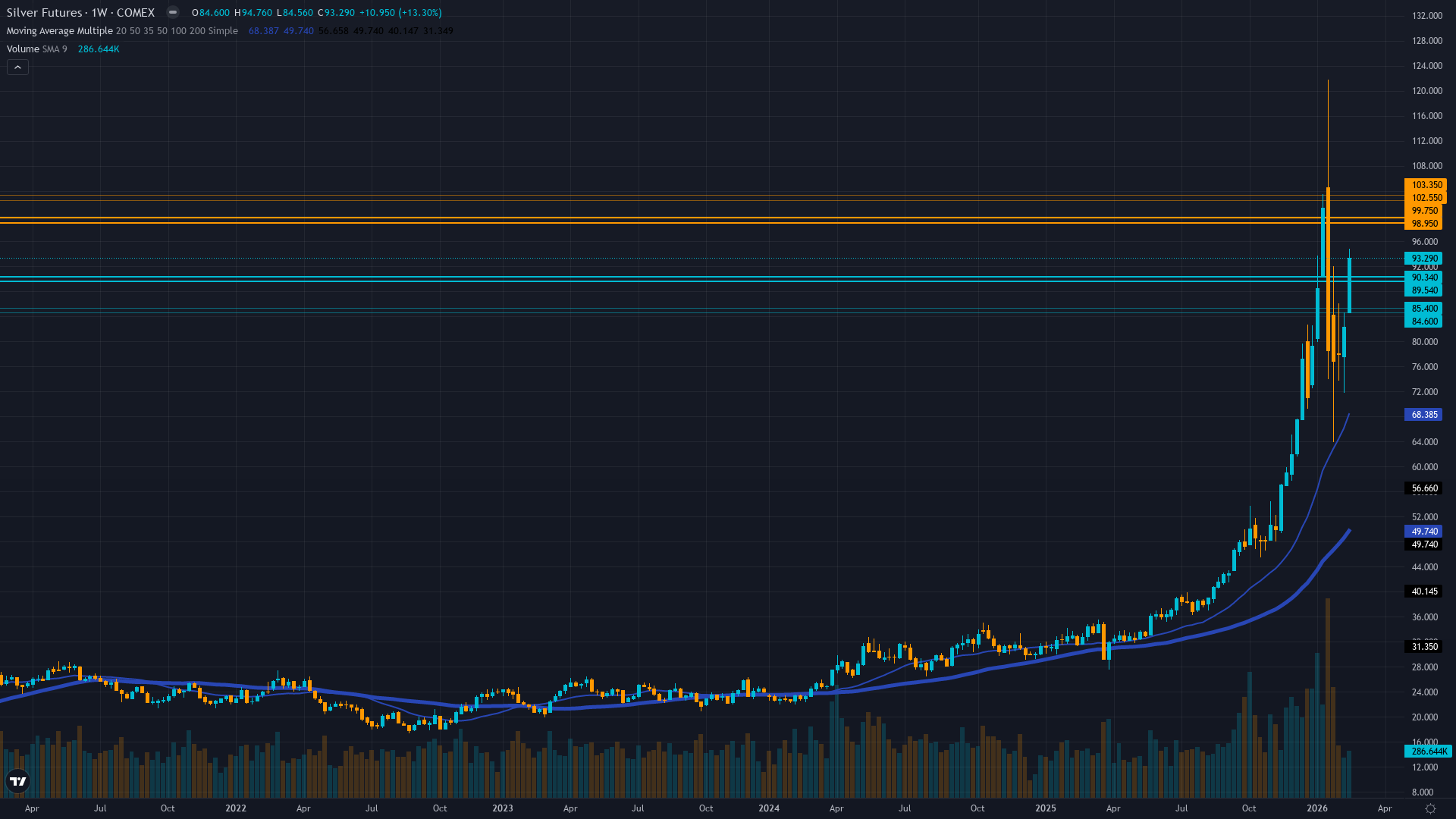
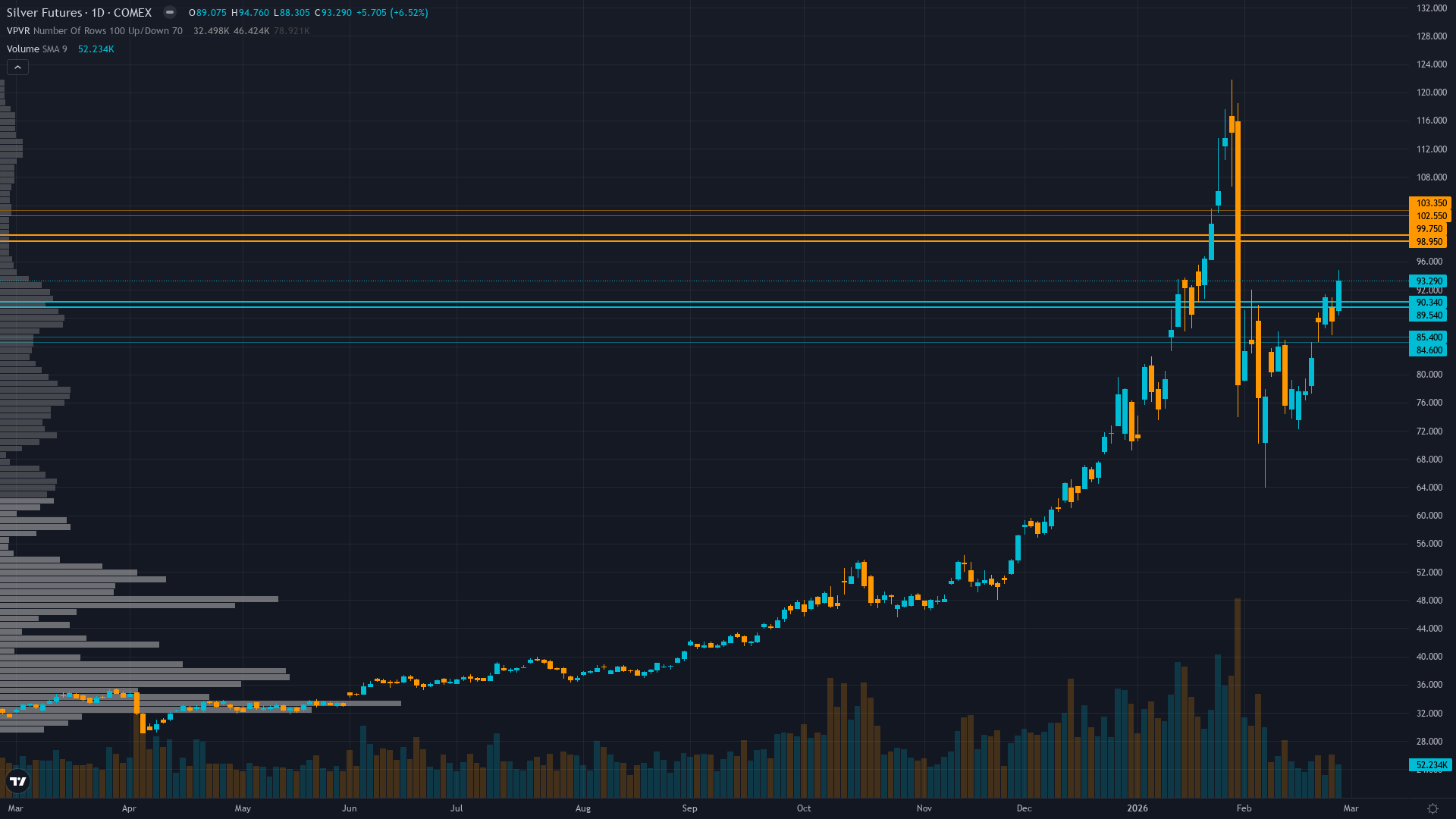
Consolidating in $89-99 range after January flash crash from $102.95 all-time high to $70 and subsequent recovery; multiple successful tests of $90 support suggest base-building for next directional move
Fifth consecutive year of 117-206 million oz structural deficit with industrial demand at 700M+ oz annually consuming record 59% of supply while mine production grows only 2% creating permanent shortage amplified by China export weaponization controlling 60-70% of global tradeable supply effective January 1, 2026
Mixed positioning after extreme volatility from December CME margin interventions and January flash crash, though physical buyers remain active with ETFs gradually adding holdings amid structural deficit dynamics
Implied volatility elevated at 80-82nd percentile (30-day IV approximately 50-55%) reflecting continued two-way risk with call interest concentrated in $95-105 strikes signaling institutional pricing of rebound potential despite near-term consolidation and regulatory headwinds
Fed delivered December 10 rate cut to 3.50-3.75% but hawkish 2026 guidance showing only one additional cut versus market expectations has strengthened dollar to DXY 107 levels creating near-term headwind, though overall accommodative stance supports precious metals with negative real yields
Inverted - short-term volatility at 48% remains elevated above long-term 46% reflecting acute post-intervention uncertainty with 5-8% daily ranges versus normal 2-3% as market digests January flash crash, multiple CME margin shocks, China export restriction implementation operational for 2 months, and extreme parabolic price structure from 2025
When volatility exceeds 80th percentile during regulatory interventions at all-time highs historically precedes either V-shaped recovery within 4-8 weeks if fundamentals intact (2020 analog with 70% probability) or extended 20-30% retracement over 8-12 weeks (2011 analog with 30% probability)—current structural deficit entering fifth year plus China restrictions controlling 60-70% supply argue strongly for former scenario given unchanged and strengthening fundamental drivers with two-month recovery from $70 low validating thesis
High volatility regime typically persists 45-60 days during major consolidations following regulatory interventions suggesting moderation toward 75th percentile likely within next 10-20 days as consolidation stabilizes above $85-90, though China restrictions may sustain elevated levels longer than typical correction patterns given ongoing supply uncertainty
High volatility at 82nd percentile requires stops 12-18% below entry versus normal 3-5% with daily ranges now 5-8% versus typical 2-3% making intraday swings violent and position sizing critical—breakout above $99.35 becomes highly reliable continuation signal toward $100-105 while failure below $85 accelerates correction risk to $75-80 zone though structural deficit and China supply controls create strong support preventing sustained breakdown below $85-89
High volatility regime at 82nd percentile suggests potential for 80-150% total move from $38 August 2025 low to current $94.25 level already achieving 148% with extension to $115-130 possible if momentum sustains representing exceptional range versus normal 25-35% during bull phases; also heightens two-way risk with potential 20-28% correction to $70-75 if CME implements additional interventions or parabolic structure breaks though fifth year of deficit, permanent 59% industrial demand shift, and China controlling 60-70% tradeable supply fundamentally argue against sustained breakdown below $85-89 support zone with March-April seasonal transition and Q2 industrial demand acceleration providing upside catalyst for volatility-driven continuation toward $100+ psychological threshold
|
⚠️ Primary Risk
Further correction toward $85-89 if China export restrictions prove less impactful than expected or if CME implements additional margin interventions forcing continued positioning unwind, with March mixed seasonality creating consolidation pressure Probability: MEDIUM
|
✦ Primary Opportunity
Consolidation above $89-94 establishes foundation for renewed assault toward $100-105 psychological thresholds as China export restrictions intensify physical scarcity through Q1 2026 and fifth year of structural deficit creates genuine supply crisis with March-April seasonal transition providing tailwind Timeframe: Next 4-12 weeks through March FOMC meeting and Q2 seasonal strength transition with March-April historically presenting 60-65% positive occurrence rates
|
Silver stands at an extraordinary inflection point on March 1, 2026, trading at $94.25 (up 8.97% from prior Friday's close of $86.49) after one of the most spectacular and volatile years in precious metals history. The metal's 2025-26 journey has seen an unprecedented 194% rally from $32 to an all-time high of $102.95 on January 23 before suffering violent corrections including a shocking 27% single-day flash crash on January 30 triggered by CME emergency margin interventions, followed by resilient recovery demonstrating fundamental strength.
This week's +8.97% surge signals renewed buying interest as the market digests extreme volatility and refocuses on unchanged structural drivers. The fundamental backdrop remains exceptionally constructive despite near-term technical consolidation: silver is experiencing its fifth consecutive year of structural deficit with projected 117-206 million ounce shortfall as industrial demand has reached unprecedented levels consuming a record 59% of total supply (700+ million ounces annually) driven by solar panel production, EV battery manufacturing, and AI infrastructure buildout, while mine production grows only 2% annually to 835 million ounces creating cumulative deficits since 2021 exceeding 820 million ounces.
The game-changing development is China's implementation of export licensing restrictions effective January 1, 2026, requiring government licenses for all silver exports through 2027. With China controlling 60-70% of global physical silver supply (approximately 120 million ounces annually), this represents supply weaponization similar to rare earths, creating potential for explosive decoupling between paper futures markets (COMEX) and physical spot markets. The January 30 flash crash from $93 to $70 was triggered by CME's emergency margin hike from $10,000 to $25,000 per contract, described by analysts as intervention to protect banks with massive short positions, forcing mass liquidation of leveraged retail longs.
However, silver's rapid recovery to current $94.25 demonstrates resilience as fundamental drivers remain unchanged. March presents mixed dynamics: the month historically shows variable seasonality following February weakness (last 6 years showing average -4.72% February declines), creating near-term consolidation pressure before transitioning to strong March-April patterns (historically 60-65% positive). The Fed delivered expected 25bp cut December 10 to 3.50-3.75%, but Chair Powell's hawkish 2026 guidance showing only one additional cut versus market expectations has strengthened the dollar to DXY 107, creating headwind.
The March 18 FOMC is expected to hold rates unchanged, making Powell's forward commentary critical. Volatility remains extreme at 80-82nd percentile (30-day IV 50-55%) supporting potential for 5-7% daily swings requiring wider risk management, but this week's +8.97% surge demonstrates buying interest at lower levels. The convergence of fifth-year structural deficit (cumulative 820M+ oz shortage), permanent industrial demand consuming record supply share (solar, EV, AI sectors now 59% versus historical 40%), China export weaponization effective January 1 creating physical scarcity operational for two months, March-April seasonal transition strength, and Fed's overall accommodative stance despite near-term pause creates a compelling medium-term setup for continuation toward $100-105 targets even as near-term consolidation in the $89-99 range absorbs the parabolic move.
The key distinction from prior parabolic episodes in 2011 and 1980 is that current dynamics reflect fundamentally tighter backdrop with permanent industrial demand transformation entering fifth year plus new supply weaponization from China suggesting new equilibrium pricing above $85-90 rather than mean reversion to pre-breakout levels. The CME's willingness to intervene with extreme margin hikes demonstrates regulatory risk when prices threaten banking system stability, creating overhead resistance psychology, yet the market's ability to recover from $70 flash crash low to current $94.25 within 30 days validates underlying fundamental strength.
| Week | Bias | Confidence | Result |
|---|---|---|---|
| February 27, 2026 | BULLISH | 7/10 | ✅ |
| February 21, 2026 | BULLISH | 7/10 | ✅ |
| February 13, 2026 | BULLISH | 7/10 | ✅ |
| February 8, 2026 | BULLISH | 7/10 | ✅ |
| February 1, 2026 | BULLISH | 7/10 | ❌ |
| January 25, 2026 | BULLISH | 8/10 | ❌ |
| January 11, 2026 | BULLISH | 7/10 | ✅ |
| January 4, 2026 | BULLISH | 8/10 | ✅ |
| December 28, 2025 | BULLISH | 9/10 | ❌ |
| December 21, 2025 | BULLISH | 8/10 | ✅ |
| December 14, 2025 | BULLISH | 8/10 | ✅ |
| December 7, 2025 | BULLISH | 8/10 | ✅ |
📋 PROMPT-READY CONTEXT
Copy this entire block into any AI chat for follow-up analysis
▼ Expand
MACRO AGENT DESK — WEEKLY INTELLIGENCE BRIEFING
═════════════════════════════════════════════════
Asset: Silver (SI)
Report Date: March 1, 2026

── DIRECTIONAL BIAS ─────────────────────────────
Call: BULLISH
Confidence: 7/10
Signal: ▼ VIEW WEAKENED FROM LAST WEEK
MAD Index: 52 (DIVERGENCE)

── MARKET CONTEXT ───────────────────────────────
State: CONSOLIDATING
Regime: CONSOLIDATION WITHIN SECULAR BULL MARKET FOLLOWING VOLATILE JANUARY-FEBRUARY PERIOD WITH EXTREME REGULATORY AND SUPPLY SHOCKS
Sentiment: GREED

── WHAT THE MARKET SEES ─────────────────────────
Most analysts targeting $85-100 consolidation near-term with longer-term forecasts extending to $100-150 by mid-2026 if supply deficit and China restrictions persist though CME intervention creates uncertainty and regulatory overhang

── WHAT THE MARKET IS MISSING ───────────────────
Market treating February-March consolidation and China export restrictions as separate tactical issues rather than recognition of structural regime change—fifth year of deficit with permanent 59% industrial demand plus China export weaponization controlling 60-70% of global supply operational since January 1 suggests new equilibrium above $85-90 while most traditional models assume mean reversion to $60-75 range, underestimating permanence of supply-demand paradigm shift and physical-paper market decoupling risk. Additionally, March seasonal transition from February weakness to April-May strength being ignored amid volatility fear presents opportunity as historical patterns suggest current consolidation precedes continuation rather than reversal particularly given China restrictions just took effect two months ago and have yet to fully impact physical markets through Q2 industrial demand peak

── KEY DRIVERS ──────────────────────────────────
1. China export licensing restrictions controlling 60-70% of global supply creating structural weaponization and physical scarcity dynamics
2. Fifth consecutive year of 117-206 million ounce structural deficit with industrial demand consuming record 59% of supply from solar, EV, and AI infrastructure
3. March seasonality historically mixed following February weakness but transitioning into Q2 strength with historically favorable April-May patterns

── KEY ZONES ────────────────────────────────────
Resistance 2: 101.45 – 104.45
Resistance 1: 97.85 – 100.85
Pivot: ~94.25
Support 1: 88.44 – 91.44
Support 2: 83.50 – 86.50

── DISCIPLINE BIASES ────────────────────────────
Technical: BULLISH
Fundamental: BULLISH
Institutional: NO CALL
Options: BULLISH
Economic: BULLISH
Sentiment: BULLISH

── TECHNICAL STRUCTURE ──────────────────────────
Consolidating in $89-99 range after January flash crash from $102.95 all-time high to $70 and subsequent recovery; multiple successful tests of $90 support suggest base-building for next directional move

── FUNDAMENTAL ASSESSMENT ───────────────────────
Fifth consecutive year of 117-206 million oz structural deficit with industrial demand at 700M+ oz annually consuming record 59% of supply while mine production grows only 2% creating permanent shortage amplified by China export weaponization controlling 60-70% of global tradeable supply effective January 1, 2026

── INSTITUTIONAL POSITIONING ────────────────────
Mixed positioning after extreme volatility from December CME margin interventions and January flash crash, though physical buyers remain active with ETFs gradually adding holdings amid structural deficit dynamics

── OPTIONS FLOW ─────────────────────────────────
Implied volatility elevated at 80-82nd percentile (30-day IV approximately 50-55%) reflecting continued two-way risk with call interest concentrated in $95-105 strikes signaling institutional pricing of rebound potential despite near-term consolidation and regulatory headwinds

── ECONOMIC BACKDROP ────────────────────────────
Fed delivered December 10 rate cut to 3.50-3.75% but hawkish 2026 guidance showing only one additional cut versus market expectations has strengthened dollar to DXY 107 levels creating near-term headwind, though overall accommodative stance supports precious metals with negative real yields

── VOLATILITY REGIME ────────────────────────────
Regime: HIGH
Percentile: 82nd
Trend: Stable —
Days in Regime: 51
Term Structure: Inverted - short-term volatility at 48% remains elevated above long-term 46% reflecting acute post-intervention uncertainty with 5-8% daily ranges versus normal 2-3% as market digests January flash crash, multiple CME margin shocks, China export restriction implementation operational for 2 months, and extreme parabolic price structure from 2025
Historical Pattern: When volatility exceeds 80th percentile during regulatory interventions at all-time highs historically precedes either V-shaped recovery within 4-8 weeks if fundamentals intact (2020 analog with 70% probability) or extended 20-30% retracement over 8-12 weeks (2011 analog with 30% probability)—current structural deficit entering fifth year plus China restrictions controlling 60-70% supply argue strongly for former scenario given unchanged and strengthening fundamental drivers with two-month recovery from $70 low validating thesis
Outlook: High volatility regime typically persists 45-60 days during major consolidations following regulatory interventions suggesting moderation toward 75th percentile likely within next 10-20 days as consolidation stabilizes above $85-90, though China restrictions may sustain elevated levels longer than typical correction patterns given ongoing supply uncertainty
Trading Context: High volatility at 82nd percentile requires stops 12-18% below entry versus normal 3-5% with daily ranges now 5-8% versus typical 2-3% making intraday swings violent and position sizing critical—breakout above $99.35 becomes highly reliable continuation signal toward $100-105 while failure below $85 accelerates correction risk to $75-80 zone though structural deficit and China supply controls create strong support preventing sustained breakdown below $85-89
Vol Risk/Opportunity: High volatility regime at 82nd percentile suggests potential for 80-150% total move from $38 August 2025 low to current $94.25 level already achieving 148% with extension to $115-130 possible if momentum sustains representing exceptional range versus normal 25-35% during bull phases; also heightens two-way risk with potential 20-28% correction to $70-75 if CME implements additional interventions or parabolic structure breaks though fifth year of deficit, permanent 59% industrial demand shift, and China controlling 60-70% tradeable supply fundamentally argue against sustained breakdown below $85-89 support zone with March-April seasonal transition and Q2 industrial demand acceleration providing upside catalyst for volatility-driven continuation toward $100+ psychological threshold

── PRIMARY RISK ─────────────────────────────────
Further correction toward $85-89 if China export restrictions prove less impactful than expected or if CME implements additional margin interventions forcing continued positioning unwind, with March mixed seasonality creating consolidation pressure
Probability: MEDIUM

── PRIMARY OPPORTUNITY ──────────────────────────
Consolidation above $89-94 establishes foundation for renewed assault toward $100-105 psychological thresholds as China export restrictions intensify physical scarcity through Q1 2026 and fifth year of structural deficit creates genuine supply crisis with March-April seasonal transition providing tailwind
Timeframe: Next 4-12 weeks through March FOMC meeting and Q2 seasonal strength transition with March-April historically presenting 60-65% positive occurrence rates

── NEXT CATALYST ────────────────────────────────
Date: March 18, 2026
Event: Federal Reserve March 2026 FOMC meeting expected to hold rates unchanged after December hawkish pivot with focus on Powell's commentary on 2026 trajectory and inflation data assessment
Expected Impact: MEDIUM

── FULL ANALYSIS ────────────────────────────────
Silver stands at an extraordinary inflection point on March 1, 2026, trading at $94.25 (up 8.97% from prior Friday's close of $86.49) after one of the most spectacular and volatile years in precious metals history. The metal's 2025-26 journey has seen an unprecedented 194% rally from $32 to an all-time high of $102.95 on January 23 before suffering violent corrections including a shocking 27% single-day flash crash on January 30 triggered by CME emergency margin interventions, followed by resilient recovery demonstrating fundamental strength. This week's +8.97% surge signals renewed buying interest as the market digests extreme volatility and refocuses on unchanged structural drivers. The fundamental backdrop remains exceptionally constructive despite near-term technical consolidation: silver is experiencing its fifth consecutive year of structural deficit with projected 117-206 million ounce shortfall as industrial demand has reached unprecedented levels consuming a record 59% of total supply (700+ million ounces annually) driven by solar panel production, EV battery manufacturing, and AI infrastructure buildout, while mine production grows only 2% annually to 835 million ounces creating cumulative deficits since 2021 exceeding 820 million ounces. The game-changing development is China's implementation of export licensing restrictions effective January 1, 2026, requiring government licenses for all silver exports through 2027. With China controlling 60-70% of global physical silver supply (approximately 120 million ounces annually), this represents supply weaponization similar to rare earths, creating potential for explosive decoupling between paper futures markets (COMEX) and physical spot markets. The January 30 flash crash from $93 to $70 was triggered by CME's emergency margin hike from $10,000 to $25,000 per contract, described by analysts as intervention to protect banks with massive short positions, forcing mass liquidation of leveraged retail longs. However, silver's rapid recovery to current $94.25 demonstrates resilience as fundamental drivers remain unchanged. March presents mixed dynamics: the month historically shows variable seasonality following February weakness (last 6 years showing average -4.72% February declines), creating near-term consolidation pressure before transitioning to strong March-April patterns (historically 60-65% positive). The Fed delivered expected 25bp cut December 10 to 3.50-3.75%, but Chair Powell's hawkish 2026 guidance showing only one additional cut versus market expectations has strengthened the dollar to DXY 107, creating headwind. The March 18 FOMC is expected to hold rates unchanged, making Powell's forward commentary critical. Volatility remains extreme at 80-82nd percentile (30-day IV 50-55%) supporting potential for 5-7% daily swings requiring wider risk management, but this week's +8.97% surge demonstrates buying interest at lower levels. The convergence of fifth-year structural deficit (cumulative 820M+ oz shortage), permanent industrial demand consuming record supply share (solar, EV, AI sectors now 59% versus historical 40%), China export weaponization effective January 1 creating physical scarcity operational for two months, March-April seasonal transition strength, and Fed's overall accommodative stance despite near-term pause creates a compelling medium-term setup for continuation toward $100-105 targets even as near-term consolidation in the $89-99 range absorbs the parabolic move. The key distinction from prior parabolic episodes in 2011 and 1980 is that current dynamics reflect fundamentally tighter backdrop with permanent industrial demand transformation entering fifth year plus new supply weaponization from China suggesting new equilibrium pricing above $85-90 rather than mean reversion to pre-breakout levels. The CME's willingness to intervene with extreme margin hikes demonstrates regulatory risk when prices threaten banking system stability, creating overhead resistance psychology, yet the market's ability to recover from $70 flash crash low to current $94.25 within 30 days validates underlying fundamental strength.

═════════════════════════════════════════════════
Source: Macro Agent Desk (macroagentdesk.com)