Mon-T Weekly Review — w/e 2 Oct 2026
Three from four, the Nasdaq finally breaks through its all-time high, and ten NO CALLs watch silver bleed 5% and soybeans crash 3% from the cheap seats.

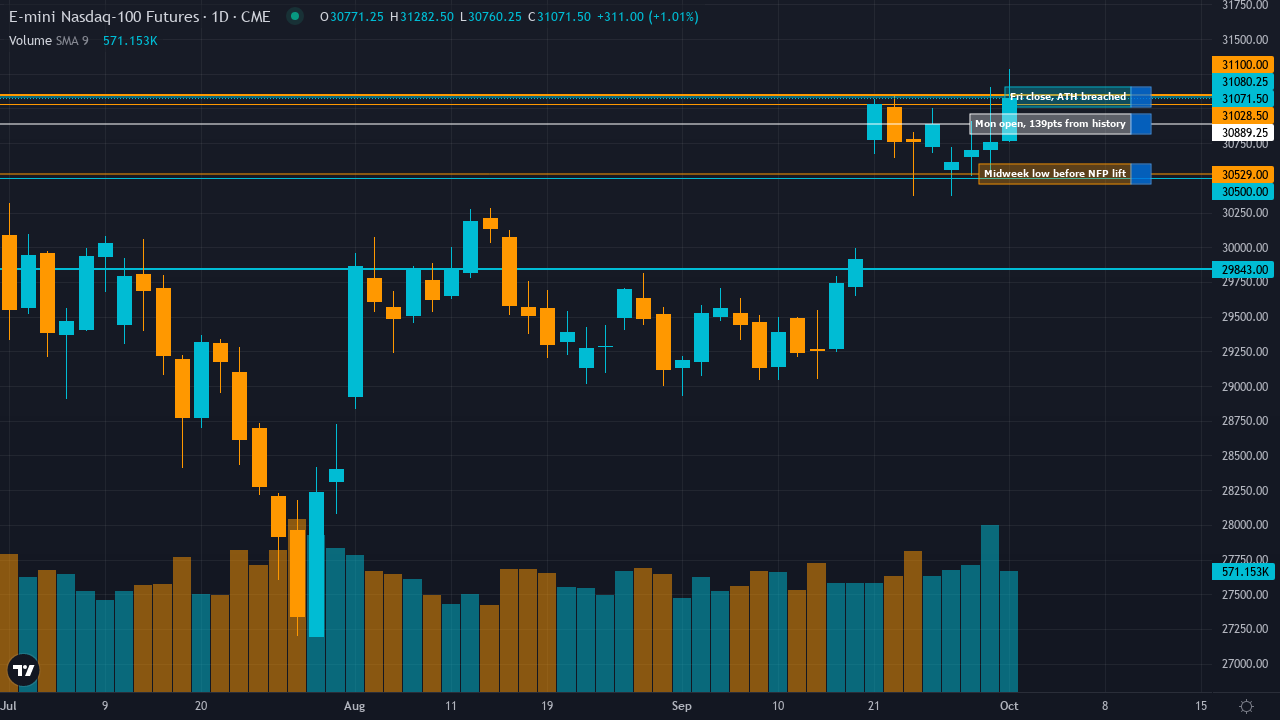
After last week's 80% headline that had me feeling cautiously optimistic about the desk's trajectory, this week delivered something almost as clean. Four directional calls, three correct, a 75% accuracy rate. The Nasdaq, this week's Market of the Week, was called BULLISH at 7/10 and edged 0.62% higher to close at 31,080, quietly slipping past the all-time high of 31,028.50 that had been lurking like a toll booth on a motorway. Treasury bonds, called BEARISH at 7/10, collapsed 1.88% as 30-year yields continued their violent march toward levels not seen since the early 2000s. And the Russell 2000, BEARISH at 5/10, scraped a correct result with a 0.24% decline that barely qualified as movement but technically went in the right direction.
The lone directional miss belongs to copper, called BULLISH at 7/10 on the Escondida strike vote thesis, which fell 1.64% as the broader selloff in industrial metals overwhelmed the supply disruption catalyst the desk was banking on. That is now a theme I have been tracking for months: supply-side analysis on copper works until the macro regime decides it doesn't, and this week the macro regime was not in a cooperative mood.
The ten NO CALL markets produced the familiar parade of missed opportunities I have been documenting since March. Silver dropped 5.28%. Soybeans crashed 3.17%. Platinum fell 3.57%. Wheat lost 2.88%. The Aussie dollar shed 1.10%. EUR/USD slipped 1.06%. The desk said nothing about any of them. I have written some variation of this paragraph so many times it now has its own filing cabinet in my office, complete with alphabetised tabs for each market the desk has watched decline from behind the signal threshold barrier.
|
14
Markets
|
4
Directional
|
3
Correct
|
75%
Accuracy
|
10
No Calls
|
Four directional calls this week, with three landing on the right side. The other ten markets got the NO CALL treatment. A 75% directional accuracy rate sustains the improved trajectory from last week's 80%, and the average confidence of 6.5 across those four calls represents the desk's strongest average commitment in recent memory. Both 7/10 calls that went the right way, NQ BULLISH and ZB BEARISH, delivered cleanly. The RTY BEARISH at 5/10 scraped through with a 0.24% decline that is the directional equivalent of winning a chess game on time rather than checkmate. The sole miss, copper BULLISH at 7/10, stings because it was the desk's joint-highest conviction and the Escondida strike vote thesis sounded compelling on Sunday evening.
The real story, as always, lies in the abstentions. Six of ten NO CALL markets produced moves exceeding 1%, with silver's 5.28% drop and soybeans' 3.17% crash leading the parade. When your abstentions produce bigger moves than your commits, the framework is protecting your accuracy percentage at the cost of demonstrating relevance. That trade-off has been the desk's defining characteristic since the Iran conflict rewrote every correlation in March, and nine months later the song remains the same.
|
35/65
Correct / Total
|
53.8%
Accuracy
|
65 / 111
Directional / No Call
|
The rolling twelve-week figure sits at 53.8% across 65 directional calls, with 111 no-call abstentions. That engagement split means the desk calls direction on roughly 37% of market-weeks, a rate that has been declining since February's 70% pace and is now approaching the level where the NO CALL column does three times the work of the directional one. This week's 75% on four calls nudges the number modestly, but with only four calls entering the denominator, the needle barely moves. The desk needs to either increase its directional volume while maintaining accuracy above 65%, or accept that the mid-fifties is the structural ceiling for a framework operating at this level of selectivity. At 53.8%, we are just above the threshold where following the desk offers measurable advantage over a coin.
|
Bias Called
BULLISH
|
Confidence
7/10
|
Result
CORRECT
|
Grade
B+
|
| Monday Open | 30889.25 |
| Friday Close | 31080.25 |
| Move | 0.62 |
| ▼ R2 | 31100 |
| ▼ R1 | 31028.5 |
| ▲ S1 | 30500 |
| ▲ S2 | 29843 |
R1 at 31,028.50, the all-time high, was the level that mattered. NQ opened Monday at 30,889.25, just 139 points below that ceiling, and spent the first half of the week grinding sideways through the JOLTs, Consumer Confidence, and Fed speech cluster. Friday provided the fireworks. TheStreet confirmed the Nasdaq jumped 1.35% on October 2 as the September nonfarm payrolls report showed employers added just 29,000 jobs, well below expectations. The soft jobs data sent rate-hike fears receding, and the index pushed past the 31,028.50 ATH to close at 31,080.25. R2 at 31,100 was within touching distance but not quite reached. S1 at 30,500 was never remotely threatened. The levels framework correctly identified the all-time high as the gatekeeper, and the market needed the full week's catalyst cluster to generate enough escape velocity to clear it.
The called edge identified a stark divergence between extreme retail bearishness at AAII 48.1% bears versus 32.7% bulls and accelerating institutional accumulation, with CFTC COT showing non-commercial net longs surging 66% in a single week to the 98.7th percentile of the 3-year range. The desk argued sophisticated money was buying what the crowd was selling. That thesis was directionally correct. Friday's soft payrolls print at 29,000 jobs provided the permissive catalyst for the breakout, as markets interpreted the weak data as reducing the probability of another Warsh rate hike. The cautionary note from the Institutional agent about the 98.7th percentile COT creating reversal risk did not materialise this week, though the 0.62% gain is modest enough that the jury remains out on whether the crowded positioning is a vulnerability or validation.
Five of six disciplines pointed BULLISH, with only the Institutional agent dissenting at a -4.2 signal warning about the most crowded speculative positioning in the 158-week dataset. The Sentiment agent earned particular credit, identifying the AAII -15.4% bull-bear spread as a contrarian buying signal at levels approaching capitulation. The Economic agent correctly read the RISK-ON regime with VIX at 14.87 as structurally supportive for duration-sensitive tech. The Technical agent confirmed the uptrend above both 50-day and 200-day MAs with 11 of 12 moving averages issuing buy signals. The Options agent flagged the positive gamma regime at $759.9M dealer long as providing structural stability. When the desk achieves this level of unanimity minus one dissenting voice carrying just 12% weight, the synthesis framework tends to deliver. This week, it did.
The Nasdaq 100 made its third appearance as Market of the Week, and after July's bearish debut that caught a 4.44% selloff and last week's BULLISH call that delivered a 4.33% explosion on the PMI blowout, this week's result is quieter but perhaps more significant. NQ closed at 31,080.25, above the 31,028.50 all-time high for the first time. That is new territory. Literally.
The week's price action was a study in patience rewarded by data. Monday through Thursday saw NQ consolidating in a tight range around the 30,800 to 31,000 zone as markets digested the dense catalyst cluster the desk had identified: JOLTs Job Openings, CB Consumer Confidence, and five Fed speeches on September 29 alone, followed by ADP employment and Core PCE through midweek. None of these individually detonated the breakout. Then came Friday. The September nonfarm payrolls report showed US employers added just 29,000 jobs, well below expectations. TheStreet confirmed the Nasdaq jumped 1.35% on the day as rate-hike fears retreated. The index pushed through R1 at the ATH and closed at 31,080.25, just 20 points below R2 at 31,100.
The free MOTW report, published on the Ghost site at macroagentdesk.com, laid out the institutional-versus-retail divergence thesis with the COT data showing a 66% weekly surge in speculative longs to the 98.7th percentile. The report correctly identified the approaching data cluster as the catalyst window, though it was Friday's payrolls report, rather than the Monday-to-Wednesday releases, that ultimately provided the fuel. For readers who had the analysis before Monday's open, the direction was called, the resistance level was mapped to the tick, and the ATH was breached by week's end.
The grade is B+ rather than A because, while direction was correct at the desk's highest conviction, the 0.62% move was modest for an index that routinely produces 2-4% weekly swings. The levels framework was precise, with R1 at the exact ATH providing the inflection point, but the magnitude of the gain was the kind of win you put in the 'correct' column without feeling the need to celebrate. Quarter-end window dressing on September 30 likely contributed some mechanical support, and whether the breakout above the ATH is the beginning of a sustained move toward 32,000+ or a false breakout that gets reversed by Q3 earnings will determine if the thesis has legs.
After spending most of 2026 either sitting out the Nasdaq's rallies with NO CALL abstentions that I criticised in approximately seventy paragraphs, or catching the occasional bearish pullback, the desk has now strung together two consecutive correct BULLISH calls on NQ. That is not yet a streak. But it might be the beginning of one.
| Market | Bias | Conf. | Mon Open | Fri Close | Move | Result | Grade |
|---|---|---|---|---|---|---|---|
|
Nasdaq 100
CORE
|
BULLISH | 7/10 | 30889.25 | 31080.25 | 0.62 | CORRECT | B+ |
| This week's MOTW. BULLISH at 7/10 and NQ edged past the 31,028.50 all-time high to close at 31,080.25 as Friday's soft payrolls at 29,000 jobs provided the final push. The retail-versus-institutional divergence thesis proved directionally correct. See the full deep-dive above. The free report is on the Ghost site. | |||||||
|
S&P 500
CORE
|
NO CALL | — | 7803.75 | 7782.25 | -0.28 | — | — |
| NO CALL at 4/10 and the S&P slipped 0.28%, well within noise. TheStreet confirmed a 0.89% gain on Friday alone as the soft payrolls lifted equities, but the weekly Monday-to-Friday window captured a modest decline. A correct abstention. | |||||||
|
Crude Oil
CORE
|
NO CALL | — | 92.41 | 91.4 | -1.09 | — | — |
| NO CALL at 4/10 under mandatory reset after seven consecutive missed calls, and crude dropped 1.09%. The Hormuz de-escalation thesis continues its slow grind, with Iran's 7-day reopening offer at the UN providing the backdrop. A correct abstention, though barely, as the 1.09% move sits just above the noise threshold. | |||||||
|
EUR/USD
CORE
|
NO CALL | — | 1.1409 | 1.1289 | -1.06 | — | — |
| NO CALL at 4/10 and the euro dropped 1.06% as US 10-year yields surging to 5.17% powered the dollar. The desk's conviction penalty from two consecutive missed calls locked it out of a meaningful move. The Eurozone CPI data at 4.7% apparently failed to support the currency against relentless USD strength. | |||||||
|
Silver
EXTENDED
|
NO CALL | — | 64.245 | 60.85 | -5.28 | — | — |
| NO CALL at 5/10 and silver crashed 5.28% from $64.25 to $60.85. The metal that once dominated this column with four consecutive weeks of MOTW glory back in February continues its decline under the weight of 10-year yields at 5.17%. A 5% move on a NO CALL is the kind of miss that makes the signal threshold framework look expensive. | |||||||
|
Japanese Yen
EXTENDED
|
NO CALL | — | 0.006375 | 0.006371 | -0.07 | — | — |
| NO CALL at 5/10 and the yen moved 7 basis points. The platonic ideal of a correct NO CALL. After the BOJ's September 18 sell-the-fact hike, the yen has settled into the kind of post-catalyst digestion that rewards patience and punishes conviction in equal measure. | |||||||
|
GBP/USD
EXTENDED
|
NO CALL | — | 1.3253 | 1.3247 | -0.05 | — | — |
| NO CALL at 5/10 under mandatory reset after two consecutive missed calls, and sterling drifted 5 pips. The desk and cable continue their legendary non-relationship, which has now persisted for the better part of eight months. Extreme COT shorts at the 3.2nd percentile remain coiled but untriggered. | |||||||
|
Copper
EXTENDED
|
BULLISH | 7/10 | 6.6955 | 6.585 | -1.64 | MISSED | D |
| BULLISH at 7/10 and copper fell 1.64%. The Escondida strike vote thesis met a market more interested in the macro selloff than the supply disruption. The 98.7th percentile COT long positioning the desk dismissed as 'validated by fresh catalysts' turned out to be exactly the kind of crowded trade that punishes optimism. The worst directional call on the board. | |||||||
|
Russell 2000
EXTENDED
|
BEARISH | 5/10 | 2859.3 | 2852.3 | -0.24 | CORRECT | C+ |
| BEARISH at 5/10 and the Russell slipped 0.24%, the thinnest of correct calls. 10-year yields at 5.17% continued to pressure credit-sensitive small-cap balance sheets carrying floating-rate debt. Direction right, conviction whispered, magnitude negligible. When your correct call moves 0.24%, nobody is framing the certificate. | |||||||
|
AUD/USD
FULL DESK
|
NO CALL | — | 0.7026 | 0.6949 | -1.1 | — | — |
| NO CALL at 5/10 and the Aussie dropped 1.10% as the RBA September 29 rate decision and subsequent Australian CPI data failed to support the currency against broad USD strength. A meaningful FX move the desk missed, with the signal sitting below the FX_MAJOR threshold despite the densest catalyst cluster in months. | |||||||
|
30Y Treasury
FULL DESK
|
BEARISH | 7/10 | 104.6875 | 102.72 | -1.88 | CORRECT | A |
| BEARISH at 7/10 and bonds fell 1.88% as the MOVE Index spiked 30% and 30-year yields pushed toward 5.50%, the highest since 2004. The desk's most durable directional conviction of 2026 keeps delivering. Best call on the board this week, and the paid report covers the full fiscal deficit, Warsh regime, and MOVE complacency thesis. | |||||||
|
Wheat
FULL DESK
|
NO CALL | — | 703.25 | 683 | -2.88 | — | — |
| NO CALL at 4/10 and wheat fell 2.88% as the Black Sea supply disruption thesis met weakening export demand and a speculative positioning flip that has seen managed money swing from the 99.4th percentile long in August to the 93rd percentile short. Another week of agricultural drama behind the NO CALL curtain. | |||||||
|
Soybeans
FULL DESK
|
NO CALL | — | 1319 | 1277.25 | -3.17 | — | — |
| NO CALL at 3/10 and soybeans crashed 3.17% as the rain-delayed harvest and extreme speculative long positioning at the 99.4th percentile collided. The desk flagged the positioning extreme as the 'single largest vulnerability in the dataset' and then sat on its hands while it detonated. The September 30 Grain Stocks report apparently resolved bearishly. | |||||||
|
Platinum
FULL DESK
|
NO CALL | — | 1774.7 | 1711.4 | -3.57 | — | — |
| NO CALL at 3/10, the lowest conviction on the board, and platinum fell 3.57%. The WPIC surplus revision has removed the immediate deficit catalyst, and the metal continues consolidating in the $1,700 to $1,840 range the desk has been tracking. A 3.57% move on a NO CALL is a proper miss, though the minimum conviction was appropriate given the complete absence of a near-term catalyst before the November 18 WPIC Quarterly report. | |||||||
|
✦ Best Call: 30Y Treasury (ZB)
BEARISH at 7/10 and bonds fell 1.88% from 104.6875 to 102.72, pushing 30-year yields further into territory not seen since 2004. The desk's thesis about structural fiscal deterioration, the Warsh hawkish regime, and the MOVE Index spike to 104 creating acceleration potential rather than mean reversion was vindicated with force. This is the desk's most durable directional conviction of 2026, and it keeps delivering. When your highest-conviction bearish call produces the week's largest correct directional move by a comfortable margin, the system is telling you where its genuine edge lives. The paid report covers the full thesis. |
⚠️ Worst Call: Copper (HG)
BULLISH at 7/10 and copper fell 1.64% from $6.70 to $6.59. The desk positioned for the Escondida No.2 supervisors strike vote at the world's largest copper mine to validate the extreme speculative long positioning at the 98.7th percentile. Instead, the broader selloff in industrial metals dragged copper lower despite the supply disruption thesis. I have been documenting the desk's copper saga since June's double-MOTW debacle where it chased its own tail between bullish and bearish, and while the consistency has improved since then, the 98.7th percentile COT reading the desk dismissed as 'fresh supply disruption validating the longs' turned out to be exactly the kind of crowded positioning that makes a market vulnerable. When everyone is already long and the catalyst disappoints, there is nobody left to buy. |
The Economic agent had the strongest week across the directional calls, correctly supporting the bearish Treasury bond thesis through the hawkish Fed repricing and fiscal deficit deterioration framework that has been the desk's most reliable analytical lens since the Warsh era began. Its identification of 10-year yields at 5.17% as a structural headwind for the broader commodity complex proved directionally correct across multiple markets, even those the desk did not formally call.
The Fundamental agent continues its year-long pattern of being correct about supply dynamics and wrong about timing. Its Grasberg supply deficit thesis on copper drove the BULLISH call that missed, as the structural supply story was overwhelmed by the macro selloff. On silver, where the structural deficit thesis remains intact, the metal dropped 5.28% while the desk watched from behind the signal threshold. The Sentiment agent earned quiet credit on the Nasdaq, where its identification of extreme AAII bearishness at 48.1% as a contrarian buying signal proved to be the analytical foundation for the week's MOTW call. After months of being the desk's least-weighted discipline, the Sentiment agent is earning its keep when the retail crowd capitulates at exactly the wrong moment.
October opens with two defining themes. Q3 earnings season begins in earnest, and whether the AI capex cycle that powered the Nasdaq through the ATH can deliver revenue conversion will determine if the breakout holds or reverses. The October 28 FOMC looms as the next major Fed event, with CME FedWatch pricing 75.8% probability of a 25bp hike that would take rates to 4.00-4.25%, a level the bond market is already pricing with extreme prejudice at 30-year yields near 5.50%. The Hormuz de-escalation narrative that sent crude oil below $92 this week could accelerate if Iran's 7-day reopening offer gains traction, potentially removing the geopolitical premium that has distorted energy markets since February. And the desk needs to find a way to participate in the precious metals and agricultural moves it keeps watching from behind the NO CALL curtain. Ten abstentions with a 5% silver decline and a 3% soybeans crash is procedurally clean and practically invisible.