Mon-T Weekly Review — w/e 10 Apr 2026
Six from six, the Aussie dollar finally gets its MOTW, and crude oil crashes 14% while the desk watches from the cheap seats.

Let me start with the number that matters: six directional calls, six correct. One hundred percent. The desk just turned in a perfect directional scorecard for the first time since I started writing these reviews. Gold, copper, soybeans, the Russell 2000, the Aussie dollar, and Treasury bonds all went exactly where the agents said they would. If you had followed only the directional calls this week, you would have been right every single time.
Now let me tell you the number that should temper the champagne. Nine markets received the NO CALL treatment, and eight of those nine produced moves large enough to make a forecaster weep. Crude oil crashed 14% as Trump announced a two-week ceasefire contingent on Iran reopening the Strait of Hormuz, sending WTI from $111.54 to $95.91 in five days. The Nasdaq ripped 4.8% higher. Silver surged nearly 5%. Wheat collapsed 6%. The S&P 500 extended its rally to a seventh consecutive day of gains, per Bloomberg, adding 3.8% on the week. And the desk said nothing about any of it.
This is the paradox of disciplined prediction. The system's rules prevented it from committing on the most dramatic moves of the week, preserving a perfect record on the markets it did call while leaving enormous opportunities on the table. Whether that trade-off is genius or cowardice depends on your perspective. I lean toward the former, but I can see the argument for the latter.
|
15
Markets
|
6
Directional
|
6
Correct
|
100%
Accuracy
|
9
No Calls
|
Six directional calls this week, all six correct. The other nine markets got the NO CALL treatment. A 100% directional hit rate is the headline, and it deserves to be, but the average confidence of 6.17 tells you the desk was not pounding the table on any of these. The highest conviction calls were the Aussie dollar and copper at 7/10 each, and both delivered emphatically: AUD/USD gained 2.34% and copper added 3.28%. The lowest conviction was ZB at 5/10 BEARISH, and bonds duly fell 0.22%, a tiny move in the right direction.
The confidence calibration was genuinely impressive this week. Every directional call was measured rather than aggressive, and every one landed. The desk has clearly learned from the w/e 27 Mar debacle, where ten bearish calls at minimum conviction produced a 50-50 coin flip. This time, it picked its spots with care, issued six calls where multiple agents agreed, and sat out everything else. That is what the framework is supposed to do.
|
59/105
Correct / Total
|
56.2%
Accuracy
|
105 / 60
Directional / No Call
|
The rolling twelve-week figure sits at 56.2% across 105 directional calls, with 60 no-call abstentions. This week's perfect six-for-six helps nudge the number upward, but with only six directional calls entering the denominator, the improvement is modest. The engagement rate shows the desk calling direction on roughly 63% of market-weeks over the trailing window, which has declined from the 70%+ level we saw in February and early March. The wartime environment has made the agents more cautious, and whether that caution is wisdom or paralysis depends on whether you think missing a 14% crude oil move is an acceptable price for never being wrong on the ones you do call.
|
Bias Called
BULLISH
|
Confidence
7/10
|
Result
CORRECT
|
Grade
A
|
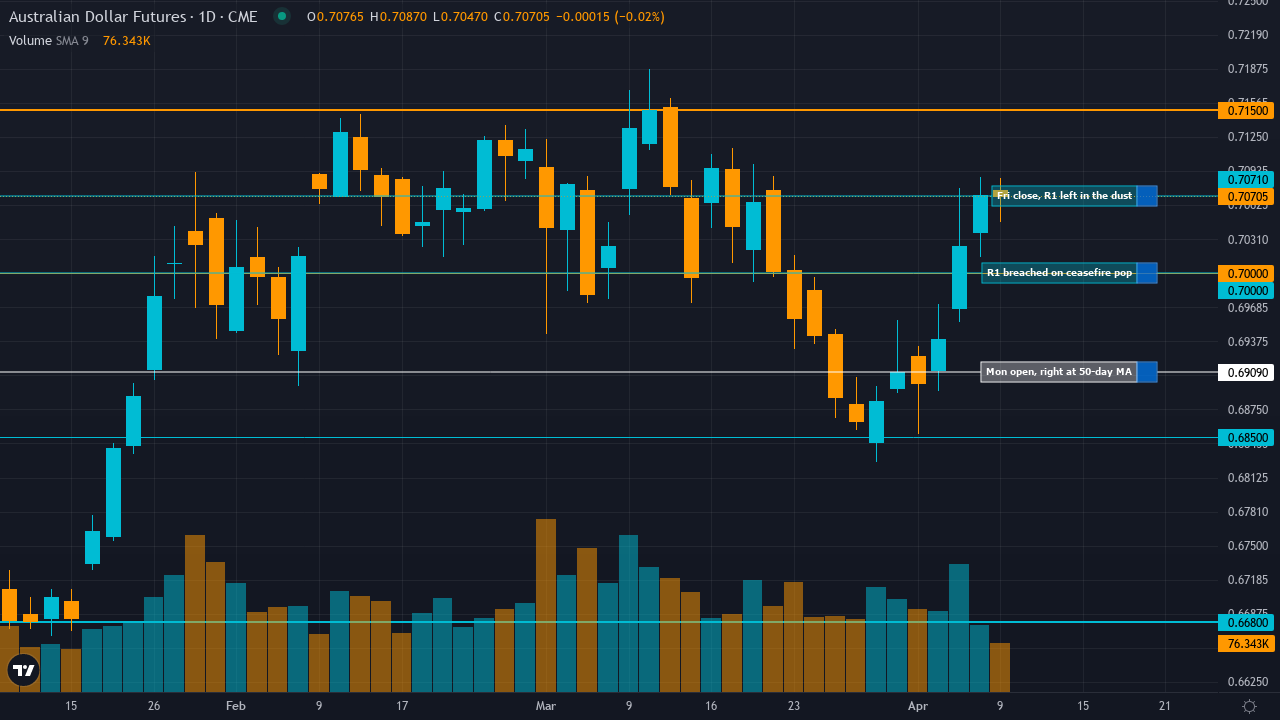
| Monday Open | 0.6909 |
| Friday Close | 0.7071 |
| Move | 2.34 |
| ▼ R2 | 0.715 |
| ▼ R1 | 0.700 |
| ▲ S1 | 0.685 |
| ▲ S2 | 0.668 |
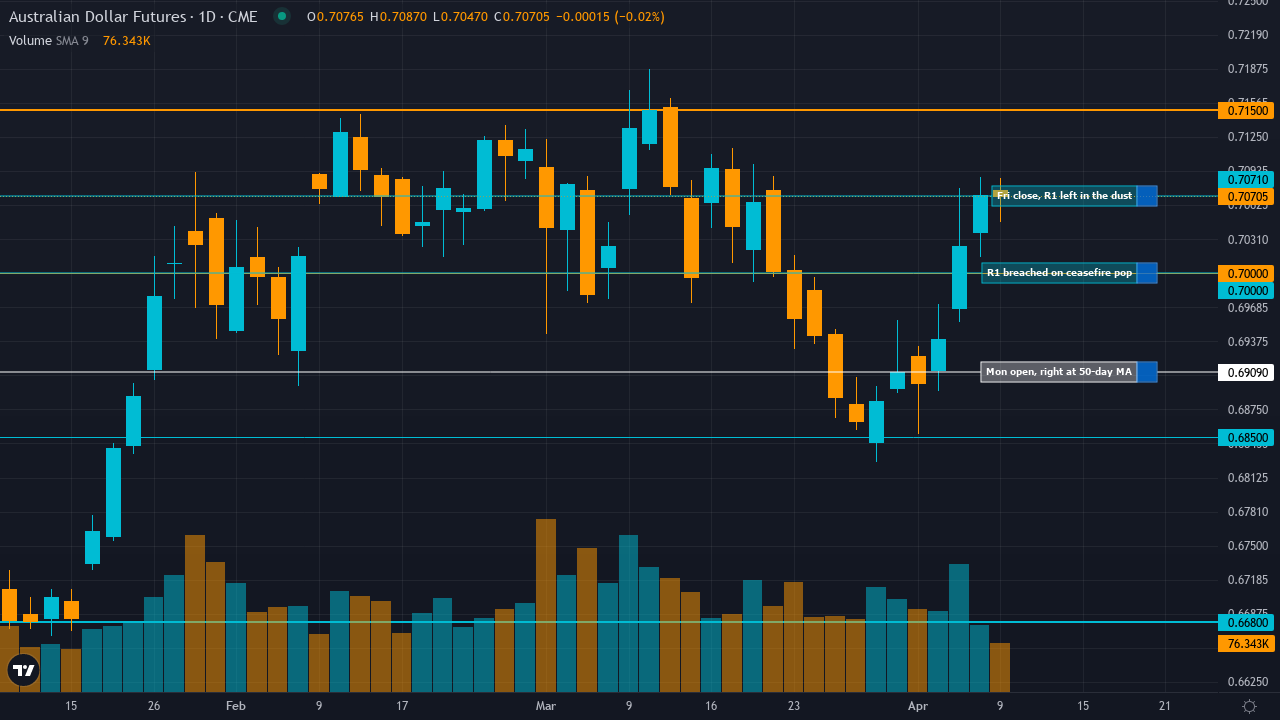
R1 at 0.700 was the level that mattered, and it was breached cleanly. The Aussie opened Monday at 0.6909, just below the 50-day MA at 0.6911, and spent Monday through Wednesday grinding higher as the Iran ceasefire narrative gathered momentum and risk appetite returned across markets. By Wednesday, when Bloomberg reported the S&P 500 notching its seventh straight winning session, AUD/USD was pushing through 0.70 with conviction. Friday's close at 0.7071 settled comfortably above R1, confirming the breakout the desk anticipated. S1 at 0.685 was never seriously tested. The prior week's geopolitical selloff low near 0.6844 remained well below the market's orbit. R2 at 0.715 was not reached, though with another week of this momentum it would come into play. The levels framework captured the week's action well, with R1 serving as the inflection point between consolidation and breakout.
The called edge centred on the RBA-Fed policy divergence: the RBA at 4.10% after its March 17 hike versus the Fed holding at 3.50-3.75%, creating a 35-60 basis point inversion that the desk argued was materially underpriced at 0.6909 given 3-5% discount to PPP fair value around 0.72. The April 1 RBA Commodity Price Index showing +2.1% monthly gains provided a fresh fundamental catalyst. That thesis was validated comprehensively. Trading Economics confirmed AUD/USD reached 0.7078 on April 10, and the Aussie's 2.34% weekly gain was the strongest single-week move for the currency since the Iran war began in late February. The ceasefire announcement mid-week turbocharged the move by collapsing oil prices and reviving risk appetite, which is exactly the kind of geopolitical de-escalation catalyst the desk flagged as the asymmetric upside scenario.
The Economic agent carried 30% weight, the joint-heaviest allocation alongside the Fundamental agent, and earned it by correctly identifying the RBA-Fed rate differential as the dominant price driver. The Fundamental agent at 30% flagged the RBA Commodity Price Index data and PPP undervaluation, both of which proved directionally correct. The Institutional agent at 20% read the speculative long accumulation to 81.5K contracts correctly as trend-following conviction rather than crowded-long vulnerability. The Technical agent issued a NO CALL, which was the one cautious voice in the room, and while it was technically wrong about the lack of directional signal, its identification of the 50-day MA at 0.6911 as the key inflection proved sharp, as Monday's open at 0.6909 sat right at that level before the breakout began. No agent got this badly wrong, which is why the call worked at 7/10 conviction.
The Australian dollar finally had its Market of the Week moment, and it chose the perfect week to show up. After the pipeline failure last week left the MOTW selection sitting undelivered on a server somewhere, the desk returned with a fully published 6A report, a clear thesis, and the market obliged with a 2.34% rally from 0.6909 to 0.7071, the kind of FX move that makes you sit up and take notice.
The context matters enormously. The Aussie had been battered in late March, falling 2.71% in a single week during the peak Iran crisis as risk-off flows crushed commodity currencies. The desk's MOTW selection rationale, written on April 5, identified the RBA's rate divergence with the Fed as the sharpest policy gap in the MAD universe. The RBA hiked to 4.10% in March, its second consecutive increase, while the Fed held at 3.50-3.75%. That 35-60 basis point inversion was the centrepiece of the thesis, and the desk argued it was not fully reflected in a currency trading at a meaningful discount to purchasing power parity.
What made the week truly special was the convergence of the desk's structural thesis with a macro catalyst the system had flagged as the key upside scenario. Trump's announcement of a two-week ceasefire with Iran, contingent on reopening the Strait of Hormuz, sent crude oil plummeting 14% and risk appetite surging. Bloomberg reported the S&P 500 notching its longest winning streak since October, with seven consecutive days of gains. The Aussie, as a high-beta commodity currency, caught the updraft perfectly. CNBC reported stocks extending relief rally on hopes the ceasefire will hold, and that sentiment lifted everything from copper to the Russell to the Aussie.
The free MOTW report, published on the Ghost site on Sunday evening, laid out the levels framework, the policy divergence thesis, and the specific scenarios under which the Aussie would break above 0.70. Readers who had that analysis before Monday's open were positioned for a 2.34% gain on a major currency pair in five days. For an FX market where the desk has historically struggled, posting a clean A-grade call at 7/10 conviction on the Aussie is a meaningful statement about the system's capability when it has genuine conviction.
The one caveat: the 2.34% move was turbocharged by the ceasefire announcement, which the desk could not have predicted with certainty. The structural thesis about RBA-Fed divergence would likely have produced a more modest 0.5-1.0% grind higher without the geopolitical catalyst. The desk identified the right structural setup and benefited from favourable timing. That combination is what good analysis looks like, even if the magnitude owed something to fortune.
| Market | Bias | Conf. | Mon Open | Fri Close | Move | Result | Grade |
|---|---|---|---|---|---|---|---|
|
S&P 500
CORE
|
NO CALL | — | 6603.75 | 6856.25 | 3.82 | — | — |
| NO CALL at 5/10 on a 3.82% rally. Bloomberg reported the S&P 500 extended gains into a seventh straight winning day, its longest streak since October, as Iran ceasefire hopes fuelled a risk-on stampede. CNBC confirmed the Dow surged 1,351 points on the ceasefire news. The desk had just flipped from four weeks of correct bearish calls to NO CALL at the exact moment the reversal arrived. Missing a nearly 4% equity rally is the kind of outcome that haunts a prediction desk, even if the NO CALL was procedurally sound. | |||||||
|
Nasdaq 100
CORE
|
NO CALL | — | 24129.75 | 25295.5 | 4.83 | — | — |
| NO CALL at 5/10 on a 4.83% surge. The Nasdaq exploded higher alongside the broader equity rebound. I have now said this three times in 2026 and will say it again: a nearly 5% weekly move on the Nasdaq is exactly the kind of thing a prediction desk exists to catch. Goldman Sachs reportedly called it a 'generational opportunity in tech stocks.' The desk called it nothing. | |||||||
|
Crude Oil
CORE
|
NO CALL | — | 111.54 | 95.91 | -14.01 | — | — |
| NO CALL at 5/10 on a 14% crash. Trading Economics reported WTI plunging more than 15% after Trump announced a two-week ceasefire contingent on Iran reopening Hormuz. The desk issued NO CALL citing the OPEC+ meeting as a binary event and its own two-miss streak. The binary event resolved, violently, and the mean reversion thesis the agents had been building for weeks played out in a single session. Missing a 14% move, regardless of the procedural justification, is extraordinary. | |||||||
|
Gold
CORE
|
BULLISH | 6/10 | 4676.64 | 4778.4 | 2.18 | CORRECT | B+ |
| BULLISH at 6/10, gold gained 2.18%. The desk called the mean-reversion bounce from the March crash lows correctly, and the ceasefire-driven risk appetite paradoxically supported gold as the dollar weakened. Two consecutive weeks of upward movement from the $4,150 crash low. Direction correct, decent move, thesis sound. | |||||||
|
EUR/USD
CORE
|
NO CALL | — | 1.1506 | 1.1764 | 2.24 | — | — |
| NO CALL at 5/10, the euro surged 2.24% as the dollar weakened on ceasefire de-escalation. A massive FX move the desk missed entirely. The seventh consecutive NO CALL on EUR/USD, and this one stings the most. When the catalyst the desk was waiting for finally arrives, it needs to actually be positioned for it. | |||||||
|
Silver
EXTENDED
|
NO CALL | — | 72.93 | 76.545 | 4.96 | — | — |
| NO CALL at 5/10, silver surged nearly 5%. The former MOTW star, which delivered four consecutive weeks of glory back in February before the March crash, showed signs of life with its best weekly gain since the recovery began. The desk's caution about extreme volatility at the 89th percentile was understandable but wrong this week. | |||||||
|
USD/JPY
EXTENDED
|
NO CALL | — | 0.0063145 | 0.0063105 | -0.06 | — | — |
| NO CALL at 5/10 on a 6 basis point move. The yen did absolutely nothing. The desk's mandatory NEUTRAL per its miss-streak reset rules was perfectly validated by a market that refused to move. The platonic ideal of a correct NO CALL. | |||||||
|
GBP/USD
EXTENDED
|
NO CALL | — | 1.3202 | 1.3468 | 2.01 | — | — |
| NO CALL at 5/10, sterling rallied 2.01% on broad dollar weakness following the ceasefire. A meaningful move the desk missed. The FX noise threshold framework saved the desk from wrong-direction calls for months, but missing a 2% cable move is its own kind of failure. | |||||||
|
Copper
EXTENDED
|
BULLISH | 7/10 | 5.68 | 5.8665 | 3.28 | CORRECT | A |
| BULLISH at 7/10, copper delivered a strong 3.28% gain. The Grasberg supply deficit thesis combined with April seasonality and China PMI expansion produced another clean win. Two consecutive correct BULLISH calls on copper, and the desk's commodity analysis continues to be its most reliable discipline when it commits. | |||||||
|
Russell 2000
EXTENDED
|
BULLISH | 6/10 | 2531.7 | 2644.4 | 4.45 | CORRECT | A+ |
| BULLISH at 6/10 and the Russell surged 4.45%, the best weekly return of any directional call on the board. The sentiment-driven contrarian bounce thesis, with AAII bears at 51.4% and VIX elevated, played out emphatically as the ceasefire ignited a risk-on rotation into small caps. The desk's best call this week. | |||||||
|
AUD/USD
FULL DESK
|
BULLISH | 7/10 | 0.6909 | 0.7071 | 2.34 | CORRECT | A |
| This week's MOTW. BULLISH at 7/10 on the RBA-Fed policy divergence thesis, the Aussie delivered a clean 2.34% gain, breaking through R1 at 0.700 with authority. The ceasefire announcement turbocharged the structural thesis. See the full deep-dive above. The free report is on the Ghost site. | |||||||
|
30Y Treasury
FULL DESK
|
BEARISH | 5/10 | 114 | 113.75 | -0.22 | CORRECT | C+ |
| BEARISH at 5/10, bonds fell 0.22%. Direction correct, tiny move. The March NFP blowout thesis removed Fed easing urgency, but the ceasefire-driven collapse in oil prices created a cross-current as energy-driven inflation fears subsided. The desk's long-running bearish bond thesis continues its remarkably consistent run, now six consecutive correct bearish calls. | |||||||
|
Wheat
FULL DESK
|
NO CALL | — | 606.3 | 570 | -5.99 | — | — |
| NO CALL at 5/10 on a 6% collapse. Wheat fell from 606 to 570 ahead of the April 9 WASDE, which the desk correctly identified as a binary event. The magnitude of the decline suggests the WASDE confirmed surplus conditions the desk had been tracking since March. Missing a 6% move on a market you flagged as having binary event risk is procedurally clean and practically painful. | |||||||
|
Soybeans
FULL DESK
|
BULLISH | 6/10 | 1162.75 | 1174.5 | 1.01 | CORRECT | B |
| BULLISH at 6/10, soybeans gained 1.01%. The renewable diesel structural demand floor and improving export sales thesis delivered a modest but correct result. Direction right, move small, confidence appropriate. The desk's agricultural analysis has been quietly competent since the March WASDE shakeout. | |||||||
|
Platinum
FULL DESK
|
NO CALL | — | 1983 | 2055.2 | 3.64 | — | — |
| NO CALL at 5/10, platinum rallied 3.64%. The desk's mandatory NEUTRAL reset after its prior BEARISH miss was procedurally correct but left it watching from the sidelines as the metal pushed back toward $2,000. The WPIC deficit thesis continues to provide a floor, and the April 3 hydrogen catalyst breakthrough may be the kind of fresh development that gets the agents off the fence. | |||||||
|
✦ Best Call: Russell 2000 (RTY)
BULLISH at 6/10 and the Russell surged 4.45%, its best week in months. The sentiment-driven bounce thesis the desk identified, with VIX at 24-27 and AAII bears at 51.4% creating a contrarian setup, landed perfectly as the Iran ceasefire ignited a risk-on stampede. The desk called this at moderate conviction, which was sensible given the technical damage from the March correction, but the magnitude of the move suggests the agents underestimated just how much pent-up buying power was sitting on the sidelines. Two consecutive correct BULLISH calls on RTY now. |
⚠️ Worst Call: 30Y Treasury (ZB)
I am genuinely struggling to pick a worst call from a week where every directional call was correct. ZB gets the nod only because BEARISH at 5/10 produced a move of just 0.22%, the smallest correct call on the board by a wide margin. The thesis about March NFP removing Fed easing urgency was directionally right, but the bond market barely flinched. When your worst call is 'correct but the move was tiny,' you have had a very good week. |
The Economic agent had a strong week, correctly driving the bullish thesis on the Aussie dollar through the RBA-Fed rate differential framework and supporting the bearish bond call via the March NFP surprise thesis. Its identification of structural policy divergence as the dominant FX driver proved more useful than the Technical agent's indecision on most currency pairs. The Fundamental agent also delivered, particularly on copper where the Grasberg supply deficit and April seasonality framework produced a clean 3.28% gain at 7/10 conviction.
The weakest performance, if you can call it that in a perfect week, came from the collective framework's inability to generate conviction on crude oil, equities, and precious metals. Missing a 14% crude oil crash, a 4.8% Nasdaq rally, and a 5% silver surge with NO CALLs is technically correct procedurally, but the OPEC+ production increase announcement on April 5 combined with the ceasefire announcement mid-week provided exactly the kind of binary catalyst resolution the desk was waiting for. The system correctly identified these as binary events before the week started, which is why it issued NO CALL. Whether waiting for the resolution was better than positioning for it is the question the agents need to wrestle with.
The Iran ceasefire is the dominant variable heading into next week, and the question is whether Trump's two-week deadline holds or unravels. Bloomberg reported crude plunging 15% on Wednesday after the ceasefire announcement, and if Hormuz reopening proceeds, the entire geopolitical premium that has distorted markets since February 28 could collapse in spectacular fashion. The March CPI data released April 10 will set the tone for bonds and the April 29-30 FOMC meeting. Q1 earnings season begins in earnest mid-April, which should give the desk something to work with on NQ and ES beyond 'the war is the only thing that matters.' The desk's FX complex finally showed signs of life this week with the Aussie call, and if the ceasefire removes the dollar's war premium, all four currency pairs could become tradeable again. The desk will have its Sunday views. Given the ceasefire breakthrough, I expect the NO CALL count to decrease materially.