S&P 500 Key Levels This Week — Support, Resistance & Confluence Zones
S&P 500 key levels breakdown: support zones, resistance zones, confluence and price structure.

Price Architecture
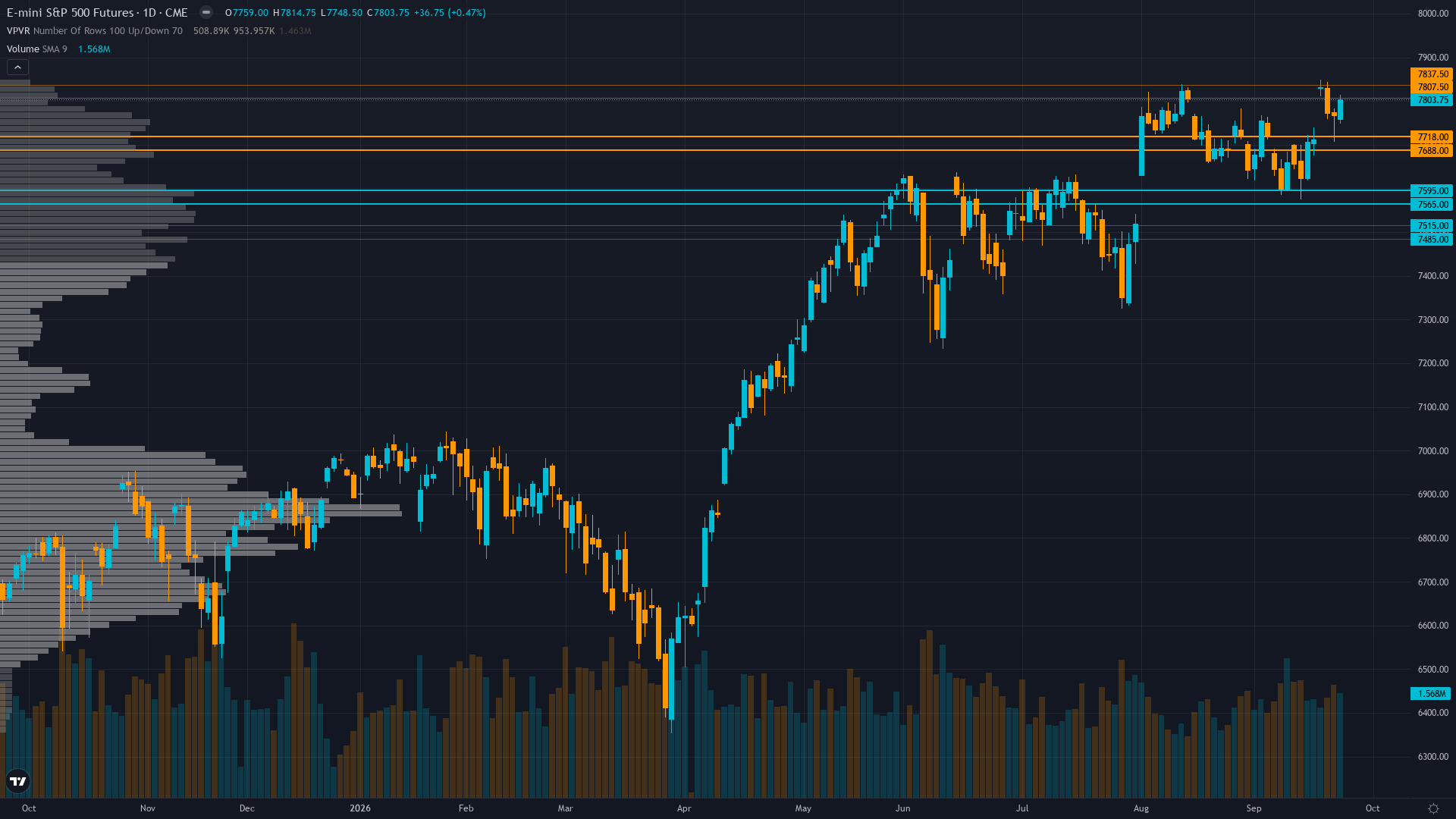
S&P 500 fell to 6412 on a 1.73% decline, with selling pressure dominating price action. S&P 500 futures is in a breaking down market state, requiring careful assessment of current conditions.
Confirmed breakdown - ES at 6412 decisively below 50-day MA 6547 and 200-day MA 6742 with RSI 22.08 deeply oversold creating classic dual signals of continuation risk versus mean reversion potential
Trend strength is low at 2/10, indicating weak directional conviction and potential for range-bound behaviour.
Downside Protection
The downside architecture for S&P index features support zones rooted in prior buying activity. These are not arbitrary lines but areas where real capital has previously been committed.
The reliability of support under breaking down conditions is shaped by the interplay between volatility regime and historical volume at each level.
Resistance Zone Context
The upside path for ES futures is marked by resistance zones where prior selling activity created structural barriers. Clearing these zones requires either strong momentum or a shift in the fundamental picture.
In the current market state, resistance zones remain key decision points.
Analytical Convergence
The most actionable levels for S&P 500 are those where multiple analytical disciplines converge. When technical structure, institutional positioning, and options flow all point to the same zone, the probability of price reacting there increases meaningfully.
High volatility regime suggests 1.5-2.5% daily ES moves expected with current 6380-6547 range representing 2.6% width - breakdown below 6380 presents asymmetric expansion risk with potential 3-4% intraday swings on cascade selling while hold creates compression opportunity
Our Multi-Agent Approach to Key Levels
The levels in our paid reports are generated by six specialist agents working in parallel. Technical analysis provides the structural framework, institutional data shows where capital is committed, options flow reveals hedging behaviour, fundamentals anchor levels to value, sentiment gauges crowd positioning, and economic analysis times the catalysts.
The output is a curated set of levels with institutional-grade validation — the kind of multi-dimensional analysis that hedge fund research desks produce, delivered at a fraction of the cost.
Our paid reports include specific support and resistance levels identified by six specialist agents — technical structure, institutional positioning, options flow, fundamentals, sentiment, and economic analysis. Not just lines on a chart, but zones validated by multi-discipline confluence.
Start Free — Get the Market of the WeekFree weekly report · No credit card · Upgrade anytime