Russell 2000 Key Levels This Week — Support, Resistance & Confluence Zones
Russell 2000 key levels breakdown: support zones, resistance zones, confluence and price structure.

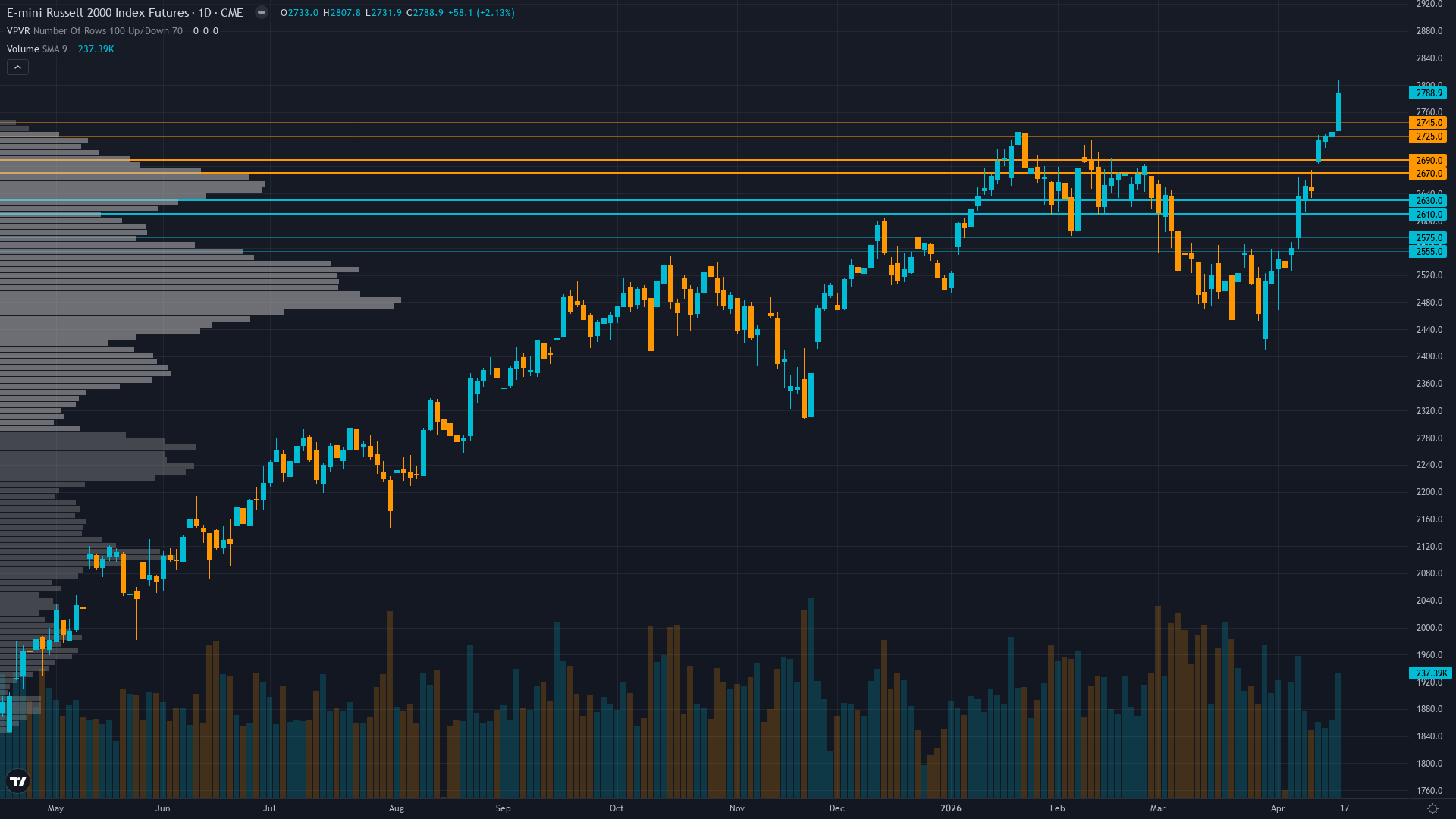
Structural Assessment
At 2713.1, Russell 2000 has gained 2.35% over the past session with buying pressure clearly in the driving seat. Russell 2000 futures is in a trending up market state, requiring careful assessment of current conditions.
Strong uptrend confirmed with price at 2713 above 50-day MA at 2492 and 200-day MA at 2564, fresh ATH breakout to 2797.1 on April 17 validates bullish structure with consolidation 3% below peak
At 8/10, trend strength signals that directional momentum is firmly in control.
Support Architecture
Support levels for Russell 2000 are defined by zones of prior institutional demand. The depth and frequency of prior tests at these levels determines their likely strength.
The strength of support depends on the current trending up regime and volume profile at each level.
Upside Barriers
Resistance levels above small-cap futures current price represent zones of historical supply. The significance of each level scales with the number of prior tests and the volume traded there.
The current trending up regime influences how aggressively these resistance zones are likely to be tested and whether they hold or fold.
Confluence & Methodology
Confluence is the differentiator between a line on a chart and a level worth trading. For Russell 2000 futures, the zones with the highest conviction are those validated across technical, institutional, and derivatives dimensions simultaneously.
Normal volatility regime at 58th percentile supports standard risk management with 3-4% stops below 2565 support, expect 40-60 point daily ranges versus 60-100 during March correction, stable pattern suggests directional trending environment
Beyond Lines on a Chart
Our approach to key levels is designed to filter noise from signal. Six independent agents each assess the same price zones from different perspectives. A level confirmed by one discipline is interesting. A level confirmed by four or five is worth building a trade plan around.
This multi-discipline approach means the levels in our paid reports carry institutional-grade confluence — not just lines on a chart, but zones validated across every analytical dimension that matters.
Our paid reports include specific support and resistance levels identified by six specialist agents — technical structure, institutional positioning, options flow, fundamentals, sentiment, and economic analysis. Not just lines on a chart, but zones validated by multi-discipline confluence.
Start Free — Get the Market of the WeekFree weekly report · No credit card · Upgrade anytime