Russell 2000 Forecast This Week — Outlook, Drivers & Key Levels
This week's Russell 2000 outlook: key drivers, volatility context, risk-opportunity assessment and the week ahead.

This Week's Starting Point
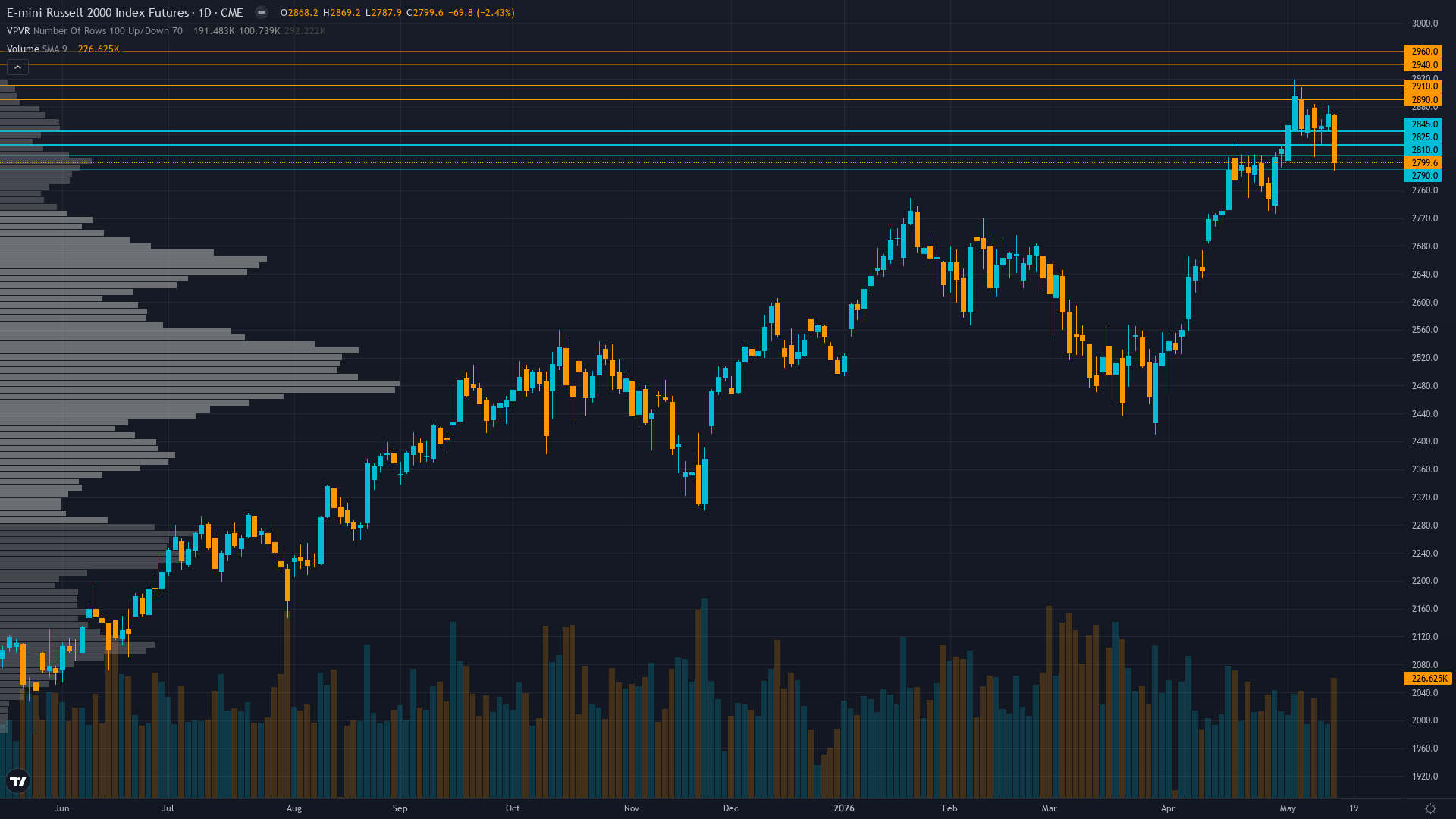
Trading at 2799.6 after a 2.43% slide, Russell 2000 faces sustained selling interest. Russell 2000 futures is in a breaking down market state, requiring careful assessment of current conditions.
Small-caps pulling back from May 6 all-time high at 2,888.62 but maintaining constructive longer-term view on Q1 earnings and eventual Fed easing supporting small-cap rotation narrative
Bull & Bear Case
Primary risk: Continued breakdown below 2,787 support triggering algorithmic cascade toward 2,700 major support representing additional 3-4% decline as Q1 earnings disappoint 44.9% consensus and VIX expansion signals risk-off rotation from small-caps (Probability: high)
Primary opportunity: Technical bounce from deeply oversold RSI 33.73 if 2,787 support validates into June FOMC, targeting 2,832-2,850 resistance as counter-trend relief rally though structural headwinds remain intact (Timeframe: 3-7 days if support holds)
This week's edge: Market consensus celebrating prior May 6 ATH and maintaining small-cap structural bullish narrative may be severely underpricing breakdown risk evidenced by today's -2.43% cascade below 2,800, while desk sees confirmed technical failure of May 10 thesis with 4 of 6 disciplines bearish creating high-probability continuation toward 2,700-2,750 support before any sustainable bounce materializes
This Week's Catalysts & Drivers
Primary driver: Technical breakdown confirmed with RTY plunging -2.43% today from open at 2,868 to close at 2,799.60, breaking below May 10 ATH of 2,899.30 and trading 3.1% below May 6 all-time high of 2,888.62, invalidating last week's bullish breakout thesis
Secondary factor: Severe discipline conflict with 4 of 6 agents now showing bearish/neutral leans: Technical -2.5 (conf 7), Economic -1.5 (conf 6), Fundamental -1.5 (conf 4), Institutional -0.5 (conf 3) versus only Sentiment neutral (0, conf 6) creating acute reversal pressure
Additional influence: VIX normalization to 17.99-18.43 remains below 20 threshold but ticked up 6.78% on May 15 signaling modest risk-off rotation, while equity put/call at 0.59 shows complacency persists despite -2.43% daily drop creating vulnerability to further selling
Economic backdrop: Fed on hold at 3.50-3.75% with June 17-18 FOMC meeting 31 days away showing 98% market expectation of hold per Polymarket, April NFP weak at 115K versus expectations with unemployment steady at 4.3% creating transitional macro regime uncertainty
Fundamental assessment: Q1 2026 earnings concerns emerging with -2.4% weekly price decline during active earnings season suggesting results disappointing elevated 44.9% YoY growth consensus, forward P/E at 25.39 representing 86% premium to 13.62-17.34 historical range creating valuation vulnerability
Technical Picture
Confirmed breakdown with price at 2,799.60 falling -2.43% today, testing critical 2,787.90 intraday low and trading well below 50-day MA at 2,491.98 per Technical agent, RSI 33.73 oversold without bullish divergence signaling further downside risk
At 3/10, trend strength is subdued, suggesting the market lacks a clear directional mandate.
Risk Environment
With vol at the 62th percentile over 90 days, RTY futures is in a measured regime that doesn't require unusual adjustments. Volatility is expanding, with realised vol rising across timeframes. This typically signals increasing uncertainty and wider daily ranges ahead.
Normal-to-elevated volatility regime at 62nd percentile requires wider risk management with 3-4% stops below 2,700 support, expect 60-90 point daily ranges versus 40-60 normal, breakdown combined with vol expansion suggests highly directional environment favoring trend-following over mean-reversion
Seasonal Context
Historical seasonal patterns for small-cap futures offer no strong directional signal in May 2026 (48% win rate). Sell in May narrative can weigh on small-caps.
Week Ahead Outlook
The next major catalyst is Federal Reserve FOMC Meeting June 17-18 with statement and forward guidance critical for rate-sensitive small-caps following April jobs miss and persistent higher-for-longer stance on Wednesday 17 June — a high-impact event that could materially shift the directional picture.
For Russell 2000, the balance between existing momentum and scheduled risk events sets the stage for the week ahead.
This analysis covers one dimension. Our full weekly report combines six specialist agents into a single actionable briefing with directional bias, key levels, and risk-opportunity matrix.
Start Free — Get the Market of the WeekFree weekly report · No credit card · Upgrade anytime