Crude Oil Forecast This Week — Outlook, Drivers & Key Levels
This week's Crude Oil outlook: key drivers, volatility context, risk-opportunity assessment and the week ahead.

Current Market Picture
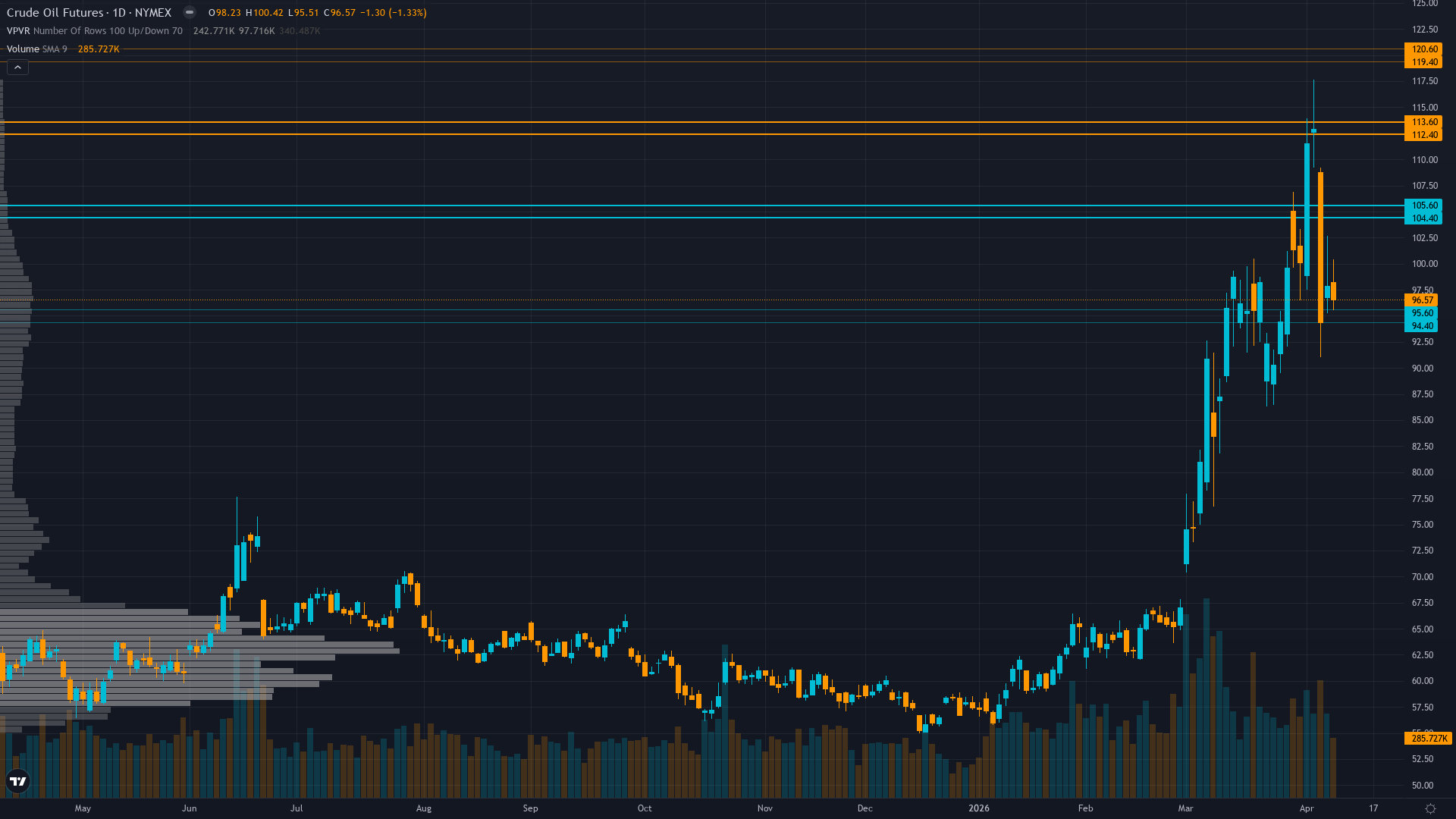
crude oil stands at 97.5, having rallied 1.50% as bulls press their advantage. crude oil futures is in a consolidating after violent selloff market state, requiring careful assessment of current conditions.
Tactically bearish on ceasefire-driven geopolitical premium fade but acknowledging fragility with April 22 expiration creating binary risk; structural oversupply forecasts (EIA $88/b Q4, Goldman $87 Q2, IEA 1.9 mb/d surplus) imply significant downside from current $97.50 once Hormuz fully normalizes
Key Drivers This Week
Primary driver: Geopolitical premium collapse following April 8 U.S.-Iran two-week ceasefire announcement triggering violent 14% selloff from $111.54 to $96 range as Strait of Hormuz begins controlled reopening, yet structural oversupply fundamentals (IEA 1.9 mb/d surplus 2026, EIA forecasting Brent declining to $88/b Q4) now reasserting dominance as war premium unwinds
Secondary factor: Ceasefire fragility creates binary path dependency with Strait of Hormuz still effectively restricted (Iran charging $1M+ tolls per ship, limiting passage) preventing full normalization while two-week timeline creates countdown clock to potential re-escalation if diplomacy fails
Additional influence: Extreme speculative positioning unwind accelerating with managed money net-long moderating from 202.2K contracts as Goldman Sachs Q2 forecast revision to $87 WTI/$90 Brent validates commercial bearish view reflected in producer hedging above $90
Economic backdrop: MACRO REGIME: TRANSITIONAL - VIX at 19.23 (normal range below 20 threshold) indicating geopolitical risk contained to energy sector rather than systemic; ceasefire removes acute supply shock narrative allowing structural oversupply and weak demand fundamentals to dominate forward pricing
Fundamental assessment: Crude overvalued 10-15% vs structural fair value $85-88; EIA April STEO forecasts Brent peaking $115/b Q2 then declining to $88/b Q4 (10% below current) as geopolitical premium fades and structural oversupply (IEA 1.9 mb/d surplus) reasserts with weak China demand
Price Structure
WTI at $97.50 consolidating after 14% collapse from $111.54, trading mid-range between $92 support and psychological $100 resistance; RSI 77 overbought with bearish divergence and declining open interest suggesting distribution
Trend strength at 4/10 paints a picture of a market with some direction but lacking strong conviction.
Upside & Downside
Primary risk: Ceasefire collapses before April 22 expiration with renewed U.S.-Israel strikes on Iran or Strait of Hormuz complete closure re-imposing supply shock, forcing violent reversal back toward $110-120 range and invalidating mean reversion thesis (Probability: low)
Primary opportunity: Ceasefire extends to permanent agreement by April 22 with full Strait of Hormuz normalization, triggering complete geopolitical premium unwind toward Goldman Sachs Q2 forecast $87 WTI as structural oversupply fundamentals (IEA 1.9 mb/d surplus, weak China demand, OPEC+ production increase) overwhelm tactical support within 2-4 weeks (Timeframe: 2-4 weeks through late April into early May as ceasefire clarity emerges)
This week's edge: Market may be underpricing probability of permanent ceasefire and full Strait normalization by April 22, creating asymmetric downside setup as extreme speculative positioning (202K net-long) unwinds, producer hedging above $90 validates commercial bearish view, and structural oversupply fundamentals (IEA 1.9 mb/d surplus, weak China demand, OPEC+ production increase) overwhelm temporary geopolitical support driving mean reversion toward Goldman $87 forecast within 2-4 weeks
Volatility Context
At the 90th percentile of its 90-day range, oil price volatility is running hot, creating both opportunity and risk for directional traders. Realised vol is holding its current level, suggesting the market has found a temporary equilibrium in its risk pricing.
High but contracting vol requires moderately wide stops; expect 3-5% daily ranges currently versus 6-8% during peak conflict as ceasefire stabilizes sentiment; consolidation at $95-100 range with ceasefire countdown to April 22 creating coiled energy for directional resolution favoring downside on normalization or upside on collapse
Week Ahead Outlook
The next major catalyst is Two-week U.S.-Iran ceasefire expires April 22, creating binary catalyst where either permanent peace agreement validates mean reversion to fundamentals or re-escalation forces geopolitical premium repricing on Wednesday 22 April — a high-impact event that could materially shift the directional picture.
For CL futures, the balance between existing momentum and scheduled risk events sets the stage for the week ahead.
This analysis covers one dimension. Our full weekly report combines six specialist agents into a single actionable briefing with directional bias, key levels, and risk-opportunity matrix.
Start Free — Get the Market of the WeekFree weekly report · No credit card · Upgrade anytime