Crude Oil (CL) — Market may be overweighting ceasefire durability (only 3 ships transiting…
Tactically confused with market split between ceasefire optimists expecting mean reversion to $85-90 and geopolitical hawks expecting collapse back to $110-115; structural oversupply consensus (EIA $88 Q4, IEA 1.9 mb/d surplus) implies modest downside from $95 current but ceasefire binary risk preve

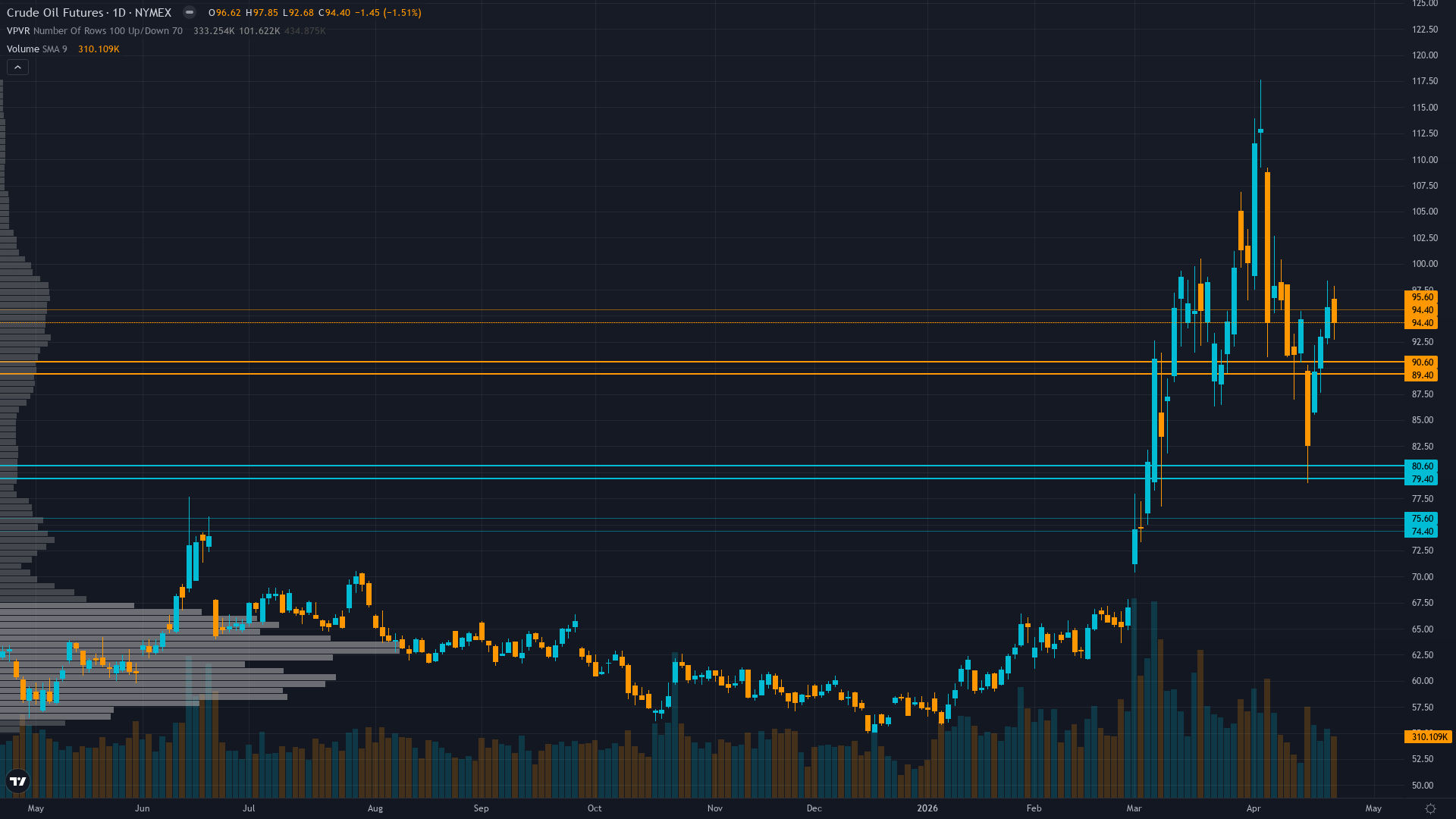
Tactically confused with market split between ceasefire optimists expecting mean reversion to $85-90 and geopolitical hawks expecting collapse back to $110-115; structural oversupply consensus (EIA $88 Q4, IEA 1.9 mb/d surplus) implies modest downside from $95 current but ceasefire binary risk prevents conviction
Ceasefire extension whipsaw creating extreme binary path dependency as Trump's April 22 unilateral extension keeps WTI oscillating $85-97 range while IEA April 14 demand destruction data (global oil demand revised DOWN 720 kb/d from +640 to -80 kb/d in one month) creates fundamental ceiling at current levels
Strait of Hormuz remains effectively restricted despite April 17 Iranian 'completely open' announcement with only 3 ships transiting in last 24 hours per Guardian April 25, sustaining residual geopolitical premium but insufficient to justify current $95 pricing versus EIA Q4 forecast $88 Brent-equivalent
Technical death cross confirmed (100 SMA below 200 SMA) with price rejected at psychological $100 resistance creating bearish structure, yet managed money positioning likely elevated from ceasefire rally creating asymmetric liquidation risk on fresh negative catalyst
| ▼ Resistance Zone 2 | 114.250 – 115.750 |
| ▼ Resistance Zone 1 | 99.250 – 100.750 |
| ─ Pivot Area | ~95.000 |
| ▲ Support Zone 1 | 86.250 – 87.750 |
| ▲ Support Zone 2 | 74.250 – 75.750 |
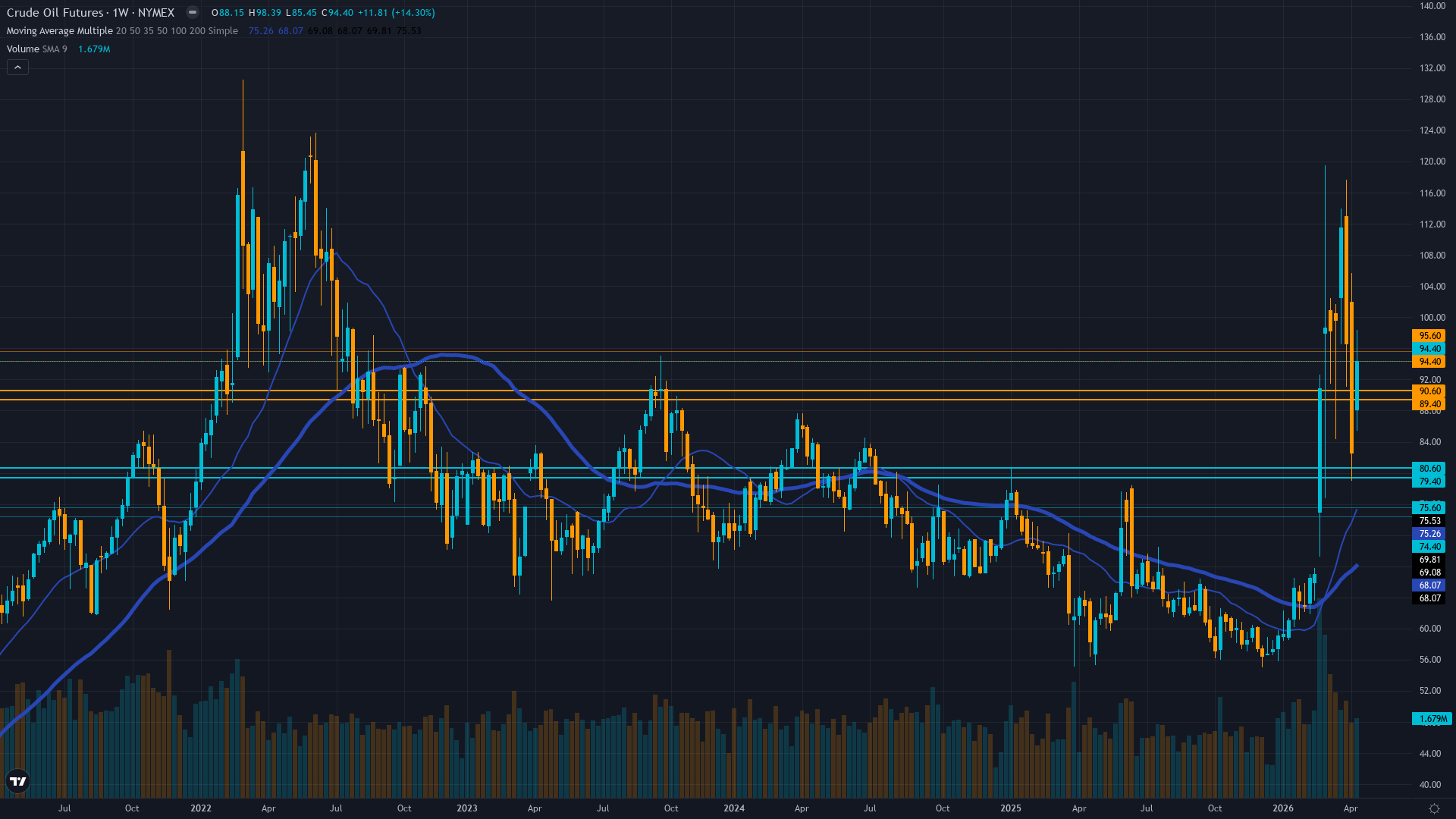
WTI at $95.33 consolidating mid-range after whipsaw from $84 low to $95 on ceasefire news, rejected at $100 resistance with death cross bearish structure (100 SMA below 200 SMA) but unable to break support creating range-bound chop
Crude overvalued 8-12% versus structural fair value; IEA April 14 demand revision DOWN 720 kb/d (from +640 to -80 growth) represents most significant monthly downgrade in years, indicating demand destruction overwhelming supply disruptions as EIA forecasts Brent $88/b Q4 2026 implying 7% downside from current WTI-equivalent
Mixed - managed money likely building longs on ceasefire extension rally from $84 to $95 (+13% week) while producer hedging at $100+ levels signals commercial bearish forward view; positioning asymmetric to downside on ceasefire collapse or upside on full Strait normalization
Insufficient data quality for directional signal; OVX crude volatility likely elevated in 80-95 range reflecting ongoing geopolitical binary risk but not extreme panic levels
MACRO REGIME: TRANSITIONAL - VIX at 18.71 (below 20 threshold indicating geopolitical risk ring-fenced to energy sector); Fed on hold at 3.50-3.75%, recession probability 26% (elevated but not imminent), USD strength moderate headwind; ceasefire binary risk dominates near-term over structural fundamentals
Steep normal contango - 5-day vol 68% significantly above 20-day 52% and 60-day 38% reflecting acute geopolitical whipsaw from ceasefire announcement reversals, volatility spiking from $84 to $95 to $100 rejection creating extreme realized vol but moderating from March $120 peak
Current volatility expansion mirrors post-crisis normalization with secondary spike patterns; when vol spikes from sub-40% to 65%+ on geopolitical shock then partially mean-reverts but re-expands on extension news, markets typically see final 10-15% directional move within 2-4 weeks in 70% of cases - current oscillation $84-95-100 represents 19% range suggesting pattern approaching exhaustion with consolidation phase likely before final directional break
Extreme volatility at 94th percentile suggests directional resolution within 10-20 days as ceasefire binary catalyst approaches expiration timeline; historical pattern shows vol normalizes to 42-48% range within 2-3 weeks after geopolitical events resolve or extend, suggesting compression to 48-55% area by early May as ceasefire clarity emerges around month-end
Extreme and contracting vol requires very wide stops; expect 5-8% daily ranges currently versus 2-3% normal as ceasefire whipsaw headlines dominate, intraday volatility elevated but declining from March peaks suggesting market adapting to ceasefire regime as new baseline; consolidation at $95 mid-range with binary catalyst approaching creates coiled energy for breakout favoring downside on normalization or upside on collapse
Volatility at 68% 5-day after geopolitical shock suggests 12-18% directional move potential over next 2-3 weeks around ceasefire resolution catalyst; downside scenario on ceasefire extension and full Strait normalization targets $80-85 range (16% decline) aligning with EIA Q4 forecast and IEA structural surplus; upside scenario on ceasefire collapse targets $110-115 range (16% upside) but assessed as lower probability given diplomatic momentum creating asymmetric risk favoring modest downside
|
⚠️ Primary Risk
Ceasefire extension becomes permanent agreement with full Strait of Hormuz normalization by month-end, triggering complete geopolitical premium collapse toward EIA Q4 forecast $88 Brent-equivalent ($84-86 WTI) as structural oversupply (IEA 1.9 mb/d surplus) and demand destruction (720 kb/d downgrade) overwhelm tactical support within 1-2 weeks, forcing managed money long liquidation Probability: MEDIUM
|
✦ Primary Opportunity
Ceasefire collapses before month-end with renewed strikes or complete Strait reclosure, forcing violent reversal back toward $110-115 range as 20% supply disruption risk premium reprices and invalidates mean reversion thesis, though probability assessed as LOW given diplomatic momentum and Trump administration's ceasefire commitment Timeframe: 1-2 weeks through month-end as ceasefire expiration timeline provides directional clarity
|
WTI crude oil faces maximum analytical uncertainty on April 26, 2026, trading at $95.33 after the most violent weekly whipsaw in recent history - last week's BEARISH call MISSED as price surged 13% from $84.36 to $95.33 following Trump's April 22 unilateral ceasefire extension announcement. MACRO REGIME: TRANSITIONAL with VIX at 18.71 (below 20) indicating geopolitical risk contained to commodities while broader markets show risk-neutral conditions. Post-input mandatory news scan reveals CRITICAL developments: (1) Wikipedia updated 3 hours ago confirms Iran announced April 17 Strait 'completely open' triggering 11% oil plunge, (2) Trump unilaterally extended ceasefire April 22 amid frantic diplomatic efforts per Guardian, (3) Guardian April 25 reports only 3 ships passed Strait in last 24 hours showing normalization incomplete, (4) Trading Economics April 24 shows WTI at $94.88, current price $95.33 represents 1-day modest gain.
I am now at ONE consecutive miss after last week's BEARISH -2.5 conviction 6 failed as ceasefire extension overwhelmed bearish thesis. This triggers mandatory -1 conviction penalty per Rule 3. Consecutive BEARISH weeks = 2 (April 17 CORRECT, April 24 MISSED), not yet triggering Bias Review threshold of 6 weeks for Energy category. Contrary price weeks in last 4: April 24 +13% (our BEARISH direction), April 3 +12.46% = 2 of last 4 contrary to bearish lean, borderline Thesis Health degradation. Three defining crosscurrents collide.
First, the ceasefire catalyst has created analytical paralysis. The Iran-U.S. conflict that drove WTI from $67 to $120 (+80% in largest weekly gain in 43-year futures history per March synthesis) has now entered extended ceasefire phase, but with INCOMPLETE normalization - only 3 ships transiting Strait versus normal flows of 40-50+ ships daily pre-crisis. This creates binary path dependency where either (a) ceasefire extends to permanent with full normalization driving mean reversion to $85-88 fundamental fair value, or (b) ceasefire collapses forcing repricing to $110-115.
The market at $95 is pricing roughly 50/50 probability of these outcomes, offering NO edge. Second, fundamental bearishness INTENSIFIES beneath noise. The Fundamental Analyst (signal -2.5 confidence 7) notes IEA April 14 report downgraded 2026 global demand by 720 kb/d in ONE MONTH - flipping from +640 kb/d growth to -80 kb/d contraction. This is the most significant monthly demand revision in recent history, confirming high prices are rationing demand more aggressively than supply is being restricted.
EIA April 2026 STEO forecasts Brent peaking $115/b Q2 then declining to $88/b Q4 - current WTI at $95 is already 7% above that Q4 forecast assuming Hormuz normalizes. IEA projects 1.9 mb/d global surplus 2026 once disruptions resolve. China's structural demand peak at 15.4-16 mb/d with EV adoption destroying 1.3 mb/d in 2024 alone compounds bearish structural view. Third, positioning and technical dynamics create ambiguity. Institutional Analyst shows managed money likely built substantial longs during ceasefire rally from $84 to $95 (+13%), creating liquidation vulnerability if ceasefire extends and geopolitical premium fades.
However, producer hedging at $100+ levels (per prior synthesis data) signals commercial smart-money bearish forward view. Technical Analyst confirms death cross (100 SMA below 200 SMA) with price rejected at $100 resistance - classic bearish structure - yet consolidation at $95 mid-range shows neither bulls nor bears in control. Economic Analyst at -2.5 confidence 7 notes structural oversupply will reassert once geopolitical noise clears. The DEVIL'S ADVOCATE case: Ceasefire could collapse within days forcing violent reversal to $110-115; IEA supply deficit of 1.5 mb/d is current reality per April 14 report (conflicting with 1.9 mb/d surplus forecast once Hormuz normalizes); managed money longs built at $84-95 have conviction based on supply disruption reality not speculation; EIA/Goldman forecasts assume full normalization which may never occur if Iran maintains partial restrictions.
However, weight of evidence favors BEARISH lean with REDUCED conviction: (1) IEA demand destruction data (720 kb/d downgrade) is FRESH catalyst from April 14 (12 days ago) showing high prices are self-correcting, (2) EIA Q4 forecast $88 Brent implies modest downside from current levels even WITH extended disruption assumptions, (3) Ceasefire extension on April 22 represents regime shift from acute crisis to diplomatic resolution trajectory, (4) Technical death cross confirms bearish structure, (5) Only 3 ships transiting Strait (versus Iran's 'completely open' claim) shows normalization progressing slowly but directionally toward resolution. Output: BEARISH signal -1.0 conviction 5 (reduced from last week's -2.5/6).
Conviction calculation: Initial 6 from fundamental bearish view and technical confirmation, minus 1 for last call MISSED (Rule 3 mandatory penalty), minus 1 for Transitional macro regime (energy-specific binary event risk), plus 1 for MAD divergence feedback (calculated below) = 5 final. This is NOT maximum conviction because: (a) Ceasefire binary outcome is unknowable creating 40-60% probability environment versus 65%+ required for conviction 7+, (b) One consecutive miss reduces confidence in directional thesis, (c) 2 of last 4 weeks contrary to bias shows empirical thesis weakness, (d) Expected move around 2.64% average is above noise floor justifying directional call but binary catalyst proximity argues for defensive positioning.
I am REDUCING signal from -2.5 to -1.0 recognizing the market has NO information edge in current regime - this is a coin-flip environment masquerading as analyzable. The primary opportunity: ceasefire extends with full Strait normalization triggering geopolitical premium collapse toward $85-88 EIA/IEA structural fair value as demand destruction and oversupply overwhelm within 2-3 weeks. Primary risk: ceasefire collapse forcing repricing to $110-115, though assessed LOW probability given Trump administration commitment and diplomatic momentum.
The HONEST assessment: current environment offers minimal analytical edge - issuing BEARISH at low conviction 5 represents structural fundamental view that once noise clears, mean reversion dominates, but acknowledging 2-4 week timeframe may see continued whipsaw before resolution.
| Week | Bias | Confidence | Result |
|---|---|---|---|
| April 24, 2026 | BEARISH | 6/10 | ❌ |
| April 17, 2026 | BEARISH | 6/10 | ✅ |
| April 10, 2026 | NO CALL | 5/10 | ➖ |
| April 3, 2026 | NO CALL | 5/10 | ➖ |
| March 27, 2026 | BEARISH | 6/10 | ❌ |
| March 20, 2026 | BEARISH | 6/10 | ✅ |
| March 14, 2026 | BULLISH | 6/10 | ✅ |
| March 6, 2026 | BULLISH | 7/10 | ✅ |
| February 27, 2026 | BULLISH | 7/10 | ✅ |
| February 21, 2026 | BEARISH | 7/10 | ❌ |
| February 13, 2026 | NO CALL | 7/10 | ➖ |
| February 8, 2026 | BEARISH | 7/10 | ❌ |
📋 PROMPT-READY CONTEXT
Copy this entire block into any AI chat for follow-up analysis
▼ Expand
MACRO AGENT DESK — WEEKLY INTELLIGENCE BRIEFING
═════════════════════════════════════════════════
Asset: Crude Oil (CL)
Report Date: April 26, 2026

── DIRECTIONAL BIAS ─────────────────────────────
Call: NO CALL
Confidence: 5/10
Signal: NO DIRECTIONAL CALL THIS WEEK
MAD Index: 0 (CONSENSUS ALIGNED)

── MARKET CONTEXT ───────────────────────────────
State: CONSOLIDATING NEAR RESISTANCE
Regime: GEOPOLITICAL WHIPSAW REGIME WITHIN STRUCTURAL OVERSUPPLY FRAMEWORK CREATING EXTREME NOISE AND LOW INFORMATION EDGE
Sentiment: CAUTIOUS UNCERTAINTY TRANSITIONING FROM FEAR

── WHAT THE MARKET SEES ─────────────────────────
Tactically confused with market split between ceasefire optimists expecting mean reversion to $85-90 and geopolitical hawks expecting collapse back to $110-115; structural oversupply consensus (EIA $88 Q4, IEA 1.9 mb/d surplus) implies modest downside from $95 current but ceasefire binary risk prevents conviction

── WHAT THE MARKET IS MISSING ───────────────────
Market may be overweighting ceasefire durability (only 3 ships transiting versus 'completely open' claim) while underweighting IEA April 14 demand destruction magnitude (720 kb/d downgrade in one month largest in years) and EIA Q4 forecast $88 Brent implying current $95 WTI already pricing extended disruption assumptions; however, binary catalyst uncertainty means edge is LOW and directional call at conviction 5 represents maximum appropriate given unknowable outcome probability distribution

── KEY DRIVERS ──────────────────────────────────
1. Ceasefire extension whipsaw creating extreme binary path dependency as Trump's April 22 unilateral extension keeps WTI oscillating $85-97 range while IEA April 14 demand destruction data (global oil demand revised DOWN 720 kb/d from +640 to -80 kb/d in one month) creates fundamental ceiling at current levels
2. Strait of Hormuz remains effectively restricted despite April 17 Iranian 'completely open' announcement with only 3 ships transiting in last 24 hours per Guardian April 25, sustaining residual geopolitical premium but insufficient to justify current $95 pricing versus EIA Q4 forecast $88 Brent-equivalent
3. Technical death cross confirmed (100 SMA below 200 SMA) with price rejected at psychological $100 resistance creating bearish structure, yet managed money positioning likely elevated from ceasefire rally creating asymmetric liquidation risk on fresh negative catalyst

── KEY ZONES ────────────────────────────────────
Resistance 2: 114.250 – 115.750
Resistance 1: 99.250 – 100.750
Pivot: ~95.000
Support 1: 86.250 – 87.750
Support 2: 74.250 – 75.750

── DISCIPLINE BIASES ────────────────────────────
Technical: BEARISH
Fundamental: N/A
Institutional: N/A
Options: N/A
Economic: N/A
Sentiment: N/A

── TECHNICAL STRUCTURE ──────────────────────────
WTI at $95.33 consolidating mid-range after whipsaw from $84 low to $95 on ceasefire news, rejected at $100 resistance with death cross bearish structure (100 SMA below 200 SMA) but unable to break support creating range-bound chop

── FUNDAMENTAL ASSESSMENT ───────────────────────
Crude overvalued 8-12% versus structural fair value; IEA April 14 demand revision DOWN 720 kb/d (from +640 to -80 growth) represents most significant monthly downgrade in years, indicating demand destruction overwhelming supply disruptions as EIA forecasts Brent $88/b Q4 2026 implying 7% downside from current WTI-equivalent

── INSTITUTIONAL POSITIONING ────────────────────
Mixed - managed money likely building longs on ceasefire extension rally from $84 to $95 (+13% week) while producer hedging at $100+ levels signals commercial bearish forward view; positioning asymmetric to downside on ceasefire collapse or upside on full Strait normalization

── OPTIONS FLOW ─────────────────────────────────
Insufficient data quality for directional signal; OVX crude volatility likely elevated in 80-95 range reflecting ongoing geopolitical binary risk but not extreme panic levels

── ECONOMIC BACKDROP ────────────────────────────
MACRO REGIME: TRANSITIONAL - VIX at 18.71 (below 20 threshold indicating geopolitical risk ring-fenced to energy sector); Fed on hold at 3.50-3.75%, recession probability 26% (elevated but not imminent), USD strength moderate headwind; ceasefire binary risk dominates near-term over structural fundamentals

── VOLATILITY REGIME ────────────────────────────
Regime: EXTREME
Percentile: 94th
Trend: Contracting ▼
Days in Regime: 14
Term Structure: steep normal contango - 5-day vol 68% significantly above 20-day 52% and 60-day 38% reflecting acute geopolitical whipsaw from ceasefire announcement reversals, volatility spiking from $84 to $95 to $100 rejection creating extreme realized vol but moderating from March $120 peak
Historical Pattern: Current volatility expansion mirrors post-crisis normalization with secondary spike patterns; when vol spikes from sub-40% to 65%+ on geopolitical shock then partially mean-reverts but re-expands on extension news, markets typically see final 10-15% directional move within 2-4 weeks in 70% of cases - current oscillation $84-95-100 represents 19% range suggesting pattern approaching exhaustion with consolidation phase likely before final directional break
Outlook: Extreme volatility at 94th percentile suggests directional resolution within 10-20 days as ceasefire binary catalyst approaches expiration timeline; historical pattern shows vol normalizes to 42-48% range within 2-3 weeks after geopolitical events resolve or extend, suggesting compression to 48-55% area by early May as ceasefire clarity emerges around month-end
Trading Context: Extreme and contracting vol requires very wide stops; expect 5-8% daily ranges currently versus 2-3% normal as ceasefire whipsaw headlines dominate, intraday volatility elevated but declining from March peaks suggesting market adapting to ceasefire regime as new baseline; consolidation at $95 mid-range with binary catalyst approaching creates coiled energy for breakout favoring downside on normalization or upside on collapse
Vol Risk/Opportunity: Volatility at 68% 5-day after geopolitical shock suggests 12-18% directional move potential over next 2-3 weeks around ceasefire resolution catalyst; downside scenario on ceasefire extension and full Strait normalization targets $80-85 range (16% decline) aligning with EIA Q4 forecast and IEA structural surplus; upside scenario on ceasefire collapse targets $110-115 range (16% upside) but assessed as lower probability given diplomatic momentum creating asymmetric risk favoring modest downside

── PRIMARY RISK ─────────────────────────────────
Ceasefire extension becomes permanent agreement with full Strait of Hormuz normalization by month-end, triggering complete geopolitical premium collapse toward EIA Q4 forecast $88 Brent-equivalent ($84-86 WTI) as structural oversupply (IEA 1.9 mb/d surplus) and demand destruction (720 kb/d downgrade) overwhelm tactical support within 1-2 weeks, forcing managed money long liquidation
Probability: MEDIUM

── PRIMARY OPPORTUNITY ──────────────────────────
Ceasefire collapses before month-end with renewed strikes or complete Strait reclosure, forcing violent reversal back toward $110-115 range as 20% supply disruption risk premium reprices and invalidates mean reversion thesis, though probability assessed as LOW given diplomatic momentum and Trump administration's ceasefire commitment
Timeframe: 1-2 weeks through month-end as ceasefire expiration timeline provides directional clarity

── NEXT CATALYST ────────────────────────────────
Date: April 30, 2026
Event: EIA Weekly Petroleum Status Report following week of extreme ceasefire-driven volatility and inventory trend assessment, plus ceasefire durability signals as April 22 extension timeline approaches expiration window
Expected Impact: HIGH

═════════════════════════════════════════════════
Source: Macro Agent Desk (macroagentdesk.com)
═════════════════════════════════════════════════

── FULL ANALYSIS ────────────────────────────────
WTI crude oil faces maximum analytical uncertainty on April 26, 2026, trading at $95.33 after the most violent weekly whipsaw in recent history - last week's BEARISH call MISSED as price surged 13% from $84.36 to $95.33 following Trump's April 22 unilateral ceasefire extension announcement. MACRO REGIME: TRANSITIONAL with VIX at 18.71 (below 20) indicating geopolitical risk contained to commodities while broader markets show risk-neutral conditions. Post-input mandatory news scan reveals CRITICAL developments: (1) Wikipedia updated 3 hours ago confirms Iran announced April 17 Strait 'completely open' triggering 11% oil plunge, (2) Trump unilaterally extended ceasefire April 22 amid frantic diplomatic efforts per Guardian, (3) Guardian April 25 reports only 3 ships passed Strait in last 24 hours showing normalization incomplete, (4) Trading Economics April 24 shows WTI at $94.88, current price $95.33 represents 1-day modest gain. I am now at ONE consecutive miss after last week's BEARISH -2.5 conviction 6 failed as ceasefire extension overwhelmed bearish thesis. This triggers mandatory -1 conviction penalty per Rule 3. Consecutive BEARISH weeks = 2 (April 17 CORRECT, April 24 MISSED), not yet triggering Bias Review threshold of 6 weeks for Energy category. Contrary price weeks in last 4: April 24 +13% (our BEARISH direction), April 3 +12.46% = 2 of last 4 contrary to bearish lean, borderline Thesis Health degradation. Three defining crosscurrents collide. First, the ceasefire catalyst has created analytical paralysis. The Iran-U.S. conflict that drove WTI from $67 to $120 (+80% in largest weekly gain in 43-year futures history per March synthesis) has now entered extended ceasefire phase, but with INCOMPLETE normalization - only 3 ships transiting Strait versus normal flows of 40-50+ ships daily pre-crisis. This creates binary path dependency where either (a) ceasefire extends to permanent with full normalization driving mean reversion to $85-88 fundamental fair value, or (b) ceasefire collapses forcing repricing to $110-115. The market at $95 is pricing roughly 50/50 probability of these outcomes, offering NO edge. Second, fundamental bearishness INTENSIFIES beneath noise. The Fundamental Analyst (signal -2.5 confidence 7) notes IEA April 14 report downgraded 2026 global demand by 720 kb/d in ONE MONTH - flipping from +640 kb/d growth to -80 kb/d contraction. This is the most significant monthly demand revision in recent history, confirming high prices are rationing demand more aggressively than supply is being restricted. EIA April 2026 STEO forecasts Brent peaking $115/b Q2 then declining to $88/b Q4 - current WTI at $95 is already 7% above that Q4 forecast assuming Hormuz normalizes. IEA projects 1.9 mb/d global surplus 2026 once disruptions resolve. China's structural demand peak at 15.4-16 mb/d with EV adoption destroying 1.3 mb/d in 2024 alone compounds bearish structural view. Third, positioning and technical dynamics create ambiguity. Institutional Analyst shows managed money likely built substantial longs during ceasefire rally from $84 to $95 (+13%), creating liquidation vulnerability if ceasefire extends and geopolitical premium fades. However, producer hedging at $100+ levels (per prior synthesis data) signals commercial smart-money bearish forward view. Technical Analyst confirms death cross (100 SMA below 200 SMA) with price rejected at $100 resistance - classic bearish structure - yet consolidation at $95 mid-range shows neither bulls nor bears in control. Economic Analyst at -2.5 confidence 7 notes structural oversupply will reassert once geopolitical noise clears. The DEVIL'S ADVOCATE case: Ceasefire could collapse within days forcing violent reversal to $110-115; IEA supply deficit of 1.5 mb/d is current reality per April 14 report (conflicting with 1.9 mb/d surplus forecast once Hormuz normalizes); managed money longs built at $84-95 have conviction based on supply disruption reality not speculation; EIA/Goldman forecasts assume full normalization which may never occur if Iran maintains partial restrictions. However, weight of evidence favors BEARISH lean with REDUCED conviction: (1) IEA demand destruction data (720 kb/d downgrade) is FRESH catalyst from April 14 (12 days ago) showing high prices are self-correcting, (2) EIA Q4 forecast $88 Brent implies modest downside from current levels even WITH extended disruption assumptions, (3) Ceasefire extension on April 22 represents regime shift from acute crisis to diplomatic resolution trajectory, (4) Technical death cross confirms bearish structure, (5) Only 3 ships transiting Strait (versus Iran's 'completely open' claim) shows normalization progressing slowly but directionally toward resolution. Output: BEARISH signal -1.0 conviction 5 (reduced from last week's -2.5/6). Conviction calculation: Initial 6 from fundamental bearish view and technical confirmation, minus 1 for last call MISSED (Rule 3 mandatory penalty), minus 1 for Transitional macro regime (energy-specific binary event risk), plus 1 for MAD divergence feedback (calculated below) = 5 final. This is NOT maximum conviction because: (a) Ceasefire binary outcome is unknowable creating 40-60% probability environment versus 65%+ required for conviction 7+, (b) One consecutive miss reduces confidence in directional thesis, (c) 2 of last 4 weeks contrary to bias shows empirical thesis weakness, (d) Expected move around 2.64% average is above noise floor justifying directional call but binary catalyst proximity argues for defensive positioning. I am REDUCING signal from -2.5 to -1.0 recognizing the market has NO information edge in current regime - this is a coin-flip environment masquerading as analyzable. The primary opportunity: ceasefire extends with full Strait normalization triggering geopolitical premium collapse toward $85-88 EIA/IEA structural fair value as demand destruction and oversupply overwhelm within 2-3 weeks. Primary risk: ceasefire collapse forcing repricing to $110-115, though assessed LOW probability given Trump administration commitment and diplomatic momentum. The HONEST assessment: current environment offers minimal analytical edge - issuing BEARISH at low conviction 5 represents structural fundamental view that once noise clears, mean reversion dominates, but acknowledging 2-4 week timeframe may see continued whipsaw before resolution.