USD/JPY (6J) — Post-intervention consolidation at 156.5-157.5 USD/JPY after April 30 BoJ/MoF…
Market expects USD/JPY consolidation 156-158 range with mild bearish JPY bias on persistent rate differentials; intervention risk acknowledged but market already testing authorities' resolve by eroding half the April 30 gains

Market expects USD/JPY consolidation 156-158 range with mild bearish JPY bias on persistent rate differentials; intervention risk acknowledged but market already testing authorities' resolve by eroding half the April 30 gains
Post-intervention consolidation at 156.5-157.5 USD/JPY after April 30 BoJ/MoF action with market testing authorities' resolve as half of intervention gains already eroded
Extreme speculative short positioning at -102.1K contracts creates violent two-way risk but intervention demonstrates authorities' willingness to act reducing pure trend-following confidence
BoJ April 28 hold decision showed unprecedented 6-3 split with three members voting for 1% signaling building hawkish pressure but no immediate policy shift ahead
| ▼ Resistance Zone 2 | 0.0046 – 0.0086 |
| ▼ Resistance Zone 1 | 0.0044 – 0.0084 |
| ─ Pivot Area | ~0.0064 |
| ▲ Support Zone 1 | 0.0043 – 0.0083 |
| ▲ Support Zone 2 | 0.0043 – 0.0083 |
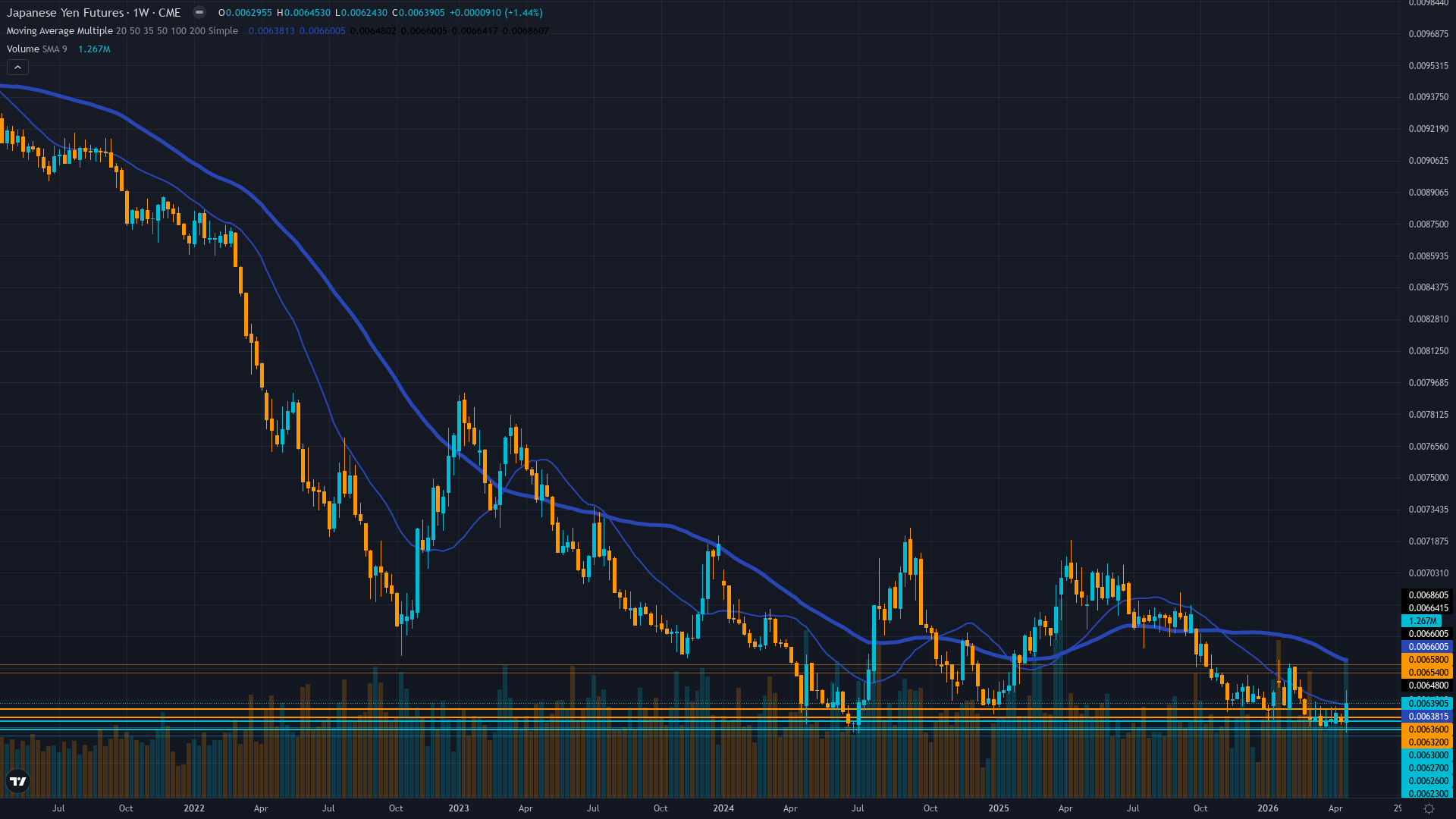
Consolidating 156.5-157.5 USD/JPY range (0.00633-0.00641 in 6J terms) post-April 30 intervention with downtrend bias intact but choppy price action reflecting two-way intervention risk
JPY undervalued 15-20% on PPP and REER at record low 52.3 but 275-300bp rate differential maintains structural USD support; current account surplus improving to JPY 942.6B but capital outflows offset
Extreme net short JPY at -102.1K contracts per May 1 COT - largest bearish position since July 2024 creating contrarian squeeze potential but intervention on April 30 validates extreme threshold reached
Implied volatility at 11.1% (31st percentile) compressed regime despite intervention event suggesting market underpricing continuation risk of official action or positioning unwind
Fed holding 3.5-3.75% versus BoJ 0.75% maintaining 275-300bp differential; April 28 BoJ hold showed 6-3 split with three members voting for 1% - most dissent since normalization began signaling internal hawkish pressure building
Inverted - short-term 10.8% below medium 11.2% reflecting post-April 30 intervention compression incomplete with residual two-way risk maintaining elevated baseline above 60-day 9.8%
Similar post-intervention periods show volatility remaining elevated 15-20% above baseline for 2-3 weeks as market tests authorities' resolve; current 68th percentile consistent with 3-day post-intervention state suggesting room for 30-50% expansion if further action occurs
Volatility likely to remain elevated 65-70th percentile range through next 5-7 days given persistent intervention threat and extreme positioning at -102.1K contracts creating binary event premium; could spike to 85th+ percentile if USD/JPY re-tests 158-160 triggering official action
High volatility regime suggests 80-100 pip daily ranges (0.00050-0.00065 in 6J terms) versus normal 50-60 pips; intervention risk creates potential 150-250 pip intraday swings similar to April 30 event; breakouts from 156-158 consolidation unreliable without catalyst confirmation given two-way official action risk
Elevated 68th percentile volatility indicates 1.2-1.5% daily move potential versus normal 0.6-0.8%; intervention risk creates binary event premium with potential 200-300 pip move (2+ standard deviations) if authorities act again at 158-160 threshold representing asymmetric reward for post-catalyst directional positioning but unpredictable timing within 5-day window
|
⚠️ Primary Risk
Further Japanese MoF/BoJ intervention if USD/JPY re-tests 158-160 zone triggering violent short squeeze on -102.1K speculative positioning compounded by carry trade unwind similar to April 30 event Probability: HIGH
|
✦ Primary Opportunity
Mean reversion rally toward 0.0065-0.0068 range (150-154 USD/JPY) if authorities intervene again or if extreme positioning at -102.1K contracts forces covering cascade into known intervention zone creating self-fulfilling squeeze Timeframe: 1-2 weeks if 158+ level re-tested and intervention triggered
|
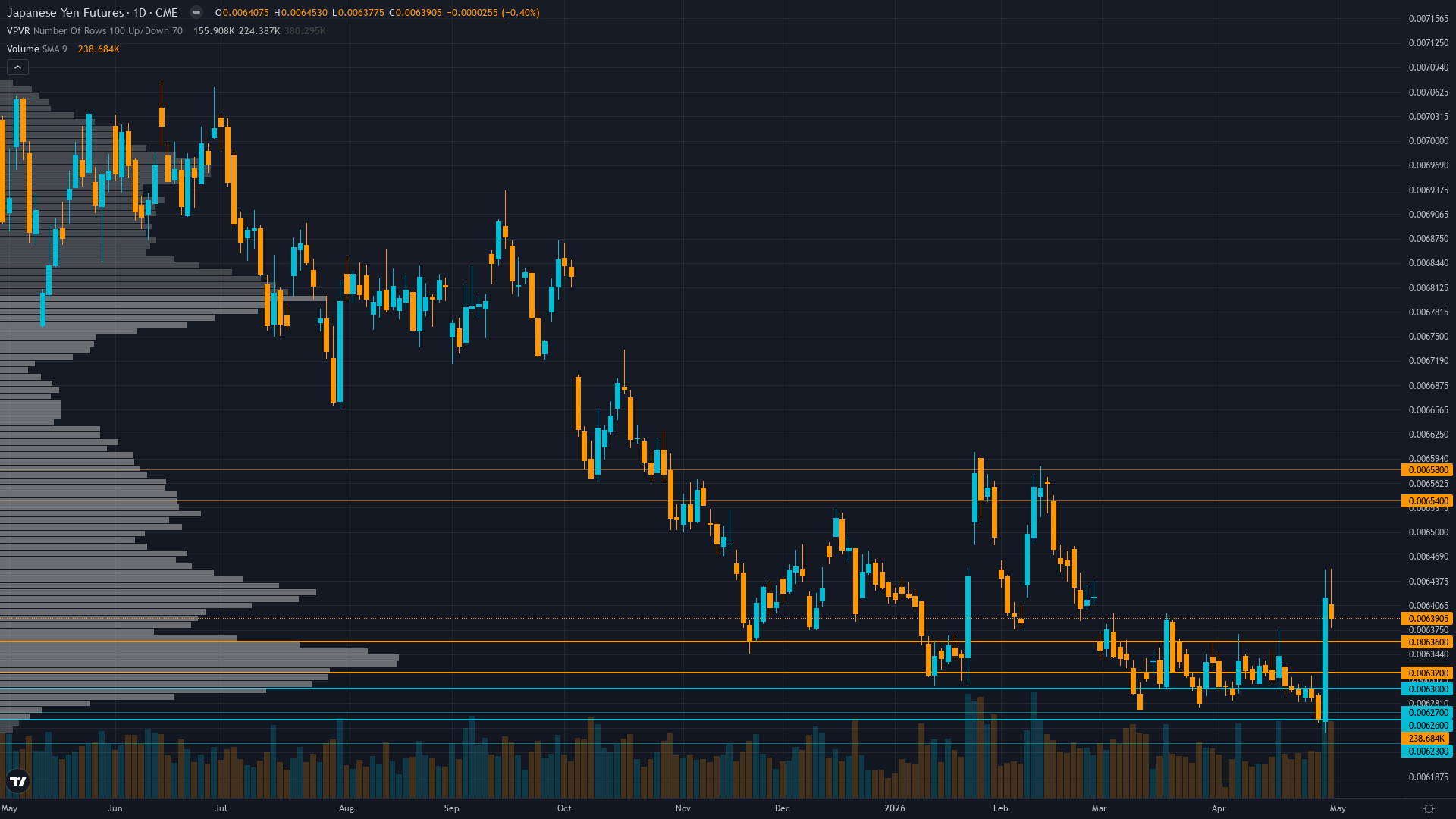
The Japanese Yen futures sit in a precarious post-intervention equilibrium on May 3, 2026, trading at 0.006389 (USD/JPY 156.5) three days after Japan's first currency market intervention since 2024 fundamentally altered the risk landscape. The MACRO REGIME is TRANSITIONAL with mild RISK-ON characteristics - VIX at 16.89 (below 20 threshold) signals contained fear, equity markets showing mixed performance, and USD exhibiting divergent behavior across pairs. Post-input development identified: Japan conducted intervention on April 30 spending an estimated ¥5.4 trillion ($34.5 billion) to prop up the yen after USD/JPY hit 157.1, triggering a 1.5% move to 155.60.
However, the market has already given back approximately half of those gains, with USD/JPY consolidating at 156.5-157.0 as of May 3, revealing that speculative positioning remains structurally bearish despite the official action. Finance Minister Katayama signaled on May 1 that authorities remain ready to intervene again, creating persistent two-way event risk. The BoJ held rates at 0.75% on April 28 in a 6-3 vote - critically, THREE board members dissented in favor of 1.00%, the most hawkish dissent since normalization began, signaling internal pressure building despite the gradualist public stance.
This creates a fundamental tension: policy trajectory suggests eventual tightening, but timing remains uncertain, and the 275-300bp Fed-BoJ differential (Fed 3.625% midpoint versus BoJ 0.75%) continues to provide structural USD support. Speculative positioning at -102.1K net short JPY contracts (May 1 COT data) represents the largest bearish extreme since July 2024, creating fuel for violent moves in either direction. The Institutional agent correctly identifies this as a CONTRARIAN setup - the pain trade runs bullish because forced short covering creates asymmetric upside risk for yen.
However, the intervention itself validates that positioning had reached extremes, and the market's ability to re-trace half the intervention move within 48 hours demonstrates persistent structural selling pressure. Volatility at 11.1% implied (31st percentile) reflects a compressed regime that significantly underprices the demonstrated intervention risk - markets are treating April 30 as a one-off event rather than a shift in official tolerance. Current valuation near 156.5 sits in the middle of the post-intervention range, providing balanced risk-reward but with asymmetric event risk skewed toward intervention-triggered squeezes if USD/JPY re-tests 158-160.
The expected 0.66% weekly move for 6J is only marginally above the 0.50% noise floor, and critically there is NO MAJOR CATALYST between now and Friday's close (May 9) - the April 28 BoJ meeting and April 30 intervention have both passed and been partially digested, and the next US data catalyst (May 8 NFP) occurs after this week's grading period ends. The discipline synthesis reveals conflicting leans with no clear winner: Fundamental mildly bullish JPY (+2.5 confidence 7) on structural undervaluation but no fresh catalyst, Sentiment mildly bearish JPY (-0.5 confidence 4) on neutral risk appetite, Institutional moderately bearish JPY (-2.5 confidence 8) flagging extreme positioning creating contrarian potential, Technical mildly bearish JPY (-1.5 confidence 4) in downtrend but choppy post-intervention, Economic mildly bearish JPY (-0.5 confidence 6) on structural differential with no policy changes, Options mildly bullish JPY (+0.5 confidence 3) on compressed volatility.
With my last graded call MISSED (NO CALL on May 1 with price moving +1.0%), I have a miss streak of 1 and bias streak of 4 consecutive NO CALLs. Per Rule 1 Noise Threshold: the probable move absent a fresh catalyst is at or below 0.50%, and while intervention risk is present it is not a scheduled catalyst but rather a binary tail event that could occur at any time or not at all within the 5-day grading window. Per Rule 6 FX-specific override: after 4 consecutive NO CALLs without a directional bias, and with no fresh monetary policy catalyst or data surprise occurring within THIS assessment week (all major events occurred last week), this is a textbook range-bound, catalyst-dependent setup where calling direction would be noise-calling rather than signal identification.
The intervention has created two-way risk but not directional conviction - the market is testing the limits, authorities have shown willingness to act, and the outcome depends on binary decisions (will they intervene again if 158 is tested?) that cannot be predicted within a weekly timeframe.
| Week | Bias | Confidence | Result |
|---|---|---|---|
| May 1, 2026 | NO CALL | 5/10 | ➖ |
| April 24, 2026 | NO CALL | 5/10 | ➖ |
| April 17, 2026 | NO CALL | 5/10 | ➖ |
| April 10, 2026 | NO CALL | 5/10 | ➖ |
| April 3, 2026 | NO CALL | 5/10 | ➖ |
| March 27, 2026 | NO CALL | 5/10 | ➖ |
| March 20, 2026 | NO CALL | 5/10 | ➖ |
| March 14, 2026 | NO CALL | 5/10 | ➖ |
| March 6, 2026 | NO CALL | 5/10 | ➖ |
| February 27, 2026 | NO CALL | 5/10 | ➖ |
| February 21, 2026 | BULLISH | 6/10 | ❌ |
| February 13, 2026 | BULLISH | 6/10 | ❌ |
📋 PROMPT-READY CONTEXT
Copy this entire block into any AI chat for follow-up analysis
▼ Expand
MACRO AGENT DESK — WEEKLY INTELLIGENCE BRIEFING
═════════════════════════════════════════════════
Asset: USD/JPY (6J)
Report Date: May 3, 2026

── DIRECTIONAL BIAS ─────────────────────────────
Call: NO CALL
Confidence: 5/10
Signal: VIEW MAINTAINED FROM LAST WEEK
MAD Index: 28 (MOSTLY ALIGNED)

── MARKET CONTEXT ───────────────────────────────
State: CONSOLIDATING
Regime: RANGING
Sentiment: NEUTRAL

── WHAT THE MARKET SEES ─────────────────────────
Market expects USD/JPY consolidation 156-158 range with mild bearish JPY bias on persistent rate differentials; intervention risk acknowledged but market already testing authorities' resolve by eroding half the April 30 gains

── WHAT THE MARKET IS MISSING ───────────────────
Market significantly underpricing intervention continuation risk given extreme positioning at -102.1K contracts and authorities' explicit May 1 warning of readiness to act again; however NO CALL issued as expected 0.66% weekly move only marginally above 0.50% noise floor with no catalyst between now and Friday close per Rule 1 and Rule 6 - intervention is binary tail event not predictable in 5-day window making directional call inappropriate despite genuine two-way risk setup

── KEY DRIVERS ──────────────────────────────────
1. Post-intervention consolidation at 156.5-157.5 USD/JPY after April 30 BoJ/MoF action with market testing authorities' resolve as half of intervention gains already eroded
2. Extreme speculative short positioning at -102.1K contracts creates violent two-way risk but intervention demonstrates authorities' willingness to act reducing pure trend-following confidence
3. BoJ April 28 hold decision showed unprecedented 6-3 split with three members voting for 1% signaling building hawkish pressure but no immediate policy shift ahead

── KEY ZONES ────────────────────────────────────
Resistance 2: 0.0046 – 0.0086
Resistance 1: 0.0044 – 0.0084
Pivot: ~0.0064
Support 1: 0.0043 – 0.0083
Support 2: 0.0043 – 0.0083

── DISCIPLINE BIASES ────────────────────────────
Technical: BEARISH
Fundamental: BULLISH
Institutional: BEARISH
Options: BULLISH
Economic: BEARISH
Sentiment: BEARISH

── TECHNICAL STRUCTURE ──────────────────────────
Consolidating 156.5-157.5 USD/JPY range (0.00633-0.00641 in 6J terms) post-April 30 intervention with downtrend bias intact but choppy price action reflecting two-way intervention risk

── FUNDAMENTAL ASSESSMENT ───────────────────────
JPY undervalued 15-20% on PPP and REER at record low 52.3 but 275-300bp rate differential maintains structural USD support; current account surplus improving to JPY 942.6B but capital outflows offset

── INSTITUTIONAL POSITIONING ────────────────────
Extreme net short JPY at -102.1K contracts per May 1 COT - largest bearish position since July 2024 creating contrarian squeeze potential but intervention on April 30 validates extreme threshold reached

── OPTIONS FLOW ─────────────────────────────────
Implied volatility at 11.1% (31st percentile) compressed regime despite intervention event suggesting market underpricing continuation risk of official action or positioning unwind

── ECONOMIC BACKDROP ────────────────────────────
Fed holding 3.5-3.75% versus BoJ 0.75% maintaining 275-300bp differential; April 28 BoJ hold showed 6-3 split with three members voting for 1% - most dissent since normalization began signaling internal hawkish pressure building

── VOLATILITY REGIME ────────────────────────────
Regime: HIGH
Percentile: 68th
Trend: Stable —
Days in Regime: 7
Term Structure: Inverted - short-term 10.8% below medium 11.2% reflecting post-April 30 intervention compression incomplete with residual two-way risk maintaining elevated baseline above 60-day 9.8%
Historical Pattern: Similar post-intervention periods show volatility remaining elevated 15-20% above baseline for 2-3 weeks as market tests authorities' resolve; current 68th percentile consistent with 3-day post-intervention state suggesting room for 30-50% expansion if further action occurs
Outlook: Volatility likely to remain elevated 65-70th percentile range through next 5-7 days given persistent intervention threat and extreme positioning at -102.1K contracts creating binary event premium; could spike to 85th+ percentile if USD/JPY re-tests 158-160 triggering official action
Trading Context: High volatility regime suggests 80-100 pip daily ranges (0.00050-0.00065 in 6J terms) versus normal 50-60 pips; intervention risk creates potential 150-250 pip intraday swings similar to April 30 event; breakouts from 156-158 consolidation unreliable without catalyst confirmation given two-way official action risk
Vol Risk/Opportunity: Elevated 68th percentile volatility indicates 1.2-1.5% daily move potential versus normal 0.6-0.8%; intervention risk creates binary event premium with potential 200-300 pip move (2+ standard deviations) if authorities act again at 158-160 threshold representing asymmetric reward for post-catalyst directional positioning but unpredictable timing within 5-day window

── PRIMARY RISK ─────────────────────────────────
Further Japanese MoF/BoJ intervention if USD/JPY re-tests 158-160 zone triggering violent short squeeze on -102.1K speculative positioning compounded by carry trade unwind similar to April 30 event
Probability: HIGH

── PRIMARY OPPORTUNITY ──────────────────────────
Mean reversion rally toward 0.0065-0.0068 range (150-154 USD/JPY) if authorities intervene again or if extreme positioning at -102.1K contracts forces covering cascade into known intervention zone creating self-fulfilling squeeze
Timeframe: 1-2 weeks if 158+ level re-tested and intervention triggered

── NEXT CATALYST ────────────────────────────────
Date: May 8, 2026
Event: US April non-farm payrolls release May 8 at 8:30am ET - labor market data could shift Fed rate expectations and affect USD/JPY rate differential trajectory
Expected Impact: MEDIUM

═════════════════════════════════════════════════
Source: Macro Agent Desk (macroagentdesk.com)
═════════════════════════════════════════════════

── FULL ANALYSIS ────────────────────────────────
The Japanese Yen futures sit in a precarious post-intervention equilibrium on May 3, 2026, trading at 0.006389 (USD/JPY 156.5) three days after Japan's first currency market intervention since 2024 fundamentally altered the risk landscape. The MACRO REGIME is TRANSITIONAL with mild RISK-ON characteristics - VIX at 16.89 (below 20 threshold) signals contained fear, equity markets showing mixed performance, and USD exhibiting divergent behavior across pairs. Post-input development identified: Japan conducted intervention on April 30 spending an estimated ¥5.4 trillion ($34.5 billion) to prop up the yen after USD/JPY hit 157.1, triggering a 1.5% move to 155.60. However, the market has already given back approximately half of those gains, with USD/JPY consolidating at 156.5-157.0 as of May 3, revealing that speculative positioning remains structurally bearish despite the official action. Finance Minister Katayama signaled on May 1 that authorities remain ready to intervene again, creating persistent two-way event risk. The BoJ held rates at 0.75% on April 28 in a 6-3 vote - critically, THREE board members dissented in favor of 1.00%, the most hawkish dissent since normalization began, signaling internal pressure building despite the gradualist public stance. This creates a fundamental tension: policy trajectory suggests eventual tightening, but timing remains uncertain, and the 275-300bp Fed-BoJ differential (Fed 3.625% midpoint versus BoJ 0.75%) continues to provide structural USD support. Speculative positioning at -102.1K net short JPY contracts (May 1 COT data) represents the largest bearish extreme since July 2024, creating fuel for violent moves in either direction. The Institutional agent correctly identifies this as a CONTRARIAN setup - the pain trade runs bullish because forced short covering creates asymmetric upside risk for yen. However, the intervention itself validates that positioning had reached extremes, and the market's ability to re-trace half the intervention move within 48 hours demonstrates persistent structural selling pressure. Volatility at 11.1% implied (31st percentile) reflects a compressed regime that significantly underprices the demonstrated intervention risk - markets are treating April 30 as a one-off event rather than a shift in official tolerance. Current valuation near 156.5 sits in the middle of the post-intervention range, providing balanced risk-reward but with asymmetric event risk skewed toward intervention-triggered squeezes if USD/JPY re-tests 158-160. The expected 0.66% weekly move for 6J is only marginally above the 0.50% noise floor, and critically there is NO MAJOR CATALYST between now and Friday's close (May 9) - the April 28 BoJ meeting and April 30 intervention have both passed and been partially digested, and the next US data catalyst (May 8 NFP) occurs after this week's grading period ends. The discipline synthesis reveals conflicting leans with no clear winner: Fundamental mildly bullish JPY (+2.5 confidence 7) on structural undervaluation but no fresh catalyst, Sentiment mildly bearish JPY (-0.5 confidence 4) on neutral risk appetite, Institutional moderately bearish JPY (-2.5 confidence 8) flagging extreme positioning creating contrarian potential, Technical mildly bearish JPY (-1.5 confidence 4) in downtrend but choppy post-intervention, Economic mildly bearish JPY (-0.5 confidence 6) on structural differential with no policy changes, Options mildly bullish JPY (+0.5 confidence 3) on compressed volatility. With my last graded call MISSED (NO CALL on May 1 with price moving +1.0%), I have a miss streak of 1 and bias streak of 4 consecutive NO CALLs. Per Rule 1 Noise Threshold: the probable move absent a fresh catalyst is at or below 0.50%, and while intervention risk is present it is not a scheduled catalyst but rather a binary tail event that could occur at any time or not at all within the 5-day grading window. Per Rule 6 FX-specific override: after 4 consecutive NO CALLs without a directional bias, and with no fresh monetary policy catalyst or data surprise occurring within THIS assessment week (all major events occurred last week), this is a textbook range-bound, catalyst-dependent setup where calling direction would be noise-calling rather than signal identification. The intervention has created two-way risk but not directional conviction - the market is testing the limits, authorities have shown willingness to act, and the outcome depends on binary decisions (will they intervene again if 158 is tested?) that cannot be predicted within a weekly timeframe.