USD/JPY (6J) — Japanese 10-year yields at 21st century highs (2.26%) creating fiscal…
BOJ to maintain gradualist policy normalization with hold likely through Q1; yen consolidation with slight bearish bias on persistent USD strength and fiscal concerns

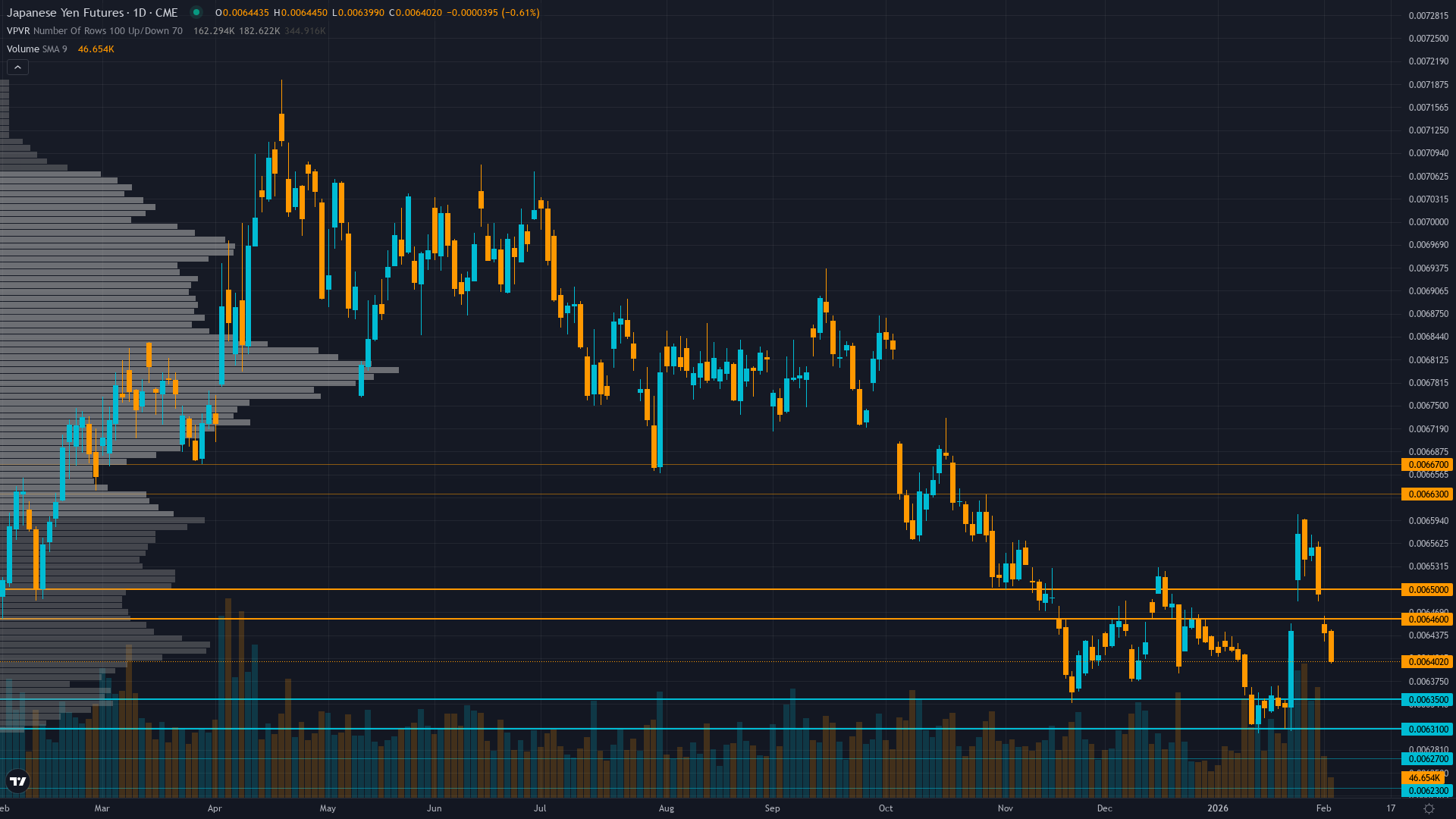
BOJ to maintain gradualist policy normalization with hold likely through Q1; yen consolidation with slight bearish bias on persistent USD strength and fiscal concerns
Japanese 10-year yields at 21st century highs (2.26%) creating fiscal sustainability concerns that overshadow BOJ normalization progress
February 8th snap election introducing political uncertainty just days away, complicating BOJ policy path and market direction
Fed holding rates at 3.5-3.75% while BOJ at 0.75% maintains 275-300bp differential favoring structural USD strength despite narrowing
| ▲ Resistance Zone 2 | 0.0046 – 0.0086 |
| ▲ Resistance Zone 1 | 0.0045 – 0.0085 |
| ─ Pivot Area | ~0.0064 |
| ▼ Support Zone 1 | 0.0043 – 0.0083 |
| ▼ Support Zone 2 | 0.0043 – 0.0083 |
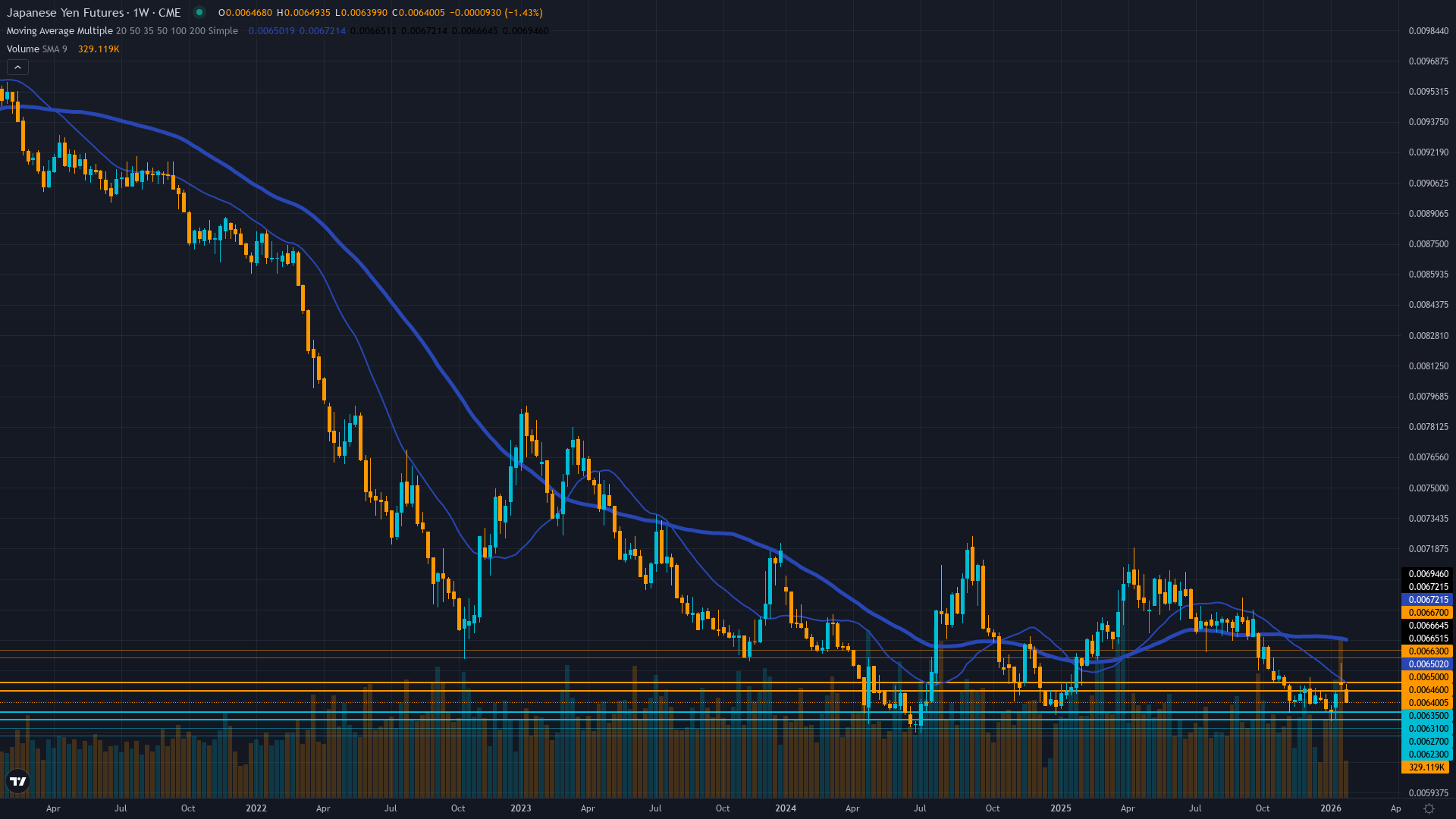
Consolidating in 155-158 USD/JPY range (0.00633-0.00648 6J) post-BOJ hold; price testing 200-day MA support with weakening momentum indicators
BOJ policy hold at 0.75% with Takata dissent proposing 1% signals growing internal hawkish pressure despite gradualist facade; JGB yields at 2.26% creating fiscal crisis risks
Defensive positioning post-BOJ January hold with net short JPY reduced from extremes; 295K open interest showing cautious two-way engagement
Volatility compressed to 68th percentile post-BOJ January meeting but elevated versus historical norms; term structure pricing residual February election uncertainty
Fed paused at 3.5-3.75% after January 28 hold; Japan GDP upgraded to 0.9-1.0% but fiscal concerns mounting with debt service at 25% of budget and yields at 30-year highs
Normal - short-term 9.8% below medium 10.5% and long 11.8% reflecting post-BOJ event compression from pre-meeting anxiety though February 8 election risk maintains elevated baseline
Similar post-BOJ hold consolidations see vol compress 15-20% over 2-3 weeks then re-expand on next catalyst; current 68th percentile positioning suggests room for 25-30% expansion if election surprises
Volatility likely to re-expand 3-5 days into February 8 election then compress post-event; historical pattern shows 70% probability of vol spike to 80th+ percentile around major political catalysts in Japan
High vol regime suggests 80-100 pip daily ranges (0.00050-0.00065 in 6J terms) versus normal 50-60 pips; February 8 election likely triggers 150-250 pip move in 24-48 hours; breakouts from 155-158 consolidation more reliable if accompanied by 120+ pip sustained moves
Elevated 68th percentile vol indicates 1.2-1.5% daily move potential versus normal 0.6-0.8%; February 8 election creates binary risk premium with potential 200-300 pip move (2+ standard deviations) on surprise outcome representing asymmetric reward for directional positioning post-clarity
|
⚠️ Primary Risk
Japanese 10-year yields breaking above 2.3% triggering fiscal crisis concerns and forcing BOJ intervention in bond markets, undermining normalization credibility Probability: MEDIUM
|
✦ Primary Opportunity
Yen mean reversion rally toward 0.00665-0.0068 (150-147 USD/JPY) if February 8 election validates Takaichi mandate enabling BOJ acceleration or if JGB yield surge forces official response Timeframe: 1-2 weeks around February 8 election through mid-February
|
The Japanese Yen sits at a critical crossroads on February 1, 2026, trapped between three powerful opposing forces that have created an unstable equilibrium just one week before Japan's February 8th snap election. Trading at 0.006421 (USD/JPY ~155.8), 6J futures reflect a market in paralysis as it navigates the most complex policy landscape since the August 2024 carry trade unwind. The dominant narrative is no longer simply Fed-BOJ rate differentials—though the 275-300bp gap (Fed 3.5-3.75% vs BOJ 0.75%) continues to provide structural USD support.
Instead, the Yen now faces an unprecedented fiscal sustainability crisis signaled by Japanese 10-year yields surging to 2.26%, the highest level of the 21st century. This yield explosion reflects deep market anxiety about Japan's fiscal position with national debt exceeding 260% of GDP and debt service consuming 25% of the FY2025 budget. The January 23rd BOJ decision revealed critical internal divisions: while the board voted 8-1 to hold at 0.75%, board member Hajime Takata's dissenting vote proposing 1% represents the first crack in the gradualist consensus and signals mounting internal pressure for faster normalization.
Yet this hawkish signal paradoxically weakened the Yen as markets focused on the overall hold decision and dovish forward guidance lacking specificity on future hikes. The February 8th election adds acute near-term uncertainty. PM Takaichi's snap election call—just three months into her tenure—capitalizes on historic 75% approval ratings but introduces binary political risk. A strong LDP victory could embolden more aggressive fiscal stimulus, further pressuring JGB yields and forcing the BOJ into an impossible choice between supporting bond markets or continuing rate normalization.
Conversely, a weak result could constrain fiscal policy and paradoxically strengthen the Yen by reducing deficit concerns. Post-election, the BOJ faces its next major decision likely in March/April, where wage negotiations (Shunto) will be critical—if spring wage settlements again exceed 5%, pressure for accelerated tightening will intensify. The market currently prices this cautiously with implied volatility at the 68th percentile, elevated but compressed from pre-January BOJ peaks. Positioning shows institutional defensiveness with net short JPY reduced but still elevated, creating fuel for violent moves in either direction.
The February seasonal pattern historically shows neutral-to-slight JPY strength, though 2026's unique political catalyst overrides normal tendencies. Current valuation near the middle of the 2025 trading range (139-159 USD/JPY) provides balanced risk-reward, but the fundamental tensions are unprecedented. The market must reconcile: BOJ normalization (JPY positive) against fiscal crisis fears (JPY negative), political uncertainty (volatility) against rate differential support (USD strength), and intervention risks (JPY floor) against structural capital outflow pressures (JPY ceiling).
The next 7 days into the February 8 election represent the highest event risk period for 6J since the January BOJ meeting, with potential for 200-300 pip moves depending on electoral outcome and subsequent policy signals.
| Week | Bias | Confidence |
|---|---|---|
| February 1, 2026 | NEUTRAL | 7/10 |
| January 25, 2026 | NEUTRAL | 7/10 |
| January 18, 2026 | NEUTRAL | 7/10 |
| January 11, 2026 | BULLISH | 7/10 |
| January 4, 2026 | BEARISH | 6/10 |
| December 28, 2025 | BEARISH | 6/10 |
| December 21, 2025 | BULLISH | 7/10 |
| December 14, 2025 | BULLISH | 7/10 |
| December 7, 2025 | BEARISH | 6/10 |
| November 30, 2025 | BEARISH | 6/10 |
| November 23, 2025 | BEARISH | 7/10 |
| November 16, 2025 | BEARISH | 7/10 |