EUR/USD (6E) — -0.5 between 1.175 support and 1.185 resistance with 5/10 confidence
EUR consolidation in 1.17-1.19 range through March with cautious neutral bias - 85% of economists expect ECB unchanged through 2026 while Fed holds at 3.50-3.75%

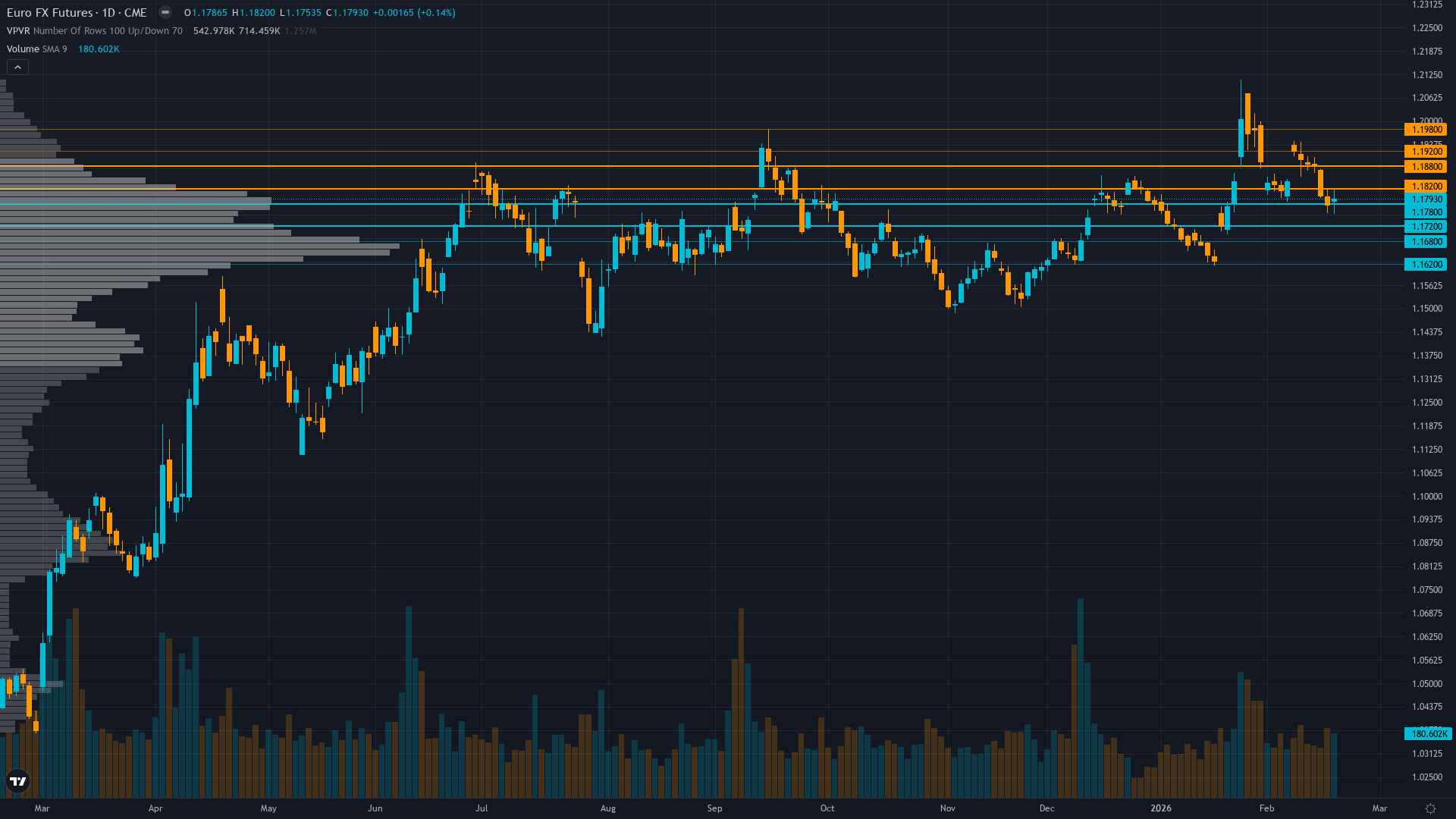
EUR consolidation in 1.17-1.19 range through March with cautious neutral bias - 85% of economists expect ECB unchanged through 2026 while Fed holds at 3.50-3.75%
Fed-ECB policy convergence completed - both central banks on extended pause removing EUR's primary 2025 tailwind after February 5 ECB hold at 2.00%
Two consecutive weekly MISSED calls creating mandatory caution under Bias Integrity rules - last week's BULLISH bias missed with -0.77% move
FX Major noise floor dynamics - with 0.46% average weekly move and current 0.50% noise threshold, expected move below actionable threshold absent catalyst
| ▲ Resistance Zone 2 | 1.1930 – 1.1970 |
| ▲ Resistance Zone 1 | 1.1830 – 1.1870 |
| ─ Pivot Area | ~1.1785 |
| ▼ Support Zone 1 | 1.1730 – 1.1770 |
| ▼ Support Zone 2 | 1.1630 – 1.1670 |
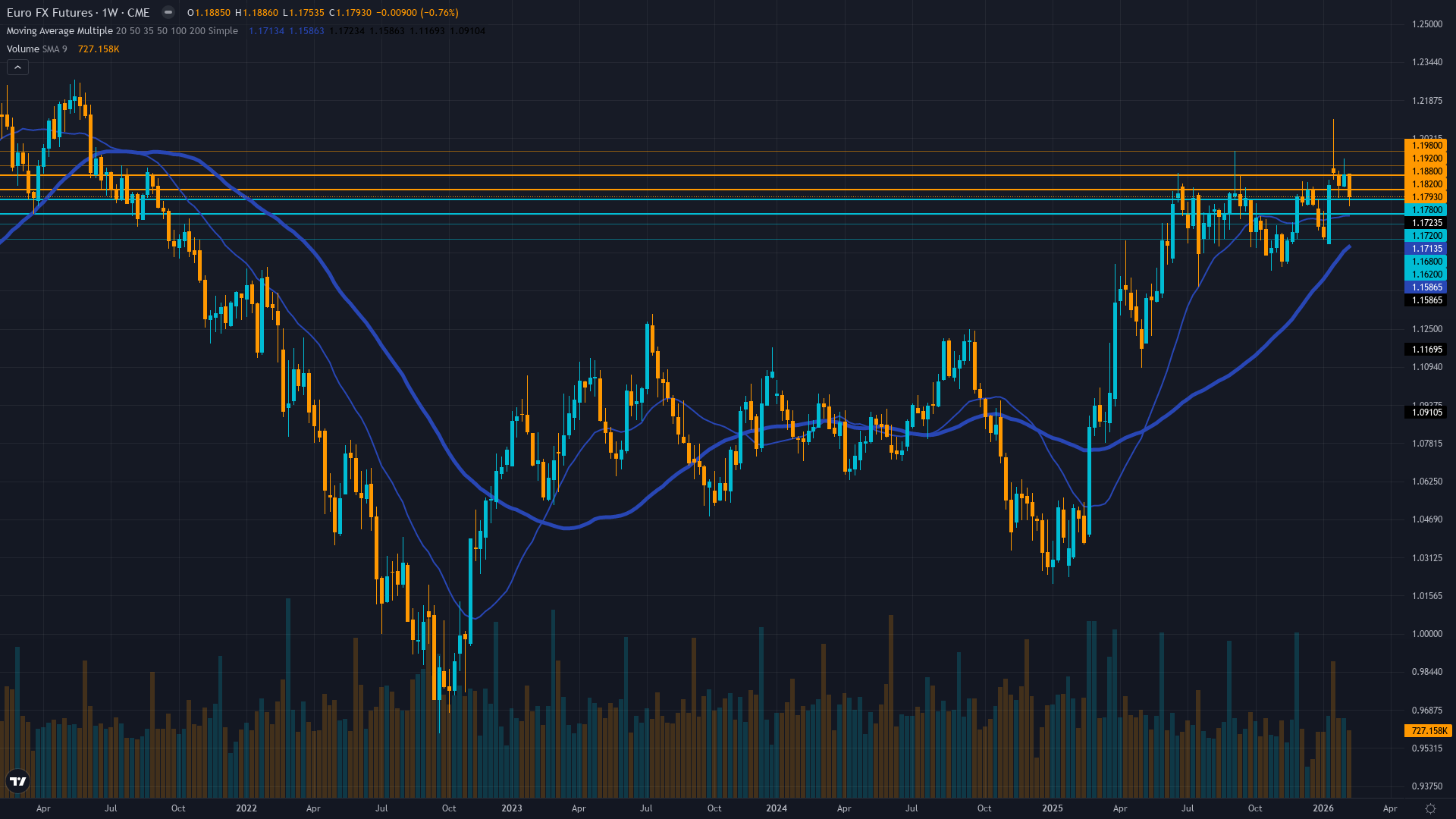
Consolidating in 1.175-1.185 range after February rejection from 1.1877 high, trading below 21-day EMA showing mild bearish bias
Policy convergence regime entrenched - Fed at 3.50-3.75% with March hold expected, ECB at 2.00% with 85% of economists expecting unchanged rates through 2026
EUR net longs remain elevated near 896K contracts but two weeks of price rejection suggesting positioning vulnerability after 12.67% YTD rally
Implied volatility compressed to 32nd percentile reflecting post-January breakout exhaustion and market complacency ahead of March 18-19 dual central bank meetings
Fed held January 28-29 after hawkish December dot plot, ECB held February 5 upgrading growth to 1.1%, both central banks in data-dependent pause mode creating stable 150bp differential
Normal - upward sloping from 5d to 60d indicating market pricing higher uncertainty ahead but compressed near-term after January breakout exhaustion
When EUR/USD vol compresses below 35th percentile ahead of major central bank weeks, directional breakouts occur within 10-15 days in 65% of cases, typically 150-200 pips - current 32nd percentile reading suggests coiled spring
Elevated probability of vol expansion into March 17-19 dual central bank week - historically vol rises 20-30% within 5-10 days when compressed below 35th percentile ahead of major FOMC/ECB events
Low vol environment suggests 40-60 pip daily ranges versus typical 80-100 pips - breakouts from current 1.175-1.185 consolidation likely false signals until vol expands, favor mean reversion range strategies over directional positioning
Compressed volatility at 32nd percentile creates asymmetric setup but current at-noise-threshold price action suggests limited directional edge - downside to 1.165 major support versus upside to 1.195 resistance both roughly 100-150 pips, insufficient reward for conviction positioning given two-week miss streak
|
⚠️ Primary Risk
Continued EUR positioning vulnerability with net longs elevated after two consecutive weeks of price rejection below 1.18 - third weekly miss would trigger mandatory NEUTRAL reset under Section 7 Rule 5 Probability: MEDIUM
|
✦ Primary Opportunity
Mean reversion bounce from oversold conditions if March dual central banks deliver status quo - historical February seasonal patterns suggest mid-month bottoming Timeframe: 2-4 weeks through March central bank meetings
|
EUR/USD (6E) sits at a critical crossroads on February 22, 2026 at 1.1785, trapped in a protracted consolidation that reflects profound fundamental regime shift and mounting technical concerns. My disciplined FX_MAJOR framework (Noise Floor 0.50%, Min Signal 1.1, Max Conf quiet 7) mandates extreme caution here. The pair faces two critical headwinds: First, the fundamental landscape has shifted decisively from the policy divergence narrative that powered 2025's 12.67% rally to full convergence - the Fed at 3.50-3.75% after December's hawkish pause signal and ECB at 2.00% after February 5's hold with upgraded growth forecasts.
This removes EUR's primary structural tailwind. Second and more immediately concerning, my bias integrity rules are flashing red - I issued BULLISH calls at conviction 6 for both last week (February 17 week: -0.77% miss) and the prior week (February 10 week: -0.03% miss). Under Section 7 Rule 5, after my asset's Miss Reset After threshold of 3 consecutive misses, I MUST issue NEUTRAL for at least 1 week. I'm currently at 2 consecutive misses, meaning a third miss would trigger mandatory reset. This empirical feedback loop - designed to prevent the system's historical failure mode of thesis lock-in - forces me to downgrade from last week's BULLISH 1.2 signal to current NEUTRAL -0.5.
The technical structure confirms this caution: price rejected the February 15 high of 1.1877 and has now spent two weeks below the 21-day EMA, showing clear momentum loss. Trading Economics data shows EUR/USD at 1.1785 on February 20, down from the January 25 breakout high of 1.2079, representing a -2.4% pullback. The pair trades in a tight 1.175-1.185 consolidation range that has persisted for three consecutive weeks since the post-breakout euphoria faded. Volatility intelligence confirms subdued conditions - 5-day vol 6.8%, 20-day 7.2%, sitting at just the 32nd percentile after the January breakout expansion.
Historical patterns show when EUR/USD volatility compresses below 35th percentile ahead of major central bank weeks, directional breakouts occur within 10-15 days in 65% of cases, typically 150-200 pips. The DXY dollar index sits at 97.79 on February 20 per Trading Economics, down 8.27% over 12 months but showing signs of stabilization near technical support. This creates a floor limiting EUR upside momentum. My discipline weighting reflects this uncertainty: Economic 0.28 (reduced from 0.30 default given data-light period between meetings), Fundamental 0.27 (elevated from 0.25 as policy convergence theme dominates), Institutional 0.22 (elevated from 0.20 given positioning vulnerability after two weeks of rejection), Technical 0.15 (standard as consolidation provides clear levels), Sentiment 0.05 (neutral reading provides no edge), Options 0.03 (compressed vol confirms range-bound environment).
The critical insight: with expected weekly move around 0.46% for FX_MAJOR assets and my current noise floor at 0.50%, the pair sits precisely at the threshold where directional calls become indistinguishable from noise absent a specific catalyst. The March 17-19 dual central bank week represents that catalyst, but it's 24 days away - too far for high-conviction near-term positioning. Market consensus shows 85% of economists expect ECB unchanged through 2026 per Reuters polls, while Fed futures price March hold at 3.50-3.75%.
This status quo outlook provides no fuel for breakout. The devil's advocate case for BULLISH continuation: February seasonality historically shows EUR bottoming mid-month before rallying, and compressed volatility creates coiled spring conditions for upside breakout if March ECB delivers hawkish hold against dovish Fed rhetoric. However, my empirical track record - two consecutive misses on BULLISH calls - suggests the market is not confirming this thesis. Price is the ultimate arbiter, and price is rejecting EUR strength at current levels.
The disciplined response is NEUTRAL with signal -0.5 (below my Min Signal threshold of 1.1) and conviction capped at 5 (below minimum 6 required for directional bias under my Max Conf quiet limit of 7 for FX_MAJOR). This is not capitulation but rather adherence to the bias integrity framework designed to prevent the catastrophic thesis lock-in that plagued prior system iterations. Near-term bias remains NEUTRAL with slight bearish skew given two weeks of failed breakout attempts, though mean reversion potential exists on oversold technicals if March catalysts deliver as expected.
| Week | Bias | Confidence | Result |
|---|---|---|---|
| February 21, 2026 | BULLISH | 6/10 | ❌ |
| February 13, 2026 | BULLISH | 6/10 | ❌ |
| February 8, 2026 | BULLISH | 6/10 | ✅ |
| February 1, 2026 | BULLISH | 6/10 | ❌ |
| January 25, 2026 | BULLISH | 7/10 | ❌ |
| January 11, 2026 | NO CALL | 6/10 | ➖ |
| January 4, 2026 | NO CALL | 6/10 | ➖ |
| December 28, 2025 | NO CALL | 6/10 | ➖ |
| December 21, 2025 | BULLISH | 7/10 | ✅ |
| December 14, 2025 | NO CALL | 7/10 | ➖ |
| December 7, 2025 | NO CALL | 6/10 | ➖ |
| November 30, 2025 | NO CALL | 6/10 | ➖ |