EUR/USD (6E) — Divergent central bank policy expectations with Fed on hold and ECB signaling…
EUR range-bound near 1.20 as both Fed and ECB signal patience; markets await fresh catalysts

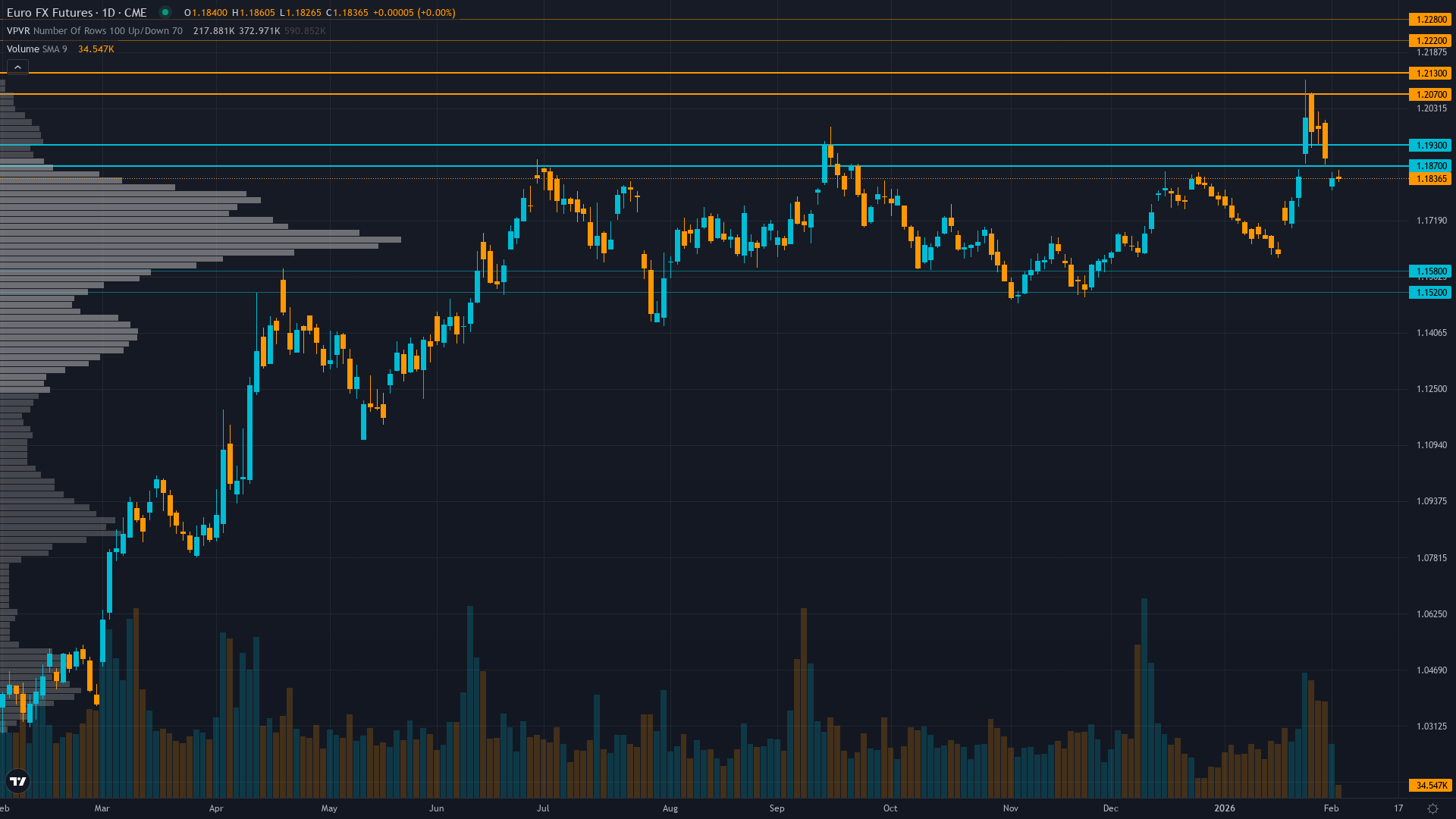
EUR range-bound near 1.20 as both Fed and ECB signal patience; markets await fresh catalysts
Divergent central bank policy expectations with Fed on hold and ECB signaling patience
US dollar technical weakness following 10% annual decline in DXY to multi-year lows
Rate differential compression as Fed remains at 3.5-3.75% with markets pricing no ECB moves in 2026
| ▲ Resistance Zone 2 | 1.2230 – 1.2270 |
| ▲ Resistance Zone 1 | 1.2080 – 1.2120 |
| ─ Pivot Area | ~1.2000 |
| ▼ Support Zone 1 | 1.1880 – 1.1920 |
| ▼ Support Zone 2 | 1.1530 – 1.1570 |
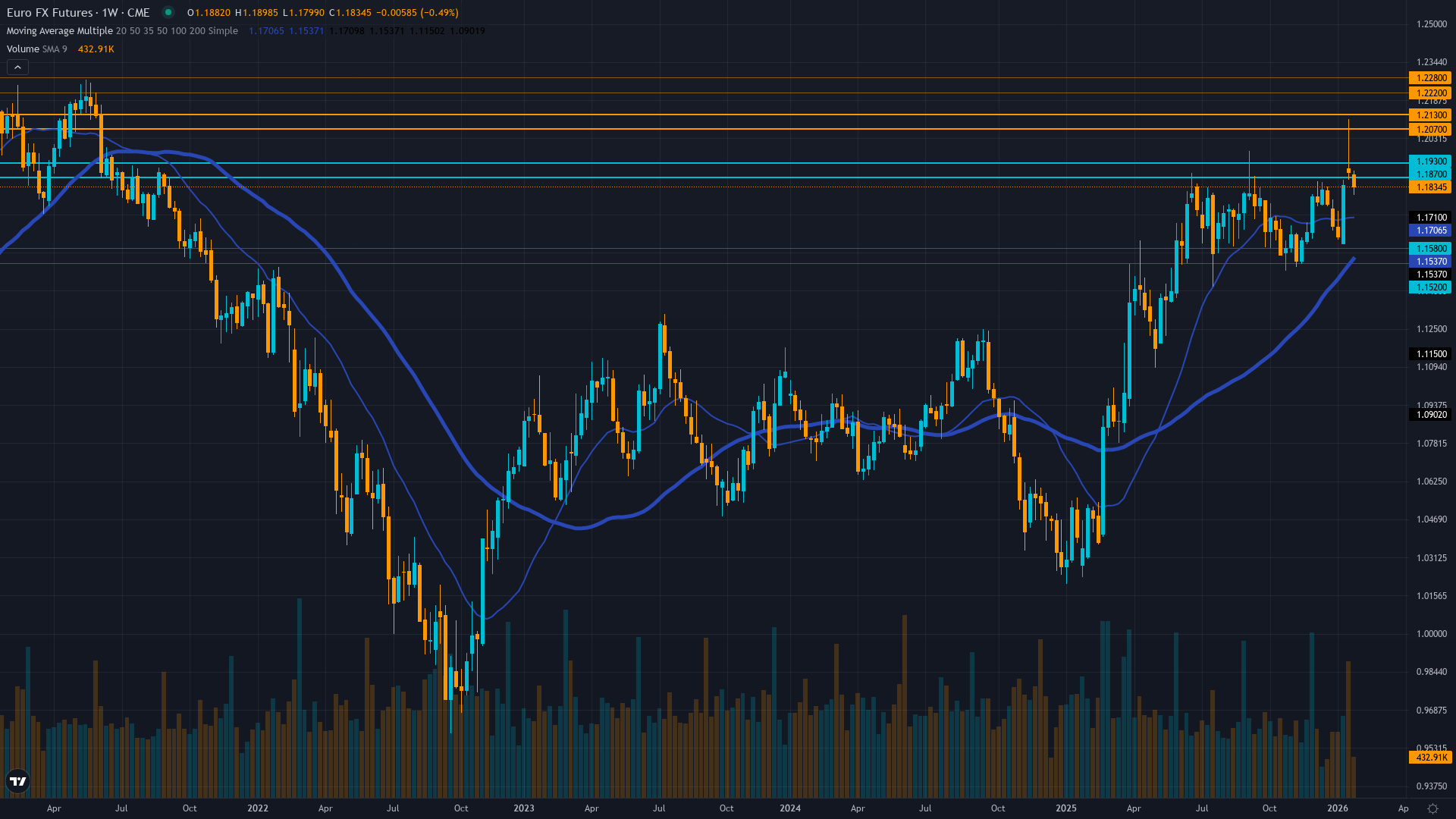
Consolidating in 1.17-1.20 range after 2025 rally from 1.04 lows; near key resistance at 1.20-1.22
Policy divergence narrowing as Fed pauses and ECB remains on hold; growth outlooks converging
Elevated net EUR longs near cycle highs after strong 2025 rally; positioning risk tilted bearish
Implied volatility subdued at 1.08% reflecting market complacency; low vol favors range trading
Fed held rates Jan 29; ECB meets Feb 5 with no change expected; US jobs data Feb 6 key catalyst
Normal - short-term vol below medium-term reflecting consolidation phase
Similar low-vol consolidations at cycle highs have preceded sharp moves; 2025 saw vol compression before Fed pivot announcements
Elevated probability of vol expansion into ECB and jobs data Feb 5-6; expect realized vol to rise 20-30% within 5 days
Low vol suits range strategies; expect 30-50 pip daily ranges until catalysts hit; breakouts likely false until vol expands
Asymmetric risk: downside vol spikes tend to be sharper when unwinding crowded longs; 1.5:1 risk-reward favors fading rallies above 1.21
|
⚠️ Primary Risk
Hawkish Fed pivot or stronger US data could trigger sharp EUR reversal from extended levels Probability: MEDIUM
|
✦ Primary Opportunity
Breakout above 1.2050-1.21 if ECB signals extended pause and Fed maintains dovish bias Timeframe: 1-2 weeks through ECB meeting and US jobs data
|
EUR/USD enters February 2026 in a consolidative state after a powerful 2025 rally that lifted the pair from 1.04 lows to the current 1.20 area, driven by aggressive Fed rate cuts that have now paused. The market sits at a critical juncture: the DXY has collapsed 10% year-over-year to 97, yet EUR faces its own headwinds as the ECB signals no urgency to ease further. Both central banks are now on hold—the Fed at 3.5-3.75% and ECB deposit rate comfortable—compressing the rate differential that fueled euro strength.
With the ECB meeting in 4 days (Feb 5) and US jobs data the following day (Feb 6), traders are navigating a low-volatility environment (1.08% vol rating) that masks underlying tension. Positioning data suggests crowded EUR longs near cycle highs, creating vulnerability to profit-taking on any hawkish Fed pivot or disappointing eurozone data. Technically, 6E futures trade around 1.2032, testing the upper end of a 1.17-1.20 consolidation range. The 1.15-1.16 support zone remains critical; below that signals trend failure.
Above 1.2050-1.21, a breakout toward 1.22-1.23 becomes viable. February's seasonal tailwind (historically positive for EUR from early-month lows) aligns with current price action, but mean reversion risks loom after such an extended move. The Fed's pause removes a key bearish USD catalyst, while the ECB's reluctance to cut eliminates a euro negative. This stalemate favors range-bound trading until data forces a policy re-pricing. The January 29 FOMC decision to hold rates was well-telegraphed; what matters now is whether incoming US employment, inflation, or growth data warrants a change in the 'patient' Fed narrative.
Similarly, ECB rhetoric on February 5 will be parsed for any shift toward easing bias. Short-term, the pair lacks a clear directional catalyst, resulting in choppy two-way action. Longer-term, valuation concerns persist—EUR/USD in the 84th percentile of its 2-year range suggests limited upside without fresh fundamental support.
| Week | Bias | Confidence |
|---|---|---|
| February 1, 2026 | BULLISH | 6/10 |
| January 25, 2026 | BULLISH | 7/10 |
| January 18, 2026 | NEUTRAL | 6/10 |
| January 11, 2026 | NEUTRAL | 6/10 |
| January 4, 2026 | NEUTRAL | 6/10 |
| December 28, 2025 | NEUTRAL | 6/10 |
| December 21, 2025 | NEUTRAL | 7/10 |
| December 14, 2025 | NEUTRAL | 7/10 |
| December 7, 2025 | NEUTRAL | 6/10 |
| November 30, 2025 | NEUTRAL | 6/10 |
| November 23, 2025 | NEUTRAL | 6/10 |
| November 16, 2025 | BULLISH | 6/10 |