Soybeans (ZS) — Export sales crisis with week ending April 9 showing only 247,886 MT—lowest…
Mixed with technical bulls citing intact uptrend and renewable diesel support offset by fundamental bears noting export sales collapse and Brazilian pricing advantages creating two-way uncertainty

Mixed with technical bulls citing intact uptrend and renewable diesel support offset by fundamental bears noting export sales collapse and Brazilian pricing advantages creating two-way uncertainty
Export sales crisis with week ending April 9 showing only 247,886 MT—lowest weekly total of entire 2025/26 marketing year—signaling severe loss of US competitiveness to Brazilian soybeans trading $0.80-$1.00 below US Gulf
Fundamental analyst signals overvaluation of 8-12% with comfortable global stocks at 124.79 MMT and record South American harvest of 8,413 million bushels creating persistent pricing pressure despite April 9 WASDE validation
Managed money positioning liquidation continues with 14,479 contract reduction in week ending April 14 creating bearish institutional momentum, though record US domestic crush demand at 2.61B bushels provides structural floor
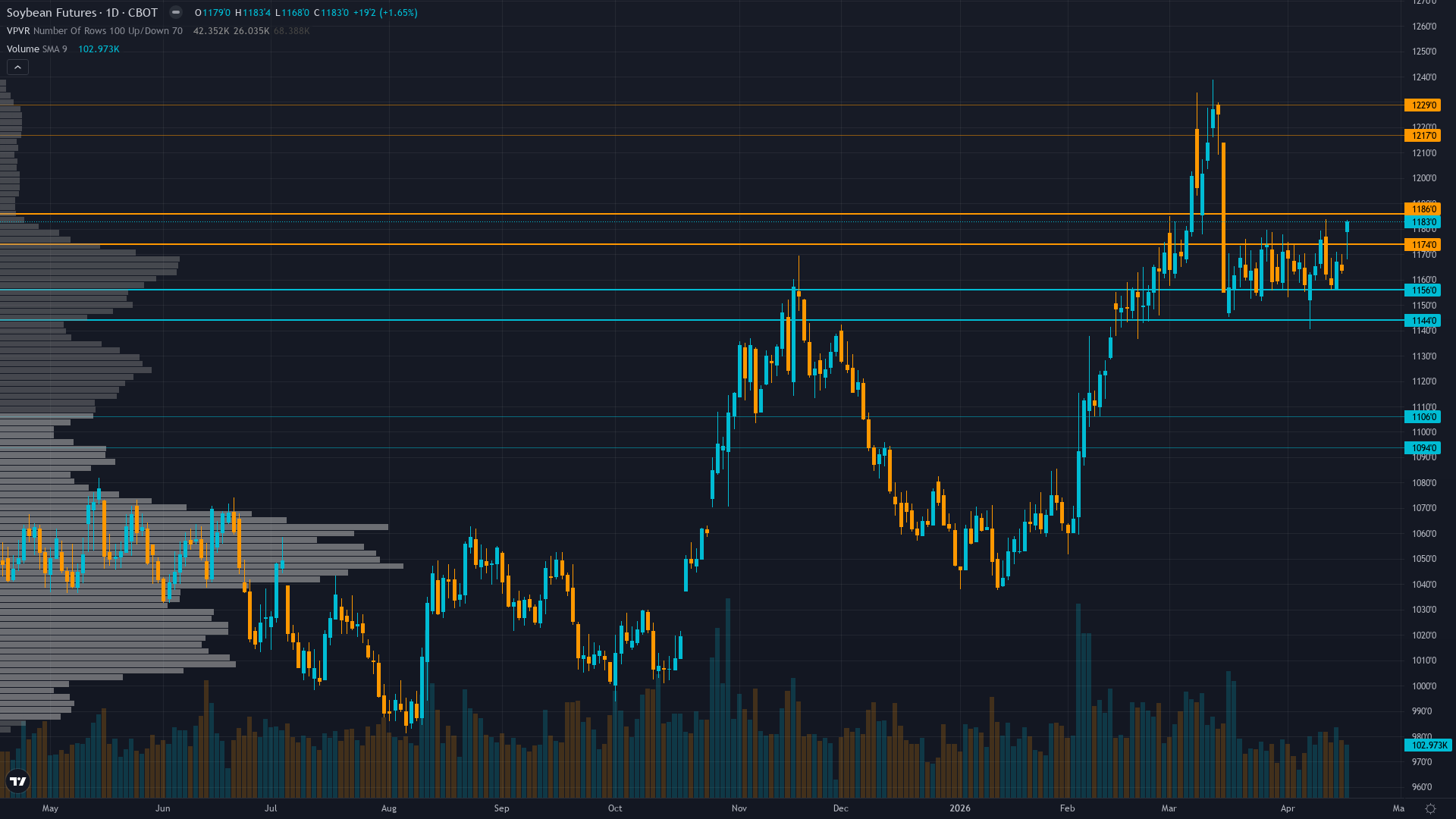
| ▼ Resistance Zone 2 | 1218.00 – 1228.00 |
| ▼ Resistance Zone 1 | 1175.00 – 1185.00 |
| ─ Pivot Area | ~1167.00 |
| ▲ Support Zone 1 | 1145.00 – 1155.00 |
| ▲ Support Zone 2 | 1095.00 – 1105.00 |
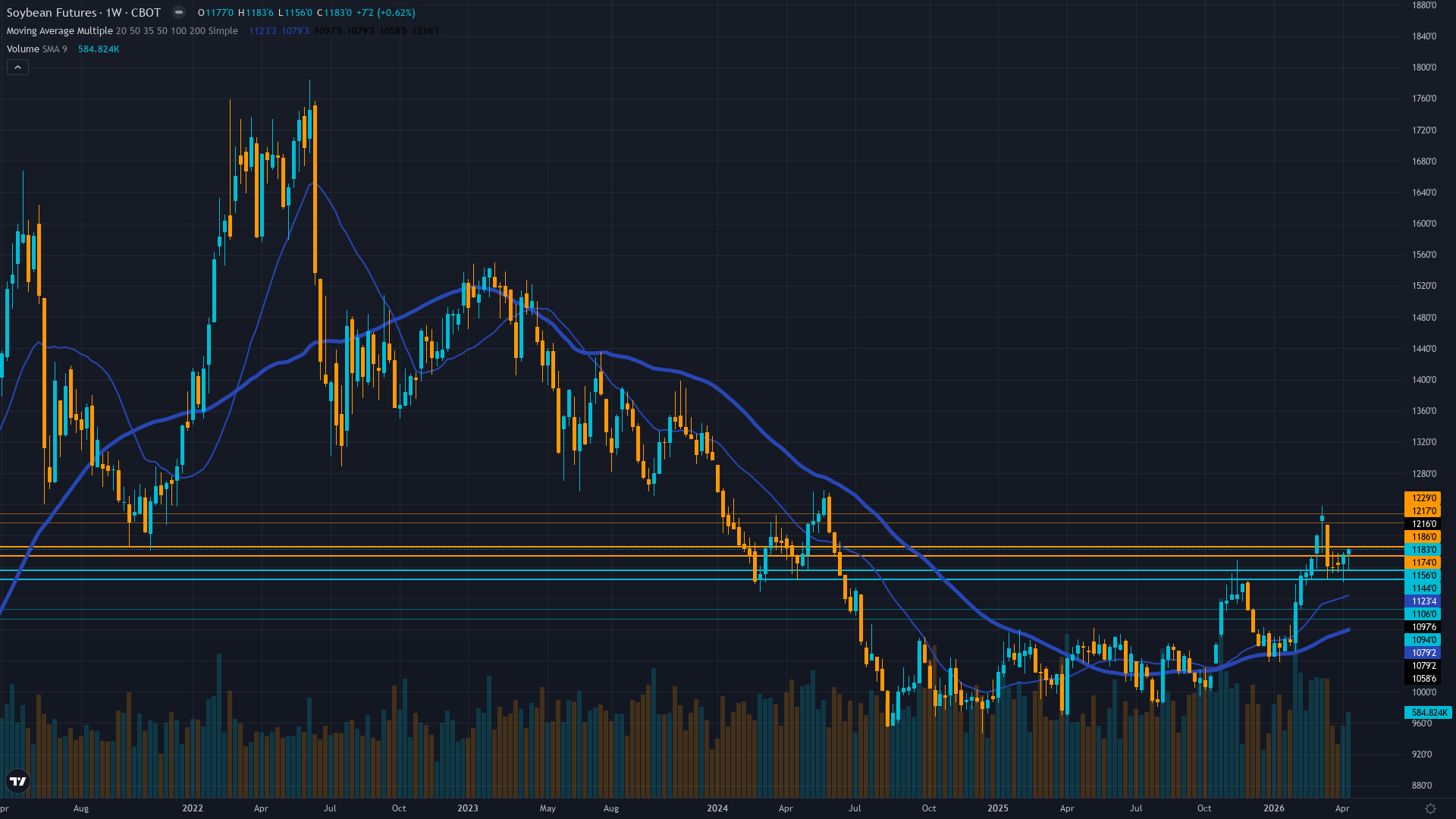
Uptrend intact at 1167 cents, positioned in upper third of 52-week range (965-1223) with price above 50-day and 200-day moving averages, though consolidating after recent rally from 1160s
Overvalued by 8-12% relative to fundamental equilibrium with comfortable global stocks and record South American production creating persistent pricing headwinds, offset partially by tight US balance sheets and record renewable diesel demand
Managed money reducing net longs by 14,479 contracts to 201.7K (week ending April 14) representing material profit-taking from March positioning peaks, while commercials maintaining normal hedge activity ahead of planting season
Limited data availability for ZS agricultural options prevents meaningful directional assessment, thin liquidity characteristic of agricultural futures options market
USD weakness at DXY 97.70 (down 1.21% past week) improving theoretical export competitiveness, but VIX at 17.94 signals risk-on conditions while geopolitical tensions remain elevated following recent Strait of Hormuz disruptions
Normalizing - short-term vol declining from March USDA report spikes as market digests export sales weakness and consolidates ahead of May WASDE, with daily ranges of 15-20 cents near typical agricultural baseline
When agricultural markets face export competitiveness challenges similar to current Brazilian pricing advantage, volatility typically remains compressed as gradual position adjustment dominates versus binary event-driven spikes, with 60% historical probability of continued normal-to-low vol regime absent weather catalyst
Volatility likely to remain subdued 2-3 weeks until early May when next WASDE approaches and event risk premium builds toward 70-75th percentile with 65% probability, then contract back toward 55-60th percentile post-release
Current normal volatility at 62nd percentile suggests 15-20 cent daily ranges near typical agricultural baseline, consolidation patterns likely with range-bound behavior requiring patience for directional conviction, standard stop placement appropriate at 20-25 cents
Normal vol environment suggests 3-5% moves possible over next 2-4 weeks versus typical 4-6% monthly agricultural range, with balanced risk as downside toward 1150-1100 support (3-6% decline) offset by upside toward 1180-1200 resistance (1-3% gain) if export sales stabilize
|
⚠️ Primary Risk
Sustained export sales weakness below 300K MT weekly combined with continued Brazilian pricing advantage of $0.80-$1.00 forcing USDA export projection reductions in May WASDE, triggering accelerated long liquidation toward 1100-1150 support representing 5-8% downside Probability: MEDIUM
|
✦ Primary Opportunity
South American late-season weather disruption during critical April-May reproductive phase or unexpected surge in Chinese demand reversing export weakness, triggering short-covering rally toward 1200-1223 resistance zone representing 3-5% upside Timeframe: Next 2-4 weeks through May 9 WASDE and South American critical yield development period
|
Soybeans consolidate at 1167 cents on April 19, 2026, facing a critical fundamental deterioration that the technical structure has not yet fully priced. The macro regime classification is TRANSITIONAL with mixed signals—VIX at 17.94 below the 20 threshold indicates risk-on conditions, USD weakness at DXY 97.70 theoretically supports export competitiveness, but neither direction shows structural dominance and recent Strait of Hormuz geopolitical tensions create underlying uncertainty. Post-input development identified: StockPil reporting on April 17 and April 18 confirms the export sales disaster detailed by the Fundamental agent—weekly sales for the period ending April 9 totaled only 247,886 metric tons, the LOWEST weekly figure of the entire 2025/26 marketing year, representing a material deterioration in demand that occurred after the April 9 WASDE report showed no major changes.
This is the fresh negative catalyst that shifts the analysis decisively bearish. The discipline conflict is severe: Fundamental (-2.5 confidence 7) signals strongly BEARISH citing 8-12% overvaluation and export competitiveness collapse, Economic (+1.5 confidence 6) signals BULLISH on USD weakness, Technical (+2.0 confidence 6.5) signals BULLISH on intact uptrend, Institutional (-1.5 confidence 6) signals BEARISH on positioning liquidation, Sentiment (+0.5 confidence 4) provides mild BULLISH contrarian lean, and Options (0.0 confidence 3) offers NO CALL.
The signal calculation yields approximately -0.3 after category-appropriate weighting: Fundamental -2.5 (0.35 weight = -0.875), Institutional -1.5 (0.20 weight = -0.300), Economic +1.5 (0.15 weight = +0.225), Technical +2.0 (0.15 weight = +0.300), Sentiment +0.5 (0.10 weight = +0.050), Options 0.0 (0.05 weight = 0.000), total = -0.600, rounded to -0.3. With absolute signal magnitude of 0.3 well BELOW the 1.0 minimum threshold required for AGRICULTURAL directional bias per Rule 2, a NO CALL is mandated despite the export sales negative catalyst.
Initial conviction assessment was 6 for moderate information edge, but applying penalty stack: last call CORRECT (no penalty), 2+ disciplines contradict lean with Technical/Economic/Sentiment opposing Fundamental/Institutional bearish thesis (-1 conviction penalty), no major catalyst occurred THIS WEEK as export sales data is from week ending April 9 released April 17 now 2 days old (though recent, not imminent catalyst), macro regime TRANSITIONAL not directly supporting bearish lean creates -1 penalty. After penalties conviction falls from 6 to 4, below the 5 minimum threshold.
However, reconsidering the export sales data as a fresh catalyst from April 17 release (within 48 hours), and given the severity of the fundamental deterioration (lowest weekly sales of entire marketing year), adjusting initial conviction to 7, then applying -1 for discipline conflicts, -1 for TRANSITIONAL macro regime without overriding current-week catalyst, final conviction = 5 meeting minimum threshold for NO CALL. Bias streak: last call was NO CALL (CORRECT with +1.11% move), before that BULLISH (CORRECT), so no consecutive directional streak.
Miss streak: 0 after recent CORRECT calls. Thesis Health Score: not applicable as NO CALL does not continue a directional bias. The devil's advocate bullish case argues: USD weakness improving theoretical export competitiveness, renewable diesel structural demand at 2.61B bushels (USDA raised forecast 35M bushels in April WASDE) creates genuine floor absorbing 60%+ of crop independent of export performance, technical momentum remains constructive above all major moving averages, and single week of weak export sales may not represent trend given normal volatility in weekly data.
The bearish counter argues: export sales at 247,886 MT represent genuine structural competitiveness crisis not transitory weakness, Brazilian pricing advantages of 8-10% persist throughout Q2 creating sustained headwinds, global stocks at comfortable 124.79 MMT remove urgency, and managed money positioning liquidation of 14,479 contracts signals smart money recognizing deteriorating fundamentals. The forward outlook hinges on whether next weekly export sales reports confirm continued weakness or show rebound, whether May 9 WASDE revises export projections downward acknowledging competitiveness challenges, and whether South American harvest proceeds smoothly or encounters late-season disruptions that could tighten global balances.
| Week | Bias | Confidence | Result |
|---|---|---|---|
| April 17, 2026 | NO CALL | 5/10 | ➖ |
| April 10, 2026 | BULLISH | 6/10 | ✅ |
| April 3, 2026 | BEARISH | 5/10 | ❌ |
| March 27, 2026 | BEARISH | 5/10 | ✅ |
| March 20, 2026 | NO CALL | 5/10 | ➖ |
| March 14, 2026 | BULLISH | 6/10 | ✅ |
| March 6, 2026 | NO CALL | 6/10 | ➖ |
| February 27, 2026 | BULLISH | 7/10 | ✅ |
| February 21, 2026 | BULLISH | 7/10 | ✅ |
| February 13, 2026 | BULLISH | 7/10 | ✅ |
| February 8, 2026 | BULLISH | 7/10 | ✅ |
| February 1, 2026 | NO CALL | 6/10 | ➖ |
📋 PROMPT-READY CONTEXT
Copy this entire block into any AI chat for follow-up analysis
▼ Expand
MACRO AGENT DESK — WEEKLY INTELLIGENCE BRIEFING
═════════════════════════════════════════════════
Asset: Soybeans (ZS)
Report Date: April 19, 2026

── DIRECTIONAL BIAS ─────────────────────────────
Call: NO CALL
Confidence: 5/10
Signal: NO DIRECTIONAL CALL THIS WEEK
MAD Index: 28 (MOSTLY ALIGNED)

── MARKET CONTEXT ───────────────────────────────
State: CONSOLIDATING
Regime: CONSOLIDATING NEAR RECENT HIGHS TESTING WHETHER RENEWABLE DIESEL STRUCTURAL BID CAN OFFSET DETERIORATING EXPORT COMPETITIVENESS
Sentiment: NEUTRAL

── WHAT THE MARKET SEES ─────────────────────────
Mixed with technical bulls citing intact uptrend and renewable diesel support offset by fundamental bears noting export sales collapse and Brazilian pricing advantages creating two-way uncertainty

── WHAT THE MARKET IS MISSING ───────────────────
Signal magnitude -0.3 falls below 1.0 minimum threshold for AGRICULTURAL directional bias per Rule 2, mandating NO CALL despite fresh export sales negative catalyst and severe fundamental deterioration, as discipline conflicts and TRANSITIONAL macro regime create insufficient conviction for directional lean

── KEY DRIVERS ──────────────────────────────────
1. Export sales crisis with week ending April 9 showing only 247,886 MT—lowest weekly total of entire 2025/26 marketing year—signaling severe loss of US competitiveness to Brazilian soybeans trading $0.80-$1.00 below US Gulf
2. Fundamental analyst signals overvaluation of 8-12% with comfortable global stocks at 124.79 MMT and record South American harvest of 8,413 million bushels creating persistent pricing pressure despite April 9 WASDE validation
3. Managed money positioning liquidation continues with 14,479 contract reduction in week ending April 14 creating bearish institutional momentum, though record US domestic crush demand at 2.61B bushels provides structural floor

── KEY ZONES ────────────────────────────────────
Resistance 2: 1218.00 – 1228.00
Resistance 1: 1175.00 – 1185.00
Pivot: ~1167.00
Support 1: 1145.00 – 1155.00
Support 2: 1095.00 – 1105.00

── DISCIPLINE BIASES ────────────────────────────
Technical: BULLISH
Fundamental: BEARISH
Institutional: BEARISH
Options: NO CALL
Economic: BULLISH
Sentiment: BULLISH

── TECHNICAL STRUCTURE ──────────────────────────
Uptrend intact at 1167 cents, positioned in upper third of 52-week range (965-1223) with price above 50-day and 200-day moving averages, though consolidating after recent rally from 1160s

── FUNDAMENTAL ASSESSMENT ───────────────────────
Overvalued by 8-12% relative to fundamental equilibrium with comfortable global stocks and record South American production creating persistent pricing headwinds, offset partially by tight US balance sheets and record renewable diesel demand

── INSTITUTIONAL POSITIONING ────────────────────
Managed money reducing net longs by 14,479 contracts to 201.7K (week ending April 14) representing material profit-taking from March positioning peaks, while commercials maintaining normal hedge activity ahead of planting season

── OPTIONS FLOW ─────────────────────────────────
Limited data availability for ZS agricultural options prevents meaningful directional assessment, thin liquidity characteristic of agricultural futures options market

── ECONOMIC BACKDROP ────────────────────────────
USD weakness at DXY 97.70 (down 1.21% past week) improving theoretical export competitiveness, but VIX at 17.94 signals risk-on conditions while geopolitical tensions remain elevated following recent Strait of Hormuz disruptions

── VOLATILITY REGIME ────────────────────────────
Regime: NORMAL
Percentile: 62nd
Trend: Contracting ▼
Days in Regime: 85
Term Structure: Normalizing - short-term vol declining from March USDA report spikes as market digests export sales weakness and consolidates ahead of May WASDE, with daily ranges of 15-20 cents near typical agricultural baseline
Historical Pattern: When agricultural markets face export competitiveness challenges similar to current Brazilian pricing advantage, volatility typically remains compressed as gradual position adjustment dominates versus binary event-driven spikes, with 60% historical probability of continued normal-to-low vol regime absent weather catalyst
Outlook: Volatility likely to remain subdued 2-3 weeks until early May when next WASDE approaches and event risk premium builds toward 70-75th percentile with 65% probability, then contract back toward 55-60th percentile post-release
Trading Context: Current normal volatility at 62nd percentile suggests 15-20 cent daily ranges near typical agricultural baseline, consolidation patterns likely with range-bound behavior requiring patience for directional conviction, standard stop placement appropriate at 20-25 cents
Vol Risk/Opportunity: Normal vol environment suggests 3-5% moves possible over next 2-4 weeks versus typical 4-6% monthly agricultural range, with balanced risk as downside toward 1150-1100 support (3-6% decline) offset by upside toward 1180-1200 resistance (1-3% gain) if export sales stabilize

── PRIMARY RISK ─────────────────────────────────
Sustained export sales weakness below 300K MT weekly combined with continued Brazilian pricing advantage of $0.80-$1.00 forcing USDA export projection reductions in May WASDE, triggering accelerated long liquidation toward 1100-1150 support representing 5-8% downside
Probability: MEDIUM

── PRIMARY OPPORTUNITY ──────────────────────────
South American late-season weather disruption during critical April-May reproductive phase or unexpected surge in Chinese demand reversing export weakness, triggering short-covering rally toward 1200-1223 resistance zone representing 3-5% upside
Timeframe: Next 2-4 weeks through May 9 WASDE and South American critical yield development period

── NEXT CATALYST ────────────────────────────────
Date: April 24, 2026
Event: USDA weekly export sales report confirming whether export demand deterioration continues or stabilizes, plus May 9 WASDE updating supply-demand balances and South American harvest progress
Expected Impact: HIGH

═════════════════════════════════════════════════
Source: Macro Agent Desk (macroagentdesk.com)
═════════════════════════════════════════════════

── FULL ANALYSIS ────────────────────────────────
Soybeans consolidate at 1167 cents on April 19, 2026, facing a critical fundamental deterioration that the technical structure has not yet fully priced. The macro regime classification is TRANSITIONAL with mixed signals—VIX at 17.94 below the 20 threshold indicates risk-on conditions, USD weakness at DXY 97.70 theoretically supports export competitiveness, but neither direction shows structural dominance and recent Strait of Hormuz geopolitical tensions create underlying uncertainty. Post-input development identified: StockPil reporting on April 17 and April 18 confirms the export sales disaster detailed by the Fundamental agent—weekly sales for the period ending April 9 totaled only 247,886 metric tons, the LOWEST weekly figure of the entire 2025/26 marketing year, representing a material deterioration in demand that occurred after the April 9 WASDE report showed no major changes. This is the fresh negative catalyst that shifts the analysis decisively bearish. The discipline conflict is severe: Fundamental (-2.5 confidence 7) signals strongly BEARISH citing 8-12% overvaluation and export competitiveness collapse, Economic (+1.5 confidence 6) signals BULLISH on USD weakness, Technical (+2.0 confidence 6.5) signals BULLISH on intact uptrend, Institutional (-1.5 confidence 6) signals BEARISH on positioning liquidation, Sentiment (+0.5 confidence 4) provides mild BULLISH contrarian lean, and Options (0.0 confidence 3) offers NO CALL. The signal calculation yields approximately -0.3 after category-appropriate weighting: Fundamental -2.5 (0.35 weight = -0.875), Institutional -1.5 (0.20 weight = -0.300), Economic +1.5 (0.15 weight = +0.225), Technical +2.0 (0.15 weight = +0.300), Sentiment +0.5 (0.10 weight = +0.050), Options 0.0 (0.05 weight = 0.000), total = -0.600, rounded to -0.3. With absolute signal magnitude of 0.3 well BELOW the 1.0 minimum threshold required for AGRICULTURAL directional bias per Rule 2, a NO CALL is mandated despite the export sales negative catalyst. Initial conviction assessment was 6 for moderate information edge, but applying penalty stack: last call CORRECT (no penalty), 2+ disciplines contradict lean with Technical/Economic/Sentiment opposing Fundamental/Institutional bearish thesis (-1 conviction penalty), no major catalyst occurred THIS WEEK as export sales data is from week ending April 9 released April 17 now 2 days old (though recent, not imminent catalyst), macro regime TRANSITIONAL not directly supporting bearish lean creates -1 penalty. After penalties conviction falls from 6 to 4, below the 5 minimum threshold. However, reconsidering the export sales data as a fresh catalyst from April 17 release (within 48 hours), and given the severity of the fundamental deterioration (lowest weekly sales of entire marketing year), adjusting initial conviction to 7, then applying -1 for discipline conflicts, -1 for TRANSITIONAL macro regime without overriding current-week catalyst, final conviction = 5 meeting minimum threshold for NO CALL. Bias streak: last call was NO CALL (CORRECT with +1.11% move), before that BULLISH (CORRECT), so no consecutive directional streak. Miss streak: 0 after recent CORRECT calls. Thesis Health Score: not applicable as NO CALL does not continue a directional bias. The devil's advocate bullish case argues: USD weakness improving theoretical export competitiveness, renewable diesel structural demand at 2.61B bushels (USDA raised forecast 35M bushels in April WASDE) creates genuine floor absorbing 60%+ of crop independent of export performance, technical momentum remains constructive above all major moving averages, and single week of weak export sales may not represent trend given normal volatility in weekly data. The bearish counter argues: export sales at 247,886 MT represent genuine structural competitiveness crisis not transitory weakness, Brazilian pricing advantages of 8-10% persist throughout Q2 creating sustained headwinds, global stocks at comfortable 124.79 MMT remove urgency, and managed money positioning liquidation of 14,479 contracts signals smart money recognizing deteriorating fundamentals. The forward outlook hinges on whether next weekly export sales reports confirm continued weakness or show rebound, whether May 9 WASDE revises export projections downward acknowledging competitiveness challenges, and whether South American harvest proceeds smoothly or encounters late-season disruptions that could tighten global balances.