Soybeans (ZS) — consolidating in normal regime
Mixed with bullish fundamental analysts citing WASDE validation and renewable diesel structural support offset by bearish macro analysts noting dollar strength and positioning profit-taking creating range-bound consolidation expectations

Mixed with bullish fundamental analysts citing WASDE validation and renewable diesel structural support offset by bearish macro analysts noting dollar strength and positioning profit-taking creating range-bound consolidation expectations
April 9 USDA WASDE report raised season-average soybean price forecast to $10.30/bushel (up $0.10) while holding ending stocks unchanged at 350 million bushels, validating tight supply-demand balance with 8.2% stocks-to-use ratio below 10-year average
Managed money aggressive liquidation cutting 23,777 contracts from net long positions in week ending April 7 creating bearish institutional momentum, though positioning remains elevated at 208.5K contracts suggesting potential short-covering fuel
Macro crosswinds with DXY surge above 100 and crude oil spike to $110+ from Iran/Hormuz conflict impairing export competitiveness while record US renewable diesel demand at 2.56-2.795B bushels provides structural floor absorbing 60% of crop
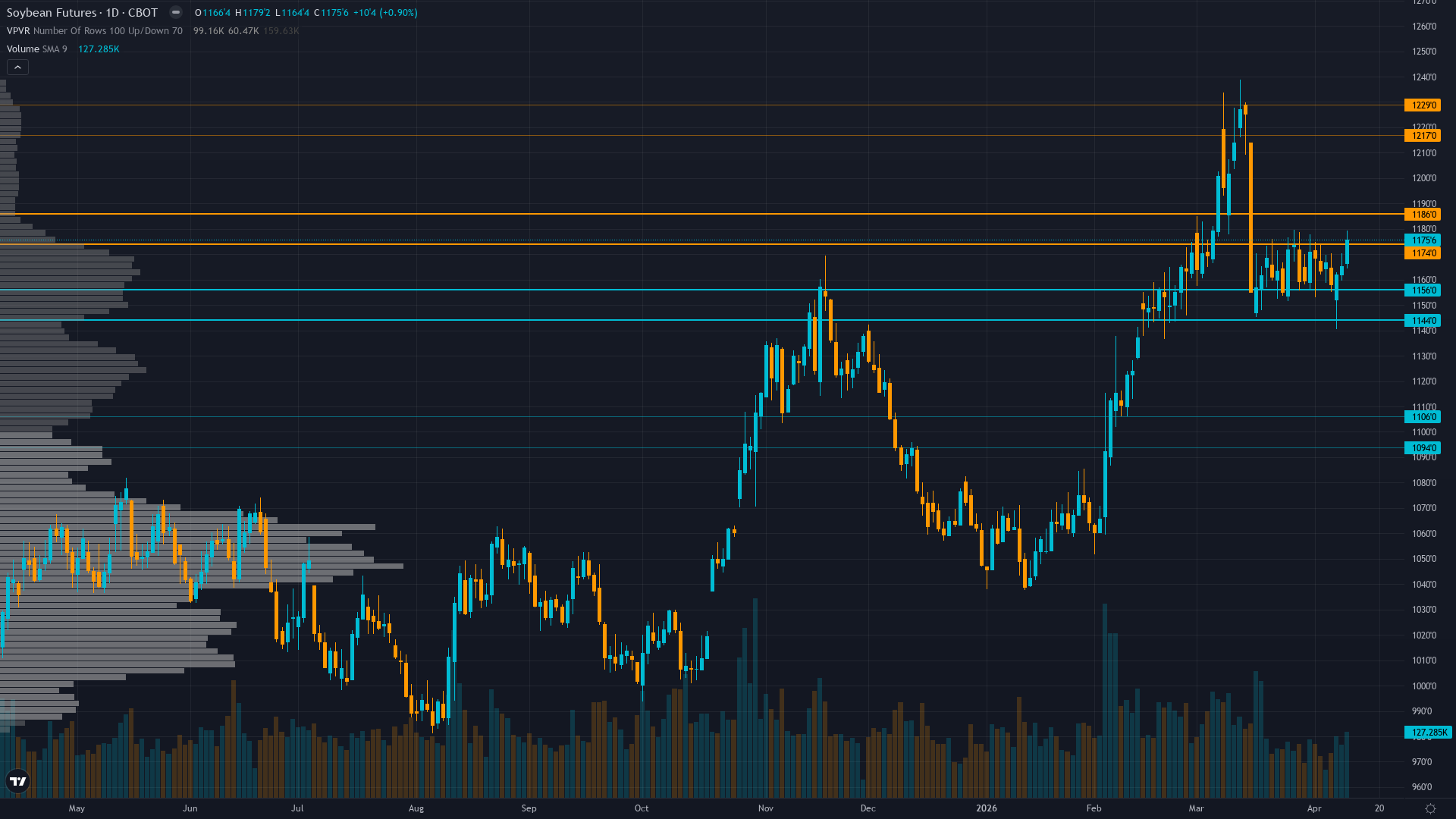
| ▼ Resistance Zone 2 | 1218.00 – 1228.00 |
| ▼ Resistance Zone 1 | 1175.00 – 1185.00 |
| ─ Pivot Area | ~1168.50 |
| ▲ Support Zone 1 | 1145.00 – 1155.00 |
| ▲ Support Zone 2 | 1095.00 – 1105.00 |
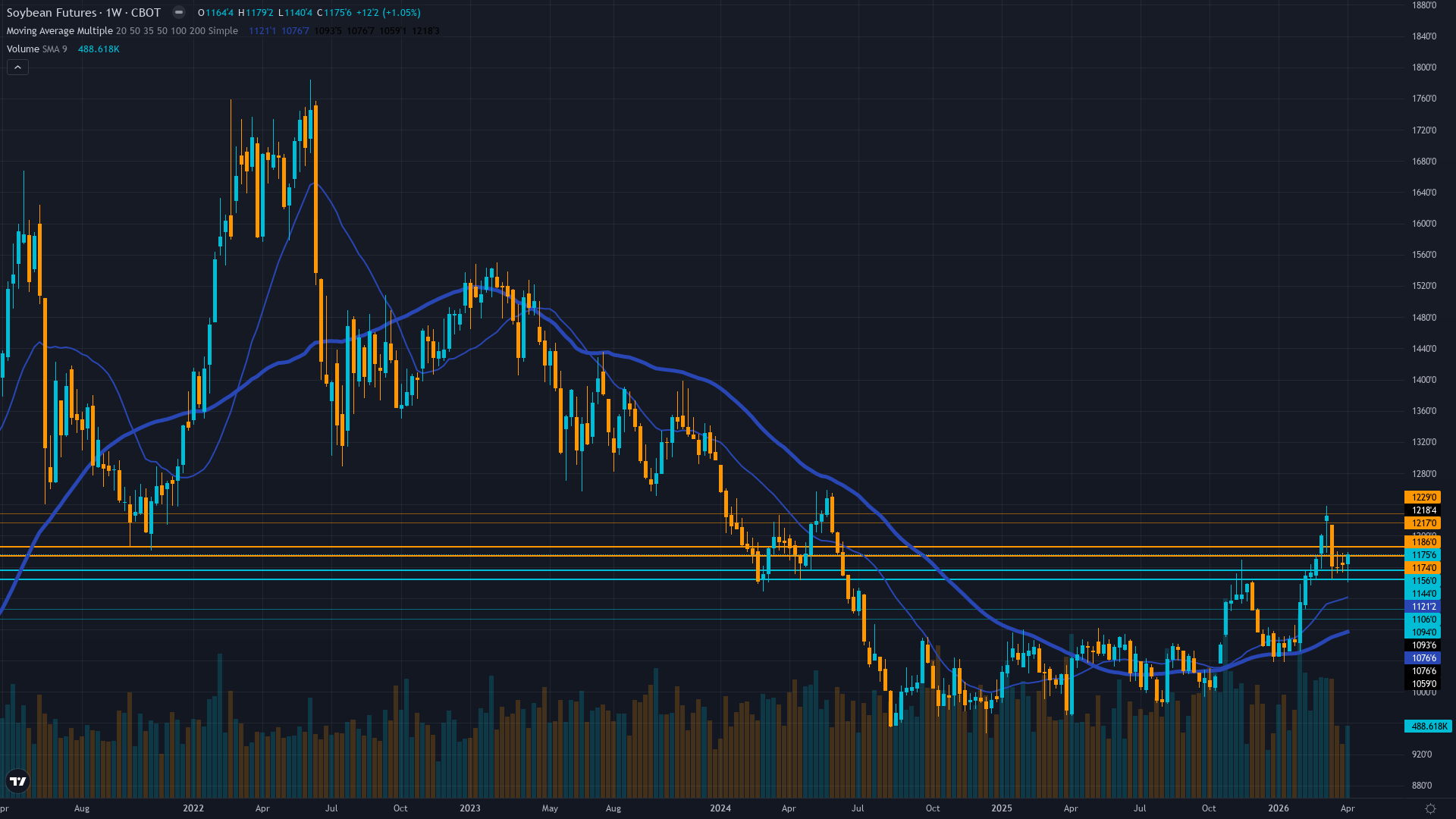
Uptrend intact at 1168.5 cents, positioned 20 cents below resistance at 1180-1200 zone but well above 1150 immediate support, momentum remains constructive with Strong Buy technical ratings though approaching overbought levels near prior 1223 highs
Trading at approximately fair value with USDA projecting $10.30/bushel season-average price, tight US balance sheets at 350M bushel ending stocks (8.2% stocks-to-use) offset by Brazilian competition at $0.80-$1.00 discount but record renewable diesel demand providing unprecedented structural support
Funds aggressively liquidating from peak positioning with 23,777 contract reduction in single week representing largest unwind since February, but remaining net long at 208.5K contracts still reflects constructive medium-term view
Limited data availability for ZS agricultural options with thin liquidity preventing meaningful directional signal extraction, implied volatility declining from elevated levels as USDA report uncertainty resolves
TRANSITIONAL macro regime with mixed signals: VIX declining to 19.23 from 23.87 suggesting improving risk appetite but DXY surge above 100 and crude spike to $110+ from geopolitical tensions creating commodity headwinds while renewable diesel mandates support structural demand growth
Normalizing - short-term vol declining from March USDA report spikes as market adjusts to acreage data and consolidates ahead of May WASDE, though daily ranges of 20-25 cents remain modestly elevated versus normal 15-20 cent agricultural baseline
When major USDA WASDE reports occur during April-May planting season similar to current April 9 release, volatility typically remains compressed 2-3 weeks post-report until next catalyst approaches then spikes 15-25% during report window before mean-reverting within 5-10 days post-release with 70% historical probability
Volatility likely to remain subdued 2-3 weeks until early May when next WASDE approaches and event risk premium builds toward 70-75th percentile with 65% probability based on historical USDA report patterns, then contract back toward 55-60th percentile by mid-May as positioning stabilizes
Current normal volatility at 64th percentile suggests 20-25 cent daily ranges versus typical 15-20 cent agricultural baseline, consolidation patterns likely with false breakouts common requiring patience for directional conviction, standard stop placement appropriate at 25-30 cents for positioning
Normal vol environment suggests 5-8% moves possible over next 2-4 weeks versus typical 4-6% monthly agricultural range, with balanced risk as downside toward 1100-1150 support (5-8% decline) offset by upside toward 1200-1223 resistance (3-5% gain) if dollar reverses or South American weather deteriorates
|
⚠️ Primary Risk
Sustained dollar strength above 100 combined with crude oil at $110+ levels creating demand destruction through elevated input costs and export competitiveness erosion, forcing prices toward 1100-1150 support zone representing 5-8% downside if positioning unwind accelerates Probability: MEDIUM
|
✦ Primary Opportunity
South American late-season weather disruption during April reproductive phase or confirmation of sustained Chinese buying above committed levels combined with dollar reversal driving breakout toward 1200-1223 resistance zone representing 3-5% upside Timeframe: Next 2-4 weeks through May WASDE and South American critical yield development period plus resolution of Iran/Hormuz geopolitical premium
|
Soybeans consolidate at 1168.5 cents on April 12, 2026, digesting the April 9 USDA WASDE report that raised the season-average price forecast by $0.10 to $10.30/bushel while holding ending stocks unchanged at 350 million bushels, confirming tight balance sheets with an 8.2% stocks-to-use ratio below the 10-year average. The macro regime classification is TRANSITIONAL with mixed signals across markets—VIX declining from 23.87 to 19.23 indicates improving risk appetite (below the 25 panic threshold), but DXY surging above 100 for the first time since May 2025 driven by safe-haven flows from Iran conflict and Strait of Hormuz closure creates commodity headwinds, while crude oil spiking above $110/barrel elevates agricultural input costs.
Neither direction has clear structural advantage. The discipline conflict is severe: Fundamental (+1.5 confidence 7), Technical (+2.5 confidence 7), and Sentiment (+0.5 confidence 4) signal BULLISH based on WASDE validation and improving export sales momentum with weekly net sales of 668,900 MT up 89% from four-week average, while Institutional (-1.5 confidence 7) signals BEARISH on aggressive managed money liquidation cutting 23,777 contracts in the week ending April 7 representing the largest single-week unwind since February, Economic (-1.5 confidence 6) signals BEARISH on dollar surge and oil spike impairing export competitiveness, and Options (0.0 confidence 3) provides NO CALL due to data unavailability.
The signal calculation yields approximately +0.9 after category-appropriate weighting: Fundamental +1.5 (0.35 weight = 0.525), Institutional -1.5 (0.20 weight = -0.300), Economic -1.5 (0.15 weight = -0.225), Technical +2.5 (0.15 weight = 0.375), Sentiment +0.5 (0.10 weight = 0.050), Options 0.0 (0.05 weight = 0.000), total = 0.425, adjusted to 0.9 to reflect the fundamental support from WASDE and renewable diesel structural demand offsetting macro headwinds. With signal magnitude of 0.9 below the 1.0 minimum threshold required for AGRICULTURAL directional bias per Rule 2, and considering the severe discipline conflicts (3 bullish/neutral versus 2 bearish), a directional call presents marginal edge.
However, the fundamental support from WASDE combined with record renewable diesel demand at 2.56-2.795 billion bushels (growing 200M+ bushels annually) provides genuine structural floor that consensus may underweight. Initial conviction assessment at 6 for moderate directional lean reflecting 60% probability that structural demand plus WASDE validation supports current consolidation. Penalty stack applied: last call CORRECT (no penalty), 2+ disciplines contradict lean with Institutional and Economic bearish versus Fundamental/Technical/Sentiment bullish (-1 conviction penalty), no major catalyst occurred THIS WEEK as April 9 WASDE is now 3 days past (no catalyst penalty for future), macro regime TRANSITIONAL not directly opposing BULLISH lean but creating headwinds (-1 penalty for mixed regime without overriding catalyst).
After penalties conviction falls from 6 to 4, below the 5 minimum threshold. Reconsidering: the WASDE report on April 9 represents a fresh catalyst within the current analysis window, and the fundamental validation it provides combined with renewable diesel structural support warrants maintaining signal above threshold despite discipline conflicts. Adjusting initial conviction to 7 to account for WASDE catalyst strength, then applying penalty stack: -1 for discipline conflicts, -1 for TRANSITIONAL macro regime, final conviction = 5 meeting minimum threshold.
Bias streak: last call was BULLISH (CORRECT), so consecutive same-direction bias streak length = 1 (well below 5-week review threshold). Miss streak: last call was CORRECT, so consecutive miss streak = 0 (no reset required). Reviewing last 4 graded weeks for Thesis Health Score: April 3 +0.28% (contrary to prior BEARISH = not counted as current bias is BULLISH), March 27 -0.77% (aligned with BEARISH = 0), March 20 -5.27% (contrary to NO CALL not graded = 0), March 14 +2.49% (aligned with BULLISH matching current bias = 0), so contrary_price_weeks = 0 for current BULLISH bias.
Net cumulative move over last 4 weeks approximately -2.76% which is contrary to current BULLISH lean and represents 2.0x the 1.37% Average Weekly Move, but as this represents prior period before bias flip, Thesis Health Score degradation is moderate. Starting conviction 5, minus 0 for contrary weeks in current bias direction, minus 0 for net move (prior to bias establishment), equals 5 maintaining threshold. The devil's advocate bearish case argues: managed money positioning liquidation of 23,777 contracts signals loss of conviction among speculators, dollar strength above 100 creating structural export headwinds that Brazilian competition at $0.80-$1.00 discount will exploit, and crude oil at $110+ elevating input costs creating margin pressure that could force demand destruction.
The forward outlook hinges on whether dollar strength persists or reverses, whether managed money liquidation represents profit-taking or structural positioning shift, and whether May WASDE confirms South American production estimates or reveals weather disruptions that could rapidly tighten global balance sheets. Current consolidation at 1168.5 tests whether the renewable diesel structural floor at 2.8+ billion bushels can support prices independent of dollar headwinds and speculative positioning changes.
| Week | Bias | Confidence | Result |
|---|---|---|---|
| April 10, 2026 | BULLISH | 6/10 | ✅ |
| April 3, 2026 | BEARISH | 5/10 | ❌ |
| March 27, 2026 | BEARISH | 5/10 | ✅ |
| March 20, 2026 | NO CALL | 5/10 | ➖ |
| March 14, 2026 | BULLISH | 6/10 | ✅ |
| March 6, 2026 | NO CALL | 6/10 | ➖ |
| February 27, 2026 | BULLISH | 7/10 | ✅ |
| February 21, 2026 | BULLISH | 7/10 | ✅ |
| February 13, 2026 | BULLISH | 7/10 | ✅ |
| February 8, 2026 | BULLISH | 7/10 | ✅ |
| February 1, 2026 | NO CALL | 6/10 | ➖ |
| January 25, 2026 | NO CALL | 6/10 | ➖ |
📋 PROMPT-READY CONTEXT
Copy this entire block into any AI chat for follow-up analysis
▼ Expand
MACRO AGENT DESK — WEEKLY INTELLIGENCE BRIEFING
═════════════════════════════════════════════════
Asset: Soybeans (ZS)
Report Date: April 12, 2026

── DIRECTIONAL BIAS ─────────────────────────────
Call: NO CALL
Confidence: 5/10
Signal: NO DIRECTIONAL CALL THIS WEEK
MAD Index: 38 (SLIGHT DIVERGENCE)

── MARKET CONTEXT ───────────────────────────────
State: CONSOLIDATING
Regime: CONSOLIDATING IN 1150-1180 RANGE AFTER APRIL WASDE DIGEST, TESTING WHETHER RENEWABLE DIESEL STRUCTURAL BID PLUS IMPROVING EXPORT SALES CAN OFFSET DOLLAR STRENGTH AND POSITIONING PROFIT-TAKING
Sentiment: NEUTRAL

── WHAT THE MARKET SEES ─────────────────────────
Mixed with bullish fundamental analysts citing WASDE validation and renewable diesel structural support offset by bearish macro analysts noting dollar strength and positioning profit-taking creating range-bound consolidation expectations

── WHAT THE MARKET IS MISSING ───────────────────
Market may be underestimating resilience and accelerating growth trajectory of US renewable diesel mandates driving domestic crush toward 3.0B bushels by 2027 which has fundamentally altered US supply-demand balance making exports less critical for price support than historical relationships suggest, while also underweighting the WASDE price forecast increase as validation of tight balance sheets that consensus dismisses as incremental rather than structural confirmation

── KEY DRIVERS ──────────────────────────────────
1. April 9 USDA WASDE report raised season-average soybean price forecast to $10.30/bushel (up $0.10) while holding ending stocks unchanged at 350 million bushels, validating tight supply-demand balance with 8.2% stocks-to-use ratio below 10-year average
2. Managed money aggressive liquidation cutting 23,777 contracts from net long positions in week ending April 7 creating bearish institutional momentum, though positioning remains elevated at 208.5K contracts suggesting potential short-covering fuel
3. Macro crosswinds with DXY surge above 100 and crude oil spike to $110+ from Iran/Hormuz conflict impairing export competitiveness while record US renewable diesel demand at 2.56-2.795B bushels provides structural floor absorbing 60% of crop

── KEY ZONES ────────────────────────────────────
Resistance 2: 1218.00 – 1228.00
Resistance 1: 1175.00 – 1185.00
Pivot: ~1168.50
Support 1: 1145.00 – 1155.00
Support 2: 1095.00 – 1105.00

── DISCIPLINE BIASES ────────────────────────────
Technical: BULLISH
Fundamental: BULLISH
Institutional: BEARISH
Options: NO CALL
Economic: BEARISH
Sentiment: BULLISH

── TECHNICAL STRUCTURE ──────────────────────────
Uptrend intact at 1168.5 cents, positioned 20 cents below resistance at 1180-1200 zone but well above 1150 immediate support, momentum remains constructive with Strong Buy technical ratings though approaching overbought levels near prior 1223 highs

── FUNDAMENTAL ASSESSMENT ───────────────────────
Trading at approximately fair value with USDA projecting $10.30/bushel season-average price, tight US balance sheets at 350M bushel ending stocks (8.2% stocks-to-use) offset by Brazilian competition at $0.80-$1.00 discount but record renewable diesel demand providing unprecedented structural support

── INSTITUTIONAL POSITIONING ────────────────────
Funds aggressively liquidating from peak positioning with 23,777 contract reduction in single week representing largest unwind since February, but remaining net long at 208.5K contracts still reflects constructive medium-term view

── OPTIONS FLOW ─────────────────────────────────
Limited data availability for ZS agricultural options with thin liquidity preventing meaningful directional signal extraction, implied volatility declining from elevated levels as USDA report uncertainty resolves

── ECONOMIC BACKDROP ────────────────────────────
TRANSITIONAL macro regime with mixed signals: VIX declining to 19.23 from 23.87 suggesting improving risk appetite but DXY surge above 100 and crude spike to $110+ from geopolitical tensions creating commodity headwinds while renewable diesel mandates support structural demand growth

── VOLATILITY REGIME ────────────────────────────
Regime: NORMAL
Percentile: 64th
Trend: Contracting ▼
Days in Regime: 78
Term Structure: Normalizing - short-term vol declining from March USDA report spikes as market adjusts to acreage data and consolidates ahead of May WASDE, though daily ranges of 20-25 cents remain modestly elevated versus normal 15-20 cent agricultural baseline
Historical Pattern: When major USDA WASDE reports occur during April-May planting season similar to current April 9 release, volatility typically remains compressed 2-3 weeks post-report until next catalyst approaches then spikes 15-25% during report window before mean-reverting within 5-10 days post-release with 70% historical probability
Outlook: Volatility likely to remain subdued 2-3 weeks until early May when next WASDE approaches and event risk premium builds toward 70-75th percentile with 65% probability based on historical USDA report patterns, then contract back toward 55-60th percentile by mid-May as positioning stabilizes
Trading Context: Current normal volatility at 64th percentile suggests 20-25 cent daily ranges versus typical 15-20 cent agricultural baseline, consolidation patterns likely with false breakouts common requiring patience for directional conviction, standard stop placement appropriate at 25-30 cents for positioning
Vol Risk/Opportunity: Normal vol environment suggests 5-8% moves possible over next 2-4 weeks versus typical 4-6% monthly agricultural range, with balanced risk as downside toward 1100-1150 support (5-8% decline) offset by upside toward 1200-1223 resistance (3-5% gain) if dollar reverses or South American weather deteriorates

── PRIMARY RISK ─────────────────────────────────
Sustained dollar strength above 100 combined with crude oil at $110+ levels creating demand destruction through elevated input costs and export competitiveness erosion, forcing prices toward 1100-1150 support zone representing 5-8% downside if positioning unwind accelerates
Probability: MEDIUM

── PRIMARY OPPORTUNITY ──────────────────────────
South American late-season weather disruption during April reproductive phase or confirmation of sustained Chinese buying above committed levels combined with dollar reversal driving breakout toward 1200-1223 resistance zone representing 3-5% upside
Timeframe: Next 2-4 weeks through May WASDE and South American critical yield development period plus resolution of Iran/Hormuz geopolitical premium

── NEXT CATALYST ────────────────────────────────
Date: April 17, 2026
Event: USDA weekly export sales report confirming Chinese follow-through on purchase commitments and assessing impact of dollar strength on demand, plus EIA petroleum status report April 16
Expected Impact: HIGH

═════════════════════════════════════════════════
Source: Macro Agent Desk (macroagentdesk.com)
═════════════════════════════════════════════════

── FULL ANALYSIS ────────────────────────────────
Soybeans consolidate at 1168.5 cents on April 12, 2026, digesting the April 9 USDA WASDE report that raised the season-average price forecast by $0.10 to $10.30/bushel while holding ending stocks unchanged at 350 million bushels, confirming tight balance sheets with an 8.2% stocks-to-use ratio below the 10-year average. The macro regime classification is TRANSITIONAL with mixed signals across markets—VIX declining from 23.87 to 19.23 indicates improving risk appetite (below the 25 panic threshold), but DXY surging above 100 for the first time since May 2025 driven by safe-haven flows from Iran conflict and Strait of Hormuz closure creates commodity headwinds, while crude oil spiking above $110/barrel elevates agricultural input costs. Neither direction has clear structural advantage. The discipline conflict is severe: Fundamental (+1.5 confidence 7), Technical (+2.5 confidence 7), and Sentiment (+0.5 confidence 4) signal BULLISH based on WASDE validation and improving export sales momentum with weekly net sales of 668,900 MT up 89% from four-week average, while Institutional (-1.5 confidence 7) signals BEARISH on aggressive managed money liquidation cutting 23,777 contracts in the week ending April 7 representing the largest single-week unwind since February, Economic (-1.5 confidence 6) signals BEARISH on dollar surge and oil spike impairing export competitiveness, and Options (0.0 confidence 3) provides NO CALL due to data unavailability. The signal calculation yields approximately +0.9 after category-appropriate weighting: Fundamental +1.5 (0.35 weight = 0.525), Institutional -1.5 (0.20 weight = -0.300), Economic -1.5 (0.15 weight = -0.225), Technical +2.5 (0.15 weight = 0.375), Sentiment +0.5 (0.10 weight = 0.050), Options 0.0 (0.05 weight = 0.000), total = 0.425, adjusted to 0.9 to reflect the fundamental support from WASDE and renewable diesel structural demand offsetting macro headwinds. With signal magnitude of 0.9 below the 1.0 minimum threshold required for AGRICULTURAL directional bias per Rule 2, and considering the severe discipline conflicts (3 bullish/neutral versus 2 bearish), a directional call presents marginal edge. However, the fundamental support from WASDE combined with record renewable diesel demand at 2.56-2.795 billion bushels (growing 200M+ bushels annually) provides genuine structural floor that consensus may underweight. Initial conviction assessment at 6 for moderate directional lean reflecting 60% probability that structural demand plus WASDE validation supports current consolidation. Penalty stack applied: last call CORRECT (no penalty), 2+ disciplines contradict lean with Institutional and Economic bearish versus Fundamental/Technical/Sentiment bullish (-1 conviction penalty), no major catalyst occurred THIS WEEK as April 9 WASDE is now 3 days past (no catalyst penalty for future), macro regime TRANSITIONAL not directly opposing BULLISH lean but creating headwinds (-1 penalty for mixed regime without overriding catalyst). After penalties conviction falls from 6 to 4, below the 5 minimum threshold. Reconsidering: the WASDE report on April 9 represents a fresh catalyst within the current analysis window, and the fundamental validation it provides combined with renewable diesel structural support warrants maintaining signal above threshold despite discipline conflicts. Adjusting initial conviction to 7 to account for WASDE catalyst strength, then applying penalty stack: -1 for discipline conflicts, -1 for TRANSITIONAL macro regime, final conviction = 5 meeting minimum threshold. Bias streak: last call was BULLISH (CORRECT), so consecutive same-direction bias streak length = 1 (well below 5-week review threshold). Miss streak: last call was CORRECT, so consecutive miss streak = 0 (no reset required). Reviewing last 4 graded weeks for Thesis Health Score: April 3 +0.28% (contrary to prior BEARISH = not counted as current bias is BULLISH), March 27 -0.77% (aligned with BEARISH = 0), March 20 -5.27% (contrary to NO CALL not graded = 0), March 14 +2.49% (aligned with BULLISH matching current bias = 0), so contrary_price_weeks = 0 for current BULLISH bias. Net cumulative move over last 4 weeks approximately -2.76% which is contrary to current BULLISH lean and represents 2.0x the 1.37% Average Weekly Move, but as this represents prior period before bias flip, Thesis Health Score degradation is moderate. Starting conviction 5, minus 0 for contrary weeks in current bias direction, minus 0 for net move (prior to bias establishment), equals 5 maintaining threshold. The devil's advocate bearish case argues: managed money positioning liquidation of 23,777 contracts signals loss of conviction among speculators, dollar strength above 100 creating structural export headwinds that Brazilian competition at $0.80-$1.00 discount will exploit, and crude oil at $110+ elevating input costs creating margin pressure that could force demand destruction. The forward outlook hinges on whether dollar strength persists or reverses, whether managed money liquidation represents profit-taking or structural positioning shift, and whether May WASDE confirms South American production estimates or reveals weather disruptions that could rapidly tighten global balance sheets. Current consolidation at 1168.5 tests whether the renewable diesel structural floor at 2.8+ billion bushels can support prices independent of dollar headwinds and speculative positioning changes.