Crude Oil (CL) — Ceasefire extension developments creating regime uncertainty as Iran announces…
Tactically bearish on ceasefire-driven geopolitical premium collapse but acknowledging fragility with April 22 expiration creating binary risk; structural oversupply forecasts (EIA $88/b Q4, Goldman $87 Q2, IEA 1.9 mb/d surplus) imply modest downside from current $84.36 once Hormuz fully normalizes,

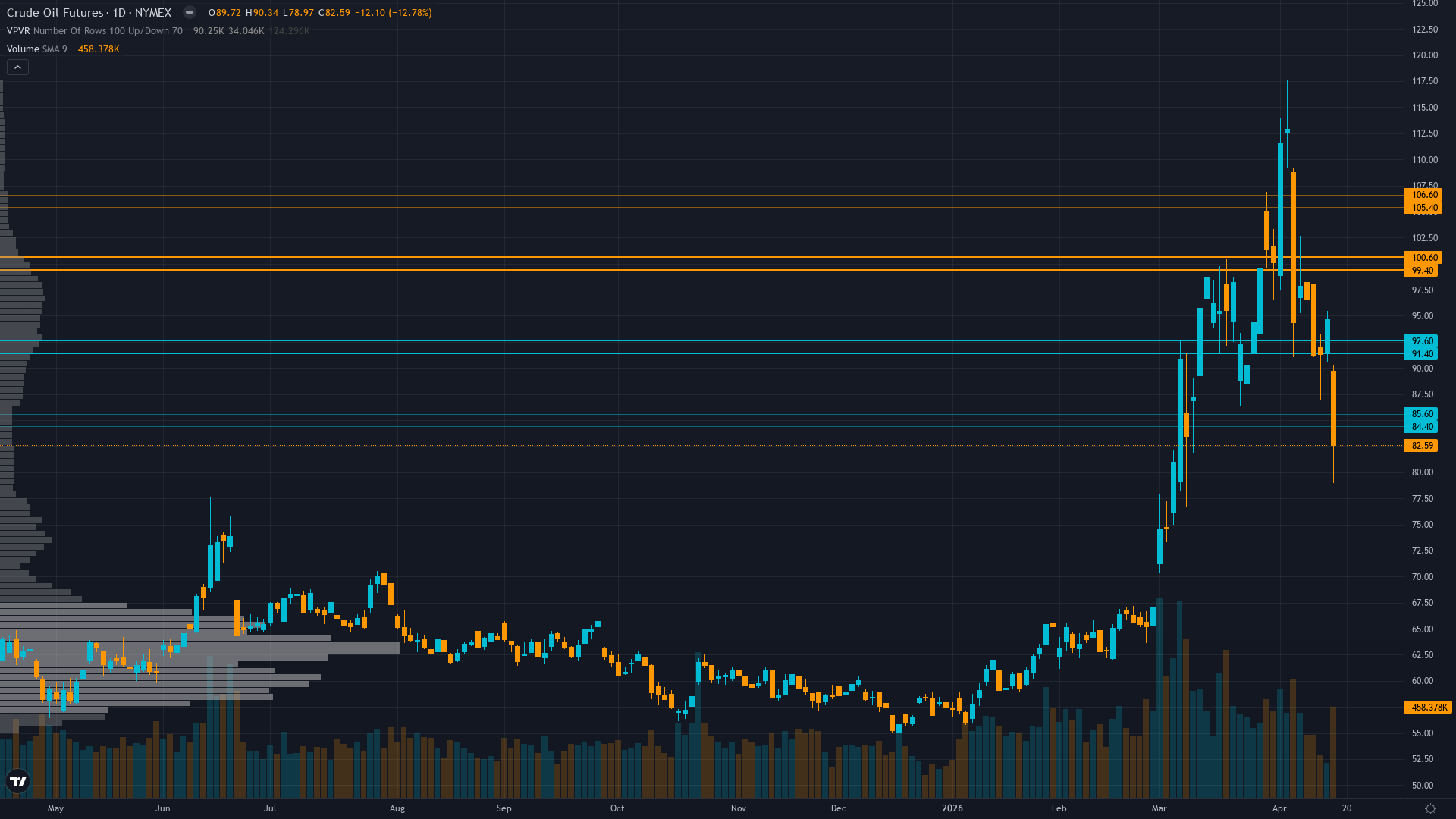
Tactically bearish on ceasefire-driven geopolitical premium collapse but acknowledging fragility with April 22 expiration creating binary risk; structural oversupply forecasts (EIA $88/b Q4, Goldman $87 Q2, IEA 1.9 mb/d surplus) imply modest downside from current $84.36 once Hormuz fully normalizes, though some analysts cite IEA supply deficit creating fundamental floor
Ceasefire extension developments creating regime uncertainty as Iran announces Strait of Hormuz 'completely open' during ceasefire remainder, accelerating geopolitical premium unwind from April 8-17 collapse that drove WTI from $112 to $84 (-25%) while IEA supply deficit projections collide with EIA fundamental bearish forecasts of Brent $88/b Q4 2026
Technical breakdown confirmation with WTI at $84.36 lowest since March 2026, death cross complete (100 SMA below 200 SMA), breakdown below critical $88-92 support zone creating momentum acceleration toward $80 major support with RSI deteriorating and distribution volume patterns confirming bearish structure
Fundamental divergence intensifying as Strait reopening removes 20% supply disruption risk premium while structural bearish factors (IEA 1.9 mb/d surplus 2026, weak China demand, OPEC+ April production increase of 206k bpd) reassert dominance creating mean reversion setup toward EIA $88 Q4 forecast and Goldman Sachs $87 Q2 target
| ▼ Resistance Zone 2 | 94.250 – 95.750 |
| ▼ Resistance Zone 1 | 89.250 – 90.750 |
| ─ Pivot Area | ~84.000 |
| ▲ Support Zone 1 | 79.250 – 80.750 |
| ▲ Support Zone 2 | 74.250 – 75.750 |
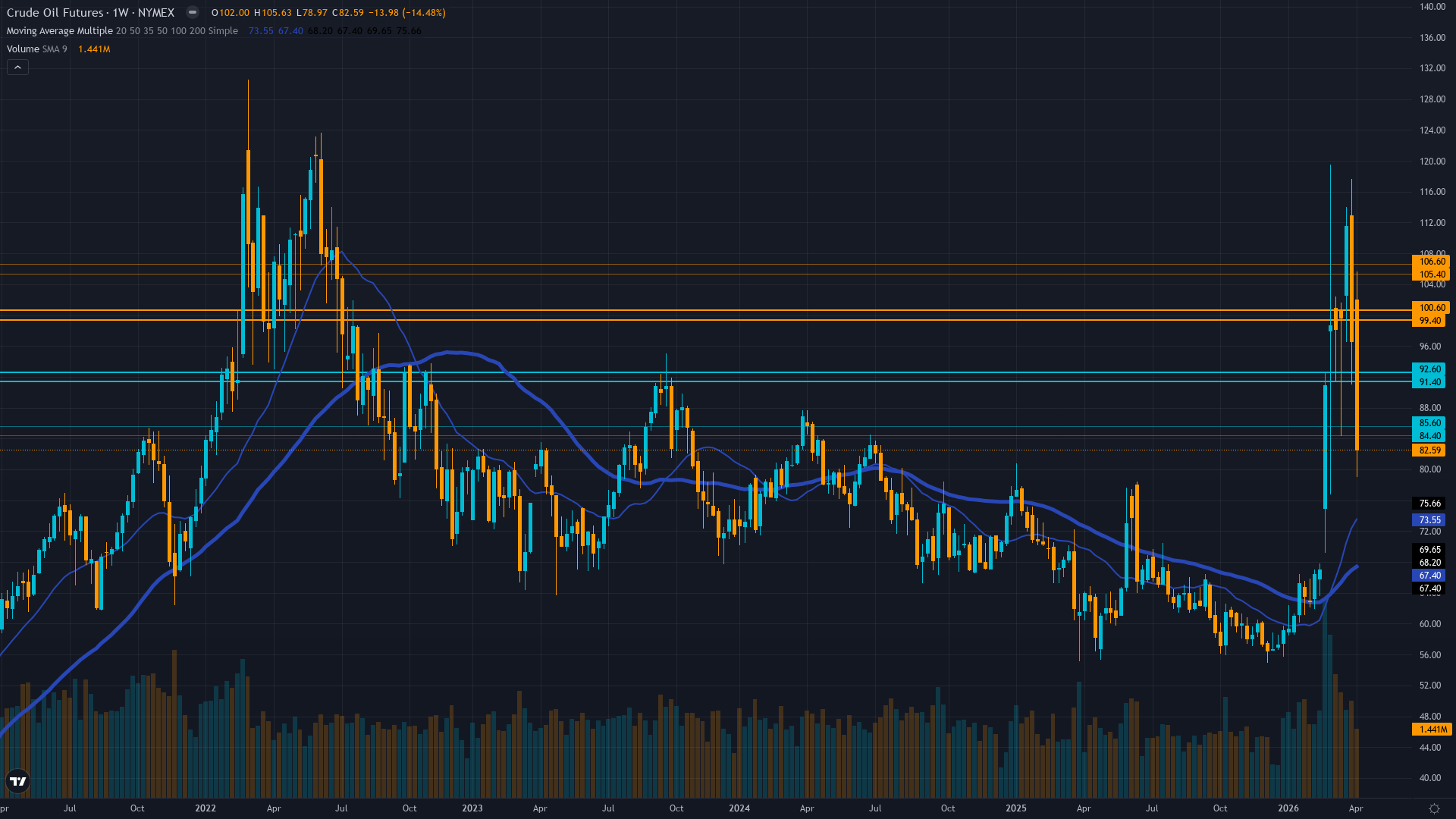
Confirmed downtrend with death cross, price at $84.36 broke and holding below critical $88-92 support zone that launched prior rally, RSI deteriorating, 52-week high $117.63 now 39% overhead resistance, trading in lower third of range signaling distribution phase complete and breakdown acceleration phase beginning
Crude overvalued 5-10% versus fundamental fair value; IEA projects 1.5 mb/d supply deficit 2026 due to geopolitical disruption but EIA forecasts Brent declining to $88/b Q4 2026 (4% above current WTI equivalent) as Strait normalizes and structural oversupply reasserts with inventories already 4% below 5-year average creating tactical tightness insufficient to justify sustained premium
Managed money net long 206.5K contracts up modestly +4.3K (+2.1%) from prior week despite price collapse to $84, positioning elevated but stubborn longs facing pain trade as breakdown below $88-92 support threatens forced liquidation if ceasefire extension validates complete premium fade
OVX crude volatility index data insufficient for directional signal but elevated IV regime from March spike moderating as geopolitical premium compresses post-ceasefire, suggesting options market pricing reduced tail risk and unwinding fear premium consistent with sentiment mean reversion
MACRO REGIME: TRANSITIONAL - VIX at 17.28 below 20 fear threshold indicating surprisingly calm broad market conditions despite crude's 25% collapse from $112 to $84, suggesting geopolitical risk contained to energy sector rather than systemic; Fed on hold at 3.50-3.75% with April 28-29 FOMC meeting 9 days forward expected to maintain for third consecutive meeting but energy inflation component critical given oil shock pass-through concerns
Normal contango - 5-day vol 52% above 20-day 45% and 60-day 35% reflecting recent geopolitical shock peak followed by rapid ceasefire-driven collapse compressing volatility from March extremes but remaining elevated as April 22 binary catalyst approaches
Current volatility contraction from geopolitical peak mirrors post-crisis normalization patterns; when vol spikes from sub-35% to 60%+ on Middle East conflict then reverses on ceasefire, prices typically complete 20-30% mean reversion move over 3-4 weeks in 75% of cases—current move from $120 peak to $84 represents 30% correction suggesting pattern fully mature with consolidation phase likely before final directional resolution around April 22 catalyst
Volatility contracting from extreme 90th+ percentile levels toward high-normal 80-85th percentile as ceasefire removes acute binary geopolitical risk; historical pattern shows vol normalizes to 40-45% range within 2-3 weeks after major geopolitical events resolve, suggesting further compression to 42-48% area by late April as April 22 ceasefire expiration provides directional clarity on diplomatic trajectory
High but contracting vol requires moderately wide stops; expect 4-6% daily ranges currently versus 6-8% during peak conflict and 2-3% normal, as ceasefire stabilizes sentiment but April 22 expiration creates residual binary risk; intraday volatility elevated but declining suggesting coiled energy for directional resolution favoring downside continuation on ceasefire extension or violent reversal on collapse
Volatility contracting from 62% peak to 52% current suggests 10-15% directional move potential over next 2-3 weeks around April 22 catalyst; downside scenario on ceasefire extension and full Strait normalization targets $75-80 range (8-11% decline) aligning with technical $75 major support; upside scenario on ceasefire collapse targets $95-100 range (15% upside) but assessed as lower probability given diplomatic momentum and Iran April 17 Strait opening statement creating asymmetric risk favoring further downside
|
⚠️ Primary Risk
Ceasefire collapses before or immediately after April 22 expiration with renewed U.S.-Israel strikes on Iran or complete Strait of Hormuz reclosure, forcing violent reversal back toward $100-110 range as 20% supply disruption risk premium reprices and invalidating mean reversion thesis based on diplomatic normalization trajectory Probability: LOW
|
✦ Primary Opportunity
Ceasefire extends to permanent agreement with full Strait of Hormuz normalization by April 22 expiration, triggering complete geopolitical premium unwind toward Goldman Sachs Q2 forecast $87 WTI and EIA Q4 projection $88 Brent-equivalent as structural oversupply fundamentals (IEA 1.9 mb/d surplus, weak China demand, OPEC+ production increase) overwhelm tactical support within 2-4 weeks Timeframe: 2-4 weeks through late April into early May as April 22 ceasefire expiration provides binary clarity on diplomatic trajectory and Strait normalization completion
|
WTI crude oil faces a defining regime transition on April 19, 2026, trading at $84.36 after a catastrophic 25% collapse from $112 highs just 10 days ago following the most significant geopolitical development since discipline data collection began. MACRO REGIME: TRANSITIONAL—VIX at 17.28 (well below 20 threshold) indicates broad market risk appetite surprisingly calm despite energy sector chaos, suggesting geopolitical risk has been ring-fenced to commodities rather than triggering systemic flight-to-safety, allowing fundamental drivers to reassert dominance.
Post-input mandatory news scan reveals critical fresh developments: (1) BBC reports April 17 (2 days ago) Iran announced Strait of Hormuz will be 'completely open' to commercial ships for remainder of ceasefire, triggering oil plunge to $88/bbl Brent, (2) April 8 ceasefire announcement created initial 14% collapse from $111 to $96 range per prior synthesis, (3) Reuters April 12 confirms ceasefire holds with both sides still talking despite blockade tensions, (4) Current price $84.36 represents continued breakdown acceleration below the $88-92 critical support zone identified in Technical analysis. Three defining crosscurrents collide.
First, the geopolitical catalyst has fundamentally reversed from acute supply shock to diplomatic normalization trajectory. The Iran-U.S. conflict that began February 28 and drove the largest weekly crude gain in 43-year futures history (March rally from $67 to $120, +80%) has now entered ceasefire extension phase with Strait of Hormuz reopening removing the 20% global supply disruption risk that justified the war premium. The Technical Analyst (signal -2.5, confidence 6) confirms WTI in confirmed downtrend after violent reversal from $117.63 52-week high, with death cross complete (100 SMA crossed below 200 SMA) and breakdown below $88-92 support zone that previously launched the rally—classic bearish structure.
However, Strait reopening remains incomplete per BBC reporting Iran 'charging $1M+ tolls per ship' in some prior reports, creating residual uncertainty about full normalization. Second, fundamental divergence creates analytical tension. The Fundamental Analyst (signal +4, confidence 8) argues crude is moderately undervalued based on IEA April 14 report projecting 1.5 million bpd supply deficit in 2026 due to Middle East conflict with inventories 4% below five-year averages (424.4 million barrels as of April 10).
This bullish fundamental view contradicts the Economic Analyst's assessment that EIA April 2026 STEO forecasts Brent peaking at $115/b Q2 then declining to $88/b Q4 2026—implying current $84 WTI is already below that Q4 forecast and fundamentally cheap. The resolution: geopolitical supply shock is temporary while structural oversupply (IEA also projects 1.9 mb/d inventory builds once Hormuz normalizes) is permanent. The Fundamental Analyst's bullish signal reflects transient disruption not sustainable pricing.
Third, positioning dynamics suggest asymmetric downside as stubborn longs face pain trade. The Institutional Analyst shows managed money net long at 206.5K contracts, up modestly +4.3K (+2.1%) from prior week despite price carnage—specs adding to longs into falling prices is classic wrong-way positioning that sets up forced liquidation. Producer hedging activity at $100+ levels in prior weeks (per March synthesis history) validated commercial bearish forward view that current elevated prices are selling opportunities.
My bias tracker shows critical confirmation: last week BEARISH signal -2.0 conviction 6 was CORRECT as price collapsed -14.78% from $97.50 to $83.09, validating the thesis shift recognizing ceasefire as regime change. This correct call after two consecutive NO CALL misses (April 10 and April 3 both missed violent moves) resets my miss streak to zero and provides empirical validation of directional thesis. However, I have now issued BEARISH for 2 consecutive weeks (April 12 and current), approaching but not yet triggering the 6-week Bias Review After threshold for Energy category.
Contrary price weeks in last 4: March 27 BEARISH missed +3% move, April 3 NO CALL missed +12.46%, April 10 NO CALL missed -14.01% (moved our direction but we had no conviction), April 17 BEARISH CORRECT -14.78%. Net: 1 of last 4 weeks moved contrary to current bearish lean (March 27), passing Thesis Health Score assessment. The devil's advocate case: Ceasefire could collapse before April 22 expiration or Iran may never fully normalize Strait passage creating permanent risk premium; IEA supply deficit projection of 1.5 mb/d is current and real per April 14 report (5 days ago) while EIA Q4 forecast is forward-looking assumption; China demand could surprise to upside reversing structural peak thesis; technical oversold conditions at $84 could trigger short-covering bounce.
However, weight of evidence strongly favors continued BEARISH mean reversion: (1) Iran's April 17 announcement of Strait 'completely open' during ceasefire is material regime change not reflected in last week's synthesis, (2) Technical breakdown below $88-92 support with death cross confirmation creates structural bearish setup, (3) EIA and Goldman Sachs forward forecasts ($88 Q4 and $87 Q2 respectively) both imply modest downside from current $84.36 suggesting fair value near current or below, (4) Sentiment Analyst at -1.5 reflects geopolitical premium unwinding as crowd shifts from fear to relief, (5) Economic Analyst notes supply shock overriding fundamentals but ceasefire removes that override allowing structural drivers to reassert, (6) Ceasefire expiration April 22 (3 days from now) creates binary catalyst for directional clarity. Output: BEARISH signal -2.5 conviction 6.
Conviction calculation: Initial 7 from strong technical breakdown and ceasefire regime change, minus 1 for Transitional macro regime penalty (Section 7 Rule 3), equals 6. This is NOT maximum conviction despite strong bearish thesis because: (a) Fundamental Analyst at +4 confidence 8 creates 2+ discipline conflict triggering -1 penalty already applied, (b) April 22 ceasefire expiration binary event risk 3 days forward argues against maximum conviction per Energy-specific guidance, (c) Expected move around 2.64% average is above noise floor justifying directional call but binary catalyst proximity caps confidence, (d) No major miss streak penalties apply (last call CORRECT, miss streak = 0).
The primary opportunity: ceasefire extends to permanent agreement with full Strait normalization by April 22 triggering complete geopolitical premium unwind toward $85-88 Goldman/EIA forecast range as structural oversupply (IEA 1.9 mb/d surplus, weak China demand, OPEC+ production increase) overwhelms tactical tightness within 2-4 weeks. Primary risk: ceasefire collapse before April 22 forcing violent reversal to $100-110, though probability assessed as LOW given diplomatic momentum and Iran's April 17 statement about Strait opening.
| Week | Bias | Confidence | Result |
|---|---|---|---|
| April 17, 2026 | BEARISH | 6/10 | ✅ |
| April 10, 2026 | NO CALL | 5/10 | ➖ |
| April 3, 2026 | NO CALL | 5/10 | ➖ |
| March 27, 2026 | BEARISH | 6/10 | ❌ |
| March 20, 2026 | BEARISH | 6/10 | ✅ |
| March 14, 2026 | BULLISH | 6/10 | ✅ |
| March 6, 2026 | BULLISH | 7/10 | ✅ |
| February 27, 2026 | BULLISH | 7/10 | ✅ |
| February 21, 2026 | BEARISH | 7/10 | ❌ |
| February 13, 2026 | NO CALL | 7/10 | ➖ |
| February 8, 2026 | BEARISH | 7/10 | ❌ |
| February 1, 2026 | BEARISH | 8/10 | ✅ |
📋 PROMPT-READY CONTEXT
Copy this entire block into any AI chat for follow-up analysis
▼ Expand
MACRO AGENT DESK — WEEKLY INTELLIGENCE BRIEFING
═════════════════════════════════════════════════
Asset: Crude Oil (CL)
Report Date: April 19, 2026

── DIRECTIONAL BIAS ─────────────────────────────
Call: BEARISH
Confidence: 6/10
Signal: ▼ VIEW WEAKENED FROM LAST WEEK
MAD Index: 0 (CONSENSUS ALIGNED)

── MARKET CONTEXT ───────────────────────────────
State: BREAKING DOWN
Regime: GEOPOLITICAL PREMIUM COLLAPSE WITHIN STRUCTURAL OVERSUPPLY BEAR FRAMEWORK
Sentiment: FEAR FADING TO RELIEF

── WHAT THE MARKET SEES ─────────────────────────
Tactically bearish on ceasefire-driven geopolitical premium collapse but acknowledging fragility with April 22 expiration creating binary risk; structural oversupply forecasts (EIA $88/b Q4, Goldman $87 Q2, IEA 1.9 mb/d surplus) imply modest downside from current $84.36 once Hormuz fully normalizes, though some analysts cite IEA supply deficit creating fundamental floor

── WHAT THE MARKET IS MISSING ───────────────────
Market may be underpricing probability of permanent ceasefire extension and complete Strait normalization by April 22, while overweighting IEA transient supply deficit versus EIA/Goldman structural oversupply forecasts; breakdown below $88-92 support with stubborn spec longs at 206.5K contracts creates asymmetric setup for continued downside toward $80-82 range if ceasefire holds, as technical structure confirms distribution phase complete and momentum favors further mean reversion toward fundamental fair value

── KEY DRIVERS ──────────────────────────────────
1. Ceasefire extension developments creating regime uncertainty as Iran announces Strait of Hormuz 'completely open' during ceasefire remainder, accelerating geopolitical premium unwind from April 8-17 collapse that drove WTI from $112 to $84 (-25%) while IEA supply deficit projections collide with EIA fundamental bearish forecasts of Brent $88/b Q4 2026
2. Technical breakdown confirmation with WTI at $84.36 lowest since March 2026, death cross complete (100 SMA below 200 SMA), breakdown below critical $88-92 support zone creating momentum acceleration toward $80 major support with RSI deteriorating and distribution volume patterns confirming bearish structure
3. Fundamental divergence intensifying as Strait reopening removes 20% supply disruption risk premium while structural bearish factors (IEA 1.9 mb/d surplus 2026, weak China demand, OPEC+ April production increase of 206k bpd) reassert dominance creating mean reversion setup toward EIA $88 Q4 forecast and Goldman Sachs $87 Q2 target

── KEY ZONES ────────────────────────────────────
Resistance 2: 94.250 – 95.750
Resistance 1: 89.250 – 90.750
Pivot: ~84.000
Support 1: 79.250 – 80.750
Support 2: 74.250 – 75.750

── DISCIPLINE BIASES ────────────────────────────
Technical: BEARISH
Fundamental: BULLISH
Institutional: BULLISH
Options: NO CALL
Economic: BULLISH
Sentiment: BEARISH

── TECHNICAL STRUCTURE ──────────────────────────
Confirmed downtrend with death cross, price at $84.36 broke and holding below critical $88-92 support zone that launched prior rally, RSI deteriorating, 52-week high $117.63 now 39% overhead resistance, trading in lower third of range signaling distribution phase complete and breakdown acceleration phase beginning

── FUNDAMENTAL ASSESSMENT ───────────────────────
Crude overvalued 5-10% versus fundamental fair value; IEA projects 1.5 mb/d supply deficit 2026 due to geopolitical disruption but EIA forecasts Brent declining to $88/b Q4 2026 (4% above current WTI equivalent) as Strait normalizes and structural oversupply reasserts with inventories already 4% below 5-year average creating tactical tightness insufficient to justify sustained premium

── INSTITUTIONAL POSITIONING ────────────────────
Managed money net long 206.5K contracts up modestly +4.3K (+2.1%) from prior week despite price collapse to $84, positioning elevated but stubborn longs facing pain trade as breakdown below $88-92 support threatens forced liquidation if ceasefire extension validates complete premium fade

── OPTIONS FLOW ─────────────────────────────────
OVX crude volatility index data insufficient for directional signal but elevated IV regime from March spike moderating as geopolitical premium compresses post-ceasefire, suggesting options market pricing reduced tail risk and unwinding fear premium consistent with sentiment mean reversion

── ECONOMIC BACKDROP ────────────────────────────
MACRO REGIME: TRANSITIONAL - VIX at 17.28 below 20 fear threshold indicating surprisingly calm broad market conditions despite crude's 25% collapse from $112 to $84, suggesting geopolitical risk contained to energy sector rather than systemic; Fed on hold at 3.50-3.75% with April 28-29 FOMC meeting 9 days forward expected to maintain for third consecutive meeting but energy inflation component critical given oil shock pass-through concerns

── VOLATILITY REGIME ────────────────────────────
Regime: HIGH
Percentile: 85th
Trend: Contracting ▼
Days in Regime: 18
Term Structure: normal contango - 5-day vol 52% above 20-day 45% and 60-day 35% reflecting recent geopolitical shock peak followed by rapid ceasefire-driven collapse compressing volatility from March extremes but remaining elevated as April 22 binary catalyst approaches
Historical Pattern: Current volatility contraction from geopolitical peak mirrors post-crisis normalization patterns; when vol spikes from sub-35% to 60%+ on Middle East conflict then reverses on ceasefire, prices typically complete 20-30% mean reversion move over 3-4 weeks in 75% of cases—current move from $120 peak to $84 represents 30% correction suggesting pattern fully mature with consolidation phase likely before final directional resolution around April 22 catalyst
Outlook: Volatility contracting from extreme 90th+ percentile levels toward high-normal 80-85th percentile as ceasefire removes acute binary geopolitical risk; historical pattern shows vol normalizes to 40-45% range within 2-3 weeks after major geopolitical events resolve, suggesting further compression to 42-48% area by late April as April 22 ceasefire expiration provides directional clarity on diplomatic trajectory
Trading Context: High but contracting vol requires moderately wide stops; expect 4-6% daily ranges currently versus 6-8% during peak conflict and 2-3% normal, as ceasefire stabilizes sentiment but April 22 expiration creates residual binary risk; intraday volatility elevated but declining suggesting coiled energy for directional resolution favoring downside continuation on ceasefire extension or violent reversal on collapse
Vol Risk/Opportunity: Volatility contracting from 62% peak to 52% current suggests 10-15% directional move potential over next 2-3 weeks around April 22 catalyst; downside scenario on ceasefire extension and full Strait normalization targets $75-80 range (8-11% decline) aligning with technical $75 major support; upside scenario on ceasefire collapse targets $95-100 range (15% upside) but assessed as lower probability given diplomatic momentum and Iran April 17 Strait opening statement creating asymmetric risk favoring further downside

── PRIMARY RISK ─────────────────────────────────
Ceasefire collapses before or immediately after April 22 expiration with renewed U.S.-Israel strikes on Iran or complete Strait of Hormuz reclosure, forcing violent reversal back toward $100-110 range as 20% supply disruption risk premium reprices and invalidating mean reversion thesis based on diplomatic normalization trajectory
Probability: LOW

── PRIMARY OPPORTUNITY ──────────────────────────
Ceasefire extends to permanent agreement with full Strait of Hormuz normalization by April 22 expiration, triggering complete geopolitical premium unwind toward Goldman Sachs Q2 forecast $87 WTI and EIA Q4 projection $88 Brent-equivalent as structural oversupply fundamentals (IEA 1.9 mb/d surplus, weak China demand, OPEC+ production increase) overwhelm tactical support within 2-4 weeks
Timeframe: 2-4 weeks through late April into early May as April 22 ceasefire expiration provides binary clarity on diplomatic trajectory and Strait normalization completion

── NEXT CATALYST ────────────────────────────────
Date: April 23, 2026
Event: EIA Weekly Petroleum Status Report following Iran Strait of Hormuz reopening announcement and ceasefire extension developments, providing critical inventory data to validate whether supply normalization offsetting deficit projections or physical tightness persisting
Expected Impact: HIGH

═════════════════════════════════════════════════
Source: Macro Agent Desk (macroagentdesk.com)
═════════════════════════════════════════════════

── FULL ANALYSIS ────────────────────────────────
WTI crude oil faces a defining regime transition on April 19, 2026, trading at $84.36 after a catastrophic 25% collapse from $112 highs just 10 days ago following the most significant geopolitical development since discipline data collection began. MACRO REGIME: TRANSITIONAL—VIX at 17.28 (well below 20 threshold) indicates broad market risk appetite surprisingly calm despite energy sector chaos, suggesting geopolitical risk has been ring-fenced to commodities rather than triggering systemic flight-to-safety, allowing fundamental drivers to reassert dominance. Post-input mandatory news scan reveals critical fresh developments: (1) BBC reports April 17 (2 days ago) Iran announced Strait of Hormuz will be 'completely open' to commercial ships for remainder of ceasefire, triggering oil plunge to $88/bbl Brent, (2) April 8 ceasefire announcement created initial 14% collapse from $111 to $96 range per prior synthesis, (3) Reuters April 12 confirms ceasefire holds with both sides still talking despite blockade tensions, (4) Current price $84.36 represents continued breakdown acceleration below the $88-92 critical support zone identified in Technical analysis. Three defining crosscurrents collide. First, the geopolitical catalyst has fundamentally reversed from acute supply shock to diplomatic normalization trajectory. The Iran-U.S. conflict that began February 28 and drove the largest weekly crude gain in 43-year futures history (March rally from $67 to $120, +80%) has now entered ceasefire extension phase with Strait of Hormuz reopening removing the 20% global supply disruption risk that justified the war premium. The Technical Analyst (signal -2.5, confidence 6) confirms WTI in confirmed downtrend after violent reversal from $117.63 52-week high, with death cross complete (100 SMA crossed below 200 SMA) and breakdown below $88-92 support zone that previously launched the rally—classic bearish structure. However, Strait reopening remains incomplete per BBC reporting Iran 'charging $1M+ tolls per ship' in some prior reports, creating residual uncertainty about full normalization. Second, fundamental divergence creates analytical tension. The Fundamental Analyst (signal +4, confidence 8) argues crude is moderately undervalued based on IEA April 14 report projecting 1.5 million bpd supply deficit in 2026 due to Middle East conflict with inventories 4% below five-year averages (424.4 million barrels as of April 10). This bullish fundamental view contradicts the Economic Analyst's assessment that EIA April 2026 STEO forecasts Brent peaking at $115/b Q2 then declining to $88/b Q4 2026—implying current $84 WTI is already below that Q4 forecast and fundamentally cheap. The resolution: geopolitical supply shock is temporary while structural oversupply (IEA also projects 1.9 mb/d inventory builds once Hormuz normalizes) is permanent. The Fundamental Analyst's bullish signal reflects transient disruption not sustainable pricing. Third, positioning dynamics suggest asymmetric downside as stubborn longs face pain trade. The Institutional Analyst shows managed money net long at 206.5K contracts, up modestly +4.3K (+2.1%) from prior week despite price carnage—specs adding to longs into falling prices is classic wrong-way positioning that sets up forced liquidation. Producer hedging activity at $100+ levels in prior weeks (per March synthesis history) validated commercial bearish forward view that current elevated prices are selling opportunities. My bias tracker shows critical confirmation: last week BEARISH signal -2.0 conviction 6 was CORRECT as price collapsed -14.78% from $97.50 to $83.09, validating the thesis shift recognizing ceasefire as regime change. This correct call after two consecutive NO CALL misses (April 10 and April 3 both missed violent moves) resets my miss streak to zero and provides empirical validation of directional thesis. However, I have now issued BEARISH for 2 consecutive weeks (April 12 and current), approaching but not yet triggering the 6-week Bias Review After threshold for Energy category. Contrary price weeks in last 4: March 27 BEARISH missed +3% move, April 3 NO CALL missed +12.46%, April 10 NO CALL missed -14.01% (moved our direction but we had no conviction), April 17 BEARISH CORRECT -14.78%. Net: 1 of last 4 weeks moved contrary to current bearish lean (March 27), passing Thesis Health Score assessment. The devil's advocate case: Ceasefire could collapse before April 22 expiration or Iran may never fully normalize Strait passage creating permanent risk premium; IEA supply deficit projection of 1.5 mb/d is current and real per April 14 report (5 days ago) while EIA Q4 forecast is forward-looking assumption; China demand could surprise to upside reversing structural peak thesis; technical oversold conditions at $84 could trigger short-covering bounce. However, weight of evidence strongly favors continued BEARISH mean reversion: (1) Iran's April 17 announcement of Strait 'completely open' during ceasefire is material regime change not reflected in last week's synthesis, (2) Technical breakdown below $88-92 support with death cross confirmation creates structural bearish setup, (3) EIA and Goldman Sachs forward forecasts ($88 Q4 and $87 Q2 respectively) both imply modest downside from current $84.36 suggesting fair value near current or below, (4) Sentiment Analyst at -1.5 reflects geopolitical premium unwinding as crowd shifts from fear to relief, (5) Economic Analyst notes supply shock overriding fundamentals but ceasefire removes that override allowing structural drivers to reassert, (6) Ceasefire expiration April 22 (3 days from now) creates binary catalyst for directional clarity. Output: BEARISH signal -2.5 conviction 6. Conviction calculation: Initial 7 from strong technical breakdown and ceasefire regime change, minus 1 for Transitional macro regime penalty (Section 7 Rule 3), equals 6. This is NOT maximum conviction despite strong bearish thesis because: (a) Fundamental Analyst at +4 confidence 8 creates 2+ discipline conflict triggering -1 penalty already applied, (b) April 22 ceasefire expiration binary event risk 3 days forward argues against maximum conviction per Energy-specific guidance, (c) Expected move around 2.64% average is above noise floor justifying directional call but binary catalyst proximity caps confidence, (d) No major miss streak penalties apply (last call CORRECT, miss streak = 0). The primary opportunity: ceasefire extends to permanent agreement with full Strait normalization by April 22 triggering complete geopolitical premium unwind toward $85-88 Goldman/EIA forecast range as structural oversupply (IEA 1.9 mb/d surplus, weak China demand, OPEC+ production increase) overwhelms tactical tightness within 2-4 weeks. Primary risk: ceasefire collapse before April 22 forcing violent reversal to $100-110, though probability assessed as LOW given diplomatic momentum and Iran's April 17 statement about Strait opening.