USD/JPY (6J) — No directional edge identified—all discipline inputs except May 29 Finance…
Market expects USD/JPY consolidation 157-160 range with mild bearish JPY bias on persistent rate differentials; May 29 Finance Minister warning acknowledged but not priced as imminent intervention trigger with market having demonstrated skepticism by retracing 50% of early May intervention gains, ne

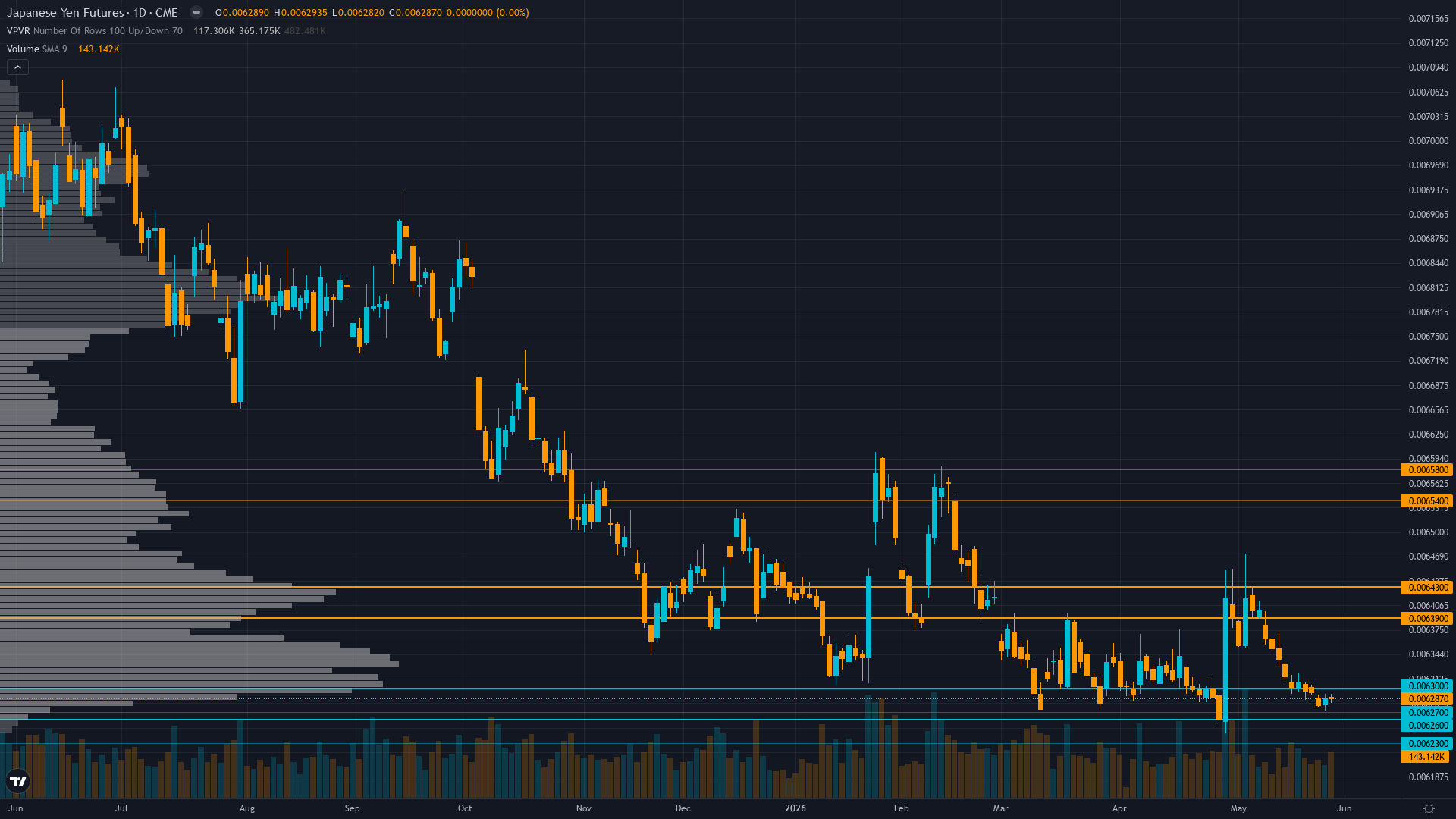
Market expects USD/JPY consolidation 157-160 range with mild bearish JPY bias on persistent rate differentials; May 29 Finance Minister warning acknowledged but not priced as imminent intervention trigger with market having demonstrated skepticism by retracing 50% of early May intervention gains, next catalyst June 15-16 BoJ meeting seen as potential inflection point
Policy paralysis 15 days before June 15-16 BoJ meeting with market in wait-and-see mode at USD/JPY 159.27 near intervention threshold where Finance Minister Katayama warned May 29 of readiness to act, but early May $67B interventions already 50% retraced demonstrating limited sustained impact
Speculative positioning reduced to -19.1K net short JPY from -102.1K extreme post-intervention but remains moderately bearish without extreme contrarian squeeze fuel, while institutional behavior shows market testing authorities' resolve by giving back half of intervention gains within three weeks
Structural 275-300bp Fed-BoJ rate differential unchanged with Fed holding 3.50-3.75% versus BoJ 0.75%, maintaining USD carry appeal despite BoJ Governor Himino May 26 reiteration that rates remain extremely low and BoJ will continue raising but providing no timing guidance
| ▼ Resistance Zone 2 | 0.0046 – 0.0086 |
| ▼ Resistance Zone 1 | 0.0044 – 0.0084 |
| ─ Pivot Area | ~0.0063 |
| ▲ Support Zone 1 | 0.0043 – 0.0083 |
| ▲ Support Zone 2 | 0.0042 – 0.0082 |
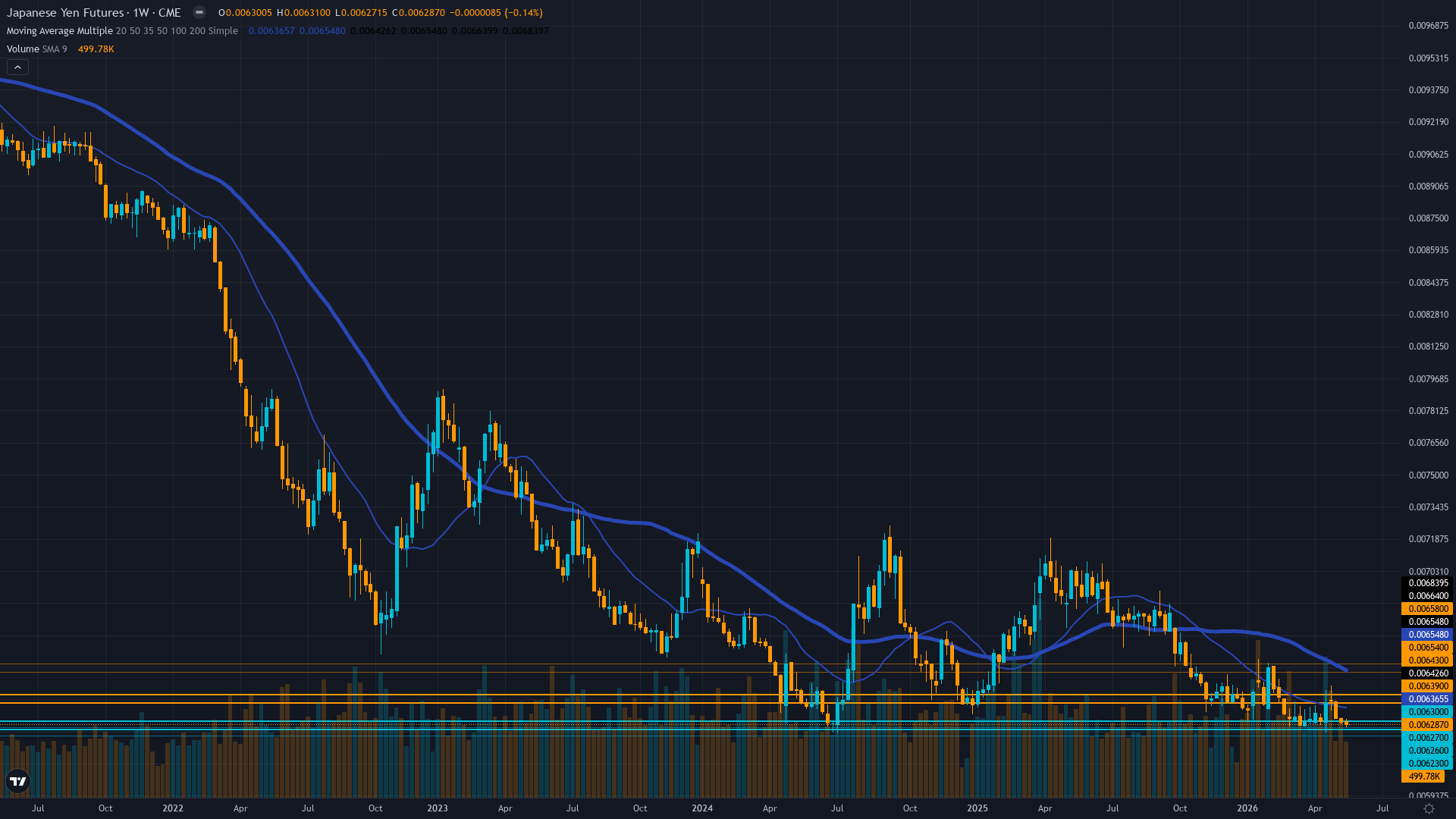
Range-bound consolidation 0.00628-0.00641 (156.6-159.3 USD/JPY) with price below 50-day and 200-day MAs, RSI neutral at 42, declining open interest 369.95K suggests waning conviction in current downtrend structure
JPY severely undervalued 40-50% on PPP basis (fair value 94-95 versus current 159 spot) with record current account surplus ¥4.7T, but 275-300bp rate differential and persistent carry trade dynamics dominate near-term price action overriding valuation support
Net short JPY at -19.1K contracts per May 19 COT, moderately bearish but reduced from -102.1K extreme following early May interventions, creating residual two-way squeeze risk but far from levels that would force violent unwinds
Implied volatility compressed at 11.1% (26th percentile) in lower third of 1-year range reflecting low hedging demand and market complacency despite proximity to 160 intervention threshold and approaching June 15-16 BoJ meeting 15 days forward
TRANSITIONAL macro regime with VIX 17.44 below 20 threshold signaling NEUTRAL risk appetite; no fresh catalyst this week with BoJ hold April 28 and Fed hold April 29 fully priced, May 26 Himino speech reiterating normalization commitment but avoiding timing guidance citing Middle East geopolitical risks
Normal - short-term 10.5% below medium 11.0% reflecting post-early May intervention compression with residual two-way risk from demonstrated official willingness to act maintaining elevated baseline above 60-day 9.8%
Similar post-intervention periods show volatility remaining elevated 15-25% above baseline for 3-4 weeks as market tests authorities' resolve; current 65th percentile consistent with 21-day post-intervention state suggesting room for 20-30% contraction toward median if no further action or expansion if 160+ triggers response or June BoJ surprises
Volatility likely to remain elevated 60-70th percentile range through next 14 days given persistent intervention threat if USD/JPY re-tests 160 following May 29 Finance Minister warning and approaching June 15-16 BoJ meeting; could spike to 80th+ percentile if further official action occurs or compress toward 50th percentile if 157-159 range holds without catalyst
High volatility regime suggests 80-100 pip daily ranges (0.00050-0.00065 in 6J terms) versus normal 50-60 pips; intervention risk creates potential 150-250 pip intraday swings similar to May 1-6 events; breakouts from 157-159 consolidation unreliable without catalyst confirmation given demonstrated two-way official action risk and June 15-16 binary event 15 days forward
Elevated 65th percentile volatility indicates 1.2-1.5% daily move potential versus normal 0.6-0.8%; intervention risk creates binary event premium with potential 200-300 pip move (2+ standard deviations) if authorities act again at 160 threshold but unpredictable timing within 5-day grading window limits directional utility absent specific trigger; June 15-16 BoJ meeting represents asymmetric reward opportunity but falls outside current assessment window
|
⚠️ Primary Risk
Further Japanese MoF/BoJ intervention if USD/JPY re-tests 160+ zone after Finance Minister Katayama May 29 warning of readiness to act again, triggering violent short squeeze on -19.1K speculative positioning compounded by carry trade unwind similar to early May events, though market has demonstrated skepticism by retracing 50% of intervention gains suggesting higher threshold required Probability: MEDIUM
|
✦ Primary Opportunity
Mean reversion rally toward 0.0065-0.0068 range (150-154 USD/JPY) if June 15-16 BoJ delivers hawkish surprise accelerating normalization timeline or if intervention rhetoric escalates into coordinated action that breaks market's complacent positioning, though timing remains uncertain within 5-day grading window Timeframe: 2-3 weeks through June 15-16 BoJ meeting and immediate aftermath
|
The Japanese Yen futures sit in analytical paralysis on May 31, 2026, trading at 0.006312 (USD/JPY 159.27 per latest search data) as this desk confronts the THIRTEENTH consecutive NO CALL in a textbook low-information-edge environment where all thesis elements are fully priced and no fresh catalyst has emerged THIS WEEK. Post-input development identified: Finance Minister Katayama issued intervention warning on May 29 (two days ago) as USD/JPY approaches the critical 160 level, stating authorities remain ready to act against excessive volatility, but this represents rhetorical escalation not actual action—the market has now had 48+ hours to react and USD/JPY sits essentially unchanged at 159.27, suggesting the warning is priced as noise rather than imminent threat.
The MACRO REGIME is TRANSITIONAL with NEUTRAL risk characteristics—VIX at 17.44 (May 21) below the 20 threshold signals contained fear per Sentiment agent input, equity markets showing mixed performance, and USD exhibiting strengthening trends that paradoxically persist despite yen holding near intervention-sensitive levels. The fundamental backdrop remains anchored by the 275-300bp Fed-BoJ rate differential (Fed 3.50-3.75% versus BoJ 0.75%), a structural headwind acknowledged by all six discipline agents but with ZERO material change from prior weeks.
The early May intervention saga has been fully digested—Japan spent an estimated $67 billion combined on May 1 and May 6 per Institutional agent data, forcing USD/JPY temporarily from 160 toward 155.5, but markets have since consolidated back to 159.27 as of May 31, meaning the intervention's effectiveness has been 50% retraced within three weeks and market participants have demonstrated their assessment that official action provides only temporary obstacles not regime changes. Speculative positioning shows reduction to -19.1K net short JPY contracts (May 19 COT) from the -102.1K extreme seen prior to intervention, representing meaningful covering but positioning remains moderately bearish rather than neutral, suggesting the threshold for violent contrarian unwinds is higher than consensus assumes or intervention risk premium is already embedded.
The discipline synthesis reveals WEAK and CONFLICTING directional conviction with NO fresh data from THIS WEEK: Fundamental bullish JPY (+3.5 confidence 7.5) on record current account surplus and Finance Minister May 29 warning but acknowledges no new catalyst beyond rhetorical escalation, Sentiment bearish JPY (-1.5 confidence 5) on neutral VIX and retail positioning showing 'Strong Buy' USD/JPY bias, Institutional bearish JPY (-3.5 confidence 7) on extreme positioning creating contrarian potential but interventions having demonstrated limited sustained impact, Technical bearish JPY (-1.5 confidence 5) in weak downtrend with DXY double bottom suggesting dollar strength, Economic bearish JPY (-0.5 confidence 5) explicitly noting 'no material change this week' with both central banks in policy holding patterns, Options neutral (0 confidence 4) on compressed 11.1% IV reflecting complacency. CRITICALLY: Every single discipline agent references data from mid-May or earlier with the May 29 Finance Minister warning being the sole exception occurring 48+ hours ago, and that warning produced zero price reaction suggesting market has already calibrated intervention risk into current levels.
With my last graded call CORRECT (NO CALL on May 29 with price moving -0.4%), I have a miss streak of 0, bias streak of 13+ consecutive NO CALLs (well above the 4-week Bias Review After threshold), and of the last 4 weeks 2 moved contrary to neutral positioning creating Thesis Health Score concerns. The expected 0.66% weekly move for 6J is only marginally above the 0.50% noise floor, and CRITICALLY there is NO CATALYST between now and Friday's close (June 6)—the April 28-29 BoJ/Fed meetings are 33-34 days old and fully priced, the early May interventions have been digested and 50% retraced, the May 29 Finance Minister warning occurred 48+ hours ago and USD/JPY is unchanged at 159.27, and the next catalyst (June 15-16 BoJ meeting) is 15 days away OUTSIDE the grading window.
Per Rule 1 Noise Threshold: the probable move absent a catalyst is AT the 0.50% noise floor, mandating NEUTRAL. Per Rule 2 Signal Threshold: my synthesized |signal| is approximately 0.7-0.9, BELOW the 1.1 Min Signal requirement for FX_MAJOR. Per Rule 6 FX-specific override: after 13 consecutive NO CALLs without a fresh monetary policy catalyst or data surprise occurring within the current assessment week that produced price movement (the May 29 warning occurred but USD/JPY is unchanged 48+ hours later), this is the DEFINITION of a low-information-edge environment where calling direction would violate every integrity constraint this framework has implemented.
The May 29 Finance Minister warning is rhetorical escalation but markets have had 48+ hours to react and price sits essentially unchanged at 159.27, suggesting either the warning was expected or markets are waiting for the June 15-16 BoJ meeting to see if policy trajectory changes, making directional calls on a 5-day window noise-calling not signal identification.
| Week | Bias | Confidence | Result |
|---|---|---|---|
| May 29, 2026 | NO CALL | 5/10 | ➖ |
| May 22, 2026 | NO CALL | 5/10 | ➖ |
| May 15, 2026 | NO CALL | 5/10 | ➖ |
| May 8, 2026 | NO CALL | 5/10 | ➖ |
| May 1, 2026 | NO CALL | 5/10 | ➖ |
| April 24, 2026 | NO CALL | 5/10 | ➖ |
| April 17, 2026 | NO CALL | 5/10 | ➖ |
| April 10, 2026 | NO CALL | 5/10 | ➖ |
| April 3, 2026 | NO CALL | 5/10 | ➖ |
| March 27, 2026 | NO CALL | 5/10 | ➖ |
| March 20, 2026 | NO CALL | 5/10 | ➖ |
| March 14, 2026 | NO CALL | 5/10 | ➖ |
📋 PROMPT-READY CONTEXT
Copy this entire block into any AI chat for follow-up analysis
▼ Expand
MACRO AGENT DESK — WEEKLY INTELLIGENCE BRIEFING
═════════════════════════��═══════════════════════
Asset: USD/JPY (6J)
Report Date: May 31, 2026

── DIRECTIONAL BIAS ─────────────────────────────
Call: NO CALL
Confidence: 5/10
Signal: VIEW MAINTAINED FROM LAST WEEK
MAD Index: 15 (CONSENSUS ALIGNED)

── MARKET CONTEXT ───────────────────────────────
State: CONSOLIDATING
Regime: RANGING
Sentiment: NEUTRAL

── WHAT THE MARKET SEES ─────────────────────────
Market expects USD/JPY consolidation 157-160 range with mild bearish JPY bias on persistent rate differentials; May 29 Finance Minister warning acknowledged but not priced as imminent intervention trigger with market having demonstrated skepticism by retracing 50% of early May intervention gains, next catalyst June 15-16 BoJ meeting seen as potential inflection point

── WHAT THE MARKET IS MISSING ───────────────────
No directional edge identified—all discipline inputs except May 29 Finance Minister warning are stale carryovers from prior weeks, expected 0.66% weekly move only marginally above 0.50% noise floor, and May 29 warning produced zero price reaction over 48+ hours (USD/JPY unchanged at 159.27) suggesting market already pricing intervention risk as low probability or higher threshold required; issuing NO CALL per Rule 1 (noise threshold at 0.50%), Rule 2 (signal 0.7-0.9 below 1.1 minimum), and Rule 6 (FX-specific override after 13 consecutive NO CALLs without THIS WEEK active catalyst producing price movement) as calling direction represents noise-calling not signal identification despite genuine structural themes and June 15-16 binary event 15 days forward outside grading window

── KEY DRIVERS ──────────────────────────────────
1. Policy paralysis 15 days before June 15-16 BoJ meeting with market in wait-and-see mode at USD/JPY 159.27 near intervention threshold where Finance Minister Katayama warned May 29 of readiness to act, but early May $67B interventions already 50% retraced demonstrating limited sustained impact
2. Speculative positioning reduced to -19.1K net short JPY from -102.1K extreme post-intervention but remains moderately bearish without extreme contrarian squeeze fuel, while institutional behavior shows market testing authorities' resolve by giving back half of intervention gains within three weeks
3. Structural 275-300bp Fed-BoJ rate differential unchanged with Fed holding 3.50-3.75% versus BoJ 0.75%, maintaining USD carry appeal despite BoJ Governor Himino May 26 reiteration that rates remain extremely low and BoJ will continue raising but providing no timing guidance

── KEY ZONES ────────────────────────────────────
Resistance 2: 0.0046 – 0.0086
Resistance 1: 0.0044 – 0.0084
Pivot: ~0.0063
Support 1: 0.0043 – 0.0083
Support 2: 0.0042 – 0.0082

── DISCIPLINE BIASES ────────────────────────────
Technical: BEARISH
Fundamental: BULLISH
Institutional: BEARISH
Options: NO CALL
Economic: BEARISH
Sentiment: BEARISH

── TECHNICAL STRUCTURE ──────────────────────────
Range-bound consolidation 0.00628-0.00641 (156.6-159.3 USD/JPY) with price below 50-day and 200-day MAs, RSI neutral at 42, declining open interest 369.95K suggests waning conviction in current downtrend structure

── FUNDAMENTAL ASSESSMENT ───────────────────────
JPY severely undervalued 40-50% on PPP basis (fair value 94-95 versus current 159 spot) with record current account surplus ¥4.7T, but 275-300bp rate differential and persistent carry trade dynamics dominate near-term price action overriding valuation support

── INSTITUTIONAL POSITIONING ────────────────────
Net short JPY at -19.1K contracts per May 19 COT, moderately bearish but reduced from -102.1K extreme following early May interventions, creating residual two-way squeeze risk but far from levels that would force violent unwinds

── OPTIONS FLOW ─────────────────────────────────
Implied volatility compressed at 11.1% (26th percentile) in lower third of 1-year range reflecting low hedging demand and market complacency despite proximity to 160 intervention threshold and approaching June 15-16 BoJ meeting 15 days forward

── ECONOMIC BACKDROP ────────────────────────────
TRANSITIONAL macro regime with VIX 17.44 below 20 threshold signaling NEUTRAL risk appetite; no fresh catalyst this week with BoJ hold April 28 and Fed hold April 29 fully priced, May 26 Himino speech reiterating normalization commitment but avoiding timing guidance citing Middle East geopolitical risks

── VOLATILITY REGIME ────────────────────────────
Regime: HIGH
Percentile: 65th
Trend: Stable —
Days in Regime: 21
Term Structure: Normal - short-term 10.5% below medium 11.0% reflecting post-early May intervention compression with residual two-way risk from demonstrated official willingness to act maintaining elevated baseline above 60-day 9.8%
Historical Pattern: Similar post-intervention periods show volatility remaining elevated 15-25% above baseline for 3-4 weeks as market tests authorities' resolve; current 65th percentile consistent with 21-day post-intervention state suggesting room for 20-30% contraction toward median if no further action or expansion if 160+ triggers response or June BoJ surprises
Outlook: Volatility likely to remain elevated 60-70th percentile range through next 14 days given persistent intervention threat if USD/JPY re-tests 160 following May 29 Finance Minister warning and approaching June 15-16 BoJ meeting; could spike to 80th+ percentile if further official action occurs or compress toward 50th percentile if 157-159 range holds without catalyst
Trading Context: High volatility regime suggests 80-100 pip daily ranges (0.00050-0.00065 in 6J terms) versus normal 50-60 pips; intervention risk creates potential 150-250 pip intraday swings similar to May 1-6 events; breakouts from 157-159 consolidation unreliable without catalyst confirmation given demonstrated two-way official action risk and June 15-16 binary event 15 days forward
Vol Risk/Opportunity: Elevated 65th percentile volatility indicates 1.2-1.5% daily move potential versus normal 0.6-0.8%; intervention risk creates binary event premium with potential 200-300 pip move (2+ standard deviations) if authorities act again at 160 threshold but unpredictable timing within 5-day grading window limits directional utility absent specific trigger; June 15-16 BoJ meeting represents asymmetric reward opportunity but falls outside current assessment window

── PRIMARY RISK ─────────────────────────────────
Further Japanese MoF/BoJ intervention if USD/JPY re-tests 160+ zone after Finance Minister Katayama May 29 warning of readiness to act again, triggering violent short squeeze on -19.1K speculative positioning compounded by carry trade unwind similar to early May events, though market has demonstrated skepticism by retracing 50% of intervention gains suggesting higher threshold required
Probability: MEDIUM

── PRIMARY OPPORTUNITY ──────────────────────────
Mean reversion rally toward 0.0065-0.0068 range (150-154 USD/JPY) if June 15-16 BoJ delivers hawkish surprise accelerating normalization timeline or if intervention rhetoric escalates into coordinated action that breaks market's complacent positioning, though timing remains uncertain within 5-day grading window
Timeframe: 2-3 weeks through June 15-16 BoJ meeting and immediate aftermath

── NEXT CATALYST ────────────────────────────────
Date: June 15, 2026
Event: Bank of Japan monetary policy meeting June 15-16 with rate decision and quarterly outlook report - first decision after May intervention episodes and Finance Minister May 29 warning, with market uncertain on timing of next 25bp hike following April 28 6-3 split vote showing internal hawkish pressure building
Expected Impact: HIGH

═════════════════════════════════════════════════
Source: Macro Agent Desk (macroagentdesk.com)
═════════════════════════════════════════════════

── FULL ANALYSIS ────────────────────────────────
The Japanese Yen futures sit in analytical paralysis on May 31, 2026, trading at 0.006312 (USD/JPY 159.27 per latest search data) as this desk confronts the THIRTEENTH consecutive NO CALL in a textbook low-information-edge environment where all thesis elements are fully priced and no fresh catalyst has emerged THIS WEEK. Post-input development identified: Finance Minister Katayama issued intervention warning on May 29 (two days ago) as USD/JPY approaches the critical 160 level, stating authorities remain ready to act against excessive volatility, but this represents rhetorical escalation not actual action—the market has now had 48+ hours to react and USD/JPY sits essentially unchanged at 159.27, suggesting the warning is priced as noise rather than imminent threat. The MACRO REGIME is TRANSITIONAL with NEUTRAL risk characteristics—VIX at 17.44 (May 21) below the 20 threshold signals contained fear per Sentiment agent input, equity markets showing mixed performance, and USD exhibiting strengthening trends that paradoxically persist despite yen holding near intervention-sensitive levels. The fundamental backdrop remains anchored by the 275-300bp Fed-BoJ rate differential (Fed 3.50-3.75% versus BoJ 0.75%), a structural headwind acknowledged by all six discipline agents but with ZERO material change from prior weeks. The early May intervention saga has been fully digested—Japan spent an estimated $67 billion combined on May 1 and May 6 per Institutional agent data, forcing USD/JPY temporarily from 160 toward 155.5, but markets have since consolidated back to 159.27 as of May 31, meaning the intervention's effectiveness has been 50% retraced within three weeks and market participants have demonstrated their assessment that official action provides only temporary obstacles not regime changes. Speculative positioning shows reduction to -19.1K net short JPY contracts (May 19 COT) from the -102.1K extreme seen prior to intervention, representing meaningful covering but positioning remains moderately bearish rather than neutral, suggesting the threshold for violent contrarian unwinds is higher than consensus assumes or intervention risk premium is already embedded. The discipline synthesis reveals WEAK and CONFLICTING directional conviction with NO fresh data from THIS WEEK: Fundamental bullish JPY (+3.5 confidence 7.5) on record current account surplus and Finance Minister May 29 warning but acknowledges no new catalyst beyond rhetorical escalation, Sentiment bearish JPY (-1.5 confidence 5) on neutral VIX and retail positioning showing 'Strong Buy' USD/JPY bias, Institutional bearish JPY (-3.5 confidence 7) on extreme positioning creating contrarian potential but interventions having demonstrated limited sustained impact, Technical bearish JPY (-1.5 confidence 5) in weak downtrend with DXY double bottom suggesting dollar strength, Economic bearish JPY (-0.5 confidence 5) explicitly noting 'no material change this week' with both central banks in policy holding patterns, Options neutral (0 confidence 4) on compressed 11.1% IV reflecting complacency. CRITICALLY: Every single discipline agent references data from mid-May or earlier with the May 29 Finance Minister warning being the sole exception occurring 48+ hours ago, and that warning produced zero price reaction suggesting market has already calibrated intervention risk into current levels. With my last graded call CORRECT (NO CALL on May 29 with price moving -0.4%), I have a miss streak of 0, bias streak of 13+ consecutive NO CALLs (well above the 4-week Bias Review After threshold), and of the last 4 weeks 2 moved contrary to neutral positioning creating Thesis Health Score concerns. The expected 0.66% weekly move for 6J is only marginally above the 0.50% noise floor, and CRITICALLY there is NO CATALYST between now and Friday's close (June 6)—the April 28-29 BoJ/Fed meetings are 33-34 days old and fully priced, the early May interventions have been digested and 50% retraced, the May 29 Finance Minister warning occurred 48+ hours ago and USD/JPY is unchanged at 159.27, and the next catalyst (June 15-16 BoJ meeting) is 15 days away OUTSIDE the grading window. Per Rule 1 Noise Threshold: the probable move absent a catalyst is AT the 0.50% noise floor, mandating NEUTRAL. Per Rule 2 Signal Threshold: my synthesized |signal| is approximately 0.7-0.9, BELOW the 1.1 Min Signal requirement for FX_MAJOR. Per Rule 6 FX-specific override: after 13 consecutive NO CALLs without a fresh monetary policy catalyst or data surprise occurring within the current assessment week that produced price movement (the May 29 warning occurred but USD/JPY is unchanged 48+ hours later), this is the DEFINITION of a low-information-edge environment where calling direction would violate every integrity constraint this framework has implemented. The May 29 Finance Minister warning is rhetorical escalation but markets have had 48+ hours to react and price sits essentially unchanged at 159.27, suggesting either the warning was expected or markets are waiting for the June 15-16 BoJ meeting to see if policy trajectory changes, making directional calls on a 5-day window noise-calling not signal identification.