USD/JPY (6J) — Japan April CPI release May 21 at 21:00 EDT - inflation data could influence…
Market expects USD/JPY consolidation 156-158 range with slight bearish JPY bias on persistent rate differentials; intervention effectiveness seen as temporary given structural carry dynamics favor USD

Market expects USD/JPY consolidation 156-158 range with slight bearish JPY bias on persistent rate differentials; intervention effectiveness seen as temporary given structural carry dynamics favor USD
Post-double-intervention consolidation at 156.6-157.0 USD/JPY with market having digested $65B+ BoJ/MoF action from late April/early May but intervention effectiveness already fading as price re-tests upper range
Speculative net short JPY reduced sharply from -102.1K to -61.7K contracts post-intervention per May 8 COT data but positioning remains moderately bearish creating residual two-way squeeze risk
Structural 275-300bp Fed-BoJ rate differential unchanged with Fed holding 3.5-3.75% versus BoJ 0.75% after April 28 hold decision 12 days ago maintaining USD carry appeal
| ▼ Resistance Zone 2 | 0.0052 – 0.0092 |
| ▼ Resistance Zone 1 | 0.0044 – 0.0084 |
| ─ Pivot Area | ~0.0064 |
| ▲ Support Zone 1 | 0.0043 – 0.0083 |
| ▲ Support Zone 2 | 0.0043 – 0.0083 |
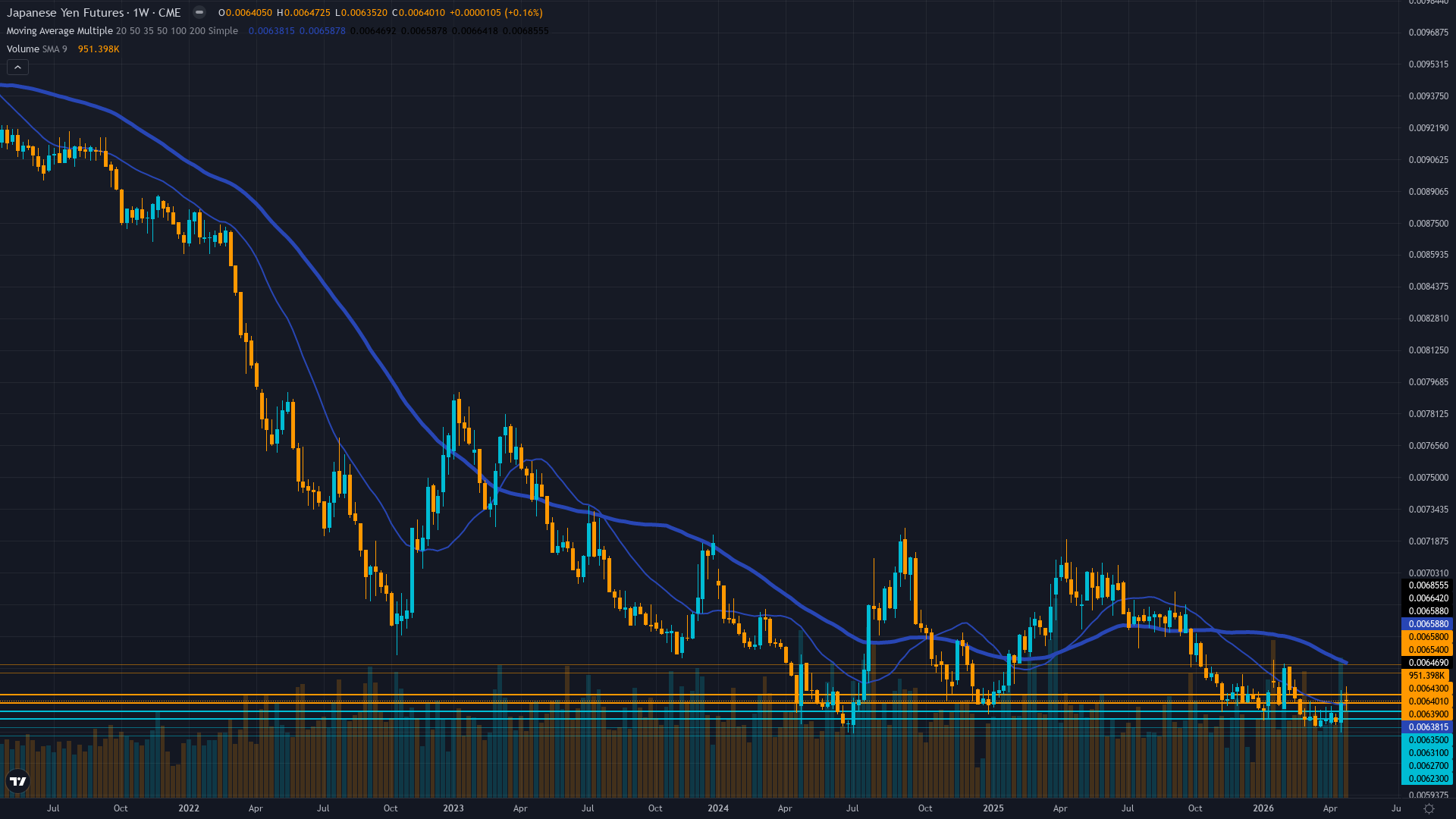
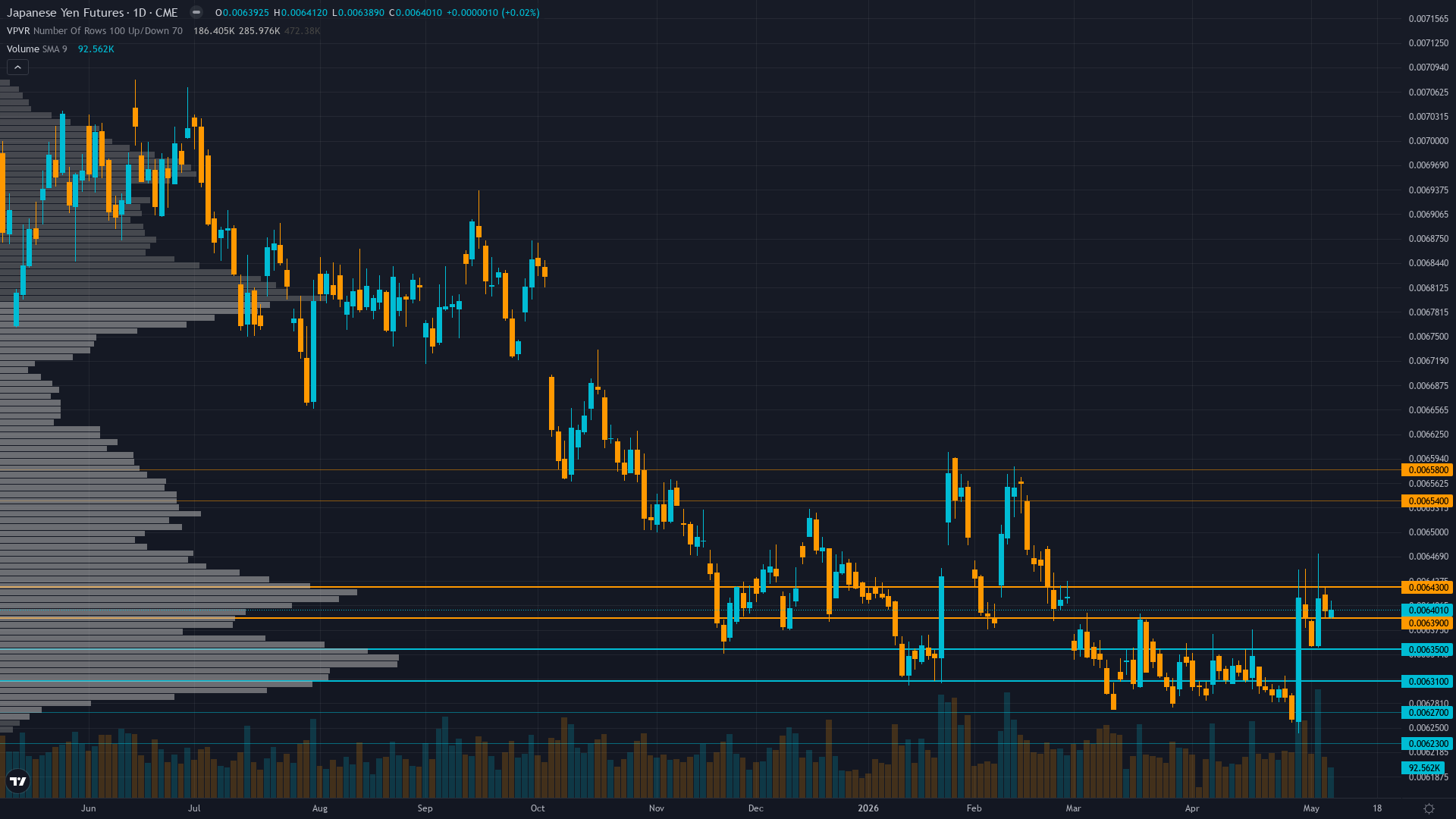
Range-bound 0.00633-0.00641 (156.6-158 USD/JPY) consolidating post-intervention with price mid-range showing no directional conviction; trading above major support 0.0062970 but below resistance 0.0071920
JPY undervalued 40% on PPP at current 156.6 USD/JPY but intervention attempts on May 1-6 have backfired per Reuters with market already re-testing highs; current account surplus 4.7% GDP provides support offset by persistent capital outflows
Net short JPY at -61.7K contracts per May 8 COT down sharply from -102.1K extreme following intervention forcing covering but still elevated versus neutral creating modest contrarian potential
No current 6J options data available due to thin liquidity in yen futures options market limiting options-derived directional signals
Fed holding 3.5-3.75% with 99.4% probability of no May change while BoJ held 0.75% April 28 in 6-3 split vote; no material policy change this week creating structural condition not fresh catalyst
Normal - short-term 10.5% below medium 11.0% reflecting post-early May intervention compression with residual two-way risk from demonstrated official willingness to act maintaining elevated baseline above 60-day 9.8%
Similar post-intervention periods show volatility remaining elevated 15-25% above baseline for 2-3 weeks as market tests authorities' resolve; current 65th percentile consistent with 9-day post-intervention state suggesting room for 20-30% contraction toward 50th percentile if no further action or expansion if 158+ triggers response
Volatility likely to remain elevated 60-70th percentile range through next 7-10 days given persistent intervention threat if USD/JPY re-tests 158-160; could spike to 80th+ percentile if further official action occurs but compression likely if range holds
High volatility regime suggests 80-100 pip daily ranges (0.00050-0.00065 in 6J terms) versus normal 50-60 pips; intervention risk creates potential 150-250 pip intraday swings similar to late April/early May events; breakouts from 156-158 consolidation unreliable without catalyst confirmation given demonstrated two-way official action risk
Elevated 65th percentile volatility indicates 1.2-1.5% daily move potential versus normal 0.6-0.8%; intervention risk creates binary event premium with potential 200-300 pip move (2+ standard deviations) if authorities act again at 158-160 threshold but unpredictable timing within 5-day grading window limits directional utility
|
⚠️ Primary Risk
Further Japanese MoF/BoJ intervention if USD/JPY re-tests 158-160 zone after previous $65B+ operations failed to generate sustained yen strength creating whipsaw risk from binary official action Probability: MEDIUM
|
✦ Primary Opportunity
Mean reversion rally toward 0.0065-0.0068 range (150-154 USD/JPY) if authorities intervene again more aggressively or if reduced positioning at -61.7K contracts forces additional covering cascade Timeframe: 1-2 weeks if 158-160 level re-tested and triggers further official action
|
The Japanese Yen futures sit in a precarious post-intervention equilibrium on May 10, 2026, trading at 0.006369 (USD/JPY 156.9) following Japan's TWO currency interventions in late April/early May that fundamentally altered the immediate risk landscape yet failed to generate sustained yen strength. The MACRO REGIME is TRANSITIONAL with NEUTRAL risk characteristics—VIX at 17.39 (below 20 threshold per Sentiment agent May 10 data) signals contained fear, equity markets showing mixed performance, and USD exhibiting divergent behavior across pairs.
Post-input development identified: Japan executed intervention operations on April 30 and again around May 1-6, spending an estimated $65+ billion total according to Reuters and Bloomberg, marking the first such actions since July 2024. However, USD/JPY spiked briefly from 160 to 155.5 before consolidating back near 156.9 as of May 10, meaning markets have already given back approximately half the intervention gains within days, revealing persistent structural selling pressure. The fundamental backdrop remains anchored by the 275-300bp Fed-BoJ rate differential (Fed 3.5-3.75% versus BoJ 0.75% per Economic agent May 10 data), a structural headwind that all six discipline agents acknowledge with zero material change from prior weeks.
The BoJ held rates at 0.75% on April 28—12 days ago—in a 6-3 split vote, but this catalyst is fully priced and generated no fresh policy signal. Speculative positioning has improved sharply to -61.7K net short contracts (May 8 COT) from the -102.1K extreme seen prior to intervention, representing a significant 40% reduction in bearish bets following forced liquidation. However, positioning remains moderately short rather than neutral, and critically the intervention's effectiveness is already fading as demonstrated by price retracing 50% of the move.
Current valuation near 156.9 sits in the middle of the post-intervention consolidation range between support at 0.00633 (156.6) and resistance at 0.00641 (158), providing balanced risk-reward but with asymmetric event risk from potential additional intervention if the 158-160 zone is re-tested. The discipline synthesis reveals weak and conflicting directional signals with NO fresh data from THIS WEEK: Fundamental bearish JPY (-1.5 confidence 5) on intervention backfire and persistent differential, Sentiment mildly bullish JPY (+0.5 confidence 4) on contrarian basis but not at extremes, Institutional mildly bearish JPY (-0.5 confidence 7) noting positioning improvement but residual shorts, Technical neutral (+0.5 confidence 4) in range consolidation, Economic bearish JPY (-1.5 confidence 6) explicitly noting 'no material change this week', Options neutral (0 confidence 3) due to data unavailability.
Critically, the Economic agent states the signal is driven by 'STRUCTURAL conditions—existing rate differential is fully priced' and flags 'No fresh catalyst this week' while the Fundamental agent notes 'intervention attempts this week have backfired'. With my last graded call MISSED (NO CALL on May 1 with price moving +1.0%), I have a miss streak of 1, bias streak of 7 consecutive NO CALLs, and zero health score concerns. The expected 0.66% weekly move for 6J is only marginally above the 0.50% noise floor, and critically there is NO MAJOR CATALYST between now and Friday's close (May 16)—the April 28 BoJ meeting is 12 days old and fully priced, the early May interventions have occurred and been 50% retraced, and the next catalyst (Japan April CPI) is May 21 outside the grading window.
Per Rule 1 Noise Threshold: the probable move absent a fresh catalyst is at or below 0.50%, and while intervention created binary event risk, that event has already occurred and been partially digested. Per Rule 6 FX-specific override: after 7 consecutive NO CALLs without a fresh monetary policy catalyst or data surprise occurring within the current assessment week, and with all thesis elements (rate differential, intervention risk, positioning dynamics) carried forward from prior weeks without new evidence, this is a classic low-information-edge environment where calling direction would be noise-calling rather than signal identification. The intervention was the catalyst, it happened, markets absorbed it, and now we're back to structural themes that are fully priced.
| Week | Bias | Confidence | Result |
|---|---|---|---|
| May 1, 2026 | NO CALL | 5/10 | ➖ |
| April 24, 2026 | NO CALL | 5/10 | ➖ |
| April 17, 2026 | NO CALL | 5/10 | ➖ |
| April 10, 2026 | NO CALL | 5/10 | ➖ |
| April 3, 2026 | NO CALL | 5/10 | ➖ |
| March 27, 2026 | NO CALL | 5/10 | ➖ |
| March 20, 2026 | NO CALL | 5/10 | ➖ |
| March 14, 2026 | NO CALL | 5/10 | ➖ |
| March 6, 2026 | NO CALL | 5/10 | ➖ |
| February 27, 2026 | NO CALL | 5/10 | ➖ |
| February 21, 2026 | BULLISH | 6/10 | ❌ |
| February 13, 2026 | BULLISH | 6/10 | ❌ |
📋 PROMPT-READY CONTEXT
Copy this entire block into any AI chat for follow-up analysis
▼ Expand
MACRO AGENT DESK — WEEKLY INTELLIGENCE BRIEFING
═════════════════════════════════════════════════
Asset: USD/JPY (6J)
Report Date: May 10, 2026

── DIRECTIONAL BIAS ─────────────────────────────
Call: NO CALL
Confidence: 5/10
Signal: VIEW MAINTAINED FROM LAST WEEK
MAD Index: 22 (MOSTLY ALIGNED)

── MARKET CONTEXT ───────────────────────────────
State: CONSOLIDATING
Regime: RANGING
Sentiment: NEUTRAL

── WHAT THE MARKET SEES ─────────────────────────
Market expects USD/JPY consolidation 156-158 range with slight bearish JPY bias on persistent rate differentials; intervention effectiveness seen as temporary given structural carry dynamics favor USD

── WHAT THE MARKET IS MISSING ───────────────────
No directional edge identified—intervention catalyst has occurred and been 50% retraced within days demonstrating market's assessment of limited efficacy, all discipline inputs reference structural conditions fully priced with no fresh data from May 3-10 period, next catalyst (April CPI May 21) outside grading window, and expected 0.66% weekly move only marginally above 0.50% noise floor; issuing NO CALL per Rule 1 (noise threshold) and Rule 6 (FX-specific override after 7 consecutive NO CALLs without THIS WEEK catalyst) as calling direction represents noise-calling not signal identification despite genuine intervention risk remaining if 158-160 re-tested

── KEY DRIVERS ──────────────────────────────────
1. Post-double-intervention consolidation at 156.6-157.0 USD/JPY with market having digested $65B+ BoJ/MoF action from late April/early May but intervention effectiveness already fading as price re-tests upper range
2. Speculative net short JPY reduced sharply from -102.1K to -61.7K contracts post-intervention per May 8 COT data but positioning remains moderately bearish creating residual two-way squeeze risk
3. Structural 275-300bp Fed-BoJ rate differential unchanged with Fed holding 3.5-3.75% versus BoJ 0.75% after April 28 hold decision 12 days ago maintaining USD carry appeal

── KEY ZONES ────────────────────────────────────
Resistance 2: 0.0052 – 0.0092
Resistance 1: 0.0044 – 0.0084
Pivot: ~0.0064
Support 1: 0.0043 – 0.0083
Support 2: 0.0043 – 0.0083

── DISCIPLINE BIASES ────────────────────────────
Technical: NO CALL
Fundamental: BEARISH
Institutional: BEARISH
Options: NO CALL
Economic: BEARISH
Sentiment: BULLISH

── TECHNICAL STRUCTURE ──────────────────────────
Range-bound 0.00633-0.00641 (156.6-158 USD/JPY) consolidating post-intervention with price mid-range showing no directional conviction; trading above major support 0.0062970 but below resistance 0.0071920

── FUNDAMENTAL ASSESSMENT ───────────────────────
JPY undervalued 40% on PPP at current 156.6 USD/JPY but intervention attempts on May 1-6 have backfired per Reuters with market already re-testing highs; current account surplus 4.7% GDP provides support offset by persistent capital outflows

── INSTITUTIONAL POSITIONING ────────────────────
Net short JPY at -61.7K contracts per May 8 COT down sharply from -102.1K extreme following intervention forcing covering but still elevated versus neutral creating modest contrarian potential

── OPTIONS FLOW ─────────────────────────────────
No current 6J options data available due to thin liquidity in yen futures options market limiting options-derived directional signals

── ECONOMIC BACKDROP ────────────────────────────
Fed holding 3.5-3.75% with 99.4% probability of no May change while BoJ held 0.75% April 28 in 6-3 split vote; no material policy change this week creating structural condition not fresh catalyst

── VOLATILITY REGIME ────────────────────────────
Regime: HIGH
Percentile: 65th
Trend: Stable —
Days in Regime: 9
Term Structure: Normal - short-term 10.5% below medium 11.0% reflecting post-early May intervention compression with residual two-way risk from demonstrated official willingness to act maintaining elevated baseline above 60-day 9.8%
Historical Pattern: Similar post-intervention periods show volatility remaining elevated 15-25% above baseline for 2-3 weeks as market tests authorities' resolve; current 65th percentile consistent with 9-day post-intervention state suggesting room for 20-30% contraction toward 50th percentile if no further action or expansion if 158+ triggers response
Outlook: Volatility likely to remain elevated 60-70th percentile range through next 7-10 days given persistent intervention threat if USD/JPY re-tests 158-160; could spike to 80th+ percentile if further official action occurs but compression likely if range holds
Trading Context: High volatility regime suggests 80-100 pip daily ranges (0.00050-0.00065 in 6J terms) versus normal 50-60 pips; intervention risk creates potential 150-250 pip intraday swings similar to late April/early May events; breakouts from 156-158 consolidation unreliable without catalyst confirmation given demonstrated two-way official action risk
Vol Risk/Opportunity: Elevated 65th percentile volatility indicates 1.2-1.5% daily move potential versus normal 0.6-0.8%; intervention risk creates binary event premium with potential 200-300 pip move (2+ standard deviations) if authorities act again at 158-160 threshold but unpredictable timing within 5-day grading window limits directional utility

── PRIMARY RISK ─────────────────────────────────
Further Japanese MoF/BoJ intervention if USD/JPY re-tests 158-160 zone after previous $65B+ operations failed to generate sustained yen strength creating whipsaw risk from binary official action
Probability: MEDIUM

── PRIMARY OPPORTUNITY ──────────────────────────
Mean reversion rally toward 0.0065-0.0068 range (150-154 USD/JPY) if authorities intervene again more aggressively or if reduced positioning at -61.7K contracts forces additional covering cascade
Timeframe: 1-2 weeks if 158-160 level re-tested and triggers further official action

── NEXT CATALYST ────────────────────────────────
Date: May 21, 2026
Event: Japan April CPI release May 21 at 21:00 EDT - inflation data could influence BoJ normalization pace expectations and rate differential trajectory
Expected Impact: MEDIUM

═════════════════════════════════════════════════
Source: Macro Agent Desk (macroagentdesk.com)
═════════════════════════════════════════════════

── FULL ANALYSIS ────────────────────────────────
The Japanese Yen futures sit in a precarious post-intervention equilibrium on May 10, 2026, trading at 0.006369 (USD/JPY 156.9) following Japan's TWO currency interventions in late April/early May that fundamentally altered the immediate risk landscape yet failed to generate sustained yen strength. The MACRO REGIME is TRANSITIONAL with NEUTRAL risk characteristics—VIX at 17.39 (below 20 threshold per Sentiment agent May 10 data) signals contained fear, equity markets showing mixed performance, and USD exhibiting divergent behavior across pairs. Post-input development identified: Japan executed intervention operations on April 30 and again around May 1-6, spending an estimated $65+ billion total according to Reuters and Bloomberg, marking the first such actions since July 2024. However, USD/JPY spiked briefly from 160 to 155.5 before consolidating back near 156.9 as of May 10, meaning markets have already given back approximately half the intervention gains within days, revealing persistent structural selling pressure. The fundamental backdrop remains anchored by the 275-300bp Fed-BoJ rate differential (Fed 3.5-3.75% versus BoJ 0.75% per Economic agent May 10 data), a structural headwind that all six discipline agents acknowledge with zero material change from prior weeks. The BoJ held rates at 0.75% on April 28—12 days ago—in a 6-3 split vote, but this catalyst is fully priced and generated no fresh policy signal. Speculative positioning has improved sharply to -61.7K net short contracts (May 8 COT) from the -102.1K extreme seen prior to intervention, representing a significant 40% reduction in bearish bets following forced liquidation. However, positioning remains moderately short rather than neutral, and critically the intervention's effectiveness is already fading as demonstrated by price retracing 50% of the move. Current valuation near 156.9 sits in the middle of the post-intervention consolidation range between support at 0.00633 (156.6) and resistance at 0.00641 (158), providing balanced risk-reward but with asymmetric event risk from potential additional intervention if the 158-160 zone is re-tested. The discipline synthesis reveals weak and conflicting directional signals with NO fresh data from THIS WEEK: Fundamental bearish JPY (-1.5 confidence 5) on intervention backfire and persistent differential, Sentiment mildly bullish JPY (+0.5 confidence 4) on contrarian basis but not at extremes, Institutional mildly bearish JPY (-0.5 confidence 7) noting positioning improvement but residual shorts, Technical neutral (+0.5 confidence 4) in range consolidation, Economic bearish JPY (-1.5 confidence 6) explicitly noting 'no material change this week', Options neutral (0 confidence 3) due to data unavailability. Critically, the Economic agent states the signal is driven by 'STRUCTURAL conditions—existing rate differential is fully priced' and flags 'No fresh catalyst this week' while the Fundamental agent notes 'intervention attempts this week have backfired'. With my last graded call MISSED (NO CALL on May 1 with price moving +1.0%), I have a miss streak of 1, bias streak of 7 consecutive NO CALLs, and zero health score concerns. The expected 0.66% weekly move for 6J is only marginally above the 0.50% noise floor, and critically there is NO MAJOR CATALYST between now and Friday's close (May 16)—the April 28 BoJ meeting is 12 days old and fully priced, the early May interventions have occurred and been 50% retraced, and the next catalyst (Japan April CPI) is May 21 outside the grading window. Per Rule 1 Noise Threshold: the probable move absent a fresh catalyst is at or below 0.50%, and while intervention created binary event risk, that event has already occurred and been partially digested. Per Rule 6 FX-specific override: after 7 consecutive NO CALLs without a fresh monetary policy catalyst or data surprise occurring within the current assessment week, and with all thesis elements (rate differential, intervention risk, positioning dynamics) carried forward from prior weeks without new evidence, this is a classic low-information-edge environment where calling direction would be noise-calling rather than signal identification. The intervention was the catalyst, it happened, markets absorbed it, and now we're back to structural themes that are fully priced.