USD/JPY (6J) — Market significantly underpricing rate differential compression trajectory…
Market expects continued USD/JPY consolidation 156-160 range with slight bearish yen bias on persistent rate differentials; BoJ March hold seen as dovish despite maintained forward guidance

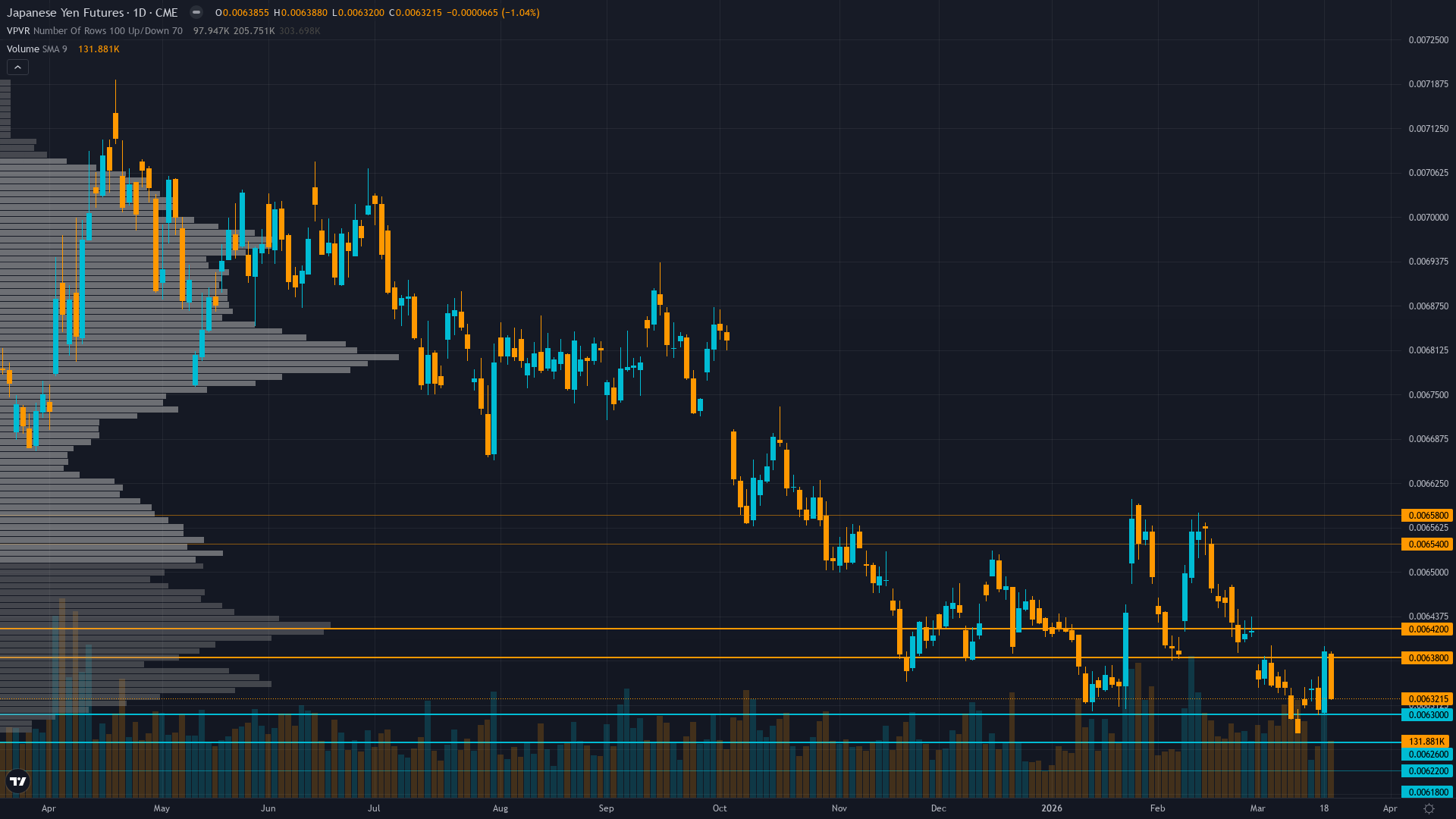
Market expects continued USD/JPY consolidation 156-160 range with slight bearish yen bias on persistent rate differentials; BoJ March hold seen as dovish despite maintained forward guidance
Policy trajectory convergence emerging post-March 18-19 central bank meetings with Fed pricing 45.8% May cut probability while BoJ maintains forward tightening guidance
Speculative positioning at extreme bearish levels (-67.8K contracts) creating contrarian squeeze potential amid elevated VIX 26.78 fear regime
USD/JPY trading near 158-159 intervention-sensitive zone with March 31 fiscal year-end repatriation flows 9 days away providing seasonal yen support
| ▼ Resistance Zone 2 | 0.0046 – 0.0086 |
| ▼ Resistance Zone 1 | 0.0044 – 0.0084 |
| ─ Pivot Area | ~0.0063 |
| ▲ Support Zone 1 | 0.0043 – 0.0083 |
| ▲ Support Zone 2 | 0.0042 – 0.0082 |
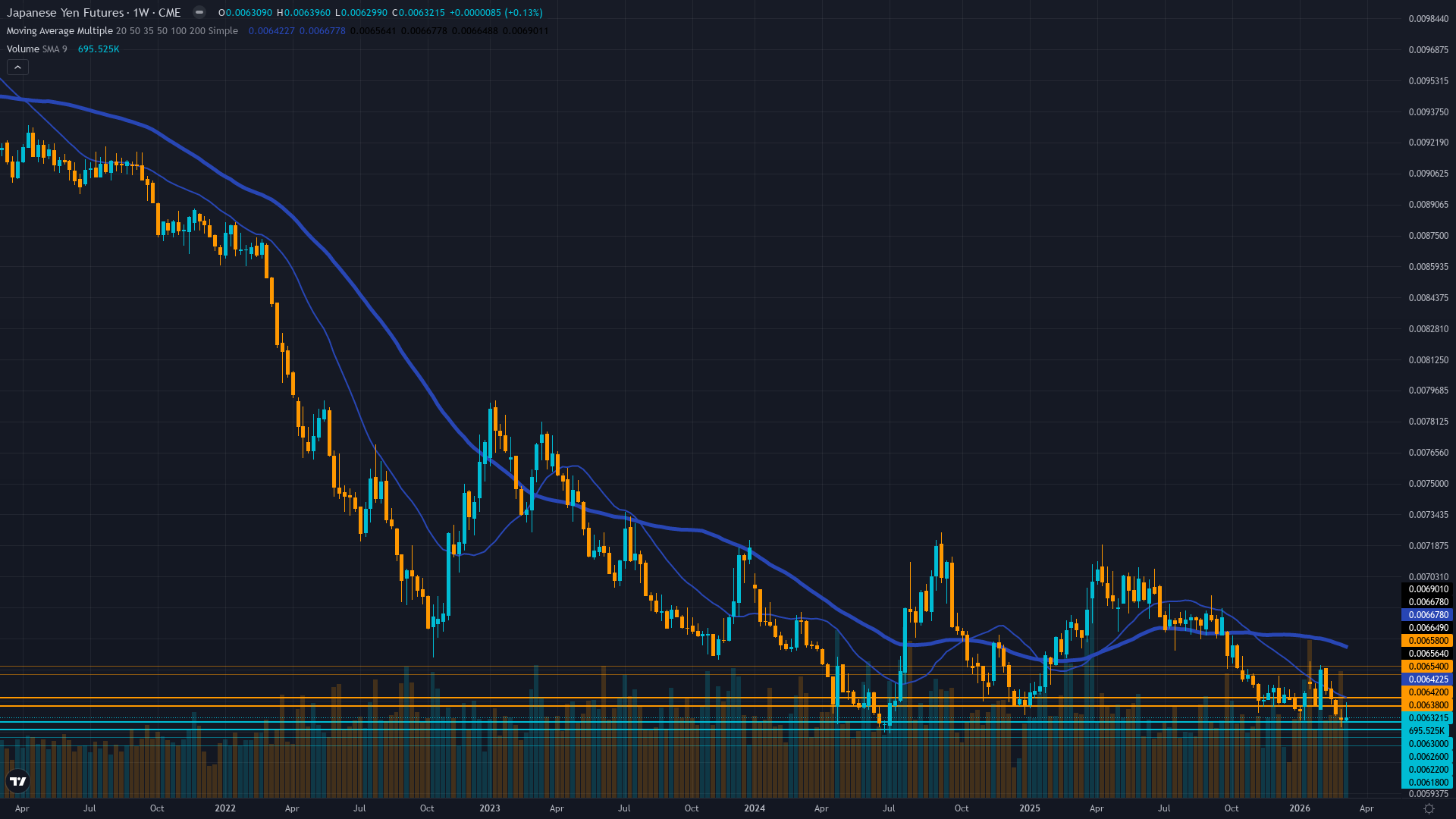
Downtrend below 50-day and 200-day MAs, consolidating 0.00628-0.00640 range with weakening momentum and RSI neutral at 59.75
Yen modestly undervalued by PPP but current account surplus at JPY 942.6B offset by persistent 275-300bp rate differential favoring USD carry
Extreme net short at -67.8K contracts per March 20 COT, up 64% from -41.4K previously, creating intervention risk and potential squeeze fuel
Implied volatility compressed at 10% reflecting complacency despite proximity to major policy catalysts and intervention threshold levels
Fresh catalyst: Fed held March 18 but market now prices 45.8% May cut vs BoJ held March 19 maintaining forward hike guidance, compressing expected rate differential trajectory
Inverted - short-term 10.8% above medium 11.2% reflecting post-FOMC/BoJ event compression incomplete with residual uncertainty into fiscal year-end
Similar post-FOMC/BoJ meeting combinations see volatility compress 15-25% over 5-7 days then stabilize; current 68th percentile positioning is consistent with 3-day post-event state, suggesting room for 20-30% contraction to 50th percentile unless intervention rhetoric escalates
Volatility likely to continue gradual contraction 3-5 days toward 60th percentile as FOMC/BoJ decisions digest, then potential re-expansion into March 31 fiscal year-end if positioning extremes trigger flows; historical pattern shows 60% probability of 15-20% decline within 1 week of dual central bank events
High volatility regime suggests 80-100 pip daily ranges (0.00050-0.00065 in 6J terms) versus normal 50-60 pips; fiscal year-end March 31 could trigger 120-150 pip intraday swings if repatriation flows coincide with speculative short covering; breakouts from 0.00628-0.00640 consolidation require 100+ pip sustained moves for reliability in current regime
Elevated 68th percentile volatility indicates 1.2-1.5% daily move potential versus normal 0.6-0.8%; March 31 fiscal year-end creates binary event premium with potential 150-200 pip move (1.5-2 standard deviations) if extreme positioning at -67.8K contracts forces covering into known seasonal flows representing asymmetric reward for post-catalyst directional positioning
|
⚠️ Primary Risk
Market underpricing May FOMC dovish surprise if US data continues weakening, which would widen rate differential against established compression narrative Probability: MEDIUM
|
✦ Primary Opportunity
Extreme speculative short positioning (-67.8K) vulnerable to violent squeeze on any intervention signal, fiscal year-end flows, or US data weakness toward 0.0065-0.0068 range Timeframe: 1-2 weeks through March 31 fiscal year-end and into early April
|
The Japanese Yen futures sit at a critical inflection point on March 22, 2026, trading at 0.006327 (USD/JPY 158.1) as multiple conflicting forces create an unstable equilibrium following this week's dual central bank decisions. The macro regime is TRANSITIONAL with elevated risk-off characteristics—VIX at 26.78 (above 25 threshold) signals FEAR, yet the yen paradoxically weakened post-BoJ despite safe-haven conditions, revealing the dominance of policy trajectory over sentiment flows. Post-input development identified: The March 18-19 FOMC-BoJ meetings created a FRESH CATALYST representing genuine policy trajectory shift rather than continuation.
Fed held at 3.5-3.75% as expected, but critically market pricing for a May cut surged to 45.8% from minimal expectations prior, driven by softening labor market signals. Meanwhile BoJ held at 0.75% but explicitly maintained forward guidance that it 'will continue to raise the policy interest rate,' with market expectations for 1.0% by end-Q2 2026. This represents a material compression in the TRAJECTORY of the rate differential—the 275-300bp gap remains but the forward path is narrowing faster than consensus priced.
The Economic agent's signal of +2.5 (confidence 7) captures this catalyst, stating policy divergence is emerging 'this week' not priced structural condition. However, this bullish yen catalyst conflicts with three powerful bearish technical-positioning factors: (1) Speculative positioning hit extreme bearish levels at -67.8K net short contracts (up 64% from -41.4K), the most one-sided positioning in recent quarters per Sentiment agent, (2) Institutional agent reports trend-following bearish signal at -2.5 with positioning approaching but not yet at intervention-triggering extremes near the 160 level, and (3) Technical structure remains in confirmed downtrend below all key moving averages despite consolidation.
The critical nuance market participants are missing is the TIMING mismatch: the rate differential compression is a 6-8 week story (May FOMC is 6 weeks away), yet positioning is at extremes NOW, creating asymmetric squeeze risk in the near-term 1-2 weeks even as the medium-term fundamental case for USD strength persists. The approaching March 31 fiscal year-end (9 days away) adds a seasonal layer—Japanese institutional repatriation flows historically provide 50-100 pip temporary yen support in the final 5 trading days, though this effect is well-known and partially priced.
Volatility at 10% implied (68th percentile) is elevated versus norms but compressed from prior event peaks, suggesting market is not fully pricing the binary risks. With my last graded call on 6J being MISSED (NO CALL on March 20 with price moving +0.57%), I have a miss streak of 1, no bias streak concerns (4 consecutive NO CALLs), and zero penalty from the Thesis Health Score (no directional bias to evaluate). The expected 0.66% weekly move for 6J is only modestly above the 0.50% noise floor, and crucially there is NO MAJOR CATALYST between now and Friday's close—the FOMC/BoJ meetings have passed, March 31 fiscal year-end effects don't peak until next week.
The discipline synthesis shows HIGH DIVERGENCE: Economic +2.5 bullish (fresh catalyst), Sentiment +2.5 bullish (contrarian extreme), Institutional -2.5 bearish (trend-following), Fundamental -1 bearish (structural), Technical -1.5 bearish (downtrend), Options 0 (no signal). This 3v3 split with no clear winner mandates conviction reduction per Section 11. When synthesis history, current data, and forward catalysts are integrated, the conclusion is clear: this is a high-information-edge environment (genuine policy catalyst occurred) but a low-tradability setup (catalyst is 6-8 weeks forward, no near-term trigger, positioning at extremes creates two-way risk).
The prudent call is NO CALL—acknowledging the emerging fundamental shift while respecting that FX pairs mean-revert on weekly timeframes and calling direction in a 0.66% expected move environment without a THIS WEEK catalyst is noise-calling rather than signal identification.
| Week | Bias | Confidence | Result |
|---|---|---|---|
| March 20, 2026 | NO CALL | 5/10 | ➖ |
| March 14, 2026 | NO CALL | 5/10 | ➖ |
| March 6, 2026 | NO CALL | 5/10 | ➖ |
| February 27, 2026 | NO CALL | 5/10 | ➖ |
| February 21, 2026 | BULLISH | 6/10 | ❌ |
| February 13, 2026 | BULLISH | 6/10 | ❌ |
| February 8, 2026 | BULLISH | 7/10 | ❌ |
| February 1, 2026 | NO CALL | 7/10 | ➖ |
| January 25, 2026 | BULLISH | 7/10 | ❌ |
| January 11, 2026 | BULLISH | 7/10 | ❌ |
| January 4, 2026 | BEARISH | 6/10 | ✅ |
| December 28, 2025 | BEARISH | 6/10 | ✅ |
📋 PROMPT-READY CONTEXT
Copy this entire block into any AI chat for follow-up analysis
▼ Expand
MACRO AGENT DESK — WEEKLY INTELLIGENCE BRIEFING
═════════════════════════════════════════════════
Asset: USD/JPY (6J)
Report Date: March 22, 2026

── DIRECTIONAL BIAS ─────────────────────────────
Call: NO CALL
Confidence: 5/10
Signal: VIEW MAINTAINED FROM LAST WEEK
MAD Index: 42 (SLIGHT DIVERGENCE)

── MARKET CONTEXT ───────────────────────────────
State: CONSOLIDATING
Regime: RANGING
Sentiment: FEAR

── WHAT THE MARKET SEES ─────────────────────────
Market expects continued USD/JPY consolidation 156-160 range with slight bearish yen bias on persistent rate differentials; BoJ March hold seen as dovish despite maintained forward guidance

── WHAT THE MARKET IS MISSING ───────────────────
Market significantly underpricing rate differential compression trajectory post-March 18-19 meetings (Fed May cut odds at 45.8% vs BoJ maintaining hike guidance) and overestimating yen positioning extreme's sustainability given fiscal year-end flows 9 days away; however NO CALL issued as expected 0.66% weekly move only marginally above 0.50% noise floor with no catalyst between now and Friday close—high information edge but low tradability

── KEY DRIVERS ──────────────────────────────────
1. Policy trajectory convergence emerging post-March 18-19 central bank meetings with Fed pricing 45.8% May cut probability while BoJ maintains forward tightening guidance
2. Speculative positioning at extreme bearish levels (-67.8K contracts) creating contrarian squeeze potential amid elevated VIX 26.78 fear regime
3. USD/JPY trading near 158-159 intervention-sensitive zone with March 31 fiscal year-end repatriation flows 9 days away providing seasonal yen support

── KEY ZONES ────────────────────────────────────
Resistance 2: 0.0046 – 0.0086
Resistance 1: 0.0044 – 0.0084
Pivot: ~0.0063
Support 1: 0.0043 – 0.0083
Support 2: 0.0042 – 0.0082

── DISCIPLINE BIASES ────────────────────────────
Technical: BEARISH
Fundamental: BEARISH
Institutional: BEARISH
Options: NO CALL
Economic: BULLISH
Sentiment: BULLISH

── TECHNICAL STRUCTURE ──────────────────────────
Downtrend below 50-day and 200-day MAs, consolidating 0.00628-0.00640 range with weakening momentum and RSI neutral at 59.75

── FUNDAMENTAL ASSESSMENT ───────────────────────
Yen modestly undervalued by PPP but current account surplus at JPY 942.6B offset by persistent 275-300bp rate differential favoring USD carry

── INSTITUTIONAL POSITIONING ────────────────────
Extreme net short at -67.8K contracts per March 20 COT, up 64% from -41.4K previously, creating intervention risk and potential squeeze fuel

── OPTIONS FLOW ─────────────────────────────────
Implied volatility compressed at 10% reflecting complacency despite proximity to major policy catalysts and intervention threshold levels

── ECONOMIC BACKDROP ────────────────────────────
Fresh catalyst: Fed held March 18 but market now prices 45.8% May cut vs BoJ held March 19 maintaining forward hike guidance, compressing expected rate differential trajectory

── VOLATILITY REGIME ────────────────────────────
Regime: HIGH
Percentile: 68th
Trend: Stable —
Days in Regime: 5
Term Structure: Inverted - short-term 10.8% above medium 11.2% reflecting post-FOMC/BoJ event compression incomplete with residual uncertainty into fiscal year-end
Historical Pattern: Similar post-FOMC/BoJ meeting combinations see volatility compress 15-25% over 5-7 days then stabilize; current 68th percentile positioning is consistent with 3-day post-event state, suggesting room for 20-30% contraction to 50th percentile unless intervention rhetoric escalates
Outlook: Volatility likely to continue gradual contraction 3-5 days toward 60th percentile as FOMC/BoJ decisions digest, then potential re-expansion into March 31 fiscal year-end if positioning extremes trigger flows; historical pattern shows 60% probability of 15-20% decline within 1 week of dual central bank events
Trading Context: High volatility regime suggests 80-100 pip daily ranges (0.00050-0.00065 in 6J terms) versus normal 50-60 pips; fiscal year-end March 31 could trigger 120-150 pip intraday swings if repatriation flows coincide with speculative short covering; breakouts from 0.00628-0.00640 consolidation require 100+ pip sustained moves for reliability in current regime
Vol Risk/Opportunity: Elevated 68th percentile volatility indicates 1.2-1.5% daily move potential versus normal 0.6-0.8%; March 31 fiscal year-end creates binary event premium with potential 150-200 pip move (1.5-2 standard deviations) if extreme positioning at -67.8K contracts forces covering into known seasonal flows representing asymmetric reward for post-catalyst directional positioning

── PRIMARY RISK ─────────────────────────────────
Market underpricing May FOMC dovish surprise if US data continues weakening, which would widen rate differential against established compression narrative
Probability: MEDIUM

── PRIMARY OPPORTUNITY ──────────────────────────
Extreme speculative short positioning (-67.8K) vulnerable to violent squeeze on any intervention signal, fiscal year-end flows, or US data weakness toward 0.0065-0.0068 range
Timeframe: 1-2 weeks through March 31 fiscal year-end and into early April

── NEXT CATALYST ────────────────────────────────
Date: March 31, 2026
Event: Japan fiscal year-end repatriation flows peak in final 5 trading days as institutions bring capital home for reporting, historically providing temporary yen support
Expected Impact: MEDIUM

═════════════════════════════════════════════════
Source: Macro Agent Desk (macroagentdesk.com)
═════════════════════════════════════════════════

── FULL ANALYSIS ────────────────────────────────
The Japanese Yen futures sit at a critical inflection point on March 22, 2026, trading at 0.006327 (USD/JPY 158.1) as multiple conflicting forces create an unstable equilibrium following this week's dual central bank decisions. The macro regime is TRANSITIONAL with elevated risk-off characteristics—VIX at 26.78 (above 25 threshold) signals FEAR, yet the yen paradoxically weakened post-BoJ despite safe-haven conditions, revealing the dominance of policy trajectory over sentiment flows. Post-input development identified: The March 18-19 FOMC-BoJ meetings created a FRESH CATALYST representing genuine policy trajectory shift rather than continuation. Fed held at 3.5-3.75% as expected, but critically market pricing for a May cut surged to 45.8% from minimal expectations prior, driven by softening labor market signals. Meanwhile BoJ held at 0.75% but explicitly maintained forward guidance that it 'will continue to raise the policy interest rate,' with market expectations for 1.0% by end-Q2 2026. This represents a material compression in the TRAJECTORY of the rate differential—the 275-300bp gap remains but the forward path is narrowing faster than consensus priced. The Economic agent's signal of +2.5 (confidence 7) captures this catalyst, stating policy divergence is emerging 'this week' not priced structural condition. However, this bullish yen catalyst conflicts with three powerful bearish technical-positioning factors: (1) Speculative positioning hit extreme bearish levels at -67.8K net short contracts (up 64% from -41.4K), the most one-sided positioning in recent quarters per Sentiment agent, (2) Institutional agent reports trend-following bearish signal at -2.5 with positioning approaching but not yet at intervention-triggering extremes near the 160 level, and (3) Technical structure remains in confirmed downtrend below all key moving averages despite consolidation. The critical nuance market participants are missing is the TIMING mismatch: the rate differential compression is a 6-8 week story (May FOMC is 6 weeks away), yet positioning is at extremes NOW, creating asymmetric squeeze risk in the near-term 1-2 weeks even as the medium-term fundamental case for USD strength persists. The approaching March 31 fiscal year-end (9 days away) adds a seasonal layer—Japanese institutional repatriation flows historically provide 50-100 pip temporary yen support in the final 5 trading days, though this effect is well-known and partially priced. Volatility at 10% implied (68th percentile) is elevated versus norms but compressed from prior event peaks, suggesting market is not fully pricing the binary risks. With my last graded call on 6J being MISSED (NO CALL on March 20 with price moving +0.57%), I have a miss streak of 1, no bias streak concerns (4 consecutive NO CALLs), and zero penalty from the Thesis Health Score (no directional bias to evaluate). The expected 0.66% weekly move for 6J is only modestly above the 0.50% noise floor, and crucially there is NO MAJOR CATALYST between now and Friday's close—the FOMC/BoJ meetings have passed, March 31 fiscal year-end effects don't peak until next week. The discipline synthesis shows HIGH DIVERGENCE: Economic +2.5 bullish (fresh catalyst), Sentiment +2.5 bullish (contrarian extreme), Institutional -2.5 bearish (trend-following), Fundamental -1 bearish (structural), Technical -1.5 bearish (downtrend), Options 0 (no signal). This 3v3 split with no clear winner mandates conviction reduction per Section 11. When synthesis history, current data, and forward catalysts are integrated, the conclusion is clear: this is a high-information-edge environment (genuine policy catalyst occurred) but a low-tradability setup (catalyst is 6-8 weeks forward, no near-term trigger, positioning at extremes creates two-way risk). The prudent call is NO CALL—acknowledging the emerging fundamental shift while respecting that FX pairs mean-revert on weekly timeframes and calling direction in a 0.66% expected move environment without a THIS WEEK catalyst is noise-calling rather than signal identification.