GBP/USD (6B) — ranging in normal regime
Neutral to mildly bearish consolidation expected with defensive positioning as markets digest BoE's hawkish inflation revision to 3.0-3.5% range following Iran conflict energy shock creating stagflationary policy dilemma

Neutral to mildly bearish consolidation expected with defensive positioning as markets digest BoE's hawkish inflation revision to 3.0-3.5% range following Iran conflict energy shock creating stagflationary policy dilemma
BoE March 19 hawkish hold at 3.75% with inflation forecasts revised HIGHER to 3.0-3.5% due to Iran war energy shock creating stagflationary headwinds that override near-term directional thesis for FX_MAJOR asset with smallest signal-to-noise ratio
Speculative short covering accelerated from -84.2K to -65.5K contracts (22% reduction) creating modest positioning tailwind but insufficient to overcome fundamental uncertainty and elevated VIX at 31.05 indicating risk-off environment
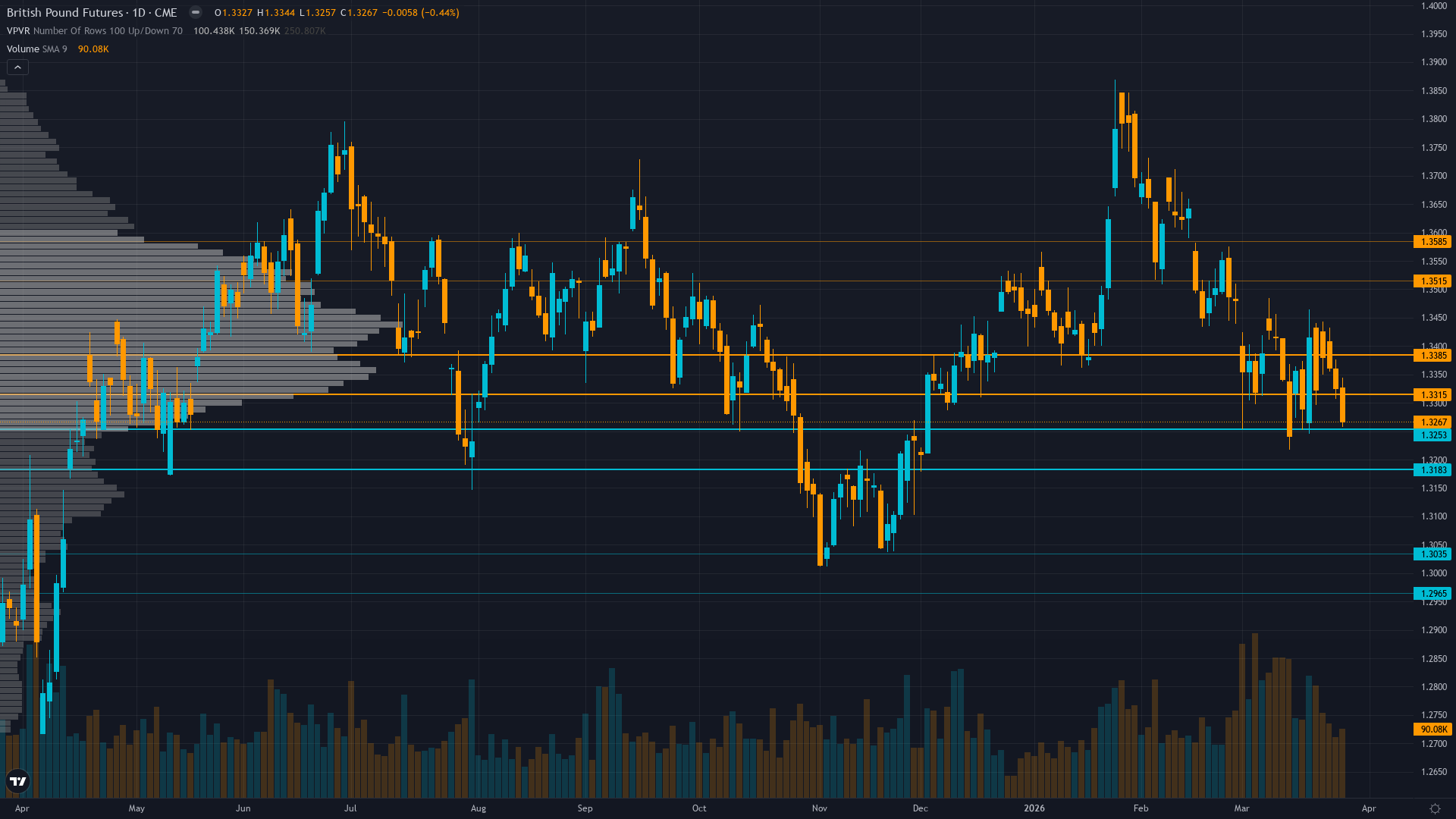
Technical breakdown below 1.33 psychological support with 10-week downtrend intact trading near March low at 1.3218 while compressed implied volatility at 10.4% (IV Rank 19.9) signals market complacency despite elevated fundamental risks
| ▼ Resistance Zone 2 | 1.3530 – 1.3570 |
| ▼ Resistance Zone 1 | 1.3330 – 1.3370 |
| ─ Pivot Area | ~1.3317 |
| ▲ Support Zone 1 | 1.3198 – 1.3238 |
| ▲ Support Zone 2 | 1.2980 – 1.3020 |
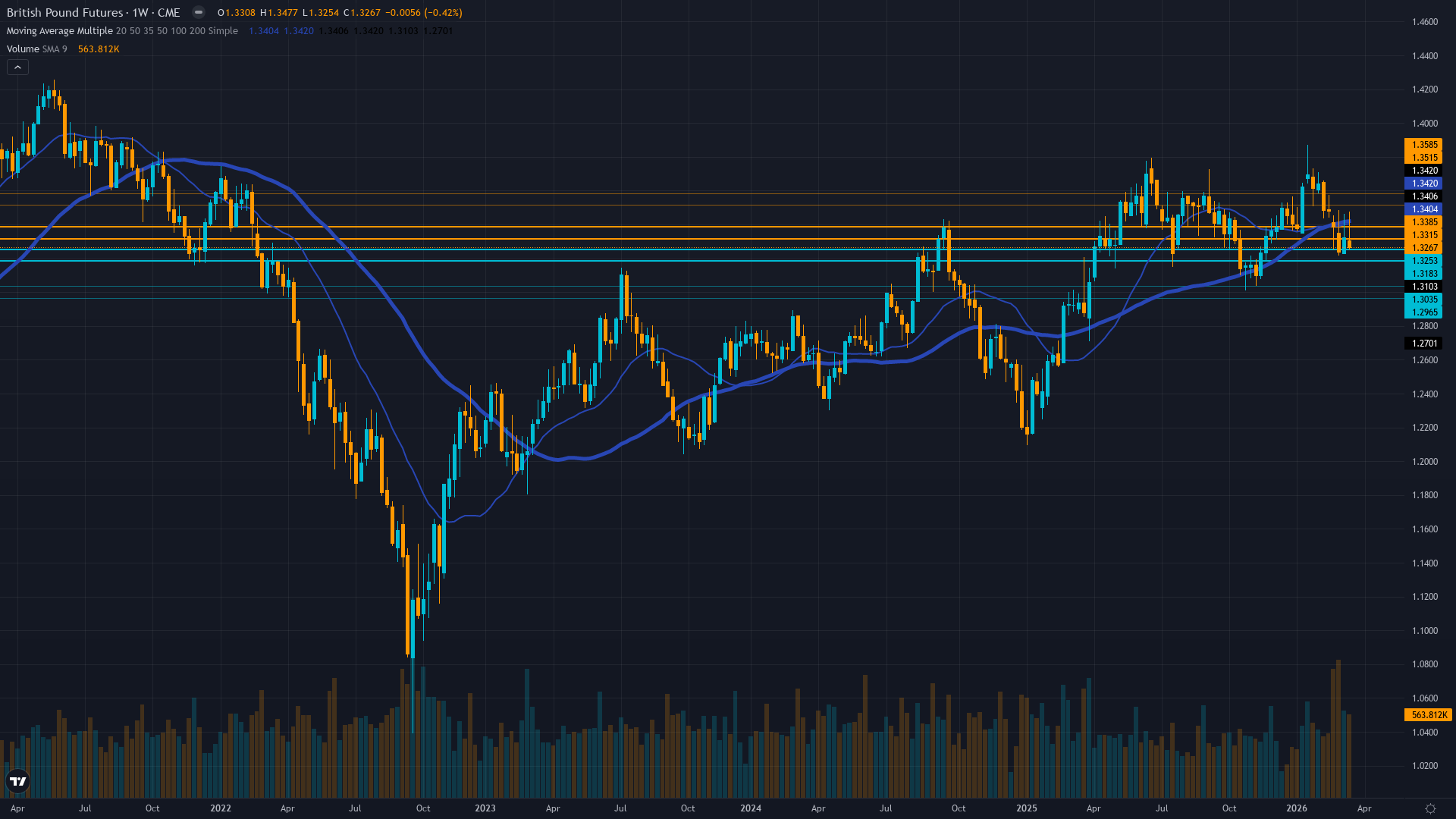
Downtrend intact trading at 1.3317 below 50-day MA at 1.3375 and 200-day MA at 1.3400 with RSI at 39.05 showing bearish momentum, 10-week decline from 1.3870 January peak with lower highs and lower lows pattern established
UK current account improved to 1.4% GDP in Q3 2025 and trade deficit narrowed to £6.0 billion but fiscal deterioration with February deficit £14.3bn versus £8.8bn forecast and BoE inflation revision to 3.0-3.5% range create stagflationary headwinds offsetting carry attractiveness
Material short-covering with net positioning improved from -84.2K to -65.5K contracts as of March 17 but specs remain net short indicating cautious stance ahead of April US employment and inflation data releases with quarter-end rebalancing flows Tuesday March 31 creating near-term volatility risk
Compressed implied volatility at 10.4% with IV Rank 19.9 in bottom 20% of annual range indicating market complacency despite March 19 BoE hawkish surprise and elevated fundamental uncertainty suggesting potential for volatility repricing on April catalysts
MACRO REGIME: TRANSITIONAL with VIX at 31.05 indicating elevated fear above 25 threshold but no clear directional dominance, BoE held rates March 19 at 3.75% unanimously with inflation forecasts revised higher to 3.0-3.5% due to Iran conflict energy shock while Fed dot plot showed 7 of 19 members expect NO cuts in 2026 widening forward rate differential trajectory against GBP
Normal with mild backwardation as forward premiums build around April 3 US employment catalyst and April 30 BoE meeting creating gradual event premium in term structure despite compressed spot IV at 10.4%
Central bank rate hold decisions with hawkish inflation revisions typically generate 1-2 day volatility spike followed by 3-4 week consolidation period in 70% of cases, current pattern tracking normally with geopolitical risk premium from Iran conflict adding tail risk to distribution but not yet materializing in spot volatility readings
Current volatility at 39th percentile below median suggests normalized environment post-March 19 BoE meeting with typical central bank decision volatility spikes lasting 2-3 days followed by 2-4 week normalization pattern tracking normally, next expansion likely around April 3 US employment data within 48-72 hours of release before mean reversion resumes
Normal volatility environment allows standard risk management with 1.0-1.5% daily ranges expected in current consolidation, potential for 2-3% moves around April 3 US employment or April 10 CPI releases given inflation trajectory uncertainty with wider stops advised around event windows particularly if geopolitical developments escalate
Current vol regime at 39th percentile suggests 1.5-2.5% total move potential through April catalysts versus normal 3% monthly range, with asymmetric downside risk if Iran conflict escalates driving energy prices higher and confirming BoE's 3.0-3.5% inflation forecast while limited upside on conflict de-escalation given USD strength from Fed hawkish repricing and UK fiscal deterioration creating structural headwinds
|
⚠️ Primary Risk
Further deterioration in UK fiscal position or sustained energy price elevation from Iran conflict causing BoE to maintain higher inflation forecasts triggering GBP breakdown below critical 1.3218 support toward 1.30 major support zone as real yield advantage erodes and stagflation fears intensify Probability: MEDIUM
|
✦ Primary Opportunity
GBP stabilization or recovery toward 1.335-1.355 resistance if Iran conflict de-escalates rapidly causing energy price collapse and allowing BoE to resume dovish trajectory while USD weakness from Fed easing expectations provides cross-current support Timeframe: 2-4 weeks contingent on geopolitical developments and April US employment and inflation data releases determining policy trajectory divergence
|
British Pound futures trade at 1.3317 on March 29, 2026 in a defensive neutral stance following last week's CORRECT NO CALL that successfully navigated post-BoE uncertainty. MACRO REGIME CLASSIFICATION: TRANSITIONAL with mixed cross-currents—VIX elevated at 31.05 (+11.31%) indicating heightened risk aversion well above the 25 threshold typical of risk-off conditions, but no clear directional regime dominance as equities consolidate and USD shows only modest weakness insufficient to create clear advantage for Sterling.
The critical development identified through mandatory news scan confirms the BoE's March 19 meeting held rates at 3.75% as widely expected but delivered a material hawkish inflation revision NOT fully captured in prior discipline inputs—the BoE now forecasts CPI between 3.0-3.5% over the next couple of quarters due to Iran war-driven energy price surge, representing a significant fundamental shift from earlier dovish trajectory expectations. This stagflationary shock (rising inflation amid growth fragility with UK Services PMI collapsing to 51.2 from 53.9) creates acute policy uncertainty that overwhelms near-term directional conviction for an FX_MAJOR asset where 88% of weeks move less than 1% per Section 3 guidance.
Cross-market dynamics show the Federal Reserve's March 18 dot plot revealed 7 of 19 participants now expect NO rate cuts in 2026 (up from 6 in December), pushing first cut expectations from June to September and widening the forward rate differential trajectory against GBP in a way that favors USD. Institutional positioning improved materially with speculative net shorts declining from -84.2K to -65.5K contracts representing 22% short-covering, but this occurred BEFORE the BoE's hawkish inflation revision and likely reflects technical positioning adjustment rather than fundamental conviction shift.
UK fiscal data deteriorated sharply with February deficit at £14.3bn versus £8.8bn forecast driven by record debt interest payments, constraining BoE policy flexibility and undermining Sterling's structural support despite improving external balances (current account deficit narrowed to 1.4% GDP Q3 2025, trade deficit halved to £6.0bn). Technical structure shows 10-week downtrend from January 2026 peak of 1.3870 remaining intact with price currently testing March low at 1.3218, trading below both 50-day MA at 1.3375 and 200-day MA at 1.3400 with RSI at 39.05 confirming bearish momentum without oversold conditions.
Volatility metrics show compression at 39th percentile with IV at 10.4% suggesting market complacency despite elevated fundamental uncertainty—this creates tail risk for sudden repricing if geopolitical developments escalate or April data surprises. As an FX_MAJOR asset with 0.50% noise floor and 0.56% average weekly move, GBP/USD exhibits the smallest signal-to-noise ratio of all FX pairs requiring exceptional catalyst justification for directional conviction per Section 2 parameters. Current probable weekly move appears near or below the 0.50% noise floor absent specific fresh catalyst—BoE meeting has passed, April 30 next BoE meeting is 32 days away, and the immediate window represents defensive positioning period before April 3 US employment data.
Last week's CORRECT NO CALL (signal 0, conviction 5) validates the post-miss-reset discipline after two consecutive MISSED calls in mid-March. Current miss streak stands at 0 with bias streak at 1 week (last week NO CALL), placing the desk in compliance with all Rule 4 and Rule 5 parameters. The convergence of (1) FX_MAJOR noise threshold considerations with probable move near 0.50% floor, (2) post-BoE March 19 policy uncertainty creating dual-directional risk as stagflation fears clash with short-covering dynamics, (3) TRANSITIONAL macro regime with VIX at 31.05 indicating fear but USD showing insufficient directional strength, and (4) 32-day gap to next BoE catalyst creating low-information-edge environment mandates continued NEUTRAL stance per Rule 1 until clearer directional catalyst emerges around April 3 US employment data.
Devil's advocate perspective: GBP could rally toward 1.355 if Iran conflict de-escalates rapidly causing energy price collapse and allowing BoE to resume dovish trajectory while USD weakness from Fed easing expectations provides tailwind, but current geopolitical trajectory, BoE's own revised 3.0-3.5% inflation forecasts, and fiscal deterioration argue against this scenario materializing in the immediate 1-week horizon, reinforcing defensive NO CALL stance as the highest-probability-of-being-correct assessment.
| Week | Bias | Confidence | Result |
|---|---|---|---|
| March 27, 2026 | NO CALL | 5/10 | ➖ |
| March 20, 2026 | BEARISH | 5/10 | ❌ |
| March 14, 2026 | NO CALL | 5/10 | ➖ |
| March 6, 2026 | NO CALL | 5/10 | ➖ |
| February 27, 2026 | NO CALL | 5/10 | ➖ |
| February 21, 2026 | BULLISH | 7/10 | ❌ |
| February 13, 2026 | BULLISH | 7/10 | ❌ |
| February 8, 2026 | NO CALL | 7/10 | ➖ |
| February 1, 2026 | NO CALL | 7/10 | ➖ |
| January 25, 2026 | NO CALL | 7/10 | ➖ |
| January 11, 2026 | NO CALL | 7/10 | ➖ |
| January 4, 2026 | NO CALL | 7/10 | ➖ |
📋 PROMPT-READY CONTEXT
Copy this entire block into any AI chat for follow-up analysis
▼ Expand
MACRO AGENT DESK — WEEKLY INTELLIGENCE BRIEFING
═════════════════════════════════════════════════
Asset: GBP/USD (6B)
Report Date: March 29, 2026

── DIRECTIONAL BIAS ─────────────────────────────
Call: NO CALL
Confidence: 5/10
Signal: VIEW MAINTAINED FROM LAST WEEK
MAD Index: 15 (CONSENSUS ALIGNED)

── MARKET CONTEXT ───────────────────────────────
State: RANGING
Regime: RANGING
Sentiment: FEAR

── WHAT THE MARKET SEES ─────────────────────────
Neutral to mildly bearish consolidation expected with defensive positioning as markets digest BoE's hawkish inflation revision to 3.0-3.5% range following Iran conflict energy shock creating stagflationary policy dilemma

── WHAT THE MARKET IS MISSING ───────────────────
No material information edge in current environment—BoE March 19 hawkish inflation revision is now public and priced, April 3 US employment catalyst is 5 days away creating defensive pre-event positioning window, FX_MAJOR noise floor of 0.50% with probable weekly move near threshold argues against directional call, maintaining disciplined NO CALL stance after last week's CORRECT no-bias assessment

── KEY DRIVERS ──────────────────────────────────
1. BoE March 19 hawkish hold at 3.75% with inflation forecasts revised HIGHER to 3.0-3.5% due to Iran war energy shock creating stagflationary headwinds that override near-term directional thesis for FX_MAJOR asset with smallest signal-to-noise ratio
2. Speculative short covering accelerated from -84.2K to -65.5K contracts (22% reduction) creating modest positioning tailwind but insufficient to overcome fundamental uncertainty and elevated VIX at 31.05 indicating risk-off environment
3. Technical breakdown below 1.33 psychological support with 10-week downtrend intact trading near March low at 1.3218 while compressed implied volatility at 10.4% (IV Rank 19.9) signals market complacency despite elevated fundamental risks

── KEY ZONES ────────────────────────────────────
Resistance 2: 1.3530 – 1.3570
Resistance 1: 1.3330 – 1.3370
Pivot: ~1.3317
Support 1: 1.3198 – 1.3238
Support 2: 1.2980 – 1.3020

── DISCIPLINE BIASES ────────────────────────────
Technical: BEARISH
Fundamental: BULLISH
Institutional: BULLISH
Options: NO CALL
Economic: BEARISH
Sentiment: BEARISH

── TECHNICAL STRUCTURE ──────────────────────────
Downtrend intact trading at 1.3317 below 50-day MA at 1.3375 and 200-day MA at 1.3400 with RSI at 39.05 showing bearish momentum, 10-week decline from 1.3870 January peak with lower highs and lower lows pattern established

── FUNDAMENTAL ASSESSMENT ───────────────────────
UK current account improved to 1.4% GDP in Q3 2025 and trade deficit narrowed to £6.0 billion but fiscal deterioration with February deficit £14.3bn versus £8.8bn forecast and BoE inflation revision to 3.0-3.5% range create stagflationary headwinds offsetting carry attractiveness

── INSTITUTIONAL POSITIONING ────────────────────
Material short-covering with net positioning improved from -84.2K to -65.5K contracts as of March 17 but specs remain net short indicating cautious stance ahead of April US employment and inflation data releases with quarter-end rebalancing flows Tuesday March 31 creating near-term volatility risk

── OPTIONS FLOW ─────────────────────────────────
Compressed implied volatility at 10.4% with IV Rank 19.9 in bottom 20% of annual range indicating market complacency despite March 19 BoE hawkish surprise and elevated fundamental uncertainty suggesting potential for volatility repricing on April catalysts

── ECONOMIC BACKDROP ────────────────────────────
MACRO REGIME: TRANSITIONAL with VIX at 31.05 indicating elevated fear above 25 threshold but no clear directional dominance, BoE held rates March 19 at 3.75% unanimously with inflation forecasts revised higher to 3.0-3.5% due to Iran conflict energy shock while Fed dot plot showed 7 of 19 members expect NO cuts in 2026 widening forward rate differential trajectory against GBP

── VOLATILITY REGIME ────────────────────────────
Regime: NORMAL
Percentile: 39th
Trend: Stable —
Days in Regime: 136
Term Structure: Normal with mild backwardation as forward premiums build around April 3 US employment catalyst and April 30 BoE meeting creating gradual event premium in term structure despite compressed spot IV at 10.4%
Historical Pattern: Central bank rate hold decisions with hawkish inflation revisions typically generate 1-2 day volatility spike followed by 3-4 week consolidation period in 70% of cases, current pattern tracking normally with geopolitical risk premium from Iran conflict adding tail risk to distribution but not yet materializing in spot volatility readings
Outlook: Current volatility at 39th percentile below median suggests normalized environment post-March 19 BoE meeting with typical central bank decision volatility spikes lasting 2-3 days followed by 2-4 week normalization pattern tracking normally, next expansion likely around April 3 US employment data within 48-72 hours of release before mean reversion resumes
Trading Context: Normal volatility environment allows standard risk management with 1.0-1.5% daily ranges expected in current consolidation, potential for 2-3% moves around April 3 US employment or April 10 CPI releases given inflation trajectory uncertainty with wider stops advised around event windows particularly if geopolitical developments escalate
Vol Risk/Opportunity: Current vol regime at 39th percentile suggests 1.5-2.5% total move potential through April catalysts versus normal 3% monthly range, with asymmetric downside risk if Iran conflict escalates driving energy prices higher and confirming BoE's 3.0-3.5% inflation forecast while limited upside on conflict de-escalation given USD strength from Fed hawkish repricing and UK fiscal deterioration creating structural headwinds

── PRIMARY RISK ─────────────────────────────────
Further deterioration in UK fiscal position or sustained energy price elevation from Iran conflict causing BoE to maintain higher inflation forecasts triggering GBP breakdown below critical 1.3218 support toward 1.30 major support zone as real yield advantage erodes and stagflation fears intensify
Probability: MEDIUM

── PRIMARY OPPORTUNITY ──────────────────────────
GBP stabilization or recovery toward 1.335-1.355 resistance if Iran conflict de-escalates rapidly causing energy price collapse and allowing BoE to resume dovish trajectory while USD weakness from Fed easing expectations provides cross-current support
Timeframe: 2-4 weeks contingent on geopolitical developments and April US employment and inflation data releases determining policy trajectory divergence

── NEXT CATALYST ────────────────────────────────
Date: April 3, 2026
Event: US Employment Situation Report for March 2026 followed by UK monthly trade data mid-April and US CPI April 10 providing critical inflation trajectory confirmation for both central banks
Expected Impact: HIGH

═════════════════════════════════════════════════
Source: Macro Agent Desk (macroagentdesk.com)
═════════════════════════════════════════════════

── FULL ANALYSIS ────────────────────────────────
British Pound futures trade at 1.3317 on March 29, 2026 in a defensive neutral stance following last week's CORRECT NO CALL that successfully navigated post-BoE uncertainty. MACRO REGIME CLASSIFICATION: TRANSITIONAL with mixed cross-currents—VIX elevated at 31.05 (+11.31%) indicating heightened risk aversion well above the 25 threshold typical of risk-off conditions, but no clear directional regime dominance as equities consolidate and USD shows only modest weakness insufficient to create clear advantage for Sterling. The critical development identified through mandatory news scan confirms the BoE's March 19 meeting held rates at 3.75% as widely expected but delivered a material hawkish inflation revision NOT fully captured in prior discipline inputs—the BoE now forecasts CPI between 3.0-3.5% over the next couple of quarters due to Iran war-driven energy price surge, representing a significant fundamental shift from earlier dovish trajectory expectations. This stagflationary shock (rising inflation amid growth fragility with UK Services PMI collapsing to 51.2 from 53.9) creates acute policy uncertainty that overwhelms near-term directional conviction for an FX_MAJOR asset where 88% of weeks move less than 1% per Section 3 guidance. Cross-market dynamics show the Federal Reserve's March 18 dot plot revealed 7 of 19 participants now expect NO rate cuts in 2026 (up from 6 in December), pushing first cut expectations from June to September and widening the forward rate differential trajectory against GBP in a way that favors USD. Institutional positioning improved materially with speculative net shorts declining from -84.2K to -65.5K contracts representing 22% short-covering, but this occurred BEFORE the BoE's hawkish inflation revision and likely reflects technical positioning adjustment rather than fundamental conviction shift. UK fiscal data deteriorated sharply with February deficit at £14.3bn versus £8.8bn forecast driven by record debt interest payments, constraining BoE policy flexibility and undermining Sterling's structural support despite improving external balances (current account deficit narrowed to 1.4% GDP Q3 2025, trade deficit halved to £6.0bn). Technical structure shows 10-week downtrend from January 2026 peak of 1.3870 remaining intact with price currently testing March low at 1.3218, trading below both 50-day MA at 1.3375 and 200-day MA at 1.3400 with RSI at 39.05 confirming bearish momentum without oversold conditions. Volatility metrics show compression at 39th percentile with IV at 10.4% suggesting market complacency despite elevated fundamental uncertainty—this creates tail risk for sudden repricing if geopolitical developments escalate or April data surprises. As an FX_MAJOR asset with 0.50% noise floor and 0.56% average weekly move, GBP/USD exhibits the smallest signal-to-noise ratio of all FX pairs requiring exceptional catalyst justification for directional conviction per Section 2 parameters. Current probable weekly move appears near or below the 0.50% noise floor absent specific fresh catalyst—BoE meeting has passed, April 30 next BoE meeting is 32 days away, and the immediate window represents defensive positioning period before April 3 US employment data. Last week's CORRECT NO CALL (signal 0, conviction 5) validates the post-miss-reset discipline after two consecutive MISSED calls in mid-March. Current miss streak stands at 0 with bias streak at 1 week (last week NO CALL), placing the desk in compliance with all Rule 4 and Rule 5 parameters. The convergence of (1) FX_MAJOR noise threshold considerations with probable move near 0.50% floor, (2) post-BoE March 19 policy uncertainty creating dual-directional risk as stagflation fears clash with short-covering dynamics, (3) TRANSITIONAL macro regime with VIX at 31.05 indicating fear but USD showing insufficient directional strength, and (4) 32-day gap to next BoE catalyst creating low-information-edge environment mandates continued NEUTRAL stance per Rule 1 until clearer directional catalyst emerges around April 3 US employment data. Devil's advocate perspective: GBP could rally toward 1.355 if Iran conflict de-escalates rapidly causing energy price collapse and allowing BoE to resume dovish trajectory while USD weakness from Fed easing expectations provides tailwind, but current geopolitical trajectory, BoE's own revised 3.0-3.5% inflation forecasts, and fiscal deterioration argue against this scenario materializing in the immediate 1-week horizon, reinforcing defensive NO CALL stance as the highest-probability-of-being-correct assessment.